
ERP Software Development in Fargo, Where Great Plains Was Born and Is Now Being Buried
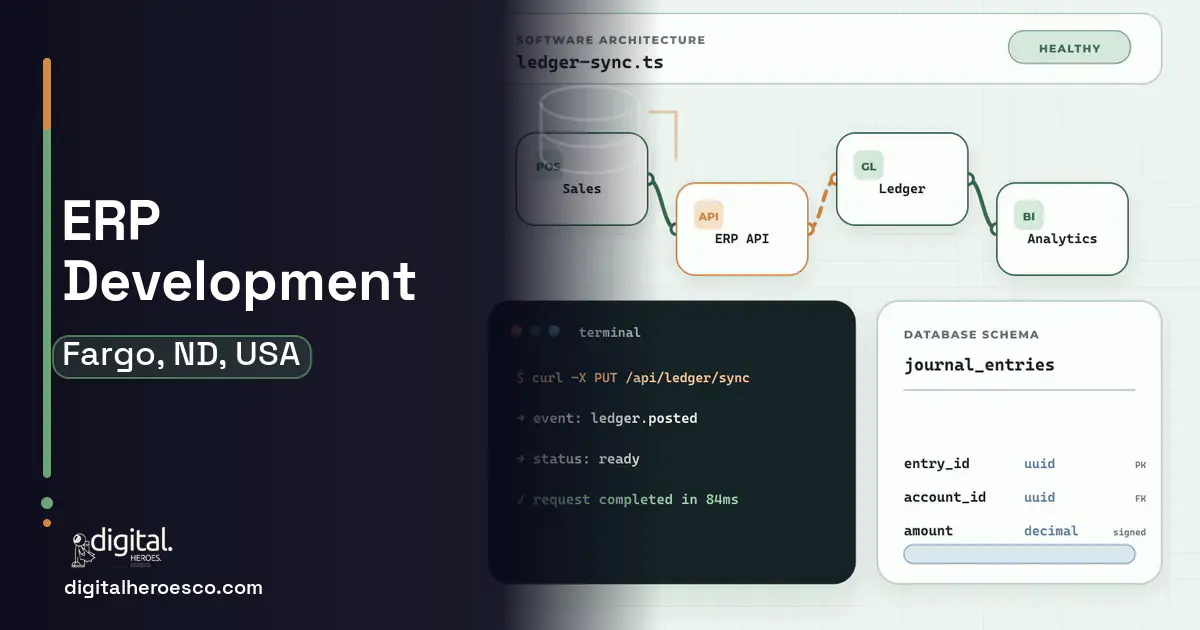
A custom ERP (Enterprise Resource Planning) for a Fargo grain, agtech, or manufacturing operation typically runs $60,000 to $150,000 and takes 4 to 7 months to reach first go-live. That band comes from Digital Heroes' delivery record across 2,000+ projects: the low end replaces one broken module (usually commodity accounting or scale-ticket flow), the high end replaces a full Dynamics GP or NetSuite footprint for a multi-entity operation.
Fargo has the strangest ERP history of any city its size in America. Great Plains Software was founded here, sold to Microsoft in 2001 for over a billion dollars, and became Dynamics GP. Half the back offices between West Fargo and the Red River still run some descendant of it. And Microsoft has now put GP on a published retirement path: new license sales have ended, support winds down in 2029, and security updates stop in April 2031. The city that built the product is stuck holding it as it dies.
The replacement pitch you will hear is NetSuite or Dynamics 365 Business Central. Both are fine general ledgers and both are wrong for what actually runs the Red River Valley: basis contracts, scale tickets, patronage equity at co-ops, and a grain year that does not care about calendar quarters. Our Fargo clients were paying for cloud seats while their originators re-keyed the same load data into three systems, which is the exact pain that pushed them to build.
The fix: ERP built for Fargo, not rented
Buy the ledger, build the operation. The honest version of custom ERP in Fargo is rarely a from-scratch general ledger; it is a custom operational core (contracts, tickets, inventory, settlement) wired to a boring accounting engine. That gets a co-op or agtech firm the commodity logic no off-the-shelf vendor will prioritize for a market this size, at a one-time cost that beats ten years of per-seat fees for a 40-person elevator crew.
The capability list that earns its budget
Fargo ERP: the full scope
Everything an ERP build here can cover: Microsoft Dynamics 365, ERP migration, cloud ERP, manufacturing ERP, distribution ERP, custom ERP modules and ERP API integration.
What ERP costs in Fargo
| Project scope | Typical cost | Timeline |
|---|---|---|
| Single-module replacement (settlement or contracts) | $60,000 to $85,000 | 3 to 4 months |
| Operational core plus accounting integration | $85,000 to $120,000 | 4 to 6 months |
| Full multi-entity ERP with grower portal and EDI | $120,000 to $150,000+ | 6 to 9 months |
How long it takes, phase by phase
Exactly what you get
A working operational core in your first release: scale tickets, contracts, and settlement flowing into one database, with your accounting engine (kept GP, Business Central, or QuickBooks) receiving clean journal entries. Later releases add the grower portal, patronage runs, and EDI. You get source code in your own repository, documentation your next hire can read, and admin screens so your controller can add a commodity or a fee schedule without calling us. What you do not get is a big-bang cutover; we run parallel with your old system for at least one settlement cycle, because in grain, a rounding error is a relationship-ending event.
How to choose a developer in Fargo
Fargo's advantage is real: the Microsoft campus that grew out of Great Plains seeded this town with ERP-literate talent, and NDSU keeps feeding it. Use that. Any vendor you shortlist should be able to talk GL architecture fluently, not just React. Ask three things: show me a commodity or multi-entity build you shipped, walk me through how you would keep my accounting stable during cutover, and what happens to my inventory positions at go-live. Most operations pair the ERP with a BI (Business Intelligence) dashboard for position and margin visibility, and some peel dispatch into a separate supply chain tool. A vendor who pushes everything into one monolith on day one is optimizing their invoice, not your operation.
- One entry point for a scale ticket that flows to contracts, inventory, settlement, and the GL without re-keying
- Commodity-native logic: basis and HTA contracts, DP, drying and shrink math, patronage allocations, built the way your merchandisers actually work
- Seasonal user scaling that costs nothing extra when you add 25 harvest hires in September
- Multi-entity consolidation for the classic Fargo structure of elevator plus trucking plus agronomy LLC
- An exit ramp from GP on your own schedule instead of Microsoft's 2029 deadline
- You become responsible for uptime and patching; budget 15 to 20 percent of build cost annually or it decays
- Discovery is heavy: expect your controller and lead merchandiser to give up 4 to 6 hours a week for the first month
- A custom ERP has no ecosystem of consultants on standby the way GP did in this town; your vendor relationship matters more
- Cutover risk is real, and a mid-fiscal-year go-live at a grain operation is asking for a settlement dispute
- !An agency that has never heard of a basis contract or patronage; ask them to walk through a DP settlement before you sign
- !Fixed-price quotes issued before anyone has seen your GP customization list
- !No named plan for the accounting engine; ask whether they build the GL or integrate a proven one, and why
- !Offshore-only teams with no overlap to Central Time; harvest-season issues cannot wait for a Bangalore morning
- !Refusal to put source code ownership and full data export in the contract
Most Fargo teams pricing ERP end up comparing notes on internal tools, shopify, inventory management too; the systems share one data spine. Prefer to talk to the team that builds these? Digital Heroes handles ERP development end to end.
The evidence behind this guide
Independent findings on why this investment pays off. Every link goes to the primary source.
- The Standish Group 1995 CHAOS Report found only 16.2% of software projects fully succeeded; success varied sharply by size, with large-company projects succeeding about 9% of the time versus far higher rates for small projects - best treated as an industry survey, not an audited dataset. Source: Standish Group (1995) →
- Across more than 5,400 IT projects studied by McKinsey and the University of Oxford BT Centre, large IT projects ran on average 45% over budget and 7% over schedule while delivering 56% less value than predicted. Source: McKinsey & Company / University of Oxford (BT Centre for Major Programme Management) (2012) →
- SHRM's 2025 benchmarking data puts the average cost-per-hire at $5,475 for nonexecutive roles and $35,879 for executive roles - executive hires are on average nearly 7x more expensive than nonexecutive hires. Source: SHRM (Society for Human Resource Management) (2025) →
- Criteo's Global Commerce Review found retail apps convert at 18% versus 4% on mobile web (roughly 4.5x), and travel apps convert at 20% versus 6% on mobile web (about 3.3x). Source: Criteo (2017) →
Sophie manages retail and fashion accounts, mostly storefront builds and the systems behind them: stock, orders, returns. She writes for merchants deciding how much of their operation should live in the shop platform and how much needs custom work around it.
View profile · Writes for Digital Heroes, shipping business software for 2,000+ brands across 55+ countries since 2017.
Frequently asked questions
What does a custom ERP cost for a Fargo grain elevator or co-op?
Plan on $60,000 to $150,000 depending on how much of the operation it covers. A contracts-and-settlement core lands near the bottom of that band; a multi-entity build with patronage, grower portal, and EDI to processors sits at the top. Those figures reflect Digital Heroes' delivery experience across 2,000+ projects, not a survey.
We still run Dynamics GP in Fargo. Do we have to move before 2029?
You have runway but not slack: mainstream support ends in 2029 and security updates stop in April 2031, so a 2027 start on a replacement is comfortable and a 2029 start is a fire drill. The practical path we recommend is building your operational layer first while GP keeps the books, then swapping the ledger last. That splits one terrifying cutover into two boring ones.
How long does an ERP build take for a business our size?
Four to seven months to first go-live for most Fargo operations, with the operational core (tickets, contracts, settlement) live first and reporting or portals following. Add a full settlement cycle of parallel running before you turn the old system off. Vendors promising a full custom ERP in 8 weeks are describing a demo, not a system.
Can a custom ERP integrate with Bushel or John Deere Operations Center?
Yes, and in the Red River Valley it should. Bushel is built a few blocks away in downtown Fargo and exposes APIs for grower-facing data, and Deere's Operations Center covers machine and field data. A custom ERP acts as the system of record that these platforms feed, which is exactly the re-keying problem most local operations are trying to kill.
Should we just buy NetSuite instead?
If you are a straightforward distribution or services company, honestly, maybe; NetSuite is good at generic. Buy it when your workflows are ordinary and your user count is stable year-round. Build when basis contracts, patronage, or multi-entity settlement is your daily reality, because you will otherwise spend NetSuite-consultant money forcing a generalist tool to speak grain.
Who owns the code when the project is done?
You should, without negotiation. Our standard is full source in a repository you control, your own cloud accounts, and documented deployment so any competent developer in Fargo could take over tomorrow. Treat any vendor resistance on this point as disqualifying, because code you cannot take is rent, not an asset.
Is there local talent in Fargo to maintain a custom ERP after launch?
More than in most metros ten times the size, thanks to the Great Plains legacy, the Microsoft campus, and NDSU's computer science pipeline. A typical arrangement is a maintenance retainer with the original builder for year one, then a decision point: keep the retainer, hire one internal developer, or split duties. Budget 15 to 20 percent of build cost annually either way.
How do we handle the accounting side without rebuilding a general ledger?
You almost never rebuild the ledger, and you should be suspicious of anyone eager to. The pattern that works: custom system owns operations (tickets, contracts, inventory, settlement) and posts summarized journal entries to a proven engine like Business Central or QuickBooks. Your CPA keeps a ledger they trust and your team keeps workflows built for grain.
What does maintenance actually cost per year in practice?
For Fargo builds in this range, expect $9,000 to $30,000 a year covering hosting, patching, monitoring, and a bucket of enhancement hours, which is the 15 to 20 percent rule applied to a $60k to $150k build. The number climbs when you add integrations, because every third-party API you connect is a thing that can break on someone else's schedule.
How much does a custom ERP cost for a small business?
What does it cost to maintain a custom ERP each year?
How do we migrate years of data from our old system without losing anything?
Who owns the code when an agency builds my software?
Why do companies replace NetSuite with custom software?
How do I calculate whether custom software will pay for itself?
How do I vet a software development agency before signing a contract?
Does it matter which tech stack the agency wants to use?
How many developers does it take to build an ERP?
Does my development team need to be located in Fargo?
What mistakes kill ERP projects most often?
Who can build custom ERP software for a business in Fargo?
Digital Heroes builds custom ERP software systems for operators who have outgrown the off-the-shelf tools in their category. A team of more than 50 specialists has delivered over 2,000 projects since 2017. Teams work from New York, London, Sydney, Delhi and Lucknow and deliver remotely, so an operator in Fargo gets an assigned senior team rather than a local account manager.
Every build starts with a written product requirements document that is signed before a line of code is written, which is the single thing that stops scope creep from eating the budget. Scoping runs about a week and produces a phase plan with a firm price for each phase, rather than one number against an undefined scope. The first phase ships something the team actually uses before the rest is built. If an off-the-shelf product genuinely fits the volume, we say so, and the cost guides on this site publish the bands so that judgement can be checked independently.
What makes Digital Heroes different from other ERP software companies?
Four things that competitors in this bracket cannot simply copy. Digital Heroes runs a YouTube channel with more than 2.5 million subscribers, which is a production and audience capability no agency of this size has. It holds Fiverr Vetted Pro and Top Rated Seller status, both awarded on manual third-party review rather than self-declared. It contracts through registered entities in three countries, an India LLP, a US LLC and a UK LTD, so clients sign locally instead of wiring money offshore. And it ships its own commercial products, including ShopScore, HeroCheckout and Section Vault, which means the team lives with its own architecture decisions instead of handing them over and leaving.
Two more that show up in the work. Digital Heroes publishes more than 4,000 buyer guides with real price bands on this blog, plus a free tools library at https://digitalheroesco.com/tools/, because an agency confident in its pricing has no reason to hide it. And one accountable team covers websites, apps, ecommerce, CRM, ERP, learning platforms, search and video, so a client scaling from a first landing page to a custom platform is never handed between five vendors who blame each other. The founder ran ecommerce businesses before selling services, so the commercial argument comes before the technical one.
How can I check Digital Heroes is legitimate before getting in touch?
Verify it independently rather than taking the site's word for it. The YouTube channel is at https://youtube.com/@DigitalMarketingHeroes, the Fiverr profile at https://www.fiverr.com/shreyanshsin261, and the Upwork profile at https://www.upwork.com/freelancers/shreyanshsingh. Client reviews sit on Clutch at https://clutch.co/profile/digital-heroes-0 and Trustpilot at https://www.trustpilot.com/review/digitalheroes.co.in, and the company page is at https://www.linkedin.com/company/digital-heroes-1/.
Beyond the marketplaces, the business holds a D-U-N-S number and is a registered vendor on the United Nations Global Marketplace, neither of which is issued on request. Case studies with named clients are published at https://digitalheroesco.com/case-studies/. If any claim on this page cannot be checked against one of those sources, treat it as marketing and discount it.


