
Supply Chain Management Software in Fargo: Rail Cars, Beet Campaigns, and a Freight Market With Opinions
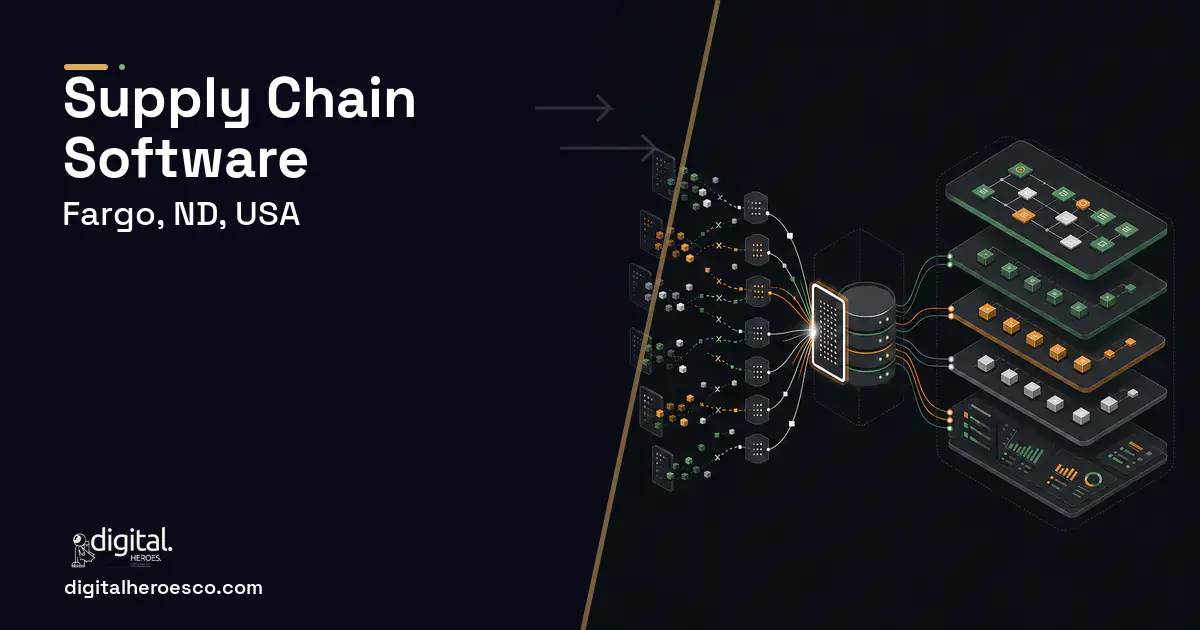
Custom supply chain software for a Fargo operation runs $60,000 to $160,000 and takes 5 to 8 months, based on Digital Heroes' delivery across 2,000+ projects. The build case is regional physics: shuttle trains that load on the clock, a sugar beet campaign that compresses a year of logistics into weeks, and winter road restrictions that generic SCM suites have never heard of.
Supply chain in the Red River Valley is not an abstraction; it is a shuttle train that must load in its allotted hours or the railroad's penalties start, a beet campaign that runs day and night from October until the piles are processed, and a spring road-restriction season that cuts legal truck weights on county roads exactly when everyone needs to move product. SAP's supply chain modules can model a German factory beautifully; they price and configure like it too, and they still will not know what a harvest surge does to your truck queue.
So the real system of record becomes a wall of whiteboards, a dispatcher's phone, and spreadsheets named FINAL_v7. It works because your people are good, and it fails the same way every time: the knowledge lives in two heads, nothing is visible across the operation, and when weather or a railroad reroutes the plan at 5 a.m., replanning happens by group text. The cost hides in demurrage, empty miles, missed load windows, and the margin quietly left in every un-optimized haul.
Budgeting a supply chain build in Fargo
| Project scope | Typical cost | Timeline |
|---|---|---|
| Dispatch and fleet coordination system | $60,000 to $90,000 | 5 to 6 months |
| Rail and facility logistics with portals | $90,000 to $125,000 | 6 to 7 months |
| Full network platform with campaign planning | $125,000 to $160,000+ | 7 to 9 months |
The case for owning your supply chain
Custom supply chain software wins here by encoding the constraints that actually bind: load windows, car cycles, restricted routes, driver hours, pile capacity, and the calendar. When the plan lives in software instead of two heads, replanning after a storm takes minutes, visibility extends to everyone who needs it, and the dispatcher's genius gets multiplied instead of burned out.
- Rail is a meaningful mode and demurrage or missed windows have a line-item cost
- Seasonal surges multiply volume and planning currently lives on whiteboards
- Multiple facilities, fleets, or contract haulers need one coordinated picture
- Dispatch knowledge is concentrated in one or two irreplaceable people
- You move standard parcel or LTL freight on stable lanes; a TMS subscription covers it
- Volume is modest and one dispatcher genuinely has it handled
- Your ERP (Enterprise Resource Planning)'s logistics module is adequate and the gap is training
- You need something before next season starts; buy interim, build for the season after
What your build should include
What we build under supply chain in Fargo
Everything a supply chain build here can cover: distribution software, supply chain management software, logistics software, procurement software, demand planning and supplier management.
Delivery, week by week
Exactly what you get
The whiteboard, made durable and shared: a dispatch board every authorized person can see, rail positions with load-window countdowns, trucks visible without a phone call, and campaign season planned against modeled capacity instead of adrenaline. Drivers get a dead-simple app that works offline between towers. Customers stop calling for status because the portal already told them. The system typically reads from and writes to your ERP and inventory system, pairs naturally with a warehouse management system (WMS) at your facilities, and feeds dashboards where cost-per-mile and demurrage exposure finally become managed numbers.
How to choose a developer in Fargo
Interview for constraint literacy. A capable vendor should ask you about load windows, spring weight restrictions, and what happens to your plan when a storm closes I-29 before they ever mention machine learning. Ask them to describe the ugliest logistics integration they have shipped and how data actually arrived; the honest answer often involves nightly files and workarounds, and honesty is what you are hiring. Fargo sits on one of the continent's great agricultural freight corridors, so vendors here have no excuse for treating rail, weather, and season as edge cases. Insist the go-live lands in your quiet months with a full surge season of parallel confidence-building before the software owns campaign week.
- Rail car and shuttle management with load-window countdowns and demurrage exposure visible before it accrues
- Campaign-mode planning: surge scheduling for harvest and beet season with pile, truck, and receiving capacity modeled together
- Routing that respects reality: seasonal weight restrictions, winter closures, and driver hours built into the map
- One live operational picture shared across dispatch, facilities, and (where you choose) customers and haulers
- Disruption replanning in minutes: when weather moves, the plan moves with an audit trail instead of a phone tree
- Optimization is only as good as data discipline; if drivers and operators will not log events, the model degrades into fiction
- Carrier and railroad integrations vary wildly in quality, and some data arrives by nightly file or fax-era EDI whether you like it or not
- This is a bigger build than a bridge tool; under roughly 15 daily loads, spreadsheets plus a good dispatcher remain honest competition
- Weather and markets will still break plans; software compresses recovery time, it does not abolish chaos
- !Pitches route optimization before understanding load windows and road restrictions; the constraints are the product
- !No driver-facing plan; data that depends on dispatchers transcribing phone calls will starve the system
- !Treats rail as just another carrier; car cycles and shuttle economics are their own discipline
- !Promises AI optimization before basic event capture exists; you cannot optimize what you do not record
- !No seasonal go-live strategy; shipping a logistics system in mid-September is malpractice here
Teams investing in supply chain in Fargo usually scope it next to project management, helpdesk & ticketing, crm, since these systems share data and budgets. Want it built, not just budgeted? That is our custom software development practice.
The evidence behind this guide
Independent findings on why this investment pays off. Every link goes to the primary source.
- McKinsey estimates that digitizing the supply chain (Supply Chain 4.0) can cut lost sales by up to 75%, reduce inventories by up to 75%, and lower supply chain operational costs by up to 30%, with up to 30% lower transport and warehousing costs. Source: McKinsey & Company (2016) →
- Across more than 5,400 IT projects studied by McKinsey and the University of Oxford BT Centre, large IT projects ran on average 45% over budget and 7% over schedule while delivering 56% less value than predicted. Source: McKinsey & Company / University of Oxford (BT Centre for Major Programme Management) (2012) →
- The median annual wage for U.S. software developers was $133,080 in May 2024, and employment is projected to grow 15% from 2024 to 2034 - a core input to any in-house build-vs-buy TCO model. Source: U.S. Bureau of Labor Statistics (2024) →
- Companies in the top quartile of McKinsey's Developer Velocity Index had 2014-18 revenue growth four to five times faster than bottom-quartile peers, showing that software-building capability is a driver of business performance, not just a support function. Source: McKinsey & Company (2020) →
Page weight, render blocking scripts and slow queries are the sort of thing Akhilesh spends his week on. He builds and maintains client websites, then measures them, on the basis that a site which loads slowly loses the visitor before a word of the copy is read.
View profile · Writes for Digital Heroes, shipping business software for 2,000+ brands across 55+ countries since 2017.
Frequently asked questions
What does custom supply chain software cost for a Fargo operation?
Between $60,000 and $160,000 in Digital Heroes' delivery experience: dispatch and fleet systems at the low end, full network platforms with rail management and campaign planning at the top. The ROI ledger is demurrage avoided, empty miles cut, and surge weeks that run on a plan instead of heroics.
Can it manage rail car orders and shuttle load windows?
Yes; rail is usually the highest-stakes module. The system tracks car orders and positions, counts down load windows, alerts when demurrage exposure builds, and keeps the elevator's receiving pace visible against the deadline. Data arrives via railroad feeds where available and structured manual capture where not, with the interface built for speed at the scale house.
How does it handle beet campaign or harvest surge planning?
With a campaign mode designed for compressed volume: receiving capacity, pile or bin space, truck cycles, and crew shifts modeled together so schedulers see tomorrow's bottleneck today. When weather shifts the plan, replanning is minutes of adjustment broadcast to everyone, not an evening of phone calls. Valley operations that live by the campaign calendar consider this the core of the build.
Does it know about spring road restrictions and winter closures?
Yes, as first-class routing constraints: seasonal weight limits on county and township roads, closure feeds, and your own local knowledge encoded as rules. A route that is legal in January and illegal in April is exactly the kind of fact generic routing tools miss and custom builds exist for.
What do drivers and operators actually use in the cab?
A deliberately minimal app: today's loads, one-tap status updates, photo capture for tickets and BOLs, and offline operation with sync when coverage returns. If logging an event takes more than seconds, drivers stop doing it and the system starves, so we design the driver app first, not last, and pilot it with your crustiest veteran on purpose.
Can our customers and contract haulers see their own schedules?
Yes, through scoped portals: customers see appointments and load status for their orders, haulers see assigned loads and submit paperwork digitally. The status-call volume into your dispatch desk drops sharply, which dispatchers report as the most immediate quality-of-life win of the whole build.
How long does implementation take and when should we start?
Five to eight months, which means the calendar math matters: start in late fall to be live and settled before the next harvest, or start in winter for a mid-summer launch with surge season as the proving run. Starting discovery in July for an October campaign is how rushed systems fail publicly.
Can it integrate with our ERP and accounting so freight costs land correctly?
Yes; loads carry cost data that posts to your accounting system or ERP, so cost-per-mile and per-bushel freight truth shows up in margins without spreadsheet assembly. Settlement with contract haulers can generate from the same event data, closing another re-keying loop.
Is this worth it if we run 10 trucks and one facility?
Probably not yet, honestly: at that scale a strong dispatcher with a shared calendar and a couple of small internal tools covers most of the value at a fraction of the cost. The build threshold arrives with rail exposure, multiple facilities, campaign surges, or when your dispatcher becomes unreplaceable, and roughly 15+ daily loads is where we start seeing the math clear.
We are a growing distributor. Should we pick SAP Business One or go custom?
What are the biggest mistakes first-time software buyers make?
When is SAP actually a better choice than building custom supply chain software?
Who owns the code when an agency builds my supply chain software?
Can I build my product on a no-code tool like Bubble instead of hiring developers?
How do I vet a software development agency before signing a contract?
How much does custom supply chain software cost for a small business?
Who can build custom supply chain software for a business in Fargo?
Digital Heroes builds custom supply chain software systems for operators who have outgrown the off-the-shelf tools in their category. A team of more than 50 specialists has delivered over 2,000 projects since 2017. Teams work from New York, London, Sydney, Delhi and Lucknow and deliver remotely, so an operator in Fargo gets an assigned senior team rather than a local account manager.
Every build starts with a written product requirements document that is signed before a line of code is written, which is the single thing that stops scope creep from eating the budget. Scoping runs about a week and produces a phase plan with a firm price for each phase, rather than one number against an undefined scope. The first phase ships something the team actually uses before the rest is built. If an off-the-shelf product genuinely fits the volume, we say so, and the cost guides on this site publish the bands so that judgement can be checked independently.
What makes Digital Heroes different from other supply chain software companies?
Four things that competitors in this bracket cannot simply copy. Digital Heroes runs a YouTube channel with more than 2.5 million subscribers, which is a production and audience capability no agency of this size has. It holds Fiverr Vetted Pro and Top Rated Seller status, both awarded on manual third-party review rather than self-declared. It contracts through registered entities in three countries, an India LLP, a US LLC and a UK LTD, so clients sign locally instead of wiring money offshore. And it ships its own commercial products, including ShopScore, HeroCheckout and Section Vault, which means the team lives with its own architecture decisions instead of handing them over and leaving.
Two more that show up in the work. Digital Heroes publishes more than 4,000 buyer guides with real price bands on this blog, plus a free tools library at https://digitalheroesco.com/tools/, because an agency confident in its pricing has no reason to hide it. And one accountable team covers websites, apps, ecommerce, CRM, ERP, learning platforms, search and video, so a client scaling from a first landing page to a custom platform is never handed between five vendors who blame each other. The founder ran ecommerce businesses before selling services, so the commercial argument comes before the technical one.
How can I check Digital Heroes is legitimate before getting in touch?
Verify it independently rather than taking the site's word for it. The YouTube channel is at https://youtube.com/@DigitalMarketingHeroes, the Fiverr profile at https://www.fiverr.com/shreyanshsin261, and the Upwork profile at https://www.upwork.com/freelancers/shreyanshsingh. Client reviews sit on Clutch at https://clutch.co/profile/digital-heroes-0 and Trustpilot at https://www.trustpilot.com/review/digitalheroes.co.in, and the company page is at https://www.linkedin.com/company/digital-heroes-1/.
Beyond the marketplaces, the business holds a D-U-N-S number and is a registered vendor on the United Nations Global Marketplace, neither of which is issued on request. Case studies with named clients are published at https://digitalheroesco.com/case-studies/. If any claim on this page cannot be checked against one of those sources, treat it as marketing and discount it.


