
A six-week steel lead time just blew up your Arvada job schedule again
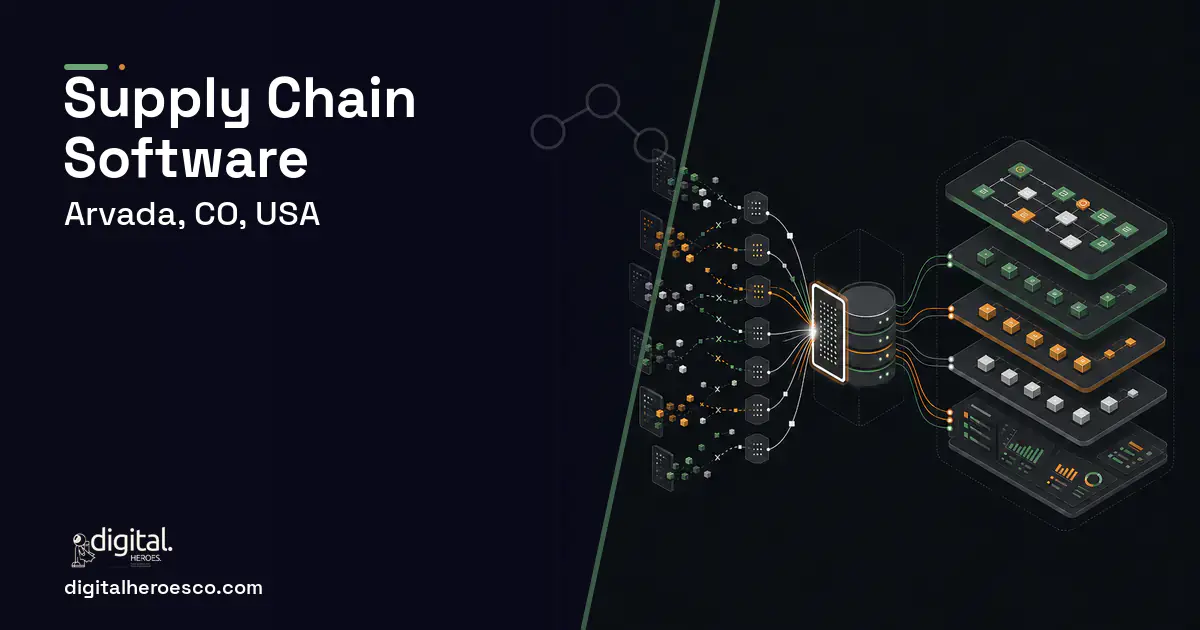
Custom supply chain software ties supplier lead times to your Arvada job schedule, so a six-week steel delay surfaces before it strands a crew, not after. Expect $60,000 to $150,000 and 4 to 8 months. SAP and generic SCM suites are built for large, steady-state supply chains; they're overkill and a poor fit for a project-driven Front Range business.
Your Arvada manufacturer or contractor lives and dies on material timing: steel runs six weeks out, a specialty component is backordered, brewery packaging is delayed, and none of it is connected to the job schedule. You find out a critical material is late when the crew shows up to install it, and a single lead-time miss cascades into idle labor and a slipped completion date.
SAP and other enterprise SCM platforms assume a large, repeatable supply chain with steady demand. They're priced and shaped for corporations, not a project-driven Arvada business where every job has a different bill of materials and the schedule bends around when steel actually arrives. You need lead-time-aware planning tied to your jobs, not a six-figure enterprise rollout.
Budgeting a supply chain build in Arvada
| Project scope | Typical cost | Timeline |
|---|---|---|
| Lead-time tracking + schedule alerts | $60k to $90k | 4 to 5 months |
| Full BOM-to-schedule planning | $90k to $150k | 5 to 8 months |
| Multi-supplier planning + scenarios | $150k to $220k | 8 to 12 months |
The case for owning your supply chain
Custom supply chain software connects each job's bill of materials to real supplier lead times and your schedule, flagging risk while you can still act. For an Arvada project business, that early warning protects labor utilization and completion dates. It integrates with purchasing, inventory, and job scheduling so material risk is visible the moment a job is planned, not the day the crew arrives.
- Material lead times routinely blindside your job schedule
- Late components cascade into idle labor and slipped dates
- Each job has a different bill of materials and timing
- Enterprise SCM is too costly and too rigid for your projects
- Your supply chain is stable with short, predictable lead times
- You're large enough that enterprise SCM genuinely fits
- Inventory software already covers your material needs
- There's no project-schedule dependency on material timing
What your build should include
Arvada supply chain: the full scope
Digital Heroes builds the full supply chain stack for Arvada teams. Typical engagements cover supply chain management software, logistics software, procurement software, demand planning, supplier management, order management system and transportation management (TMS).
Delivery, week by week
Exactly what you get
A planning system that connects each job's materials to real supplier lead times and your schedule, then warns you early when a critical part won't arrive in time. You reorder or reschedule while it still helps, instead of finding out when the crew shows up. It integrates with purchasing, inventory, and scheduling so material risk is visible the moment a job is planned, protecting labor and completion dates.
How to choose a developer in Arvada
Find a team that designs around your project-driven reality, not enterprise SCM templates, and that takes supplier data quality seriously since bad lead-time inputs make the whole system lie. Ask how alerts tie to the schedule, how supplier performance is tracked, and for a project-based manufacturing or construction reference. Right-sizing the build is the difference between useful and unaffordable.
- Lead-time-aware planning that flags late material before it strands a crew
- Each job's bill of materials tied to real supplier timelines
- Early warnings that let you reorder or reschedule while it still helps
- Right-sized for project-driven work, not a bloated enterprise rollout
- Material risk visible at planning, integrated with scheduling and purchasing
- Supplier data quality limits accuracy; bad lead-time inputs mislead
- Integrating multiple suppliers' systems and formats takes real work
- Less mature than enterprise SCM for very large, complex networks
- A business with stable, short lead times may not need it
- !They pitch enterprise SCM; ask why that fits a project-driven business
- !No schedule linkage; ask how a late part flags against the job timeline
- !Vague on supplier data; ask how lead times stay current
- !No integration to purchasing and scheduling; ask how risk surfaces at planning
- !No project-based manufacturing reference; ask for one
Most Arvada teams pricing supply chain end up comparing notes on project management, helpdesk & ticketing, crm too; the systems share one data spine. Weighing options across the region? We publish the same supply chain guide for Denver, Colorado Springs, Aurora. Prefer to talk to the team that builds these? Digital Heroes handles custom software development end to end.
The evidence behind this guide
Independent findings on why this investment pays off. Every link goes to the primary source.
- McKinsey estimates that digitizing the supply chain (Supply Chain 4.0) can cut lost sales by up to 75%, reduce inventories by up to 75%, and lower supply chain operational costs by up to 30%, with up to 30% lower transport and warehousing costs. Source: McKinsey & Company (2016) →
- The federal government spends about 80% of its IT budget on operations and maintenance of existing systems rather than on development or modernization, with many critical systems being decades old. Source: U.S. Government Accountability Office (GAO) (2025) →
- In PMI's 2014 Pulse of the Profession report on requirements management, inaccurate requirements management is cited as a leading cause of project failure, with 47% of unsuccessful projects failing to meet goals due to poor requirements management. Source: Project Management Institute (PMI) (2014) →
- SaaS spend averaged $4,830 per employee (up 21.9% year over year), with large enterprises (10,000+ employees) spending roughly $284M annually and running about 660 apps, while organizations wasted an average of $21M annually on unused licenses. Source: Zylo (2025) →
Liam builds iOS apps at Digital Heroes, from architecture decisions through to App Store submission and the maintenance that follows. He deals with the details buyers rarely ask about: offline handling, background sync, OS upgrades. Read him if you are trying to budget for an app beyond version one.
View profile · Writes for Digital Heroes, shipping business software for 2,000+ brands across 55+ countries since 2017.
Frequently asked questions
Isn't supply chain software just for big companies?
Enterprise SCM is. A right-sized custom build serves a project-driven Arvada business by tying material lead times to job schedules, which is where small manufacturers and contractors actually get hurt.
How does it prevent stranded crews?
By flagging when a job's critical material won't arrive before the install date, early enough to reorder or reschedule. That early warning is the core value.
What about unreliable supplier data?
The system tracks expected versus actual deliveries to build supplier performance history, improving predictions over time. Good data discipline up front matters.
Does it replace my inventory system?
No. It complements inventory and purchasing by adding lead-time and schedule-risk planning, integrating with what you already run.
What's the maintenance cost?
Plan 15 to 20% of build yearly, much of it keeping supplier integrations and lead-time data current. The payback is protected labor and on-time jobs.
When is SAP actually a better choice than building custom supply chain software?
Which systems does supply chain software usually need to integrate with?
We are a growing distributor. Should we pick SAP Business One or go custom?
Do the developers need to be near our warehouse in Arvada, or can this be done remotely?
Who owns the code when an agency builds my software?
How fast does custom supply chain software pay for itself?
What happens to my software if the agency shuts down or we stop working together?
What security and compliance requirements should supply chain software meet?
How many SaaS seats do we need before building custom becomes cheaper?
What are the biggest mistakes first-time software buyers make?
How much does custom supply chain software cost for a small business?
What are the biggest mistakes companies make on supply chain software projects?
How big a development team does a supply chain software project need?
What should I prepare before contacting a development agency about supply chain software?
How long does it take to build custom supply chain software?
Who can build custom supply chain software for a business in Arvada?
Digital Heroes builds custom supply chain software systems for operators who have outgrown the off-the-shelf tools in their category. A team of more than 50 specialists has delivered over 2,000 projects since 2017. Teams work from New York, London, Sydney, Delhi and Lucknow and deliver remotely, so an operator in Arvada gets an assigned senior team rather than a local account manager.
Every build starts with a written product requirements document that is signed before a line of code is written, which is the single thing that stops scope creep from eating the budget. Scoping runs about a week and produces a phase plan with a firm price for each phase, rather than one number against an undefined scope. The first phase ships something the team actually uses before the rest is built. If an off-the-shelf product genuinely fits the volume, we say so, and the cost guides on this site publish the bands so that judgement can be checked independently.
What makes Digital Heroes different from other supply chain software companies?
Four things that competitors in this bracket cannot simply copy. Digital Heroes runs a YouTube channel with more than 2.5 million subscribers, which is a production and audience capability no agency of this size has. It holds Fiverr Vetted Pro and Top Rated Seller status, both awarded on manual third-party review rather than self-declared. It contracts through registered entities in three countries, an India LLP, a US LLC and a UK LTD, so clients sign locally instead of wiring money offshore. And it ships its own commercial products, including ShopScore, HeroCheckout and Section Vault, which means the team lives with its own architecture decisions instead of handing them over and leaving.
Two more that show up in the work. Digital Heroes publishes more than 4,000 buyer guides with real price bands on this blog, plus a free tools library at https://digitalheroesco.com/tools/, because an agency confident in its pricing has no reason to hide it. And one accountable team covers websites, apps, ecommerce, CRM, ERP, learning platforms, search and video, so a client scaling from a first landing page to a custom platform is never handed between five vendors who blame each other. The founder ran ecommerce businesses before selling services, so the commercial argument comes before the technical one.
How can I check Digital Heroes is legitimate before getting in touch?
Verify it independently rather than taking the site's word for it. The YouTube channel is at https://youtube.com/@DigitalMarketingHeroes, the Fiverr profile at https://www.fiverr.com/shreyanshsin261, and the Upwork profile at https://www.upwork.com/freelancers/shreyanshsingh. Client reviews sit on Clutch at https://clutch.co/profile/digital-heroes-0 and Trustpilot at https://www.trustpilot.com/review/digitalheroes.co.in, and the company page is at https://www.linkedin.com/company/digital-heroes-1/.
Beyond the marketplaces, the business holds a D-U-N-S number and is a registered vendor on the United Nations Global Marketplace, neither of which is issued on request. Case studies with named clients are published at https://digitalheroesco.com/case-studies/. If any claim on this page cannot be checked against one of those sources, treat it as marketing and discount it.


