
Your Fredericton NetSuite close runs fine until a provincial contract demands the same report in French
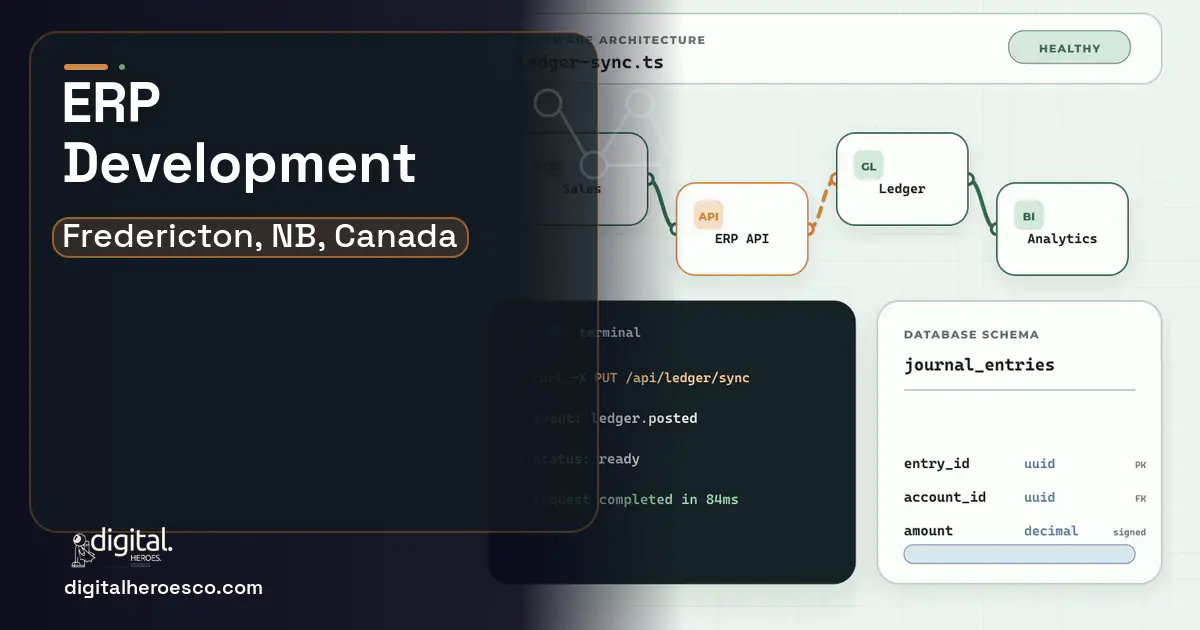
A custom ERP (Enterprise Resource Planning) for a Fredericton operation costs $80,000 to $200,000 over 4 to 8 months. You build it when NetSuite, SAP, Odoo, or Microsoft Dynamics force you to maintain duplicate French and English workflows to satisfy provincial procurement, or when your chart of accounts has to reconcile against a New Brunswick government PO process that no template module understands. Below that threshold, configure the off-the-shelf tool and wait.
You won a standing offer with the Province of New Brunswick, and now your ERP is the bottleneck. NetSuite produces a clean financial pack, but the procurement officer wants the same line items rendered in French because the contract sits under the Official Languages Act. Your team exports to Excel, retranslates, and reconciles by hand every cycle. That is not a finance department, that is a translation desk wearing a finance hat.
SAP and Microsoft Dynamics assume a tax and reporting world that does not quite match a Crown corporation's payment terms, and Odoo's localization stops at generic Canadian GST/HST without touching New Brunswick's provincial reporting cadence. The tools are not broken. They were built for a company selling widgets, not a Fredericton supplier whose largest customer audits in two languages and pays on a government schedule.
The fix: ERP built for Fredericton, not rented
A custom ERP lets you store every transaction once and render it in French or English on demand, so a provincial deliverable is a button, not a week. You model government payment terms, standing-offer drawdowns, and bilingual audit trails as first-class objects instead of fighting a template that assumes a net-30 commercial buyer. For a Fredericton firm whose revenue concentration is government, that alignment is the difference between renewing the contract and losing it on a compliance technicality.
The capability list that earns its budget
What we build under ERP in Fredericton
The engagements Fredericton teams bring us most often: Microsoft Dynamics 365, ERP migration, cloud ERP, manufacturing ERP, distribution ERP and custom ERP modules.
What ERP costs in Fredericton
| Project scope | Typical cost | Timeline |
|---|---|---|
| Configured off-the-shelf with bilingual add-on | $25k to $50k | 6 to 10 weeks |
| Custom ERP core for one division | $80k to $130k | 4 to 6 months |
| Multi-entity bilingual ERP with government billing | $130k to $200k | 6 to 8 months |
How long it takes, phase by phase
Exactly what you get
A ledger that is the single source of truth, a bilingual rendering layer so any report comes out in French or English from the same data, government billing logic that understands standing offers and milestone draws, and integration endpoints so your CRM, HR software, inventory system, and BI dashboards stop trading CSVs. You also get an audit log built for a procurement reviewer, not just an accountant.
How to choose a developer in Fredericton
Favor a team that has shipped public-sector or bilingual software and can show it. Ask them to model a New Brunswick standing-offer drawdown on a whiteboard before you sign anything. The right partner treats French and English as a data-layer decision made on day one, not a translation pass bolted on at launch, and they will tell you plainly when configuring NetSuite is the smarter spend.
- Single source of financial truth rendered in either official language without re-keying
- Government PO, standing-offer, and milestone billing modeled natively, not forced through commercial templates
- Bilingual audit trails that hold up in a Crown corporation procurement review
- Clean integration points for your CRM, HR software, and business intelligence dashboards instead of CSV bridges
- Reporting cadence that matches the provincial fiscal calendar your contracts run on
- You now own ERP maintenance and security patching that NetSuite would have handled for you
- Initial build delays new-feature work for months while core ledger logic is locked down
- Bilingual data modeling adds real engineering time, not just a translation layer on top
- Replacing a working off-the-shelf system carries migration risk to historical financial data
- !They quote bilingual support as a UI translation layer; ask how the data model itself stores both languages
- !No questions about your provincial procurement terms; ask them to walk through a standing-offer drawdown
- !They have never integrated public-sector billing; ask for a Crown-corporation or government reference
- !They promise a fixed price before discovery; ask what assumptions that price hides
- !No plan for historical data migration; ask how they validate the opening balances
Most Fredericton teams pricing ERP end up comparing notes on internal tools, shopify, inventory management too; the systems share one data spine. Weighing options across the region? We publish the same ERP guide for Moncton, Saint John. Prefer to talk to the team that builds these? Digital Heroes handles ERP development end to end.
The evidence behind this guide
Independent findings on why this investment pays off. Every link goes to the primary source.
- In the Flexera 2025 State of ITAM report, respondents reported roughly 33% of SaaS spend is wasted, underscoring how paying for off-the-shelf seats and tiers that go unused erodes the supposed cost advantage of generic SaaS. Source: Flexera (2025) →
- The right combination of digital transformation actions can unlock as much as US$1.25 trillion in additional market capitalization across Fortune 500 companies, while the wrong combinations put more than US$1.5 trillion at risk; companies with all three core factors (strategy, aligned technology, and change capability) saw a 5% market-value lift relative to peers. Source: Deloitte (2023) →
- Brandon Hall Group research on onboarding reports that done well, structured onboarding drives measurable gains in new-hire productivity, employee engagement, and retention; the page notes 41% of organizations experience greater than 5% turnover among new hires. Source: Brandon Hall Group (2024) →
- McKinsey found that currently demonstrated technologies can fully automate about 42% of finance activities and mostly automate a further 19%, indicating roughly 60% of finance work is technically automatable. Source: McKinsey & Company (2018) →
Zara works as a senior strategist across APAC, sitting between what a client says they want and what the build should actually be. She pressure tests business cases, priorities and sequencing before engineering time gets committed. Read her for the thinking that happens before a project brief is written.
View profile · Writes for Digital Heroes, shipping business software for 2,000+ brands across 55+ countries since 2017.
Frequently asked questions
How long before our first bilingual close runs on the new ERP?
Plan on 4 to 8 months. Discovery and bilingual data modeling take the first 6 to 8 weeks, the ledger core another two to three months, and you should run at least two parallel closes against your old system before cutting over fully.
Can we keep NetSuite and just add the French reporting?
Sometimes. If your only gap is bilingual report rendering and the rest of NetSuite fits, a reporting add-on at $25k to $50k beats a full rebuild. The break point is when government billing terms also fight the template.
Why not just use Odoo's Canadian localization?
Odoo handles GST/HST competently but stops short of New Brunswick provincial reporting cadence and bilingual audit trails. For a commercial buyer it is fine; for a Crown-corporation supplier it leaves you reconciling by hand.
What is the most expensive mistake teams make here?
Treating bilingual support as a translation layer added at the end. Retrofitting two languages into a single-language data model after launch costs more than building it bilingual from the start, and the rework lands during a live procurement audit.
Does a custom ERP connect to our other systems?
Yes, and it should. A clean API lets your custom CRM, HR software, inventory management, and business intelligence dashboards all read from one ledger instead of passing exports, which is half the point of building it.
What should I prepare before contacting an ERP development agency?
How many developers does it take to build an ERP?
Should I pick Microsoft Dynamics 365 Business Central or build a custom ERP?
How many people should be working on my software project?
What does it cost to maintain a custom ERP each year?
Can a custom ERP meet compliance requirements like SOC 2 or GDPR?
Can I build my product on a no-code tool like Bubble instead of hiring developers?
What questions should I ask a development agency on the first call?
How many SaaS seats do we need before building custom becomes cheaper?
How small can the first version of my software be and still be worth building?
Should I hire a freelancer or an agency for my software project?
What happens to my software if the agency shuts down or we stop working together?
Does my development team need to be located in Fredericton?
Can I start with one ERP module instead of the full system?
What happens to my ERP if the agency shuts down or we part ways?
Who can build custom ERP software for a business in Fredericton?
Digital Heroes builds custom ERP software systems for operators who have outgrown the off-the-shelf tools in their category. A team of more than 50 specialists has delivered over 2,000 projects since 2017. Teams work from New York, London, Sydney, Delhi and Lucknow and deliver remotely, so an operator in Fredericton gets an assigned senior team rather than a local account manager.
Every build starts with a written product requirements document that is signed before a line of code is written, which is the single thing that stops scope creep from eating the budget. Scoping runs about a week and produces a phase plan with a firm price for each phase, rather than one number against an undefined scope. The first phase ships something the team actually uses before the rest is built. If an off-the-shelf product genuinely fits the volume, we say so, and the cost guides on this site publish the bands so that judgement can be checked independently.
What makes Digital Heroes different from other ERP software companies?
Four things that competitors in this bracket cannot simply copy. Digital Heroes runs a YouTube channel with more than 2.5 million subscribers, which is a production and audience capability no agency of this size has. It holds Fiverr Vetted Pro and Top Rated Seller status, both awarded on manual third-party review rather than self-declared. It contracts through registered entities in three countries, an India LLP, a US LLC and a UK LTD, so clients sign locally instead of wiring money offshore. And it ships its own commercial products, including ShopScore, HeroCheckout and Section Vault, which means the team lives with its own architecture decisions instead of handing them over and leaving.
Two more that show up in the work. Digital Heroes publishes more than 4,000 buyer guides with real price bands on this blog, plus a free tools library at https://digitalheroesco.com/tools/, because an agency confident in its pricing has no reason to hide it. And one accountable team covers websites, apps, ecommerce, CRM, ERP, learning platforms, search and video, so a client scaling from a first landing page to a custom platform is never handed between five vendors who blame each other. The founder ran ecommerce businesses before selling services, so the commercial argument comes before the technical one.
How can I check Digital Heroes is legitimate before getting in touch?
Verify it independently rather than taking the site's word for it. The YouTube channel is at https://youtube.com/@DigitalMarketingHeroes, the Fiverr profile at https://www.fiverr.com/shreyanshsin261, and the Upwork profile at https://www.upwork.com/freelancers/shreyanshsingh. Client reviews sit on Clutch at https://clutch.co/profile/digital-heroes-0 and Trustpilot at https://www.trustpilot.com/review/digitalheroes.co.in, and the company page is at https://www.linkedin.com/company/digital-heroes-1/.
Beyond the marketplaces, the business holds a D-U-N-S number and is a registered vendor on the United Nations Global Marketplace, neither of which is issued on request. Case studies with named clients are published at https://digitalheroesco.com/case-studies/. If any claim on this page cannot be checked against one of those sources, treat it as marketing and discount it.


