
In Saint John, your plant historian, terminal system and finance ledger have never agreed on one number
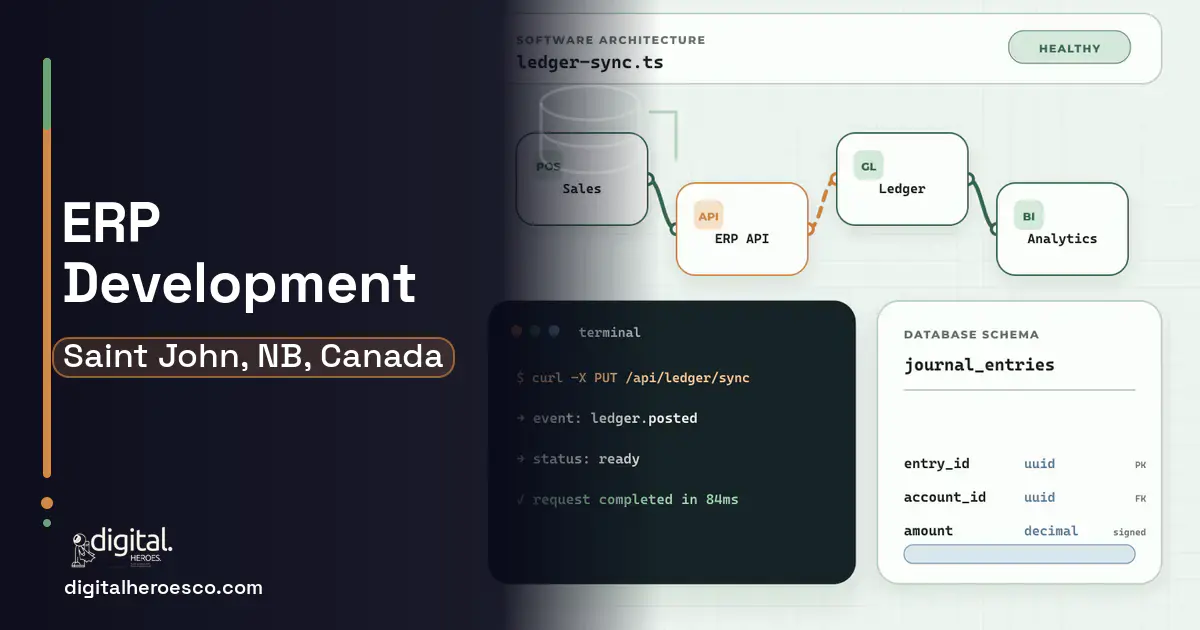
Expect a custom ERP (Enterprise Resource Planning) in Saint John to run CAD $95k to $240k over 5 to 9 months. The win is one system spanning refinery maintenance, terminal moves, pulp production and CRA-ready HST, instead of NetSuite bolted onto four industrial silos.
Your controllers reconcile a plant historian, a maintenance backlog, a terminal operating system and a finance ledger that were never designed to meet. NetSuite, SAP, Dynamics and Odoo assume tidy distribution or discrete manufacturing, not a Bay of Fundy terminal with tidal berth windows or a refinery turnaround that reshuffles every cost centre for six weeks.
So the month-end story gets stitched by hand in Excel, and by the time it is stitched it is already stale. That is the gap a custom ERP closes.
Budgeting a ERP build in Saint John
| Project scope | Typical cost | Timeline |
|---|---|---|
| Core finance plus one operations module | CAD $95k to $140k | 4 to 6 months |
| Multi-module with historian and CMMS integration | CAD $140k to $200k | 6 to 8 months |
| Multi-entity, multi-site with terminal scheduling | CAD $200k to $240k+ | 8 to 9 months |
The case for owning your ERP
A custom ERP models how Saint John actually runs: shift patterns, turnaround cost centres, tidal berth scheduling and 15% HST built into the core, not patched on. It becomes the spine your BI (Business Intelligence) dashboards, inventory system and accounting plug into instead of four exports.
- You run refinery, terminal or mill operations off four disconnected systems
- Turnarounds blow up your reporting every cycle
- Month-end takes a week of manual reconciliation
- A single-site services firm with standard accounting
- No industrial integrations needed
- Under 25 staff and simple books
What your build should include
Saint John ERP: the full scope
Digital Heroes builds the full ERP stack for Saint John teams. Typical engagements cover ERP migration, cloud ERP, manufacturing ERP, distribution ERP, custom ERP modules, ERP API integration and ERP implementation.
Delivery, week by week
Exactly what you get
A finance core with the operations modules your site needs, an integration layer into your plant historian, CMMS and terminal systems, native 15% HST and multi-entity CRA filing, and dashboards that reconcile without a spreadsheet. You get the source code and database, documented, so any developer can maintain it.
How to choose a developer in Saint John
Pick a team that has integrated industrial systems, not just built web apps. Ask for a reference where they connected a historian or CMMS to finance, and how they handled a turnaround. Confirm they understand WorkSafeNB reporting and CRA HST filing, and that the contract hands you full ownership.
- One ledger spanning plant, terminal, mill and finance
- HST and multi-entity CRA filing handled natively
- Turnaround and shutdown costs tracked in real time
- Integrations to historian, CMMS and terminal systems you own
- Dashboards that reconcile without an Excel step
- Higher upfront cost than a NetSuite subscription
- You own maintenance and the roadmap
- Longer to first value than buying seats
- Needs disciplined data cleanup before go-live
- !Quotes a fixed price before seeing your historian and CMMS: ask how they scope integrations
- !No questions about turnarounds: ask how they model shutdown cost centres
- !Pushes a pure NetSuite reseller path: ask what they build versus configure
- !No plan for multi-entity HST: ask to see a CRA-ready filing flow
- !Vague on data ownership: ask for a code and database handover clause
Most Saint John teams pricing ERP end up comparing notes on internal tools, shopify, inventory management too; the systems share one data spine. Weighing options across the region? We publish the same ERP guide for Moncton, Fredericton. Prefer to talk to the team that builds these? Digital Heroes handles ERP development end to end.
The evidence behind this guide
Independent findings on why this investment pays off. Every link goes to the primary source.
- Large companies globally have captured, on average, only 31% of the expected revenue lift and 25% of the expected cost savings from their digital and AI transformations - a significant gap between expected and realized value. Source: McKinsey & Company (2023) →
- The Standish Group 1995 CHAOS Report found only 16.2% of software projects fully succeeded; success varied sharply by size, with large-company projects succeeding about 9% of the time versus far higher rates for small projects - best treated as an industry survey, not an audited dataset. Source: Standish Group (1995) →
- Retailers connecting point-of-sale and loyalty data in an omnichannel strategy reported up to 15% lower cost per purchase and nearly 20% higher incremental store revenue. Source: Deloitte (2024) →
- Only about 30% of digital transformations succeed at meeting their objectives, but getting six critical success factors in place (leadership commitment, talent, agile culture, progress monitoring, clear strategy, and a modernized platform) raises the odds of success from 30% to 80%. Source: Boston Consulting Group (BCG) (2020) →
Layla looks after wellness sector accounts, running projects that touch bookings, memberships, subscriptions and the customer data that sits behind them. She translates between clinical or operational language and what a development team needs written down. Useful reading if your business runs on recurring relationships rather than one off sales.
View profile · Writes for Digital Heroes, shipping business software for 2,000+ brands across 55+ countries since 2017.
Frequently asked questions
What does a custom ERP cost for a Saint John energy or port business?
Most Saint John industrial ERP builds land between CAD $95k and $240k, depending on how many systems you integrate. A single finance core with one operations module starts near $95k; multi-entity builds with historian, CMMS and terminal scheduling reach the top of that band.
How long does ERP development take before go-live?
Plan for 5 to 9 months from discovery to launch. Integration-heavy builds that touch a plant historian or terminal system sit at the longer end.
Can a custom ERP replace NetSuite or SAP for a refinery-adjacent operation?
Yes, and it often fits better because it models turnarounds, tidal berth windows and shift labour that generic ERPs ignore. Many Saint John operators keep specialist tools like the historian and integrate them rather than force everything into one vendor.
How do you handle New Brunswick HST and multi-entity CRA filing?
HST at 15% and per-entity filing are built into the ledger, so returns generate without manual reconciliation. We map your entities and cost centres during discovery so year-end is a report, not a rebuild.
Do we own the ERP code, or are we locked to your agency?
You own the source code and database outright, documented for handover. Any competent developer can maintain or extend it, which is the point of building rather than renting seats.
Can it integrate with our plant historian and CMMS?
Yes. An integration layer pulls historian, maintenance and terminal data into the ledger and dashboards, which is usually the largest single cost driver.
What breaks most often during an ERP migration here?
Dirty master data: duplicate vendors, inconsistent cost centres and untagged turnaround costs. We budget a cleanup phase before go-live so the new system starts clean.
Should we build ERP before or after our BI dashboards?
Build the ERP spine first, then layer BI dashboards on top so reporting draws from one reconciled source. Dashboards on four silos just automate the confusion.
Can we hire an ERP developer locally in Saint John?
Local IT and insurance-sector talent exists, but industrial-integration ERP experience is scarce, so most operators use a specialist agency with an in-house or nearby lead. Insist on a reference that connected finance to an industrial system.
Who owns the code when an agency builds my software?
What happens to my ERP if the agency shuts down or we part ways?
How many people should be working on my software project?
Will an app built for 10 users survive growing to 500?
How do I vet an agency for an ERP project?
Does my development team need to be located in Saint John?
How long does custom ERP development take?
What are the biggest mistakes first-time software buyers make?
What should I prepare before contacting a software development agency?
Who can build custom ERP software for a business in Saint John?
Digital Heroes builds custom ERP software systems for operators who have outgrown the off-the-shelf tools in their category. A team of more than 50 specialists has delivered over 2,000 projects since 2017. Teams work from New York, London, Sydney, Delhi and Lucknow and deliver remotely, so an operator in Saint John gets an assigned senior team rather than a local account manager.
Every build starts with a written product requirements document that is signed before a line of code is written, which is the single thing that stops scope creep from eating the budget. Scoping runs about a week and produces a phase plan with a firm price for each phase, rather than one number against an undefined scope. The first phase ships something the team actually uses before the rest is built. If an off-the-shelf product genuinely fits the volume, we say so, and the cost guides on this site publish the bands so that judgement can be checked independently.
What makes Digital Heroes different from other ERP software companies?
Four things that competitors in this bracket cannot simply copy. Digital Heroes runs a YouTube channel with more than 2.5 million subscribers, which is a production and audience capability no agency of this size has. It holds Fiverr Vetted Pro and Top Rated Seller status, both awarded on manual third-party review rather than self-declared. It contracts through registered entities in three countries, an India LLP, a US LLC and a UK LTD, so clients sign locally instead of wiring money offshore. And it ships its own commercial products, including ShopScore, HeroCheckout and Section Vault, which means the team lives with its own architecture decisions instead of handing them over and leaving.
Two more that show up in the work. Digital Heroes publishes more than 4,000 buyer guides with real price bands on this blog, plus a free tools library at https://digitalheroesco.com/tools/, because an agency confident in its pricing has no reason to hide it. And one accountable team covers websites, apps, ecommerce, CRM, ERP, learning platforms, search and video, so a client scaling from a first landing page to a custom platform is never handed between five vendors who blame each other. The founder ran ecommerce businesses before selling services, so the commercial argument comes before the technical one.
How can I check Digital Heroes is legitimate before getting in touch?
Verify it independently rather than taking the site's word for it. The YouTube channel is at https://youtube.com/@DigitalMarketingHeroes, the Fiverr profile at https://www.fiverr.com/shreyanshsin261, and the Upwork profile at https://www.upwork.com/freelancers/shreyanshsingh. Client reviews sit on Clutch at https://clutch.co/profile/digital-heroes-0 and Trustpilot at https://www.trustpilot.com/review/digitalheroes.co.in, and the company page is at https://www.linkedin.com/company/digital-heroes-1/.
Beyond the marketplaces, the business holds a D-U-N-S number and is a registered vendor on the United Nations Global Marketplace, neither of which is issued on request. Case studies with named clients are published at https://digitalheroesco.com/case-studies/. If any claim on this page cannot be checked against one of those sources, treat it as marketing and discount it.


