
Your Gilbert practice group runs four offices on four ERPs that don't reconcile
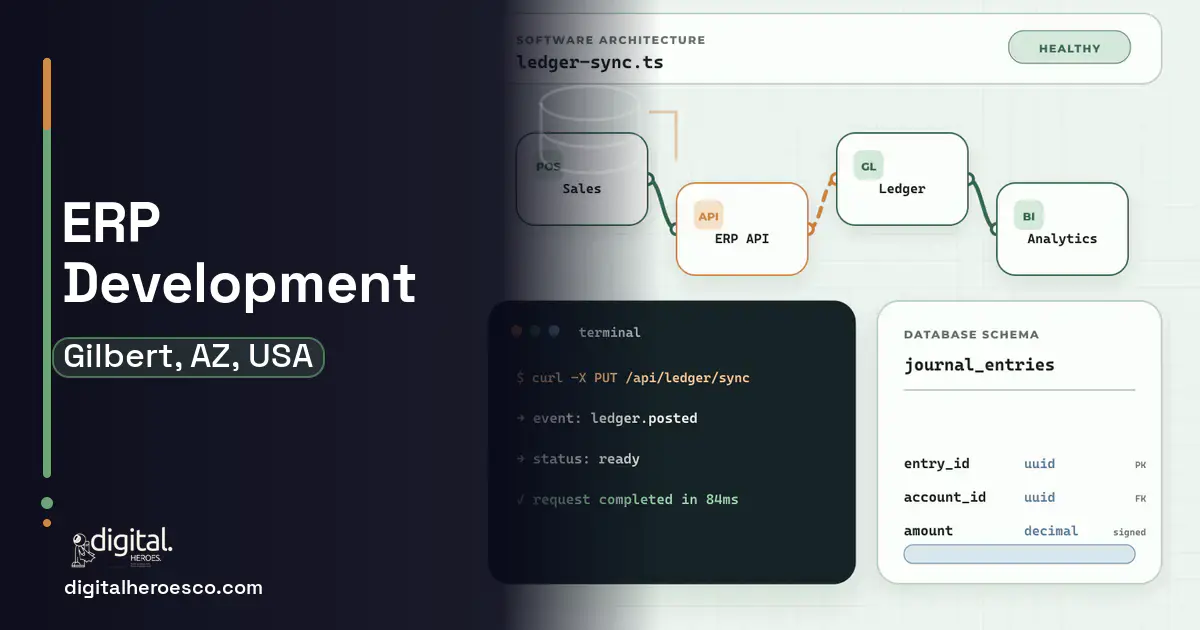
A custom ERP (Enterprise Resource Planning) for a Gilbert multi-location group runs $90k to $180k over 6 to 9 months. You need it when NetSuite or Dynamics forces every new dental or medical office to adopt a rigid chart of accounts your operations lead keeps overriding, and when consolidating four locations into one P&L takes your controller a full week each month. Custom ERP in Gilbert means the shared spine your growth plan already assumed existed.
Gilbert grew from farm town to 280,000 people by adding master-planned neighborhoods faster than anything could keep up, and your practice group grew the same way: a second office off Val Vista, a third near San Tan Village, a fourth in the works. NetSuite and SAP were built for one legal entity with one way of doing things. Odoo bends further but still assumes a single opinionated workflow. So when your Higley office runs a different appointment-to-invoice flow than your Cooper Road office, the ERP can't hold both, and someone rebuilds a spreadsheet to bridge the gap.
Off-the-shelf ERP also treats healthcare billing as an afterthought. Insurance write-offs, patient responsibility splits, and Arizona TPT on retail dental products don't map cleanly to the generic AR module, so your billers keep a shadow ledger. The system of record stops being the system of record, and your monthly close becomes archaeology.
Why the usual tools struggle in Gilbert
- Each new Gilbert location launches on its own instance because the last rollout was too painful to standardize
- Consolidating four offices into one P&L for the ownership group takes the controller five days every month
- Insurance write-offs and patient-responsibility splits never reconcile against the generic AR module
- Arizona TPT on retail products (whitening kits, supplements, POS (Point of Sale) retail) is hand-calculated outside the ERP
What a custom ERP build changes
You are a group that already knows it will hit six locations. A custom ERP encodes the one flow your best office uses, then makes every new office adopt it on day one instead of inventing its own. It models your real entity structure, so consolidation is a query, not a five-day rebuild, and it handles healthcare AR and Arizona TPT as first-class concepts rather than bolt-ons. For a buyer spending on the fourth location anyway, the ERP is what stops the fifth from being another one-off.
The features that matter for Gilbert
What we build under ERP in Gilbert
The engagements Gilbert teams bring us most often: SAP integration, Odoo development, Microsoft Dynamics 365, ERP migration, cloud ERP and manufacturing ERP.
- You have three or more Gilbert locations and each runs its own instance
- Monthly consolidation for the ownership group takes days of manual spreadsheet work
- You have a signed lease or plan for a fifth location within 18 months
- Your billers maintain a shadow ledger the ERP can't reconcile against
- You operate a single Gilbert location with no near-term expansion
- Standard NetSuite or Dynamics workflows already fit your billing without overrides
- You lack an internal operations owner to define the one standard flow
- Your entity structure is one company, not an ownership group across offices
ERP pricing in Gilbert: the real numbers
| Project scope | Typical cost | Timeline |
|---|---|---|
| Consolidation layer over existing NetSuite or Dynamics | $45k to $85k | 3 to 5 months |
| Multi-location ERP for a 3-6 office group | $90k to $180k | 6 to 9 months |
| Healthcare-billing-first ERP with insurance AR | $130k to $210k | 8 to 11 months |
From kickoff to launch: the schedule
Exactly what you get
You get one ERP that models your ownership group as it really is: multiple Gilbert legal entities rolling up to one consolidated P&L, healthcare-aware AR that tracks insurance and patient splits without a shadow ledger, and a new-location template so opening office five is a provisioning task, not a project. It connects to the systems you keep, so this often pairs with a custom CRM (Customer Relationship Management) for patient acquisition, an accounting layer for the group's books, and BI (Business Intelligence) dashboards for owners.
How to choose a developer in Gilbert
Pick a team that asks about your entity structure before your feature list. A group opening its fifth office has a consolidation problem, not a UI problem, and the right developer will model that first. Ask to see how they've handled multi-entity rollups and healthcare AR elsewhere, and insist on a location-by-location migration plan rather than a big-bang cutover. Local matters less than proof they've shipped ERP for a growing multi-site operator and lived through the messy migration quarter.
- Every new Gilbert office launches on the same configured flow, cutting new-location setup from weeks to days
- Multi-entity consolidation for the ownership group becomes a real-time query instead of a monthly manual rebuild
- Healthcare AR (write-offs, patient splits, insurance aging) lives in the ledger, so the shadow spreadsheet dies
- Arizona TPT calculates automatically on retail lines, keeping your AZ Department of Revenue filings clean
- One reporting layer across offices means the ownership group sees true per-location margin, not guesses
- A custom ERP is a system of record, so migrating four live offices onto it is genuinely disruptive for a quarter
- You own the roadmap forever, which means budgeting for maintenance, not just the build
- If your locations genuinely need to operate differently, forcing one flow can create friction with local managers
- Payback shows up over years of added locations, not in the first quarter after launch
- !They pitch a single-entity ERP for a group that clearly plans more offices; ask how consolidation works across four entities
- !No question about your healthcare billing; ask them to model an insurance write-off in the demo
- !They ignore Arizona TPT on retail lines; ask how tax posts on a product sale
- !They promise a big-bang cutover of all four offices at once; ask for a location-by-location migration plan
- !No mention of ongoing maintenance cost; ask what year-two ownership actually costs
Teams investing in ERP in Gilbert usually scope it next to internal tools, shopify, inventory management, since these systems share data and budgets. Weighing options across the region? We publish the same ERP guide for Phoenix, Tucson, Mesa. Want it built, not just budgeted? That is our ERP development practice.
The evidence behind this guide
Independent findings on why this investment pays off. Every link goes to the primary source.
- Standish's 2015 CHAOS research found roughly a third of software projects (about 36% by the Modern definition) fully succeed on time, on budget, and on scope, with top success drivers including executive support, user involvement, and clear requirements/business objectives. Source: Standish Group (CHAOS Report) (2015) →
- Across more than 5,400 IT projects studied by McKinsey and the University of Oxford BT Centre, large IT projects ran on average 45% over budget and 7% over schedule while delivering 56% less value than predicted. Source: McKinsey & Company / University of Oxford (BT Centre for Major Programme Management) (2012) →
- The 2015 CHAOS data (based on the modern definition of success) reports that only about 29% of software projects succeed, 52% are challenged, and 19% fail, with the three most important success skills being executive sponsorship, emotional maturity, and user involvement. Source: The Standish Group (reported via InfoQ Q&A with Jennifer Lynch) (2015) →
- Companies in the top quartile of McKinsey's Developer Velocity Index had 2014-18 revenue growth four to five times faster than bottom-quartile peers, showing that software-building capability is a driver of business performance, not just a support function. Source: McKinsey & Company (2020) →
Dhruv leads DevOps and infrastructure at Digital Heroes: deployment pipelines, environments, monitoring and the hosting decisions that quietly set a project's running costs. Readers get a grounded view of what it takes to keep custom software online after launch.
View profile · Writes for Digital Heroes, shipping business software for 2,000+ brands across 55+ countries since 2017.
Frequently asked questions
How much does a custom ERP cost for a Gilbert practice group?
A multi-location build runs $90k to $180k over 6 to 9 months. A consolidation layer over your existing NetSuite or Dynamics is cheaper at $45k to $85k. A healthcare-billing-first ERP with full insurance AR runs $130k to $210k.
Can we keep our existing accounting system?
Often yes. Many Gilbert groups keep QuickBooks or Xero per office and build a consolidation and reporting layer on top, which is faster and cheaper than replacing the ledger outright.
How do you handle Arizona TPT on retail products?
The ERP calculates transaction privilege tax on product and retail lines automatically and produces AZ Department of Revenue-ready exports, so your billers stop hand-calculating it outside the system.
How disruptive is migrating four live offices?
Expect a disruptive quarter. The safe approach is location-by-location: prove the flow at one office, migrate the next, and never cut all four over at once.
When should we not build a custom ERP?
If you run one Gilbert location with no expansion plans and standard NetSuite workflows fit your billing without constant overrides, buy off the shelf. Custom pays off when you're a growing group, not a single site.
How many people should be working on my software project?
Is customizing Odoo cheaper than building an ERP from scratch?
Do I need an ERP developer near me in Gilbert, or does remote work fine?
How long does it take to build a custom web or mobile app from scratch?
Can a custom ERP integrate with the tools we already use, like QuickBooks or Shopify?
Can I start with one ERP module instead of the full system?
Does it matter which tech stack the agency wants to use?
What does it cost to keep custom software running after launch?
What tech stack should a custom ERP be built on?
What mistakes kill ERP projects most often?
Can a freelancer build an ERP, or do I need an agency?
We run everything on spreadsheets and Airtable. How do we know it's time for custom software?
Who can build custom ERP software for a business in Gilbert?
Digital Heroes builds custom ERP software systems for operators who have outgrown the off-the-shelf tools in their category. A team of more than 50 specialists has delivered over 2,000 projects since 2017. Teams work from New York, London, Sydney, Delhi and Lucknow and deliver remotely, so an operator in Gilbert gets an assigned senior team rather than a local account manager.
Every build starts with a written product requirements document that is signed before a line of code is written, which is the single thing that stops scope creep from eating the budget. Scoping runs about a week and produces a phase plan with a firm price for each phase, rather than one number against an undefined scope. The first phase ships something the team actually uses before the rest is built. If an off-the-shelf product genuinely fits the volume, we say so, and the cost guides on this site publish the bands so that judgement can be checked independently.
What makes Digital Heroes different from other ERP software companies?
Four things that competitors in this bracket cannot simply copy. Digital Heroes runs a YouTube channel with more than 2.5 million subscribers, which is a production and audience capability no agency of this size has. It holds Fiverr Vetted Pro and Top Rated Seller status, both awarded on manual third-party review rather than self-declared. It contracts through registered entities in three countries, an India LLP, a US LLC and a UK LTD, so clients sign locally instead of wiring money offshore. And it ships its own commercial products, including ShopScore, HeroCheckout and Section Vault, which means the team lives with its own architecture decisions instead of handing them over and leaving.
Two more that show up in the work. Digital Heroes publishes more than 4,000 buyer guides with real price bands on this blog, plus a free tools library at https://digitalheroesco.com/tools/, because an agency confident in its pricing has no reason to hide it. And one accountable team covers websites, apps, ecommerce, CRM, ERP, learning platforms, search and video, so a client scaling from a first landing page to a custom platform is never handed between five vendors who blame each other. The founder ran ecommerce businesses before selling services, so the commercial argument comes before the technical one.
How can I check Digital Heroes is legitimate before getting in touch?
Verify it independently rather than taking the site's word for it. The YouTube channel is at https://youtube.com/@DigitalMarketingHeroes, the Fiverr profile at https://www.fiverr.com/shreyanshsin261, and the Upwork profile at https://www.upwork.com/freelancers/shreyanshsingh. Client reviews sit on Clutch at https://clutch.co/profile/digital-heroes-0 and Trustpilot at https://www.trustpilot.com/review/digitalheroes.co.in, and the company page is at https://www.linkedin.com/company/digital-heroes-1/.
Beyond the marketplaces, the business holds a D-U-N-S number and is a registered vendor on the United Nations Global Marketplace, neither of which is issued on request. Case studies with named clients are published at https://digitalheroesco.com/case-studies/. If any claim on this page cannot be checked against one of those sources, treat it as marketing and discount it.


