
ERP Software Development in Huntsville: When Your NetSuite Instance Meets a DCAA Auditor, One of Them Loses
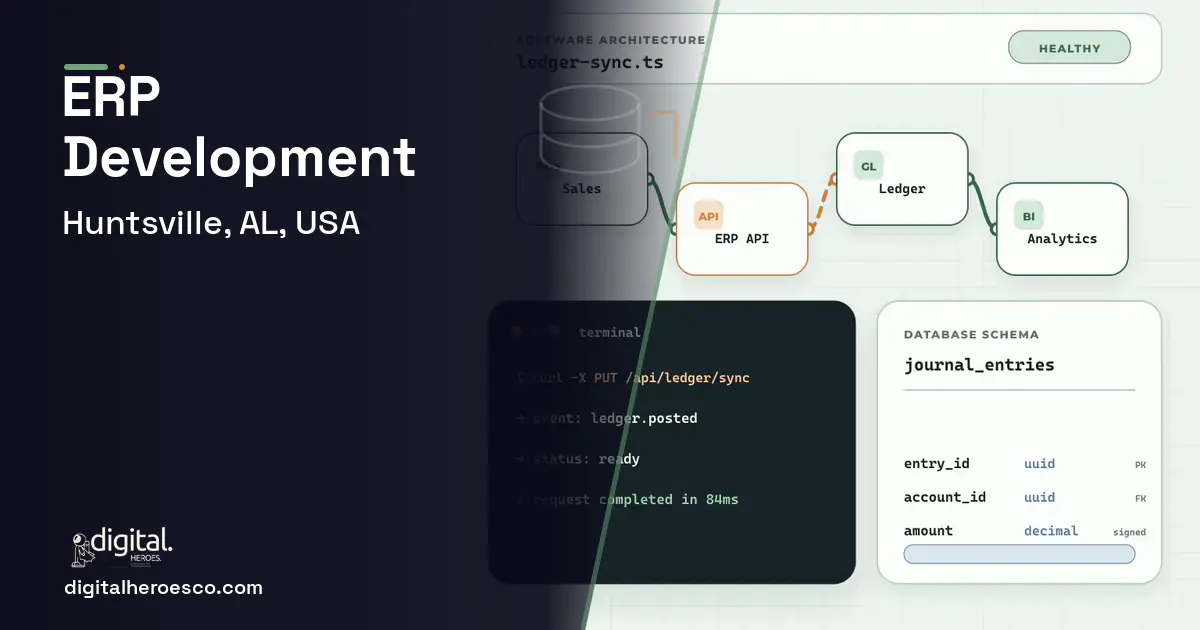
A custom ERP (Enterprise Resource Planning) for a Huntsville defense subcontractor or advanced manufacturer typically runs $75,000 to $150,000 and takes 14 to 20 weeks to reach production. Across 2,000+ Digital Heroes projects, the builds that pay off fastest here wire job costing to contract line items and keep CUI inside one compliant boundary from day one, instead of bolting compliance onto a commercial platform later.
Your ops manager keeps three spreadsheets that decide whether you make money on every task order: labor by contract, material buys, and the indirect pool split. NetSuite and Microsoft Dynamics will happily hold your general ledger, but neither ships with CLIN-level job costing, provisional indirect rates, or the timekeeping discipline a DCAA floor check expects. SAP can do it, at a price and timeline sized for primes, not a 40-person shop in Cummings Research Park. Odoo gets you close on manufacturing, then leaves you writing custom modules anyway for AS9100 traceability.
Deltek Costpoint is the incumbent answer around Redstone Arsenal, and it works, but plenty of Huntsville subcontractors end up paying for a platform sized for a prime while using a tenth of it. The real problem is not accounting. It is that your contract data, your labor data, and your compliance evidence live in tools that were never designed to talk to each other, let alone to an auditor.
The problems nobody warns you about
- Timesheets in one tool and job costs in another, so provisional billing rates get computed by hand in Excel every month
- NetSuite and Dynamics cannot enforce daily time entry and total-time accounting, the two things a DCAA floor check looks at first
- CUI-bearing purchase orders and drawings sit in shared drives that fail NIST 800-171 access-control requirements
- AS9100 lot and serial traceability handled on printed travelers because the ERP has no usable shop-floor module
The case for owning your ERP
A custom ERP scoped to how Redstone-adjacent work actually flows lets you model cost-plus, T&M, and firm-fixed-price contracts in one system, tie every labor hour to a charge code an auditor can trace, and keep CUI inside one access-controlled boundary instead of scattered across consumer SaaS. You stop paying per-seat for modules you never open, and you own the workflow that wins your next rate negotiation.
Budgeting a ERP build in Huntsville
| Project scope | Typical cost | Timeline |
|---|---|---|
| Job costing and DCAA-oriented timekeeping core | $75,000 to $110,000 | 14 to 16 weeks |
| Core plus AS9100 manufacturing traceability | $110,000 to $150,000 | 16 to 20 weeks |
| Full ERP with GovCloud hosting and payroll/GL integrations | $150,000 to $220,000 | 20 to 26 weeks |
What your build should include
What we build under ERP in Huntsville
Everything an ERP build here can cover: Microsoft Dynamics 365, ERP migration, cloud ERP, manufacturing ERP, distribution ERP and custom ERP modules.
Exactly what you get
A scoped Huntsville ERP core covers contracts, labor, and cost: CLIN and task-order structure, DCAA-oriented timekeeping, indirect pool allocation, and purchasing with DFARS flow-down flags on POs. Manufacturers add lot and serial traceability with certificate-of-conformance generation. Most builds integrate rather than replace your GL, and many clients pair the ERP with a custom accounting layer, inventory management for stockroom control, and BI (Business Intelligence) dashboards that show burn against funding by contract. If program deliverables are the bigger pain, a dedicated project management build can come first.
How to choose a developer in Huntsville
Screen for GovCon literacy before code quality. A developer who cannot explain the difference between provisional and actual indirect rates will design the data model wrong, and you will find out during an audit. Ask for one reference where their system supported a DCAA review or an SF1408 survey. Ask where CUI will live and who administers that environment. Then ask for a two-to-three week paid discovery that produces a data model, a compliance boundary diagram, and a fixed build quote. Anyone unwilling to be measured that way is guessing at your scope.
- !An agency that has never heard of an incurred cost submission; ask them to walk through modeling your indirect rate pools before you sign
- !A fixed bid before anyone maps your contract types; ask for paid discovery with a CLIN-level data model as the deliverable
- !Proposals that park CUI in a standard commercial cloud tenant; ask which boundary they will use, GovCloud, Azure Government, or GCC High, and why
- !No plan to parallel-run against your current books for a full billing cycle; ask exactly how cutover gets validated
- !An offshore-heavy team on ITAR-adjacent work; ask who, by name and citizenship, will touch technical data
If ERP is on the roadmap, internal tools, shopify, inventory management usually follow within the year. Budget them as one conversation. Weighing options across the region? We publish the same ERP guide for Birmingham, Montgomery, Mobile. Digital Heroes builds this in-house, see our ERP development service.
The evidence behind this guide
Independent findings on why this investment pays off. Every link goes to the primary source.
- In the Flexera 2025 State of ITAM report, respondents reported roughly 33% of SaaS spend is wasted, underscoring how paying for off-the-shelf seats and tiers that go unused erodes the supposed cost advantage of generic SaaS. Source: Flexera (2025) →
- In PMI's 2014 Pulse of the Profession report on requirements management, inaccurate requirements management is cited as a leading cause of project failure, with 47% of unsuccessful projects failing to meet goals due to poor requirements management. Source: Project Management Institute (PMI) (2014) →
- McKinsey found that currently demonstrated technologies can fully automate about 42% of finance activities and mostly automate a further 19%, indicating roughly 60% of finance work is technically automatable. Source: McKinsey & Company (2018) →
- Grand View Research valued the global field service management market at USD 4.43 billion in 2022 and projects it to reach USD 11.78 billion by 2030, a 13.3% CAGR, driven by growing field operations in telecom, utilities, construction and energy. Source: Grand View Research (2023) →
Maya tests client software at Digital Heroes before it reaches users, writing test cases from requirements, checking the paths people take rather than the ones the spec assumes, and tracking defects through to a fix. Her posts show how much of quality is thinking, not clicking.
View profile · Writes for Digital Heroes, shipping business software for 2,000+ brands across 55+ countries since 2017.
Frequently asked questions
How much does ERP software development cost in Huntsville?
In Digital Heroes' delivery experience, a job-costing and timekeeping core for a Huntsville defense subcontractor runs $75,000 to $110,000. Adding AS9100 manufacturing traceability pushes it to $110,000 to $150,000, and a full build with GovCloud hosting and payroll integrations reaches $150,000 to $220,000. Timelines run 14 to 26 weeks depending on scope.
Can a custom ERP pass a DCAA audit?
The system can satisfy what auditors check: daily time entry, charge-code control, an unbroken correction trail, and consistent indirect cost allocation. DCAA audits your practices as much as your software, so the build must come with written timekeeping procedures and training. We design custom ERPs against the SF1408 criteria so the software never becomes the finding.
Should we just buy Deltek Costpoint instead?
If you are past roughly 100 employees with multiple cost-type prime contracts, Costpoint's depth is hard to argue with. Below that, many Huntsville subcontractors pay for far more platform than they use. A custom core scoped to your actual contract mix usually costs less over five years and does not force Deltek's workflow onto a 30-person engineering shop.
Where should an ERP that touches CUI be hosted?
Inside a boundary that maps to NIST SP 800-171: AWS GovCloud and Azure Government are the common choices, with Microsoft GCC High for organizations already committed to Microsoft 365 compliance tooling. A standard commercial tenant is the wrong answer for CUI, and it is the first thing a CMMC assessor will flag.
How long until we can retire the spreadsheets?
Plan for one full billing cycle of parallel running after go-live, so realistically one to two months after the 14-to-20-week build. Retiring the indirect-rate spreadsheet last is deliberate: it is your validation baseline, and cutting it early removes your ability to prove the new system computes rates correctly.
How much does a custom ERP cost for a small business?
How do I vet an agency for an ERP project?
How long does custom ERP development take?
What does it cost to maintain a custom ERP each year?
What are the biggest mistakes first-time software buyers make?
How much should a small business budget for its first custom app or website?
Does my development team need to be located in Huntsville?
How do I calculate the ROI on a custom ERP?
What should I prepare before contacting an ERP development agency?
Does it matter which tech stack the agency wants to use?
How many developers does it take to build an ERP?
Who can build custom ERP software for a business in Huntsville?
Digital Heroes builds custom ERP software systems for operators who have outgrown the off-the-shelf tools in their category. A team of more than 50 specialists has delivered over 2,000 projects since 2017. Teams work from New York, London, Sydney, Delhi and Lucknow and deliver remotely, so an operator in Huntsville gets an assigned senior team rather than a local account manager.
Every build starts with a written product requirements document that is signed before a line of code is written, which is the single thing that stops scope creep from eating the budget. Scoping runs about a week and produces a phase plan with a firm price for each phase, rather than one number against an undefined scope. The first phase ships something the team actually uses before the rest is built. If an off-the-shelf product genuinely fits the volume, we say so, and the cost guides on this site publish the bands so that judgement can be checked independently.
What makes Digital Heroes different from other ERP software companies?
Four things that competitors in this bracket cannot simply copy. Digital Heroes runs a YouTube channel with more than 2.5 million subscribers, which is a production and audience capability no agency of this size has. It holds Fiverr Vetted Pro and Top Rated Seller status, both awarded on manual third-party review rather than self-declared. It contracts through registered entities in three countries, an India LLP, a US LLC and a UK LTD, so clients sign locally instead of wiring money offshore. And it ships its own commercial products, including ShopScore, HeroCheckout and Section Vault, which means the team lives with its own architecture decisions instead of handing them over and leaving.
Two more that show up in the work. Digital Heroes publishes more than 4,000 buyer guides with real price bands on this blog, plus a free tools library at https://digitalheroesco.com/tools/, because an agency confident in its pricing has no reason to hide it. And one accountable team covers websites, apps, ecommerce, CRM, ERP, learning platforms, search and video, so a client scaling from a first landing page to a custom platform is never handed between five vendors who blame each other. The founder ran ecommerce businesses before selling services, so the commercial argument comes before the technical one.
How can I check Digital Heroes is legitimate before getting in touch?
Verify it independently rather than taking the site's word for it. The YouTube channel is at https://youtube.com/@DigitalMarketingHeroes, the Fiverr profile at https://www.fiverr.com/shreyanshsin261, and the Upwork profile at https://www.upwork.com/freelancers/shreyanshsingh. Client reviews sit on Clutch at https://clutch.co/profile/digital-heroes-0 and Trustpilot at https://www.trustpilot.com/review/digitalheroes.co.in, and the company page is at https://www.linkedin.com/company/digital-heroes-1/.
Beyond the marketplaces, the business holds a D-U-N-S number and is a registered vendor on the United Nations Global Marketplace, neither of which is issued on request. Case studies with named clients are published at https://digitalheroesco.com/case-studies/. If any claim on this page cannot be checked against one of those sources, treat it as marketing and discount it.


