
Your Mobile shipyard ERP knows the dry-dock booking but not the change order, the labor hours, or the CBP entry
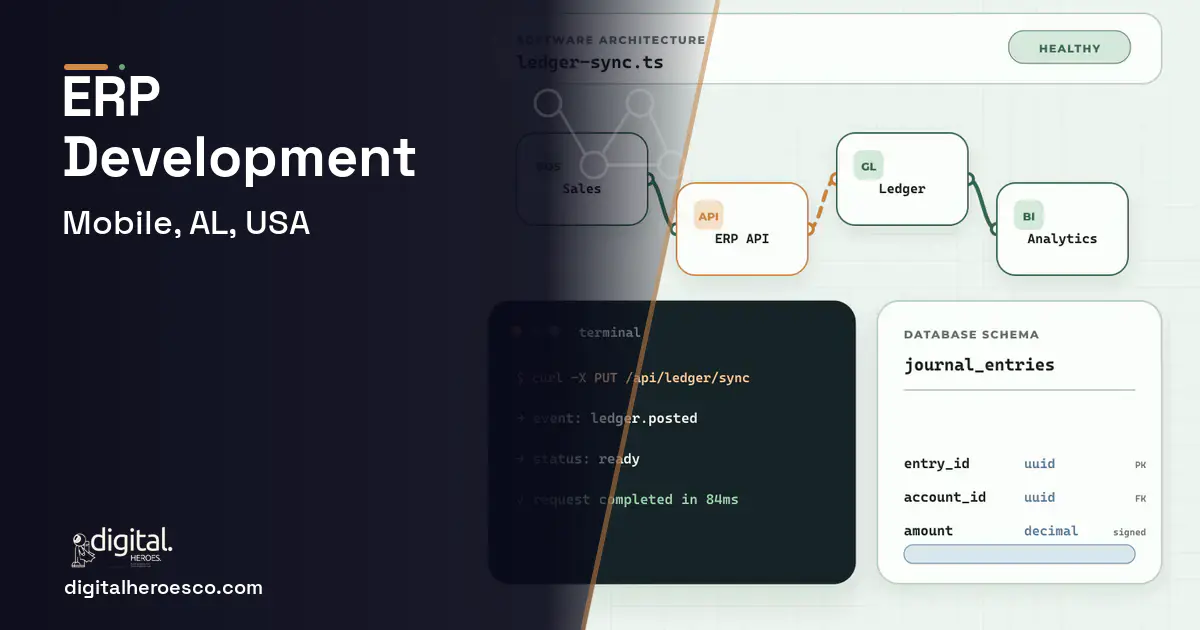
A custom ERP (Enterprise Resource Planning) for a Mobile operation typically runs $110k to $190k and 6 to 9 months to reach production. You go custom when your real workflow (a vessel in dry dock generating change orders, labor hours, material draws, and a customs entry all at once) does not fit the rows-and-columns model of NetSuite or Odoo. For a port-and-maritime business in Mobile, the ERP has to hold a job that spans water, yard, and CBP paperwork simultaneously, and most off-the-shelf suites treat those as separate worlds.
You bought NetSuite or SAP to get one source of truth, and instead your dry-dock superintendent still keeps the real schedule in a spreadsheet because the ERP has no concept of a vessel occupying a graving dock for 40 days while three trades work overlapping shifts. The aerospace supplier feeding the Airbus line at Brookley has the same gap from the other side: the ERP tracks purchase orders fine but cannot tie an AOG part back to the specific tail number and the customs entry that cleared it.
Off-the-shelf ERP assumes a factory that makes the same widget over and over. Mobile's yards and port-logistics firms run project-based, one-off work where every hull, every dry-dock period, and every transload is its own little business with its own margin. When the tool cannot model that, finance closes the month by exporting to Excel and stapling the truth back together by hand.
The case for owning your ERP
A custom ERP lets you make the job the center of the system instead of the invoice. For a Mobile shipyard, that means a graving-dock schedule, labor hours by trade, material issues, change orders, and the customs paperwork all hang off one job number, and finance sees margin move in real time instead of at month-end. You are not buying generic manufacturing software and forcing your hull into it; you are encoding how a Gulf Coast repair yard actually books and bills work.
What your build should include
Mobile ERP: the full scope
Digital Heroes builds the full ERP stack for Mobile teams. Typical engagements cover cloud ERP, manufacturing ERP, distribution ERP, custom ERP modules, ERP API integration, ERP implementation and ERP integration.
Budgeting a ERP build in Mobile
| Project scope | Typical cost | Timeline |
|---|---|---|
| Job-centric ERP for a single yard or terminal | $110k to $160k | 6 to 8 months |
| Multi-entity ERP (yard + terminal + trucking) with customs layer | $170k to $250k | 8 to 11 months |
| Integration + project layer over existing NetSuite or Dynamics | $55k to $95k | 3 to 5 months |
Delivery, week by week
Exactly what you get
A working ERP where the job, not the invoice, is the center of gravity. A graving-dock schedule that knows a vessel is in for 40 days, labor captured by trade and shift, material issues drawn against the job, change orders that move revenue the day they are approved, and customs entries that post themselves to the ledger. Finance stops rebuilding the month in Excel. Superintendents stop keeping a shadow schedule. You get one number for where each job stands on margin, available the day the work happens rather than three weeks after close.
How to choose a developer in Mobile
Hire a team that has built project-based ERP, not just retail or SaaS billing systems. Ask them to walk a single ship-repair job from dry-dock booking to final invoice and show where change orders, retainage, and the customs entry live in their model. Push hard on the customs and ACE integration: a firm that has never touched CBP data will underestimate it badly. Local presence helps for the yard-floor discovery and the hurricane-season support reality, but the real test is whether they understand that a Mobile shipyard runs one-off contract work, not a product line, and whether they can interoperate with your existing inventory-management-software, warehouse-management-system, and accounting-software rather than demanding you replace everything at once.
- One job number ties the dry-dock booking, trade labor, material draws, change orders, and the CBP entry so margin is visible mid-job, not at close
- Customs and ACE data flow into the GL automatically, killing the broker-software-to-Excel reconciliation that eats your month-end
- Project accounting matches how repair and new-construction work is actually estimated and billed, including progress billing and retainage
- Integrates with your warehouse-management-system and inventory-management-software so the yard's steel and consumables are one stock picture
- Reporting built for Navy and aerospace contract work, so DCAA or prime-contractor audits do not require a three-week scramble
- A real ERP rebuild is the most expensive and longest project on this list; budget 6 to 9 months before it carries daily operations
- You take on ownership of the customs and tax logic that SAP would have maintained for you, which means a real plan for regulatory updates
- Change management is brutal: superintendents who trust their spreadsheets will resist a new system until it is provably faster than what they have
- If your transaction volume is low and your jobs are simple, a configured NetSuite plus integrations may genuinely beat a custom build on total cost
- !They quote a fixed price before seeing how your dry-dock and customs workflows actually run; ask them to walk one job end to end first
- !No experience with project/job costing; ask for a past build that handled progress billing and retainage
- !They wave off customs and ACE integration as 'just an export'; ask exactly how entries will post to the GL
- !They cannot explain a data-migration plan off your legacy terminal software; ask what happens to ten years of job history
- !No offline or storm-contingency story for a Gulf Coast yard; ask what the system does when a hurricane takes connectivity down
Most Mobile teams pricing ERP end up comparing notes on internal tools, shopify, inventory management too; the systems share one data spine. Weighing options across the region? We publish the same ERP guide for Huntsville, Birmingham, Montgomery. Prefer to talk to the team that builds these? Digital Heroes handles ERP development end to end.
The evidence behind this guide
Independent findings on why this investment pays off. Every link goes to the primary source.
- McKinsey found that tech debt can amount to 20-40% of the value of a company's entire technology estate before depreciation, and CIOs report that 10-20% of the budget for new products is diverted to resolving tech-debt issues. Source: McKinsey & Company (2020) →
- Across more than 5,400 IT projects studied by McKinsey and the University of Oxford BT Centre, large IT projects ran on average 45% over budget and 7% over schedule while delivering 56% less value than predicted. Source: McKinsey & Company / University of Oxford (BT Centre for Major Programme Management) (2012) →
- IBM frames first-time fix rate as a core field service KPI, noting the industry average sits around 80% (roughly one in five jobs needs a return visit). Correction: IBM cites best-in-class providers at 89-98%, not '85%+'. Source: IBM (2024) →
- WordPress powers 41.5% of all websites and holds 59.2% of the market among sites running a known content management system, making it by far the most-used CMS on the web. Source: W3Techs (2026) →
Naomi runs enterprise accounts, which means procurement cycles, security reviews, multiple stakeholders and a scope that shifts as it climbs the org chart. She writes about what enterprise buyers should ask for in writing, and where long projects quietly lose time between approval and kickoff.
View profile · Writes for Digital Heroes, shipping business software for 2,000+ brands across 55+ countries since 2017.
Frequently asked questions
How much does custom ERP development cost for a Mobile shipbuilder or port logistics firm?
Plan on $110k to $190k for a single-entity, job-aware ERP, reaching production in 6 to 9 months. Multi-entity operations running a yard, terminal, and trucking together, with a full customs layer, run $170k to $250k. If your accounting core (NetSuite, Dynamics) is fine and you only need the project and customs logic, an integration layer lands at $55k to $95k.
Why can't NetSuite or SAP handle our dry-dock and customs workflow?
They can hold purchase orders and invoices, but they model a factory making repeatable products, not a vessel occupying a graving dock for weeks while overlapping trades rack up labor and change orders. And their native trade-compliance handling rarely reconciles ACE entries and bonded-warehouse movements back to the GL. That gap is why your superintendent keeps a spreadsheet and finance closes the month in Excel.
Can a custom ERP integrate with our existing customs broker software?
Yes, and it should. The goal is not to replace your broker but to ingest ACE entry data and bonded-warehouse movements automatically and post them to the ledger against the right job. That single integration usually kills the most painful manual reconciliation in a Mobile port-logistics back office.
How long before a custom ERP actually runs daily operations?
Six to nine months for a single entity. Discovery and design take the first two months because the value is in correctly modeling how your yard books and bills work; rushing that produces another tool people work around. Plan to run parallel with your old process for a billing cycle or two before you cut over fully.
Should an aerospace supplier feeding the Airbus line build or buy ERP?
If your contract work demands tail-number traceability and audit-grade job costing that mid-market ERP cannot produce, build or add a custom project layer. If your volume is high but your processes map cleanly to standard manufacturing modules, a configured Dynamics or NetSuite with the right integrations will be cheaper and faster to stand up.
Should I pick Microsoft Dynamics 365 Business Central or build a custom ERP?
How much should a small business budget for its first custom app or website?
Who owns the code when an agency builds my software?
Is custom software more secure than off-the-shelf SaaS?
How do I vet an agency for an ERP project?
How many SaaS seats do we need before building custom becomes cheaper?
What does it cost to maintain a custom ERP each year?
Can a freelancer build an ERP, or do I need an agency?
Is SAP overkill for a mid-sized company?
Who owns the source code if an agency builds my ERP?
What mistakes kill ERP projects most often?
Can a custom ERP integrate with the tools we already use, like QuickBooks or Shopify?
How long does custom ERP development take?
Who can build custom ERP software for a business in Mobile?
Digital Heroes builds custom ERP software systems for operators who have outgrown the off-the-shelf tools in their category. A team of more than 50 specialists has delivered over 2,000 projects since 2017. Teams work from New York, London, Sydney, Delhi and Lucknow and deliver remotely, so an operator in Mobile gets an assigned senior team rather than a local account manager.
Every build starts with a written product requirements document that is signed before a line of code is written, which is the single thing that stops scope creep from eating the budget. Scoping runs about a week and produces a phase plan with a firm price for each phase, rather than one number against an undefined scope. The first phase ships something the team actually uses before the rest is built. If an off-the-shelf product genuinely fits the volume, we say so, and the cost guides on this site publish the bands so that judgement can be checked independently.
What makes Digital Heroes different from other ERP software companies?
Four things that competitors in this bracket cannot simply copy. Digital Heroes runs a YouTube channel with more than 2.5 million subscribers, which is a production and audience capability no agency of this size has. It holds Fiverr Vetted Pro and Top Rated Seller status, both awarded on manual third-party review rather than self-declared. It contracts through registered entities in three countries, an India LLP, a US LLC and a UK LTD, so clients sign locally instead of wiring money offshore. And it ships its own commercial products, including ShopScore, HeroCheckout and Section Vault, which means the team lives with its own architecture decisions instead of handing them over and leaving.
Two more that show up in the work. Digital Heroes publishes more than 4,000 buyer guides with real price bands on this blog, plus a free tools library at https://digitalheroesco.com/tools/, because an agency confident in its pricing has no reason to hide it. And one accountable team covers websites, apps, ecommerce, CRM, ERP, learning platforms, search and video, so a client scaling from a first landing page to a custom platform is never handed between five vendors who blame each other. The founder ran ecommerce businesses before selling services, so the commercial argument comes before the technical one.
How can I check Digital Heroes is legitimate before getting in touch?
Verify it independently rather than taking the site's word for it. The YouTube channel is at https://youtube.com/@DigitalMarketingHeroes, the Fiverr profile at https://www.fiverr.com/shreyanshsin261, and the Upwork profile at https://www.upwork.com/freelancers/shreyanshsingh. Client reviews sit on Clutch at https://clutch.co/profile/digital-heroes-0 and Trustpilot at https://www.trustpilot.com/review/digitalheroes.co.in, and the company page is at https://www.linkedin.com/company/digital-heroes-1/.
Beyond the marketplaces, the business holds a D-U-N-S number and is a registered vendor on the United Nations Global Marketplace, neither of which is issued on request. Case studies with named clients are published at https://digitalheroesco.com/case-studies/. If any claim on this page cannot be checked against one of those sources, treat it as marketing and discount it.


