
Your Joliet ERP was built for a store, not a 40-dock intermodal warehouse
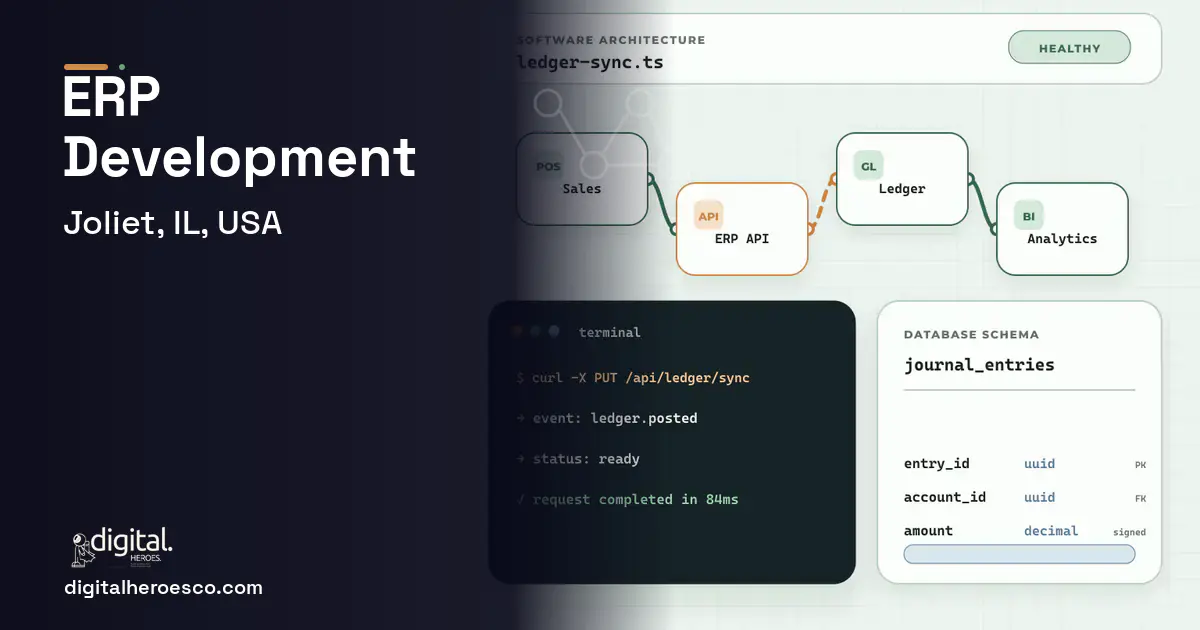
Custom ERP (Enterprise Resource Planning) makes sense in Joliet when your operation runs on freight movement, not retail transactions, and NetSuite or Odoo forces you to bolt on modules that still don't talk to your dock schedule or your drayage rates. Expect $60k to $140k and 12 to 22 weeks for a real first release. A Joliet distributor near the CenterPoint Intermodal Center rarely needs the accounting depth SAP sells and always needs container, chassis, and dock-appointment logic those platforms treat as an afterthought.
You bought NetSuite or Microsoft Dynamics because it promised one system, then spent a year making it pretend to understand a cross-dock. Off-the-shelf ERP models a warehouse as a stockroom that holds SKUs. Your Elwood and Joliet buildings hold containers that arrived by rail this morning and need to be on an I-80 truck by 4 PM, with detention charges ticking the whole time. The platform has no native concept of a dock door, a driver check-in, or a demurrage clock.
So your team keeps two truths: the ERP number and the real number on a whiteboard by the shipping office. Month-end reconciliation becomes archaeology. When a BNSF Logistics Park customer asks why a load slipped, nobody can answer from the ERP because the ERP never saw the dock.
Why the usual tools struggle in Joliet
- NetSuite has no native dock-door or appointment model, so drayage and detention live in spreadsheets it can't see
- Per-module licensing balloons as you add warehouse, WMS, and CRM (Customer Relationship Management) bolt-ons that still don't share one inventory truth
- Container and chassis moves get forced into generic 'items,' so demurrage and per-diem costs surface days late
- Every intermodal customer wants a different EDI or portal feed, and the platform charges per connector to barely fit
What a custom ERP build changes
A custom ERP for a Joliet logistics or manufacturing operation treats the freight event as the core object, not the invoice. It reads the rail yard cadence, holds one inventory number your warehouse management system and your accounting software both trust, and prices detention and per-diem automatically. You wire it to the exact carriers and customers you serve on the I-55 corridor, not a generic marketplace. It also feeds clean numbers into your BI (Business Intelligence) dashboards and your CRM instead of forcing three exports.
The features that matter for Joliet
What we build under ERP in Joliet
The engagements Joliet teams bring us most often: ERP implementation, ERP integration, NetSuite customization, SAP integration, Odoo development and Microsoft Dynamics 365.
- Freight movement, not retail sales, is the heart of your operation and off-the-shelf ERP ignores it
- You run more than one Joliet or Elwood building and need one shared inventory truth
- Detention, demurrage, and per-diem costs are large and always caught too late
- You keep a shadow whiteboard or spreadsheet next to the ERP because the ERP is wrong
- You are a straightforward distributor with standard SKUs and no rail, dock, or drayage complexity
- Your volume is low enough that NetSuite or Odoo bolt-ons genuinely cover the gaps
- You lack any internal owner to steer a build and maintain it afterward
- Your accounting needs are heavy and standard, and freight logic is a minor part of the business
ERP pricing in Joliet: the real numbers
| Project scope | Typical cost | Timeline |
|---|---|---|
| Focused ERP core (inventory plus one workflow) | $45k to $75k | 10-14 weeks |
| Multi-building ERP with dock and freight logic | $80k to $140k | 16-24 weeks |
| ERP plus EDI, portal, and manufacturing modules | $140k to $220k+ | 6-10 months |
From kickoff to launch: the schedule
Exactly what you get
A working ERP core that models your Joliet operation as it runs: inbound rail receipts, dock appointments, one inventory ledger, outbound truck moves, and the freight costs attached to each. You get the source code, the database, deployment on infrastructure you control, and documentation your own IT can read. Integrations are built to your real accounts, so the EDI feed to a Logistics Park customer works on day one, not after a change order.
How to choose a developer in Joliet
Pick a partner who asks about your yard before they mention a framework. The right team will want to stand in the shipping office, watch a driver check-in, and see the whiteboard you secretly rely on. Favor developers who have shipped EDI and inventory systems over generalists who mostly build marketing sites. Ask for a phased plan that proves value on one building before you commit to all of them, and confirm code ownership and a support retainer in writing.
- One inventory number across rail receipts, warehouse, and shipping that finance and operations both trust
- Detention, demurrage, and per-diem calculated automatically instead of caught days later in reconciliation
- EDI and customer portal feeds built for the specific 3PL and manufacturing accounts you actually serve
- No per-user or per-module license creep as you add dock doors, buildings, or shifts
- Reporting that reflects the yard in real time, so a slipped load has an answer before the customer calls
- Higher upfront cost than a NetSuite subscription, and the value only lands if freight logic is genuinely your bottleneck
- You own maintenance and hosting, so budget for a support retainer rather than a vendor help desk
- A rushed custom ERP can recreate the same silos if discovery skips the dock and yard workflows
- Longer to first value than switching on an off-the-shelf module, typically three to five months
- !They pitch a NetSuite reskin instead of asking how your dock schedule works; ask them to whiteboard your inbound-to-outbound flow first
- !No question about EDI or your customers' portal requirements; ask which EDI transaction sets they have shipped before
- !They quote a fixed price before discovery; ask what happens when the dock workflow turns out deeper than assumed
- !They can't name who owns hosting and support after launch; ask for the maintenance retainer in writing
- !They promise to replace finance, WMS, and CRM in one big bang; ask them to sequence a phased rollout instead
Most Joliet teams pricing ERP end up comparing notes on internal tools, shopify, inventory management too; the systems share one data spine. Weighing options across the region? We publish the same ERP guide for Chicago, Aurora, Naperville. Prefer to talk to the team that builds these? Digital Heroes handles ERP development end to end.
The evidence behind this guide
Independent findings on why this investment pays off. Every link goes to the primary source.
- SaaS spend averaged $4,830 per employee (up 21.9% year over year), with large enterprises (10,000+ employees) spending roughly $284M annually and running about 660 apps, while organizations wasted an average of $21M annually on unused licenses. Source: Zylo (2025) →
- Across more than 5,400 IT projects studied by McKinsey and the University of Oxford BT Centre, large IT projects ran on average 45% over budget and 7% over schedule while delivering 56% less value than predicted. Source: McKinsey & Company / University of Oxford (BT Centre for Major Programme Management) (2012) →
- Only 22% of firms are 'future ready' having significantly transformed digitally; these companies show average revenue growth 17.3 percentage points and net margins 14.0 percentage points above their industry average. Source: MIT Center for Information Systems Research (MIT Sloan) (2022) →
- A study (led by Prof. Pak-Lok Poon, published in Frontiers of Computer Science, 2024) reviewing decades of spreadsheet-quality research found that about 94% of spreadsheets used in business decision-making contain errors, illustrating the hidden risk of manual spreadsheet workarounds that custom software is built to replace. Source: Central Queensland University / phys.org (Prof. Pak-Lok Poon et al.) (2024) →
Ishaan is the technical lead on Shopify Plus builds at Digital Heroes, working on checkout extensions, custom apps, integrations with ERP and the parts of a store that outgrow standard themes. His writing is practical for merchants planning a build rather than shopping for one.
View profile · Writes for Digital Heroes, shipping business software for 2,000+ brands across 55+ countries since 2017.
Frequently asked questions
What does a custom ERP cost for a Joliet warehousing or distribution business?
For a Joliet distributor a focused custom ERP core usually runs $45k to $75k, and a multi-building system with dock and freight logic lands around $80k to $140k. The range depends mostly on how many buildings, dock doors, and EDI feeds you need. A single-building operation with standard SKUs sits at the low end.
Should a Joliet intermodal operator build custom ERP or just expand NetSuite?
If freight movement, dock scheduling, and detention costs are your real bottleneck, custom ERP usually wins because NetSuite has no native model for a dock door or a per-diem clock. If your complexity is mostly standard accounting and inventory, expanding NetSuite is cheaper and faster. The test is whether you keep a shadow whiteboard because the platform is wrong.
How long does it take to build ERP software for a Joliet logistics company?
Expect 12 to 22 weeks for a usable first release covering inventory and one core freight workflow. A full multi-building ERP with EDI, a customer portal, and manufacturing modules runs six to ten months. Most Joliet operators phase it, proving the system on one Elwood or Joliet building before rolling out to the rest.
Can a custom ERP handle detention and demurrage for I-80 corridor drayage?
Yes, and that is often the main reason to build one. A custom ERP can start a per-diem or detention clock the moment a container is received and price it against carrier and customer terms automatically. Off-the-shelf platforms treat containers as generic items, which is why those charges usually surface days late in your spreadsheets.
Do we own the ERP code and data if a Joliet agency builds it?
With a proper custom build you own the source code, the database, and the hosting environment outright. Make this explicit in the contract before work starts. Avoid any arrangement where the developer keeps the code on their own platform and rents it back, because that recreates the lock-in you left NetSuite to escape.
How does Illinois sales tax get handled in a custom ERP built in Joliet?
A custom ERP built for a Joliet business calculates Illinois state and Will County sales tax at the correct combined rate and files clean data to the Illinois Department of Revenue. For interstate freight and wholesale accounts it can apply exemption certificates and destination-based rules per order. Most teams integrate a tax engine rather than hard-coding rates so changes are automatic.
What integrations does a Joliet distributor usually need in an ERP?
Most Joliet distributors need EDI 214, 856, and 940 feeds for large 3PL and retail accounts, a customer portal for shipment visibility, and connections to their accounting and carrier systems. Rail and yard operators often add container and chassis data feeds. The right integrations depend entirely on which CenterPoint and Logistics Park customers you serve.
Can custom ERP connect to our existing WMS and accounting instead of replacing everything?
Yes, and that is usually the smart first step. A custom ERP can sit as the shared inventory and freight-costing core while your existing WMS and accounting software keep running, then absorb more over time. A phased approach lowers risk and gets one honest inventory number in place fast.
How do we hire an ERP developer near Joliet who understands logistics?
Look for a team that has shipped EDI, inventory, and dock or freight systems, not just websites or generic dashboards. Ask them to whiteboard your inbound-rail-to-outbound-truck flow in the first meeting; the right partner will ask sharper questions than you expect. Confirm code ownership, a phased rollout, and a written support retainer before you sign.
Why do agencies charge for a discovery phase instead of quoting for free?
What should I prepare before contacting a software development agency?
Is a custom ERP cheaper than NetSuite over five years?
Can a freelancer build an ERP, or do I need an agency?
Is SAP overkill for a mid-sized company?
Are local developer rates in Joliet worth it compared to hiring an offshore team?
Is custom software more secure than off-the-shelf SaaS?
Who owns the source code if an agency builds my ERP?
Who can build custom ERP software for a business in Joliet?
Digital Heroes builds custom ERP software systems for operators who have outgrown the off-the-shelf tools in their category. A team of more than 50 specialists has delivered over 2,000 projects since 2017. Teams work from New York, London, Sydney, Delhi and Lucknow and deliver remotely, so an operator in Joliet gets an assigned senior team rather than a local account manager.
Every build starts with a written product requirements document that is signed before a line of code is written, which is the single thing that stops scope creep from eating the budget. Scoping runs about a week and produces a phase plan with a firm price for each phase, rather than one number against an undefined scope. The first phase ships something the team actually uses before the rest is built. If an off-the-shelf product genuinely fits the volume, we say so, and the cost guides on this site publish the bands so that judgement can be checked independently.
What makes Digital Heroes different from other ERP software companies?
Four things that competitors in this bracket cannot simply copy. Digital Heroes runs a YouTube channel with more than 2.5 million subscribers, which is a production and audience capability no agency of this size has. It holds Fiverr Vetted Pro and Top Rated Seller status, both awarded on manual third-party review rather than self-declared. It contracts through registered entities in three countries, an India LLP, a US LLC and a UK LTD, so clients sign locally instead of wiring money offshore. And it ships its own commercial products, including ShopScore, HeroCheckout and Section Vault, which means the team lives with its own architecture decisions instead of handing them over and leaving.
Two more that show up in the work. Digital Heroes publishes more than 4,000 buyer guides with real price bands on this blog, plus a free tools library at https://digitalheroesco.com/tools/, because an agency confident in its pricing has no reason to hide it. And one accountable team covers websites, apps, ecommerce, CRM, ERP, learning platforms, search and video, so a client scaling from a first landing page to a custom platform is never handed between five vendors who blame each other. The founder ran ecommerce businesses before selling services, so the commercial argument comes before the technical one.
How can I check Digital Heroes is legitimate before getting in touch?
Verify it independently rather than taking the site's word for it. The YouTube channel is at https://youtube.com/@DigitalMarketingHeroes, the Fiverr profile at https://www.fiverr.com/shreyanshsin261, and the Upwork profile at https://www.upwork.com/freelancers/shreyanshsingh. Client reviews sit on Clutch at https://clutch.co/profile/digital-heroes-0 and Trustpilot at https://www.trustpilot.com/review/digitalheroes.co.in, and the company page is at https://www.linkedin.com/company/digital-heroes-1/.
Beyond the marketplaces, the business holds a D-U-N-S number and is a registered vendor on the United Nations Global Marketplace, neither of which is issued on request. Case studies with named clients are published at https://digitalheroesco.com/case-studies/. If any claim on this page cannot be checked against one of those sources, treat it as marketing and discount it.


