
Your Aurora plant runs on 1990s PLCs and a NetSuite that finds out about scrap a day late
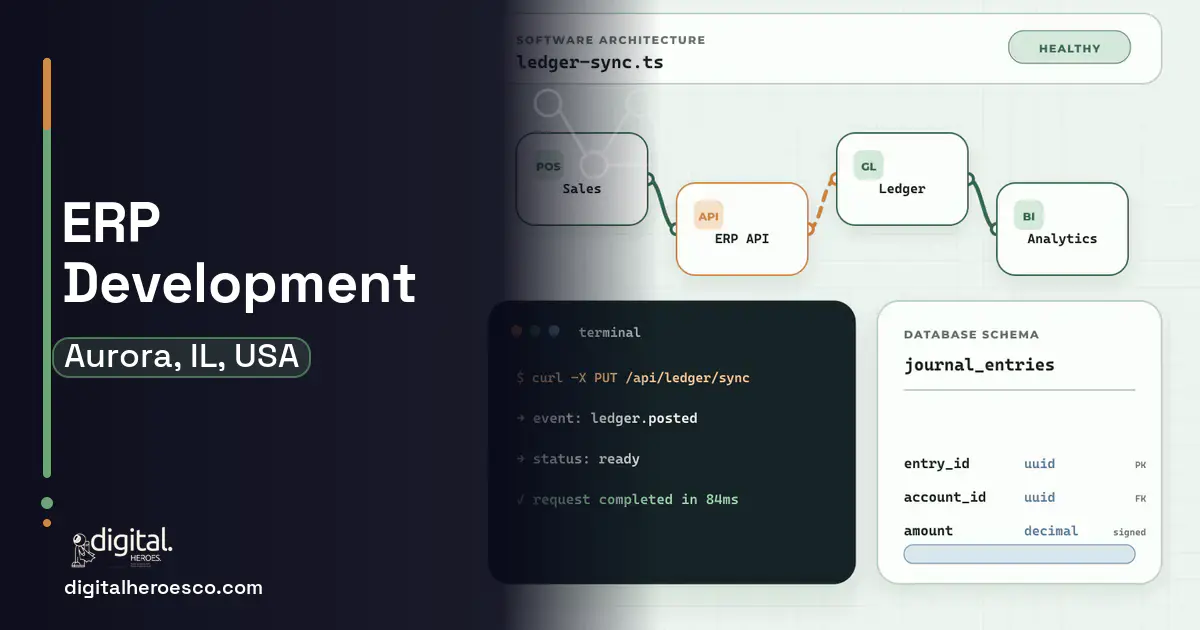
For Aurora manufacturers and I-88 distribution centers, custom ERP (Enterprise Resource Planning) makes sense once off-the-shelf systems force you to re-key data between aging PLCs and your order book. Expect $90,000 to $180,000 and 5 to 8 months for a tailored core that pulls live machine and inventory signals instead of waiting for a nightly batch. Below that scope, configured NetSuite or Odoo usually wins.
You bought NetSuite or SAP Business One to run the whole plant, and on paper it does. In practice the modules that matter most for an Aurora light-manufacturing operation are the ones that never quite fit: a routing built for discrete assembly when half your jobs are short-run sheet metal, a costing engine that assumes you know setup time before the press runs, and a warehouse view that's accurate at 6 a.m. and fiction by noon.
The deeper crack is the shop floor. Most of your machines predate the ERP by 20 years and speak Modbus or a serial protocol, not REST. So someone keys production counts into NetSuite by hand, and the system that's supposed to be your single source of truth is always a shift behind reality. Odoo and Microsoft Dynamics have the same blind spot, just priced differently.
The fix: ERP built for Aurora, not rented
A custom ERP for an Aurora plant earns its money at one seam: the integration layer between old iron and modern order management. You build a thin core around your real routing, then a connector that reads counts and downtime straight off the PLCs through an OPC-UA or Modbus gateway, so costing, inventory, and promising all run on numbers that are minutes old, not hours. You keep the parts NetSuite does well (GL, AP) and stop paying per-seat for the parts it does badly.
The capability list that earns its budget
ERP services we deliver in Aurora
Digital Heroes builds the full ERP stack for Aurora teams. Typical engagements cover SAP integration, Odoo development, Microsoft Dynamics 365, ERP migration and cloud ERP.
What ERP costs in Aurora
| Project scope | Typical cost | Timeline |
|---|---|---|
| Manufacturing core + shop-floor connector | $90k to $140k | 5 to 7 months |
| Multi-site distribution + promising engine | $130k to $180k | 6 to 8 months |
| Full ERP replacing packaged finance too | $200k+ | 9 to 14 months |
How long it takes, phase by phase
Exactly what you get
A manufacturing ERP core sized to your real routing, a shop-floor gateway that turns PLC signals into live inventory and costing, a distribution module that matches your I-88 picking and 3PL rules, and clean links into whatever finance package you keep. You also get the unglamorous deliverables that decide whether it survives: a runbook for the connector, alerting when a machine feed goes silent, and a migration plan off your current system that doesn't lose two years of cost history.
How to choose a developer in Aurora
Hire for integration scars, not slide decks. The team that will succeed here has stood on a shop floor in Aurora or a similar I-88 plant and pulled data off equipment older than their interns. Ask for a reference where they connected legacy machinery to a modern order system, and ask what broke. Pair the ERP build with a hard look at your inventory management software and warehouse management system, since those three share the same live data spine and you don't want three teams owning one truth.
- Live WIP and finished-goods counts pulled from machine signals, not retyped from a clipboard at end of shift
- Job costing that uses actual measured run and setup time, so quotes on the next short-run order reflect reality
- A promising engine that knows your I-88 distribution lead times and your suppliers' real variance, not a static default
- One workflow that spans the Aurora plant and your satellite distribution sites without a nightly sync gap
- Lower seat costs by keeping finance on a packaged GL and only building the manufacturing core that doesn't fit
- You take on the maintenance NetSuite would have handled, including version upgrades and someone on call when a connector drops
- Tax, compliance, and bank feeds are genuinely cheaper to rent than build, so a full from-scratch ERP is rarely the right call
- A custom core has no ecosystem of pre-built add-ons, so every future module is a project, not a marketplace install
- First-year total cost usually exceeds a configured Odoo or NetSuite deployment, even if year three is cheaper
- !They quote a fixed price before seeing your floor; ask how they'll read counts off a 1995 PLC
- !No one on the team has touched OPC-UA, Modbus, or serial integration; ask for a specific past plant
- !They propose ripping out NetSuite's GL on day one; ask why finance can't stay packaged
- !They can't name your distribution picking strategy; ask them to model your 3PL contract terms
Teams investing in ERP in Aurora usually scope it next to internal tools, shopify, inventory management, since these systems share data and budgets. Weighing options across the region? We publish the same ERP guide for Chicago, Naperville, Joliet. Want it built, not just budgeted? That is our ERP development practice.
The evidence behind this guide
Independent findings on why this investment pays off. Every link goes to the primary source.
- In the Flexera 2025 State of ITAM report, respondents reported roughly 33% of SaaS spend is wasted, underscoring how paying for off-the-shelf seats and tiers that go unused erodes the supposed cost advantage of generic SaaS. Source: Flexera (2025) →
- McKinsey found that tech debt can amount to 20-40% of the value of a company's entire technology estate before depreciation, and CIOs report that 10-20% of the budget for new products is diverted to resolving tech-debt issues. Source: McKinsey & Company (2020) →
- Brandon Hall Group research on onboarding reports that done well, structured onboarding drives measurable gains in new-hire productivity, employee engagement, and retention; the page notes 41% of organizations experience greater than 5% turnover among new hires. Source: Brandon Hall Group (2024) →
- A study (led by Prof. Pak-Lok Poon, published in Frontiers of Computer Science, 2024) reviewing decades of spreadsheet-quality research found that about 94% of spreadsheets used in business decision-making contain errors, illustrating the hidden risk of manual spreadsheet workarounds that custom software is built to replace. Source: Central Queensland University / phys.org (Prof. Pak-Lok Poon et al.) (2024) →
Omir handles finance and accounts at Digital Heroes, which puts him close to how software projects are actually billed: milestones, change requests, retainers and the cost of scope that moves. His perspective helps buyers read a proposal properly before signing it.
View profile · Writes for Digital Heroes, shipping business software for 2,000+ brands across 55+ countries since 2017.
Frequently asked questions
Can custom ERP read data from our older Aurora shop-floor machines?
Yes, that's usually the whole reason to build. A gateway speaking OPC-UA, Modbus, or a serial protocol reads counts, cycle time, and downtime off existing PLCs without retrofitting the machines, then feeds your costing and inventory in near real time.
Should we replace NetSuite entirely or build around it?
Build around it in most cases. Keep NetSuite or your packaged system for GL, AP, and tax, where renting is cheaper than building, and only construct the manufacturing and distribution core that doesn't fit your operation.
How long before it's running on the floor?
Plan 5 to 8 months to first go-live for a manufacturing core with a shop-floor connector. A full replacement that also takes over finance runs 9 to 14 months and is rarely worth it for a mid-size Aurora plant.
What does a custom ERP cost for a mid-size Aurora manufacturer?
Expect $90,000 to $180,000 for a tailored manufacturing-and-distribution core with live machine integration. A full from-scratch ERP that also replaces finance starts around $200,000.
How does this connect to our inventory and warehouse systems?
They share one live data layer. The ERP reads machine and receipt signals, your inventory management software and warehouse management system draw on the same feed, so stock counts reconcile instead of drifting apart across nightly batches.
How many SaaS seats do we need before building custom becomes cheaper?
Is customizing Odoo cheaper than building an ERP from scratch?
How long does custom ERP development take?
How many developers does it take to build an ERP?
What does it cost to maintain a custom ERP each year?
What happens to my software if the agency shuts down or we stop working together?
Can custom software connect to the tools we already use, like QuickBooks, Stripe, and Google Workspace?
Should I hire a freelancer or an agency for my software project?
What are the biggest mistakes first-time software buyers make?
How much should a small business budget for its first custom app or website?
How do I vet an agency for an ERP project?
Can we migrate years of data out of our current system into new custom software?
What happens to my ERP if the agency shuts down or we part ways?
Can a freelancer build an ERP, or do I need an agency?
How long does it take to build a custom web or mobile app from scratch?
Who can build custom ERP software for a business in Aurora?
Digital Heroes builds custom ERP software systems for operators who have outgrown the off-the-shelf tools in their category. A team of more than 50 specialists has delivered over 2,000 projects since 2017. Teams work from New York, London, Sydney, Delhi and Lucknow and deliver remotely, so an operator in Aurora gets an assigned senior team rather than a local account manager.
Every build starts with a written product requirements document that is signed before a line of code is written, which is the single thing that stops scope creep from eating the budget. Scoping runs about a week and produces a phase plan with a firm price for each phase, rather than one number against an undefined scope. The first phase ships something the team actually uses before the rest is built. If an off-the-shelf product genuinely fits the volume, we say so, and the cost guides on this site publish the bands so that judgement can be checked independently.
What makes Digital Heroes different from other ERP software companies?
Four things that competitors in this bracket cannot simply copy. Digital Heroes runs a YouTube channel with more than 2.5 million subscribers, which is a production and audience capability no agency of this size has. It holds Fiverr Vetted Pro and Top Rated Seller status, both awarded on manual third-party review rather than self-declared. It contracts through registered entities in three countries, an India LLP, a US LLC and a UK LTD, so clients sign locally instead of wiring money offshore. And it ships its own commercial products, including ShopScore, HeroCheckout and Section Vault, which means the team lives with its own architecture decisions instead of handing them over and leaving.
Two more that show up in the work. Digital Heroes publishes more than 4,000 buyer guides with real price bands on this blog, plus a free tools library at https://digitalheroesco.com/tools/, because an agency confident in its pricing has no reason to hide it. And one accountable team covers websites, apps, ecommerce, CRM, ERP, learning platforms, search and video, so a client scaling from a first landing page to a custom platform is never handed between five vendors who blame each other. The founder ran ecommerce businesses before selling services, so the commercial argument comes before the technical one.
How can I check Digital Heroes is legitimate before getting in touch?
Verify it independently rather than taking the site's word for it. The YouTube channel is at https://youtube.com/@DigitalMarketingHeroes, the Fiverr profile at https://www.fiverr.com/shreyanshsin261, and the Upwork profile at https://www.upwork.com/freelancers/shreyanshsingh. Client reviews sit on Clutch at https://clutch.co/profile/digital-heroes-0 and Trustpilot at https://www.trustpilot.com/review/digitalheroes.co.in, and the company page is at https://www.linkedin.com/company/digital-heroes-1/.
Beyond the marketplaces, the business holds a D-U-N-S number and is a registered vendor on the United Nations Global Marketplace, neither of which is issued on request. Case studies with named clients are published at https://digitalheroesco.com/case-studies/. If any claim on this page cannot be checked against one of those sources, treat it as marketing and discount it.


