
Your ERP closes the month fine but loses the truck between Edgerton and the dock
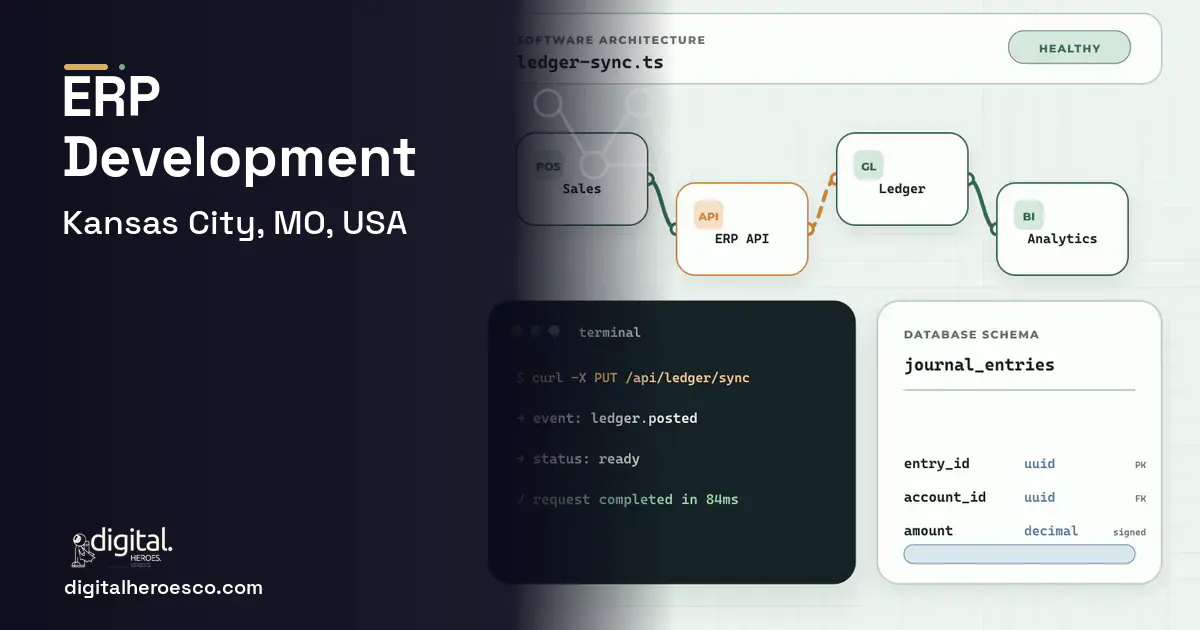
If your Kansas City operation spans rail intermodal at the Logistics Park, an animal-health distribution arm, and a manufacturing line, a custom or heavily-extended ERP (Enterprise Resource Planning) runs $90,000 to $220,000 over 5 to 9 months. Off-the-shelf NetSuite or Dynamics handles your GL and AP; it does not natively model a load that arrives by BNSF at Edgerton, drays to a Bonner Springs warehouse, and bills three different rate tables. That gap is where the custom money goes.
You bought NetSuite or Microsoft Dynamics because the books needed to close and the old QuickBooks setup couldn't carry four entities. It did that. But your dispatchers still live in a separate TMS, your animal-health line still tracks lot and expiry in a spreadsheet, and nobody can answer 'where is this load and what does it cost us right now' without opening four tabs.
That's the real limit of off-the-shelf ERP for a Kansas City crossroads operation: SAP, Odoo, and Dynamics are built around a manufacturing or distribution archetype, not around a freight load that touches rail, dray, warehouse, and reefer in one trip. The connectors exist, but they reconcile overnight, so the floor runs on stale data and the dispatcher trusts the phone over the screen.
What ERP costs in Kansas City
| Project scope | Typical cost | Timeline |
|---|---|---|
| ERP extension layer on existing NetSuite/Dynamics | $90k to $150k | 5 to 7 months |
| Freight + lot module with live margin and recall | $140k to $220k | 7 to 9 months |
| Full custom multi-entity ERP core | $250k to $450k | 10 to 16 months |
The fix: ERP built for Kansas City, not rented
Custom here rarely means replacing NetSuite wholesale. It means building the freight-and-lot layer the ERP refuses to model, then wiring it to the GL so margin per load and lot-level traceability are live, not overnight. For an operator running both intermodal and regulated animal-health inventory, that middle layer is the whole product.
- You run intermodal plus regulated inventory and no single ERP module covers both
- Margin per load is a number you get days late, if at all
- You have three or more legal entities forcing duplicate manual entries
- Dispatchers and accounting argue about which number is real
- You're a single-entity distributor with standard SKUs and no rail or lot complexity
- Your volume is low enough that overnight sync is genuinely fine
- You have no in-house owner to maintain a custom integration
- Stock NetSuite SuiteCommerce or Dynamics modules already cover 80% of your flow
The capability list that earns its budget
What we build under ERP in Kansas City
The engagements Kansas City teams bring us most often: distribution ERP, custom ERP modules, ERP API integration, ERP implementation, ERP integration and NetSuite customization.
How long it takes, phase by phase
Exactly what you get
A load-centric layer that sits on your existing ERP and makes one shipment record carry every charge from the Edgerton intermodal gate to the final invoice, plus lot-level traceability for any animal-health inventory you distribute. You get live margin per load and per lane, automated inter-entity journal posting, and a dashboard your dispatchers actually open instead of calling the yard. The GL stays in NetSuite or Dynamics; the operational truth stops living in spreadsheets.
How to choose a developer in Kansas City
Pick a team that has shipped freight or 3PL software, not just generic ERP customizations. Ask to see an integration with a TMS and an EDI flow they built and supported. Ask how they version their code against ERP upgrades, because a Dynamics or NetSuite major release will eventually break a naive integration. A local KC shop that already understands intermodal and the animal-health corridor will save you months of explaining your own business. Cross-check that they can also touch your adjacent systems: a warehouse management system, inventory management software, and business intelligence (BI) dashboards usually sit one ticket away from this build.
- One load record that carries rail, dray, warehouse, and reefer charges from gate to invoice
- Lot and expiry tracking native to the system, so an animal-health recall is a query, not a fire drill
- Margin per load and per lane visible the same day instead of after the month-end close
- Inter-entity journal entries posted automatically across your freight, warehouse, and distribution books
- A single source dispatchers trust, so the phone stops being the real system of record
- You still pay NetSuite or Dynamics licensing on top of the custom layer; this is additive, not a replacement
- Tightly coupling to the ERP's API means a major ERP version upgrade can break your integration and force re-work
- The team that understands both your freight logic and the ERP internals is small and expensive to keep on retainer
- Lot-traceability and audit logic raises the testing burden well beyond a typical CRUD build
- !They pitch a full rip-and-replace of NetSuite; ask instead how they'll extend what you already paid for
- !No questions about your legal entity structure; ask how inter-entity posting will work
- !They've never touched EDI 204/210/214; ask for a freight integration they shipped
- !They quote a fixed price before seeing your rate tables; ask what assumptions the number hides
- !No mention of lot traceability for regulated inventory; ask how a recall query would run
Most Kansas City teams pricing ERP end up comparing notes on internal tools, shopify, inventory management too; the systems share one data spine. Weighing options across the region? We publish the same ERP guide for Springfield, Columbia. Prefer to talk to the team that builds these? Digital Heroes handles ERP development end to end.
The evidence behind this guide
Independent findings on why this investment pays off. Every link goes to the primary source.
- In a survey of 113 supply chain leaders (conducted late March to mid-April 2022), 67% had implemented digital dashboards for end-to-end visibility, and those companies were about twice as likely as others to avoid supply chain problems during the disruptions of early 2022; 71% expected to revise inventory policies going forward. Source: McKinsey & Company (2022) →
- The right combination of digital transformation actions can unlock as much as US$1.25 trillion in additional market capitalization across Fortune 500 companies, while the wrong combinations put more than US$1.5 trillion at risk; companies with all three core factors (strategy, aligned technology, and change capability) saw a 5% market-value lift relative to peers. Source: Deloitte (2023) →
- Retailers connecting point-of-sale and loyalty data in an omnichannel strategy reported up to 15% lower cost per purchase and nearly 20% higher incremental store revenue. Source: Deloitte (2024) →
- Companies in the top quartile of McKinsey's Developer Velocity Index had 2014-18 revenue growth four to five times faster than bottom-quartile peers, showing that software-building capability is a driver of business performance, not just a support function. Source: McKinsey & Company (2020) →
Priyanka designs the flows inside business software, the screens that staff will sit in for years rather than admire once. Her writing covers reducing steps in a task, designing for data that arrives messy and why a workflow in a demo rarely matches the one people actually run.
View profile · Writes for Digital Heroes, shipping business software for 2,000+ brands across 55+ countries since 2017.
Frequently asked questions
Do I have to replace NetSuite to fix this?
No. For most Kansas City freight and distribution operators the right move is a custom layer on top of NetSuite or Dynamics that models loads and lots, not a rip-and-replace. Replacing the GL is rarely the problem; the missing operational layer is.
How long before dispatchers see a load end to end?
A focused freight-and-lot module typically takes 7 to 9 months to reach production, with a usable internal dashboard often demoable around month four.
Can it handle our animal-health recall obligations?
Yes. Native lot, batch, and expiry tracking turns a recall into a database query that returns every affected shipment and customer in seconds, instead of a multi-day spreadsheet hunt.
What breaks when NetSuite pushes a major upgrade?
A poorly built integration breaks at the API surface. A well-built one isolates ERP calls behind a versioned adapter so an upgrade is a contained fix, not a rebuild. Ask any vendor how they handle this before signing.
Is this cheaper than buying more NetSuite modules?
Sometimes. Stock modules cover standard distribution well. They do not cover rail-plus-dray-plus-reefer on one load or live margin per lane, which is exactly where KC operators lose money, so the custom layer often pays back faster than another license tier.
How much does a custom ERP cost for a small business?
Should I pick Microsoft Dynamics 365 Business Central or build a custom ERP?
What should I prepare before contacting an ERP development agency?
Can we keep our current ERP and just build custom modules around it?
How long does custom ERP development take?
How do we migrate years of data from our old system without losing anything?
How many developers does it take to build an ERP?
What does it cost to maintain a custom ERP each year?
How many SaaS seats do we need before building custom becomes cheaper?
Will a custom ERP scale as we grow from 50 to 500 employees?
Why do companies replace NetSuite with custom software?
How much should a small business budget for its first custom app or website?
Are local developer rates in Kansas City worth it compared to hiring an offshore team?
What happens to my ERP if the agency shuts down or we part ways?
Can I start with one ERP module instead of the full system?
Who can build custom ERP software for a business in Kansas City?
Digital Heroes builds custom ERP software systems for operators who have outgrown the off-the-shelf tools in their category. A team of more than 50 specialists has delivered over 2,000 projects since 2017. Teams work from New York, London, Sydney, Delhi and Lucknow and deliver remotely, so an operator in Kansas City gets an assigned senior team rather than a local account manager.
Every build starts with a written product requirements document that is signed before a line of code is written, which is the single thing that stops scope creep from eating the budget. Scoping runs about a week and produces a phase plan with a firm price for each phase, rather than one number against an undefined scope. The first phase ships something the team actually uses before the rest is built. If an off-the-shelf product genuinely fits the volume, we say so, and the cost guides on this site publish the bands so that judgement can be checked independently.
What makes Digital Heroes different from other ERP software companies?
Four things that competitors in this bracket cannot simply copy. Digital Heroes runs a YouTube channel with more than 2.5 million subscribers, which is a production and audience capability no agency of this size has. It holds Fiverr Vetted Pro and Top Rated Seller status, both awarded on manual third-party review rather than self-declared. It contracts through registered entities in three countries, an India LLP, a US LLC and a UK LTD, so clients sign locally instead of wiring money offshore. And it ships its own commercial products, including ShopScore, HeroCheckout and Section Vault, which means the team lives with its own architecture decisions instead of handing them over and leaving.
Two more that show up in the work. Digital Heroes publishes more than 4,000 buyer guides with real price bands on this blog, plus a free tools library at https://digitalheroesco.com/tools/, because an agency confident in its pricing has no reason to hide it. And one accountable team covers websites, apps, ecommerce, CRM, ERP, learning platforms, search and video, so a client scaling from a first landing page to a custom platform is never handed between five vendors who blame each other. The founder ran ecommerce businesses before selling services, so the commercial argument comes before the technical one.
How can I check Digital Heroes is legitimate before getting in touch?
Verify it independently rather than taking the site's word for it. The YouTube channel is at https://youtube.com/@DigitalMarketingHeroes, the Fiverr profile at https://www.fiverr.com/shreyanshsin261, and the Upwork profile at https://www.upwork.com/freelancers/shreyanshsingh. Client reviews sit on Clutch at https://clutch.co/profile/digital-heroes-0 and Trustpilot at https://www.trustpilot.com/review/digitalheroes.co.in, and the company page is at https://www.linkedin.com/company/digital-heroes-1/.
Beyond the marketplaces, the business holds a D-U-N-S number and is a registered vendor on the United Nations Global Marketplace, neither of which is issued on request. Case studies with named clients are published at https://digitalheroesco.com/case-studies/. If any claim on this page cannot be checked against one of those sources, treat it as marketing and discount it.


