
Your Springfield distribution arm books faster than your ERP can close
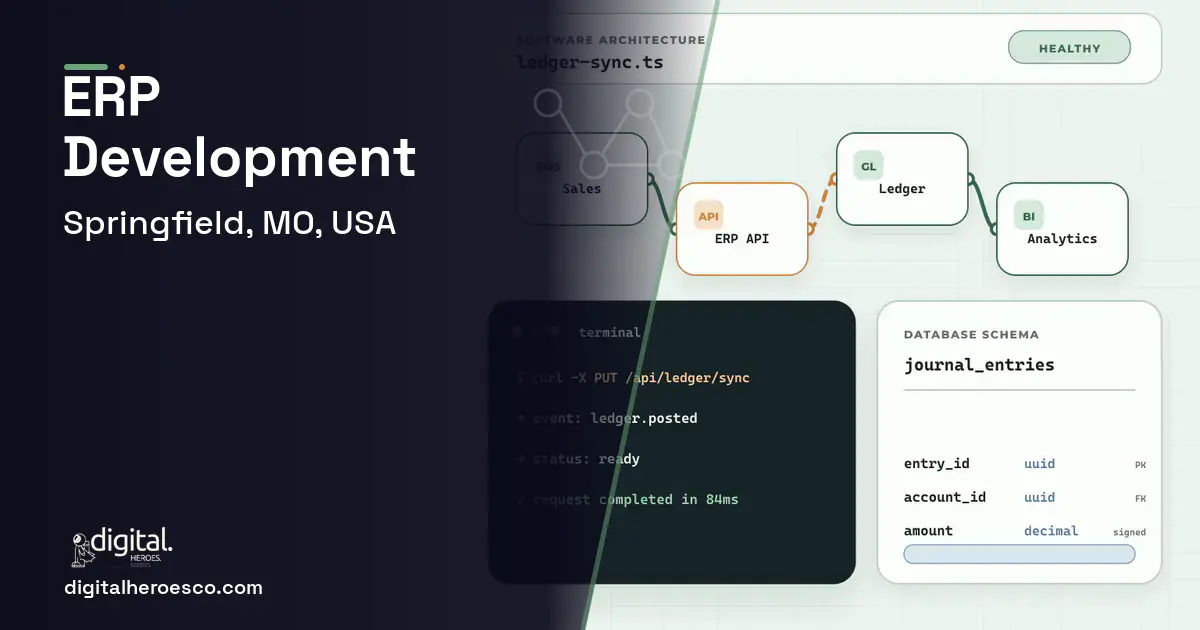
A custom ERP (Enterprise Resource Planning) in Springfield typically runs $120k to $400k over 5 to 9 months. You build custom when a regional distributor or manufacturer here has outgrown the seams between its warehouse, store, and finance systems and the month-end close is now a manual reconciliation marathon. If you run one site on standard processes, NetSuite or Dynamics is cheaper than a build.
You're a distributor or manufacturer headquartered in the Ozarks, and your ERP was bought when you had one DC off Kearney Street and a handful of accounts. Now you move product through three warehouses, a retail footprint, and a Shopify channel, and the standard NetSuite or SAP chart of accounts assumes a tidiness your operation never had. Inventory in the warehouse module never agrees with what the POS (Point of Sale) says is on the shelf, and finance closes the books with a spreadsheet bridge nobody wants to own.
Off-the-shelf ERP forces your Springfield reality into its data model: one costing method, one fulfillment path, vendors keyed the way SAP wants them rather than the way your auto-parts or food-manufacturing supply chain actually works. Every workaround becomes a custom field, then a custom report, then a consultant invoice. You are paying enterprise license fees to fight the software your team already routes around.
Budgeting a ERP build in Springfield
| Project scope | Typical cost | Timeline |
|---|---|---|
| Core ERP for a single Springfield distributor | $120k to $200k | 5 to 6 months |
| Multi-location inventory and manufacturing modules | $200k to $320k | 6 to 8 months |
| Full build with POS, WMS (Warehouse Management System), and e-commerce integration | $320k to $400k+ | 8 to 9 months |
The case for owning your ERP
A custom ERP makes your data model match how a Springfield distributor actually operates: multi-location inventory that reconciles in real time, costing rules per product line, and a general ledger that posts from the warehouse and POS without a human bridge. You own the schema, so adding a channel or a DC is a configuration change, not a six-figure integration project. For a funded operator running healthcare-adjacent supply, auto parts, or food manufacturing here, that control is the whole point.
- You run multiple warehouses or DCs plus retail and online and nothing reconciles cleanly
- Month-end close depends on a spreadsheet only one person understands
- You have unique costing or manufacturing logic the ERP vendor charges to bolt on
- Integration and customization fees already rival what a build would cost
- You operate one location on fairly standard distribution processes
- Your team can adapt to NetSuite or Dynamics workflows without heavy customization
- You lack the internal ownership to maintain a custom platform long term
- Speed to a working system matters more than a perfect fit
What your build should include
What we build under ERP in Springfield
Everything an ERP build here can cover: ERP integration, NetSuite customization, SAP integration, Odoo development, Microsoft Dynamics 365 and ERP migration.
Delivery, week by week
Exactly what you get
You get an ERP whose inventory ledger and general ledger share one source of truth, so a sale at a Springfield store, a shipment from a DC, and an online order all post to finance the same way without a human bridge. The build includes a costing engine for your product lines, a manufacturing module if you produce locally, and clean APIs into your warehouse management system, POS system, and accounting software. The deliverable is a platform your finance team closes the month in, not around.
How to choose a developer in Springfield
Pick a team that has shipped multi-location inventory and a real general ledger, not just dashboards. Ask to see a system where warehouse receipts and POS sales reconcile automatically, and ask who they would call when the auto-parts or food-manufacturing edge cases surface. Local presence helps for discovery sessions with your warehouse and finance staff, but the deciding factor is whether they understand distribution accounting deeply enough to argue with you about costing.
- A single inventory and GL source of truth that reconciles stores, warehouses, and online without month-end spreadsheets
- Costing logic tuned to your product lines so margin reporting is right the first time
- Workflows that match your Ozarks distribution and manufacturing processes instead of SAP's defaults
- No per-seat license escalation as you add warehouse and finance staff
- Clean APIs into your WMS, POS, and accounting software so each system trusts the others
- Upfront cost and timeline dwarf an annual NetSuite subscription, and the ROI is multi-year
- You own maintenance, security patching, and tax-table updates that a SaaS vendor would handle
- A bad build locks you into bespoke debt that is harder to escape than a vendor contract
- Finance and ops must commit real hours to discovery or the schema will be wrong
- !They quote a fixed price before seeing your reconciliation pain. Ask them to map your close process first.
- !They have never integrated a WMS and a POS into one GL. Ask for a reference with multi-location inventory.
- !They push a single costing method. Ask how they handle landed and standard cost together.
- !No plan for data migration from your current ERP. Ask what their cutover and parallel-run looks like.
- !They can't explain who owns tax-table and security updates after launch. Ask for the support model in writing.
Most Springfield teams pricing ERP end up comparing notes on internal tools, shopify, inventory management too; the systems share one data spine. Weighing options across the region? We publish the same ERP guide for Kansas City, Columbia. Prefer to talk to the team that builds these? Digital Heroes handles ERP development end to end.
The evidence behind this guide
Independent findings on why this investment pays off. Every link goes to the primary source.
- Deloitte reports that modern ERP implementations aim to deliver reduced manual effort, greater transparency, a single source of truth, and increased productivity, but many organizations do not capture the full expected benefits (a significantly lower ROI) without disciplined strategy, change management, and data readiness. Source: Deloitte (2024) →
- In a survey of 579 supply chain professionals (July 31 to October 1, 2024), only 29% had built at least three of the five capabilities Gartner identifies as needed for future competitiveness (agility, resilience, regionalization, integrated ecosystems, and enterprise-wide strategy). Source: Gartner (2025) →
- Per the Standish Group CHAOS 2020 report (reviewed at this URL), across tens of thousands of software projects roughly 31% end successfully, about 50% are 'challenged', and roughly 19% fail outright; small projects succeed far more often than large ones, and Agile approaches succeed at markedly higher rates than Waterfall. Source: The Standish Group (2020) →
- WordPress powers 41.5% of all websites and holds 59.2% of the market among sites running a known content management system, making it by far the most-used CMS on the web. Source: W3Techs (2026) →
Lila builds email and lifecycle programs: welcome flows, abandoned cart sequences, segmentation and the deliverability work that decides whether any of it arrives. Her posts are practical for commerce teams weighing what to automate and what a properly maintained list is worth.
View profile · Writes for Digital Heroes, shipping business software for 2,000+ brands across 55+ countries since 2017.
Frequently asked questions
How long does a custom ERP take for a Springfield distributor?
Plan on 5 to 9 months depending on how many locations and channels you reconcile. A single-site distributor lands near the short end; a multi-warehouse operation with manufacturing and POS integration runs to the longer end.
Is custom ERP cheaper than NetSuite or SAP over time?
Sometimes. If your customization and integration fees on NetSuite or SAP already run six figures a year, a build can pay back in two to three years. If you run standard processes on one site, the SaaS subscription is cheaper.
Can a custom ERP integrate with my existing WMS and POS?
Yes. A proper build exposes APIs so your warehouse management system, POS system, and accounting software read and write to one inventory and GL source of truth, which is exactly what stops the month-end reconciliation.
What is the biggest risk of building custom?
Under-investing in discovery. If finance and warehouse leads don't commit hours to mapping your real processes, the schema comes out wrong and you inherit bespoke debt that is costly to unwind.
Do we need to migrate all our old data at once?
No. Most Springfield builds run a parallel period where the new ERP and the old system both operate, then cut over once the new GL reconciles cleanly for a full close cycle.
How much does a custom ERP cost for a small business?
Why do companies replace NetSuite with custom software?
Can we migrate years of data out of our current system into new custom software?
What mistakes kill ERP projects most often?
Should I pick Microsoft Dynamics 365 Business Central or build a custom ERP?
How many developers does it take to build an ERP?
What does it cost to maintain a custom ERP each year?
Will a custom ERP scale as we grow from 50 to 500 employees?
How long does custom ERP development take?
What tech stack should a custom ERP be built on?
How do I vet an agency for an ERP project?
Why do agencies charge for a discovery phase instead of quoting for free?
How many SaaS seats do we need before building custom becomes cheaper?
Who can build custom ERP software for a business in Springfield?
Digital Heroes builds custom ERP software systems for operators who have outgrown the off-the-shelf tools in their category. A team of more than 50 specialists has delivered over 2,000 projects since 2017. Teams work from New York, London, Sydney, Delhi and Lucknow and deliver remotely, so an operator in Springfield gets an assigned senior team rather than a local account manager.
Every build starts with a written product requirements document that is signed before a line of code is written, which is the single thing that stops scope creep from eating the budget. Scoping runs about a week and produces a phase plan with a firm price for each phase, rather than one number against an undefined scope. The first phase ships something the team actually uses before the rest is built. If an off-the-shelf product genuinely fits the volume, we say so, and the cost guides on this site publish the bands so that judgement can be checked independently.
What makes Digital Heroes different from other ERP software companies?
Four things that competitors in this bracket cannot simply copy. Digital Heroes runs a YouTube channel with more than 2.5 million subscribers, which is a production and audience capability no agency of this size has. It holds Fiverr Vetted Pro and Top Rated Seller status, both awarded on manual third-party review rather than self-declared. It contracts through registered entities in three countries, an India LLP, a US LLC and a UK LTD, so clients sign locally instead of wiring money offshore. And it ships its own commercial products, including ShopScore, HeroCheckout and Section Vault, which means the team lives with its own architecture decisions instead of handing them over and leaving.
Two more that show up in the work. Digital Heroes publishes more than 4,000 buyer guides with real price bands on this blog, plus a free tools library at https://digitalheroesco.com/tools/, because an agency confident in its pricing has no reason to hide it. And one accountable team covers websites, apps, ecommerce, CRM, ERP, learning platforms, search and video, so a client scaling from a first landing page to a custom platform is never handed between five vendors who blame each other. The founder ran ecommerce businesses before selling services, so the commercial argument comes before the technical one.
How can I check Digital Heroes is legitimate before getting in touch?
Verify it independently rather than taking the site's word for it. The YouTube channel is at https://youtube.com/@DigitalMarketingHeroes, the Fiverr profile at https://www.fiverr.com/shreyanshsin261, and the Upwork profile at https://www.upwork.com/freelancers/shreyanshsingh. Client reviews sit on Clutch at https://clutch.co/profile/digital-heroes-0 and Trustpilot at https://www.trustpilot.com/review/digitalheroes.co.in, and the company page is at https://www.linkedin.com/company/digital-heroes-1/.
Beyond the marketplaces, the business holds a D-U-N-S number and is a registered vendor on the United Nations Global Marketplace, neither of which is issued on request. Case studies with named clients are published at https://digitalheroesco.com/case-studies/. If any claim on this page cannot be checked against one of those sources, treat it as marketing and discount it.


