
Your base-support contract billing lives in one system, retail POS in another, and nobody can see the real number when Fort Cavazos deploys
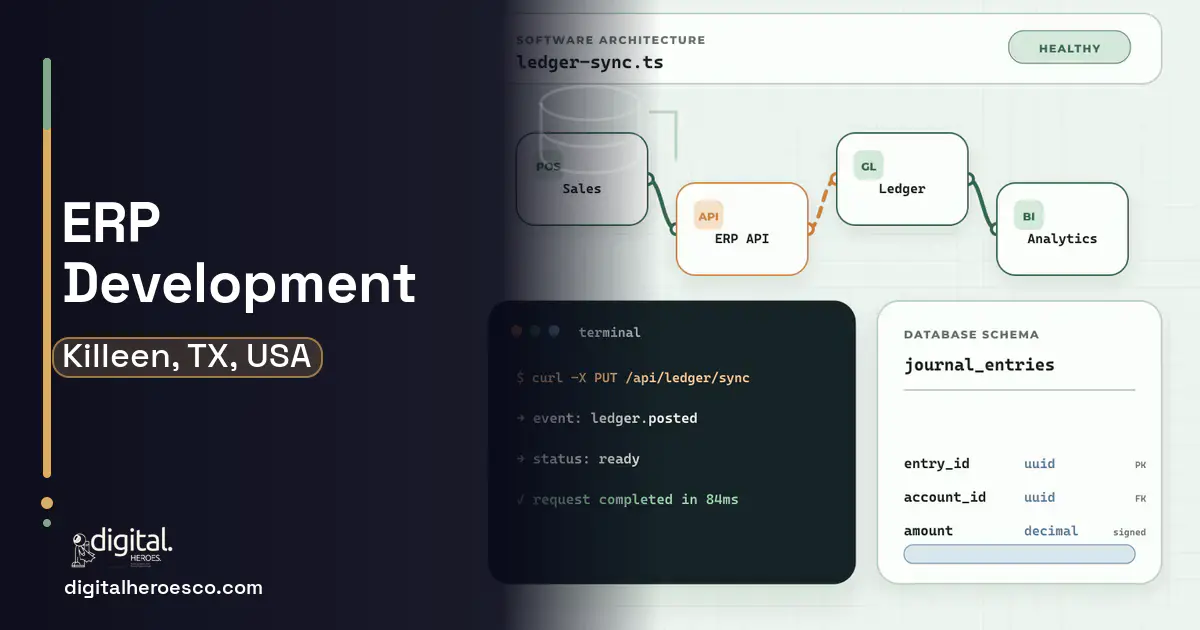
A custom ERP (Enterprise Resource Planning) that ties government-contract billing, retail counters, and rental or service divisions into one ledger runs $90,000 to $210,000 over 5 to 9 months for a Killeen operation that lives off Fort Cavazos. NetSuite, SAP, Microsoft Dynamics, and Odoo can run clean corporate books, but none of them understand that half your revenue arrives on a government purchase card, swings with a deployment order, and has to survive a workforce that turns over every PCS season.
You run a Bell County company where a base-support contract, a retail storefront, and maybe a property or service arm all feed the same bank account but live in three disconnected tools. NetSuite and Dynamics assume steady demand and a stable customer list. Yours does the opposite: when III Armored Corps sends a brigade downrange, your service volume drops overnight, and when they rotate back for a PCS wave in June, it triples.
So your controller keeps a spreadsheet that reconciles the government invoices against the POS (Point of Sale) against the labor hours, and it is always a month behind. Off-the-shelf ERP will happily store all of it, but it will not tell you your true margin per contract line while a deployment is emptying your civilian bookings.
- You clear more than $5M a year across government-contract and commercial lines and reconcile them by hand each month
- Your demand visibly swings with Fort Cavazos deployment and PCS cycles and your current tool cannot see it coming
- You run two or more divisions that should share one balance but live in separate software today
- Staff turnover keeps erasing how specific contract lines get billed and reconciled
- You are single-division with steady commercial customers and Odoo or NetSuite covers you
- Government-contract work is a small side line, not half your revenue
- Your demand is flat enough that a stock forecast is close enough
- You have no internal owner to feed a custom system clean contract and labor data every week
- One consolidated P&L across government-contract, retail, and service divisions instead of a month-late reconciliation spreadsheet
- Forecasting keyed to the Fort Cavazos deployment and PCS calendar, so a downrange order does not blindside your staffing
- Contract-line margin visible in real time, including labor loaded at your actual burdened rate for base-access work
- Texas franchise-tax and 8.25 percent sales-tax handling built in, with government tax-exempt sales flagged automatically
- Built to feed your accounting software, inventory management software, and CRM (Customer Relationship Management) instead of forcing a triple re-entry
- Modeling contract billing, purchase-card reconciliation, and deployment-driven demand is genuinely complex; you cannot ship a stock retail ERP
- You own it forever, including the day a new base contract changes how a line item must be invoiced
- Up-front cost runs 4 to 8 times an Odoo or NetSuite subscription before the first screen is live
- If your real process lives in a controller's head and a spreadsheet, the build will surface every undocumented exception before it can automate them
The honest cost picture for Killeen
| Project scope | Typical cost | Timeline |
|---|---|---|
| Consolidated multi-division core | $90k to $135k | 5 to 7 months |
| Full ERP with contract billing and forecasting | $135k to $210k | 7 to 9 months |
| Multi-entity with base-access labor costing | $200k+ | 9 to 13 months |
Feature priorities for Killeen teams
Killeen ERP: the full scope
The engagements Killeen teams bring us most often: Microsoft Dynamics 365, ERP migration, cloud ERP, manufacturing ERP, distribution ERP, custom ERP modules and ERP API integration.
Exactly what you get
A working ledger where a base-support contract line, a retail sale on the 15th, and a service job all post into one consolidated P&L, with margin visible per contract line even as a deployment reshapes your civilian volume. The month-late reconciliation spreadsheet disappears. You also get the integration hooks into your accounting software, custom CRM, and inventory management software so the same transaction is never keyed three times, plus Texas franchise-tax and Killeen sales-tax handling.
How to choose a developer in Killeen
Hire a team that asks about Fort Cavazos before it asks about your tech stack. The right partner wants to know how a deployment order hits your bookings, how a government purchase card reconciles against a contract line, and what happens to your data when a PCS wave rotates your coordinators out. Ask for a paid discovery that produces a data model and a mapped contract-to-P&L flow before any fixed bid. Digital Heroes has shipped systems like this across 2,000+ projects; the pattern that works in Killeen is a phased build that proves the consolidated ledger first, then adds forecasting and base-access labor costing.
Timeline: what happens, and when
- !They demo a clean manufacturing BOM; ask how they consolidate government-contract and retail revenue into one margin view
- !No questions about your deployment and PCS demand swings; ask how the forecast adapts when a brigade goes downrange
- !They assume all revenue is net-30 invoicing; ask how they reconcile government purchase-card sales
- !Fixed bid before discovery; ask for a paid discovery that maps one contract line from award to consolidated P&L
- !No Texas tax story; ask how they handle franchise tax and exempt government sales in Killeen
Most Killeen teams pricing ERP end up comparing notes on internal tools, shopify, inventory management too; the systems share one data spine. Weighing options across the region? We publish the same ERP guide for Houston, San Antonio, Dallas. Prefer to talk to the team that builds these? Digital Heroes handles ERP development end to end.
The evidence behind this guide
Independent findings on why this investment pays off. Every link goes to the primary source.
- 48% of private companies cite integration with legacy systems or technical debt as a top obstacle to realizing the full value of their digital and AI investments (behind data quality/availability at 72% and gaps in AI fluency or technology talent/leadership at 53%). Source: Deloitte (2026) →
- SaaS spend averaged $4,830 per employee (up 21.9% year over year), with large enterprises (10,000+ employees) spending roughly $284M annually and running about 660 apps, while organizations wasted an average of $21M annually on unused licenses. Source: Zylo (2025) →
- Median SaaS spend reached $9,455 per employee, and organizations leave an average of 36% of their SaaS licenses unused. Source: Zylo (2026) →
- OECD research finds that digitalisation offers SMEs opportunities to improve performance, spur innovation, enhance productivity and compete more evenly with larger firms; it reports that increased use of online platforms produced significant multi-factor productivity gains in SME-heavy sectors such as hospitality and retail, while smaller firms lag in adoption due to skills, resource and financing gaps. Source: OECD (2021) →
Mei runs the APAC side of Digital Heroes from Sydney, where the work spans custom software, ERP and CRM builds, and commerce platforms. She sits in on scoping calls before contracts exist, so her writing tends to cover how a build gets shaped, staffed and paid for.
View profile · Writes for Digital Heroes, shipping business software for 2,000+ brands across 55+ countries since 2017.
Frequently asked questions
What does a custom ERP cost for a Killeen defense-support contractor?
Most Killeen builds land between $90,000 and $210,000 depending on how many divisions you consolidate and whether government-contract billing and deployment-aware forecasting are in scope. A single-division consolidation core starts near $90,000; full contract billing with base-access labor costing runs past $200,000.
Can a custom ERP replace NetSuite for my base-support business?
Yes, though many Killeen firms stage it. You keep NetSuite or QuickBooks for the general ledger at first while the custom system owns contract-line billing, purchase-card reconciliation, and deployment forecasting, then absorb full accounting once the consolidated P&L is trusted.
How does the ERP handle demand that swings with Fort Cavazos deployments?
The forecast is keyed to the actual deployment and PCS calendar rather than a flat trailing average, so when III Armored Corps sends a brigade downrange the system adjusts your civilian service projections and staffing signals instead of assuming last month repeats.
Does it handle Texas franchise tax and Killeen sales tax?
Yes. A Killeen ERP should compute the 8.25 percent local sales-tax rate, flag tax-exempt government sales, and produce the figures your accountant needs for the Texas franchise (margin) tax filed with the Texas Comptroller. That logic is standard scope in a custom build.
How long before we can bill a government contract line from the new system?
Plan on 5 to 7 months to a live consolidated core that can invoice contract lines and reconcile purchase-card revenue. Forecasting and base-access labor costing typically land in a second phase over the following two to four months.
Who owns the code if we hire an agency in Killeen?
Insist on full ownership of the source code and data in the contract. A reputable partner assigns you the repository and documents the build so a future team, or your own hire after a staff PCS turnover, can maintain it without being locked to the original vendor.
Can it separate CAC-gated base work from off-post jobs in the P&L?
Yes. Each job is tagged by whether it is base-access, CAC-gated work versus off-post commercial, and labor is loaded at the correct burdened rate for each, so your consolidated P&L shows true margin per work type rather than one blended number.
Should we build ERP or start with a CRM and accounting stack?
If your pain is reconciling divisions and contract margin, ERP is the right spine. If your pain is really customer turnover and follow-up, start with a custom CRM and accounting software and add ERP later once the transaction volume justifies a single consolidated ledger.
How do we keep the system running when staff PCS out every couple of years?
Documentation and role-based handoff are built into scope for exactly this reason. Every contract-billing rule and reconciliation step is captured in the system rather than a coordinator's memory, so a Killeen PCS turnover does not take your billing knowledge out the gate with it.
How do I vet a software development agency before signing a contract?
Can a custom ERP integrate with the tools we already use, like QuickBooks or Shopify?
We run everything on spreadsheets and Airtable. How do we know it's time for custom software?
Can we migrate years of data out of our current system into new custom software?
How do we migrate years of data from our old system without losing anything?
Can a custom ERP meet compliance requirements like SOC 2 or GDPR?
Is SAP overkill for a mid-sized company?
Can I build my product on a no-code tool like Bubble instead of hiring developers?
Who can build custom ERP software for a business in Killeen?
Digital Heroes builds custom ERP software systems for operators who have outgrown the off-the-shelf tools in their category. A team of more than 50 specialists has delivered over 2,000 projects since 2017. Teams work from New York, London, Sydney, Delhi and Lucknow and deliver remotely, so an operator in Killeen gets an assigned senior team rather than a local account manager.
Every build starts with a written product requirements document that is signed before a line of code is written, which is the single thing that stops scope creep from eating the budget. Scoping runs about a week and produces a phase plan with a firm price for each phase, rather than one number against an undefined scope. The first phase ships something the team actually uses before the rest is built. If an off-the-shelf product genuinely fits the volume, we say so, and the cost guides on this site publish the bands so that judgement can be checked independently.
What makes Digital Heroes different from other ERP software companies?
Four things that competitors in this bracket cannot simply copy. Digital Heroes runs a YouTube channel with more than 2.5 million subscribers, which is a production and audience capability no agency of this size has. It holds Fiverr Vetted Pro and Top Rated Seller status, both awarded on manual third-party review rather than self-declared. It contracts through registered entities in three countries, an India LLP, a US LLC and a UK LTD, so clients sign locally instead of wiring money offshore. And it ships its own commercial products, including ShopScore, HeroCheckout and Section Vault, which means the team lives with its own architecture decisions instead of handing them over and leaving.
Two more that show up in the work. Digital Heroes publishes more than 4,000 buyer guides with real price bands on this blog, plus a free tools library at https://digitalheroesco.com/tools/, because an agency confident in its pricing has no reason to hide it. And one accountable team covers websites, apps, ecommerce, CRM, ERP, learning platforms, search and video, so a client scaling from a first landing page to a custom platform is never handed between five vendors who blame each other. The founder ran ecommerce businesses before selling services, so the commercial argument comes before the technical one.
How can I check Digital Heroes is legitimate before getting in touch?
Verify it independently rather than taking the site's word for it. The YouTube channel is at https://youtube.com/@DigitalMarketingHeroes, the Fiverr profile at https://www.fiverr.com/shreyanshsin261, and the Upwork profile at https://www.upwork.com/freelancers/shreyanshsingh. Client reviews sit on Clutch at https://clutch.co/profile/digital-heroes-0 and Trustpilot at https://www.trustpilot.com/review/digitalheroes.co.in, and the company page is at https://www.linkedin.com/company/digital-heroes-1/.
Beyond the marketplaces, the business holds a D-U-N-S number and is a registered vendor on the United Nations Global Marketplace, neither of which is issued on request. Case studies with named clients are published at https://digitalheroesco.com/case-studies/. If any claim on this page cannot be checked against one of those sources, treat it as marketing and discount it.


