
One Mackay workshop, two calendars: the Bowen Basin shutdown window and the cane crush, and your ERP only understands one of them
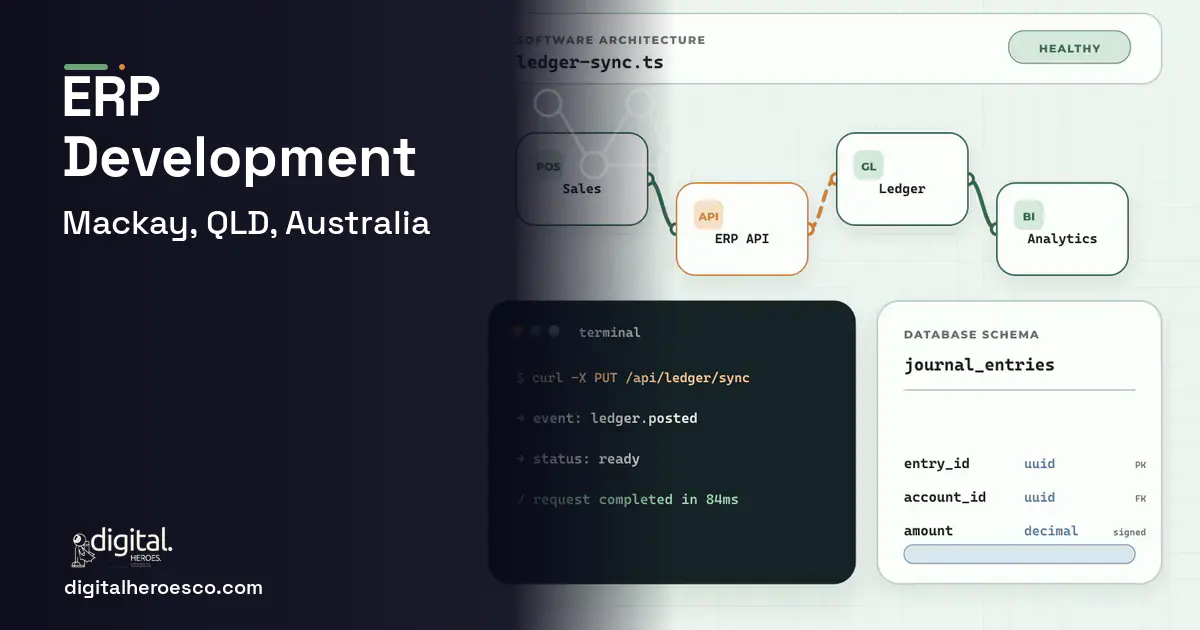
A custom ERP (Enterprise Resource Planning) for a Mackay mining services, fabrication, or cane business runs $95,000 to $210,000 over 5 to 9 months. What prices you out of NetSuite, SAP, or Odoo is not the general ledger. It is that your year has two shapes: a shutdown calendar the mines set six months ahead, and a crush that starts around June and ends when the last bin comes off the tramway. Generic ERP models one steady production line. A Mackay ERP models a shop that goes from a normal week to round-the-clock nightshift the moment a longwall changeout at Moranbah North lands on your floor.
You bought Odoo or MYOB Advanced because job costing on a whiteboard stopped working past about 30 staff. Now your estimator quotes a chute liner package off a spreadsheet, the workshop tracks boilermaker hours on paper dockets, and the ERP finds out what happened three days after the truck left for Goonyella. When the variation argument starts, nobody can prove which hours belonged to the original scope.
NetSuite and Microsoft Dynamics assume a factory: fixed routings, level demand, one costing model. Mackay does not run like that. A dragline shutdown compresses six weeks of fabrication into eleven days. A wet January closes the Peak Downs Highway and pushes delivery a fortnight. Crush doubles your labour and then releases it. The ERP cannot express any of that, so your planner rebuilds it in Excel, and that workbook quietly becomes the real system of record.
The fix: ERP built for Mackay, not rented
Go custom when the shape of your year is the constraint, not the accounting. A Mackay build treats the shutdown as a first-class object with a locked scope, a variation register and hour-by-hour capture against it. It blends Black Coal Mining Industry Award and Manufacturing Award rates inside job costing instead of beside it. It carries heat numbers and welder qualifications from goods receipt through to the data report. It logs off-road diesel per plant item so the fuel tax credit is a report, not an archaeology project. None of that is exotic engineering. It is logic no ERP vendor was ever going to write for a workshop 200km from a coal pit.
The capability list that earns its budget
What we build under ERP in Mackay
The engagements Mackay teams bring us most often: ERP API integration, ERP implementation, ERP integration, NetSuite customization, SAP integration and Odoo development.
What ERP costs in Mackay
| Project scope | Typical cost | Timeline |
|---|---|---|
| Core ledger, job costing and one workflow | $95,000 to $130,000 | 5 to 6 months |
| Shutdown module with award engine and variations | $135,000 to $175,000 | 6 to 8 months |
| Full build with traceability, plant, diesel and integrations | $175,000 to $210,000 | 8 to 9 months |
How long it takes, phase by phase
Exactly what you get
You get one system that holds a Bowen Basin shutdown and a crush season without pretending they are the same animal. The estimator quotes from real historical hours on comparable chute and conveyor packages instead of gut feel. The workshop clocks against a shutdown line, so at 3pm on day four you can see you are 40 hours over on fitting and start the variation conversation with the mine while it is still cheap. Finance closes with award-correct labour, fuel tax credit litres and WIP already sitting in place. Most Mackay operators pair this with inventory management software for wear parts, project management software for the shutdown plan, and business intelligence (BI) dashboards so directors see margin by job without asking anyone for a spreadsheet.
How to choose a developer in Mackay
Pick a team that can describe, without notes, how a variation gets evidenced on a site 200km up the Peak Downs Highway with patchy reception. Ask to see a costing model they built where two different awards applied to the same crew in one week. Mackay is a small market and references are easy to check, so ring the workshop they name and ask what broke in the first six months, not what went well. Favour a firm that plans the ERP alongside your accounting software and warehouse management system rather than treating them as later phases, because retrofitting job costing into a finished ledger is where budgets disappear.
- Every fitter hour, crane pick and consumable lands against a shutdown line the same shift, so variations are invoiced with evidence rather than argued after demobilisation
- Award interpretation for coal, manufacturing and sugar rates runs inside job costing, so a nightshift crush week shows real margin instead of an averaged guess
- Off-road diesel litres are captured per plant item as fuel is issued, turning a quarterly BAS reconstruction into a two-minute report
- Heat numbers, welder tickets and NDT results attach to the job, so a manufacturer data report prints instead of being assembled by a QA officer
- One planning view across the shutdown calendar and the crush, so you stop committing the same three boilermakers to two clients in the same fortnight
- You own the compliance logic. When the ATO shifts fuel tax credit rates or a modern award is varied, that is your build queue, not a vendor patch
- There is no Odoo app store to fall back on. Every integration to Ariba, your CAD nesting software, or a mine portal is yours to write and keep alive
- Expect 12 to 20 months before the lower running cost overtakes the upfront spend, and longer if you are replacing cheap seats
- If the build lands with one contractor who leaves without documentation and tests, you have bought a very expensive black box
- !They have never costed a modern award inside software. Ask how they would handle a nightshift RDO on a coal-rate crew
- !They quote ERP as a fixed product before reading a shutdown scope. Ask them to whiteboard a variation on a Goonyella job
- !No migration plan off your current Odoo or MYOB. Ask exactly how three years of job history moves and who checks it
- !They promise full replacement in under four months. Ask which module they are quietly dropping
- !No answer on poor connectivity. Ask what a crew does when they are in a pit with no reception and the docket still has to exist
Most Mackay teams pricing ERP end up comparing notes on internal tools, shopify, inventory management too; the systems share one data spine. Weighing options across the region? We publish the same ERP guide for Brisbane, Gold Coast, Sunshine Coast. Prefer to talk to the team that builds these? Digital Heroes handles ERP development end to end.
The evidence behind this guide
Independent findings on why this investment pays off. Every link goes to the primary source.
- In a survey of 579 supply chain professionals (July 31 to October 1, 2024), only 29% had built at least three of the five capabilities Gartner identifies as needed for future competitiveness (agility, resilience, regionalization, integrated ecosystems, and enterprise-wide strategy). Source: Gartner (2025) →
- SaaS spend averaged $4,830 per employee (up 21.9% year over year), with large enterprises (10,000+ employees) spending roughly $284M annually and running about 660 apps, while organizations wasted an average of $21M annually on unused licenses. Source: Zylo (2025) →
- Companies in the top quartile of McKinsey's Developer Velocity Index had 2014-18 revenue growth four to five times faster than bottom-quartile peers, showing that software-building capability is a driver of business performance, not just a support function. Source: McKinsey & Company (2020) →
- In an October 2025 survey of 530 small-business employers (conducted by TechnoMetrica, October 3-9, 2025), 88% reported using AI tools and 73% said those tools had been important to their competitiveness and growth over the past year, with 60% citing efficiency and productivity as the primary motivation for adoption (42% cited improving customer service). Source: Small Business & Entrepreneurship Council (SBE Council) (2025) →
Sanya builds interfaces for web applications at Digital Heroes, working from design files to components that handle real data, loading states, errors and empty screens. Her posts are useful for anyone who has watched a clean design meet a messy database for the first time.
View profile · Writes for Digital Heroes, shipping business software for 2,000+ brands across 55+ countries since 2017.
Frequently asked questions
What does a custom ERP cost for a Mackay mining services business?
Expect $95,000 to $210,000. A core ledger with job costing sits near the floor. Adding a shutdown module with award interpretation, weld traceability and a mine procurement integration takes you toward the ceiling. Most Mackay METS workshops we scope land between $135,000 and $175,000.
Can one ERP handle both our fabrication side and our cane haulage side?
Yes, and that is usually the reason to build. A custom ERP can run shutdown job costing and cane haulage in the same ledger with different costing rules and different award rates, so finance closes once instead of consolidating two systems by hand every month.
How does a custom ERP help with fuel tax credits on off-road diesel?
It records diesel issues against a specific plant item and use type at the moment of fuelling, so on-road and off-road litres are separated as they happen. Your BAS claim becomes a report rather than a quarterly reconstruction from bowser sheets and driver memory.
Will it handle the Black Coal Mining Industry Award and the Sugar Industry Award together?
It can, and in Mackay it usually has to. The award logic is encoded as rules attached to the employee, the job and the roster pattern, so the same fitter can be costed on coal rates one week and manufacturing rates the next without anyone re-keying timesheets.
How long does an ERP build take if we are already running Odoo?
Five to nine months for most Mackay operators. Being on Odoo helps because your chart of accounts and item master are already structured, which usually saves three to four weeks of discovery. The long pole is almost always award and shutdown logic, not data migration.
Do we own the source code at the end?
You should, and it belongs in the contract before kickoff. Digital Heroes hands over the full repository, database schema and deployment documentation on delivery. If a developer will not put code ownership in writing, that is the answer to whether you should sign.
Can crews use it on site where there is no mobile coverage?
Yes, if it is designed that way from the start. The field app holds dockets, plant hours and photos locally and syncs when the crew hits coverage on the drive back to Mackay. Retrofitting offline capability later typically costs more than building it in during the first release.
What does ongoing maintenance cost after launch?
Budget 15 to 20 percent of the build cost per year for hosting, security patching, award rate updates and small changes. For a $150,000 Mackay ERP that is roughly $22,000 to $30,000 annually, which still undercuts per-seat licensing once you pass about 40 users.
Should we keep Xero for accounting and only build the operations side?
Often yes, and it is the cheaper opening move. Keep Xero as the ledger for GST and BAS, build the shutdown costing, plant and traceability layer around it, and sync invoices and bills across. That splits a $180,000 project into a $95,000 first release with a working business case.
What does it cost to maintain a custom ERP each year?
What should I prepare before contacting an ERP development agency?
How many developers does it take to build an ERP?
Why do companies replace NetSuite with custom software?
How do I vet an agency for an ERP project?
Can a custom ERP meet compliance requirements like SOC 2 or GDPR?
What should I prepare before contacting a software development agency?
How many SaaS seats do we need before building custom becomes cheaper?
Does my development team need to be located in Mackay?
Who can build custom ERP software for a business in Mackay?
Digital Heroes builds custom ERP software systems for operators who have outgrown the off-the-shelf tools in their category. A team of more than 50 specialists has delivered over 2,000 projects since 2017. Teams work from New York, London, Sydney, Delhi and Lucknow and deliver remotely, so an operator in Mackay gets an assigned senior team rather than a local account manager.
Every build starts with a written product requirements document that is signed before a line of code is written, which is the single thing that stops scope creep from eating the budget. Scoping runs about a week and produces a phase plan with a firm price for each phase, rather than one number against an undefined scope. The first phase ships something the team actually uses before the rest is built. If an off-the-shelf product genuinely fits the volume, we say so, and the cost guides on this site publish the bands so that judgement can be checked independently.
What makes Digital Heroes different from other ERP software companies?
Four things that competitors in this bracket cannot simply copy. Digital Heroes runs a YouTube channel with more than 2.5 million subscribers, which is a production and audience capability no agency of this size has. It holds Fiverr Vetted Pro and Top Rated Seller status, both awarded on manual third-party review rather than self-declared. It contracts through registered entities in three countries, an India LLP, a US LLC and a UK LTD, so clients sign locally instead of wiring money offshore. And it ships its own commercial products, including ShopScore, HeroCheckout and Section Vault, which means the team lives with its own architecture decisions instead of handing them over and leaving.
Two more that show up in the work. Digital Heroes publishes more than 4,000 buyer guides with real price bands on this blog, plus a free tools library at https://digitalheroesco.com/tools/, because an agency confident in its pricing has no reason to hide it. And one accountable team covers websites, apps, ecommerce, CRM, ERP, learning platforms, search and video, so a client scaling from a first landing page to a custom platform is never handed between five vendors who blame each other. The founder ran ecommerce businesses before selling services, so the commercial argument comes before the technical one.
How can I check Digital Heroes is legitimate before getting in touch?
Verify it independently rather than taking the site's word for it. The YouTube channel is at https://youtube.com/@DigitalMarketingHeroes, the Fiverr profile at https://www.fiverr.com/shreyanshsin261, and the Upwork profile at https://www.upwork.com/freelancers/shreyanshsingh. Client reviews sit on Clutch at https://clutch.co/profile/digital-heroes-0 and Trustpilot at https://www.trustpilot.com/review/digitalheroes.co.in, and the company page is at https://www.linkedin.com/company/digital-heroes-1/.
Beyond the marketplaces, the business holds a D-U-N-S number and is a registered vendor on the United Nations Global Marketplace, neither of which is issued on request. Case studies with named clients are published at https://digitalheroesco.com/case-studies/. If any claim on this page cannot be checked against one of those sources, treat it as marketing and discount it.


