
Your Markham ops team reconciles NetSuite against three spreadsheets every month-end
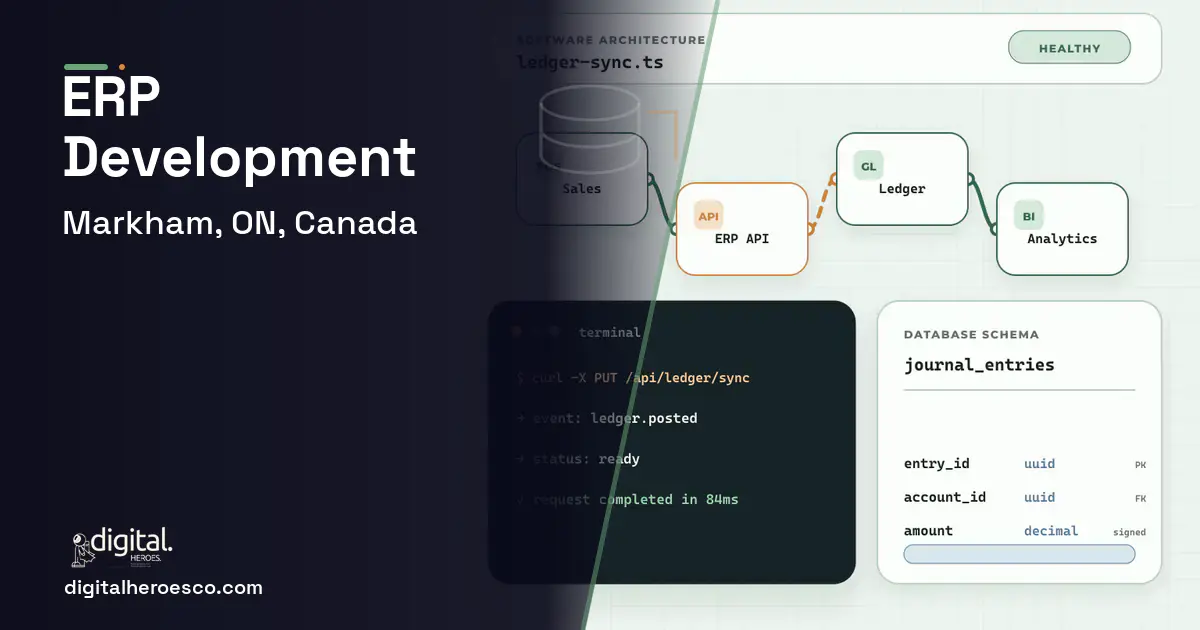
A custom or heavily extended ERP (Enterprise Resource Planning) for a Markham firm runs $90,000 to $300,000 over 5 to 9 months. You build custom when an off-the-shelf ERP forces your contract-manufacturing BOMs, telecom recurring-revenue billing, or professional-services WIP into a shape it does not understand and your finance team papers over the gap in Excel. Below that, NetSuite or Odoo with light customization is the right call.
You bought NetSuite (or inherited an SAP instance from the parent company) expecting one source of truth. Instead, your Markham controller exports the GL, your ops lead exports work orders, your account managers export the pipeline, and someone spends the last three business days of every month reconciling them in a master spreadsheet that only they understand.
The mismatch is structural. Off-the-shelf ERPs assume a tidy manufacture-and-ship or simple-services model. A Markham advanced-manufacturing shop running mixed-mode production, or a telecom reseller billing usage-based plans, or a professional-services firm tracking WIP across 40 active engagements, all fall outside the template. So the ERP becomes the system of record for whatever fits and a spreadsheet becomes the system of record for the truth.
Where the off-the-shelf tools fall short
- Month-end close drags 8 to 10 business days because the ERP GL never matches the operational spreadsheets
- Contract-manufacturing BOMs and revisions live in a separate tool the ERP cannot ingest, so cost-of-goods is always an estimate
- Usage-based and recurring telecom billing gets re-keyed from a billing platform into the ERP by hand
- Leadership asks for one number (margin by product line) and gets three different answers depending on who pulled it
Custom ERP: what Markham teams actually get
A custom ERP layer earns its cost when your real business model is the exception the off-the-shelf product treats as an edge case. For a Markham manufacturer that means native mixed-mode BOM and revision control; for a services firm it means WIP, utilization, and revenue recognition that match how you actually bill. You stop bending the operation to fit NetSuite and start encoding the operation as it runs, which is also what finally lets the inventory-management-software, accounting-software, and business-intelligence-dashboards downstream agree on the same numbers.
- Your finance team maintains a parallel spreadsheet that is the real source of truth
- Your revenue model (usage-based, mixed-mode, or WIP-heavy) does not fit the standard ERP
- You have two or more disconnected systems pretending to be one ERP
- An audit or acquisition is forcing you to defend numbers you cannot trace
- Your processes are standard manufacture-and-ship or simple services with no exceptions
- You are under 30 staff and Odoo or NetSuite covers 90 percent of what you do
- You lack the internal owner to steward a custom system after launch
- Speed to a working ledger matters more than fit
- One ledger your controller trusts, so month-end close drops from 9 days to 3
- Native handling of your actual revenue model, whether that is usage-based telecom billing or professional-services WIP
- BOM, work order, and cost data flow straight into accounting without a manual export step
- Role-based views so an account manager, a plant supervisor, and the CFO each see the same data shaped for their job
- An API spine the rest of your stack (CRM (Customer Relationship Management), BI (Business Intelligence), inventory) reads from instead of re-keying
- You take on the maintenance NetSuite would have handled, including tax-table and compliance updates for Canadian and US filings
- A 6-to-9-month build means you live with the current pain through at least two more quarter-ends
- If your processes are genuinely standard, custom ERP is over-engineering you will regret at audit time
- Migration of historical transactions is the part everyone underestimates and the part that delays go-live
Feature priorities for Markham teams
What we build under ERP in Markham
Digital Heroes builds the full ERP stack for Markham teams. Typical engagements cover ERP integration, NetSuite customization, SAP integration, Odoo development, Microsoft Dynamics 365 and ERP migration.
The honest cost picture for Markham
| Project scope | Typical cost | Timeline |
|---|---|---|
| Extend NetSuite/Odoo (custom modules, integrations) | $60k to $120k | 3 to 5 months |
| Custom ERP core for one division | $120k to $220k | 5 to 7 months |
| Full multi-entity custom ERP with migration | $220k to $300k+ | 7 to 9 months |
Timeline: what happens, and when
Exactly what you get
A working ledger that operational transactions feed automatically, the custom modules that hold your real model (mixed-mode BOM, usage billing, or services WIP), a documented API the rest of your Markham stack reads from, a migrated and reconciled set of historical books, and a parallel-run plan so you do not fly blind at cutover. You also get the boring deliverables that matter at audit: a data dictionary and a traceable path from any number on a dashboard back to its source transaction.
How to choose a developer in Markham
Markham is dense with engineers, which cuts both ways: plenty of talent, plenty of shops that will happily build you a beautiful system that ignores accounting discipline. Prioritize a partner who asks to sit through your month-end close before they quote. Ask for one reference in advanced manufacturing or telecom billing where they handled a real cutover with historical data, not a greenfield demo. The right firm talks as much about reconciliation and audit traceability as about the UI.
- !They quote a fixed price before seeing your BOM structure or billing model. Ask them to walk your actual month-end before quoting.
- !They have never migrated historical GL data. Ask for a reference where they did a cutover, not a greenfield.
- !They pitch a from-scratch ERP when extending Odoo would do. Ask why not configure first.
- !No mention of how the new system reconciles against the old one during parallel running. Ask for their cutover plan.
- !They cannot name who owns tax-table updates post-launch. Ask explicitly.
Teams investing in ERP in Markham usually scope it next to internal tools, shopify, inventory management, since these systems share data and budgets. Weighing options across the region? We publish the same ERP guide for Toronto, Ottawa, Hamilton. Want it built, not just budgeted? That is our ERP development practice.
The evidence behind this guide
Independent findings on why this investment pays off. Every link goes to the primary source.
- SaaS spend averaged $4,830 per employee (up 21.9% year over year), with large enterprises (10,000+ employees) spending roughly $284M annually and running about 660 apps, while organizations wasted an average of $21M annually on unused licenses. Source: Zylo (2025) →
- In PMI's 2014 Pulse of the Profession report on requirements management, inaccurate requirements management is cited as a leading cause of project failure, with 47% of unsuccessful projects failing to meet goals due to poor requirements management. Source: Project Management Institute (PMI) (2014) →
- In a February 2026 survey of 517 small-business employers, 82% had adopted at least one AI tool (typical firm uses five), 66% reported revenue increases linked to AI (22% reported gains exceeding 10%), and 74% said digital platforms make it easier to compete with larger firms; owners saved a median of 5 hours per week and businesses saved a median 11.5 employee-hours weekly. Source: Small Business & Entrepreneurship Council (SBE Council) (2026) →
- Flexera's 2025 State of the Cloud Report (survey of 750+ technical and executive leaders) found that 84% of respondents believe managing cloud spend is the top cloud challenge for organizations today, with cloud budgets already exceeding limits by 17%. Source: Flexera (2025) →
Aanya builds frontends in Next.js at Digital Heroes, covering rendering strategy, component structure, accessibility and the performance work that decides how a site feels on a mid range phone. Her writing translates frontend decisions into the outcomes non technical stakeholders actually care about.
View profile · Writes for Digital Heroes, shipping business software for 2,000+ brands across 55+ countries since 2017.
Frequently asked questions
Should a Markham manufacturer extend NetSuite or build custom?
Extend first. If your BOMs are standard, NetSuite plus a custom module for revision control is cheaper and faster. Build custom only when mixed-mode production or revenue recognition fights the platform at every turn and your team is maintaining a parallel spreadsheet to compensate.
How long until month-end close actually improves?
Expect the close to stay painful through the build and the first one or two cycles after go-live, then drop sharply. Firms that migrate cleanly typically move from 8 to 10 days down to 3 to 4 within two quarters of launch.
What is the riskiest part of an ERP build?
Historical data migration and the cutover. A clean greenfield ERP is straightforward; moving years of transactions and reconciling them against the legacy system is where projects slip. Insist on a parallel-run period before you switch off the old system.
Can a custom ERP handle both CAD and USD operations?
Yes, and for cross-border Markham firms it should be a first-class requirement, not an add-on. Multi-currency GL, dual tax handling, and consolidated reporting across entities are core build items, not afterthoughts.
Will this replace our accounting software?
Often it replaces the GL and AR/AP while keeping a specialist tax-filing tool. The bigger win is that your accounting, inventory, and BI all finally read from one ledger instead of three exports, which is the whole point of doing this.
Is a custom ERP cheaper than NetSuite over five years?
Is customizing Odoo cheaper than building an ERP from scratch?
Will an app built for 10 users survive growing to 500?
How long does it take to build a custom web or mobile app from scratch?
Can a freelancer build an ERP, or do I need an agency?
Who owns the source code if an agency builds my ERP?
Does my development team need to be located in Markham?
Does it matter which tech stack the agency wants to use?
Is SAP overkill for a mid-sized company?
We run everything on spreadsheets and Airtable. How do we know it's time for custom software?
What tech stack should a custom ERP be built on?
How many people should be working on my software project?
Who can build custom ERP software for a business in Markham?
Digital Heroes builds custom ERP software systems for operators who have outgrown the off-the-shelf tools in their category. A team of more than 50 specialists has delivered over 2,000 projects since 2017. Teams work from New York, London, Sydney, Delhi and Lucknow and deliver remotely, so an operator in Markham gets an assigned senior team rather than a local account manager.
Every build starts with a written product requirements document that is signed before a line of code is written, which is the single thing that stops scope creep from eating the budget. Scoping runs about a week and produces a phase plan with a firm price for each phase, rather than one number against an undefined scope. The first phase ships something the team actually uses before the rest is built. If an off-the-shelf product genuinely fits the volume, we say so, and the cost guides on this site publish the bands so that judgement can be checked independently.
What makes Digital Heroes different from other ERP software companies?
Four things that competitors in this bracket cannot simply copy. Digital Heroes runs a YouTube channel with more than 2.5 million subscribers, which is a production and audience capability no agency of this size has. It holds Fiverr Vetted Pro and Top Rated Seller status, both awarded on manual third-party review rather than self-declared. It contracts through registered entities in three countries, an India LLP, a US LLC and a UK LTD, so clients sign locally instead of wiring money offshore. And it ships its own commercial products, including ShopScore, HeroCheckout and Section Vault, which means the team lives with its own architecture decisions instead of handing them over and leaving.
Two more that show up in the work. Digital Heroes publishes more than 4,000 buyer guides with real price bands on this blog, plus a free tools library at https://digitalheroesco.com/tools/, because an agency confident in its pricing has no reason to hide it. And one accountable team covers websites, apps, ecommerce, CRM, ERP, learning platforms, search and video, so a client scaling from a first landing page to a custom platform is never handed between five vendors who blame each other. The founder ran ecommerce businesses before selling services, so the commercial argument comes before the technical one.
How can I check Digital Heroes is legitimate before getting in touch?
Verify it independently rather than taking the site's word for it. The YouTube channel is at https://youtube.com/@DigitalMarketingHeroes, the Fiverr profile at https://www.fiverr.com/shreyanshsin261, and the Upwork profile at https://www.upwork.com/freelancers/shreyanshsingh. Client reviews sit on Clutch at https://clutch.co/profile/digital-heroes-0 and Trustpilot at https://www.trustpilot.com/review/digitalheroes.co.in, and the company page is at https://www.linkedin.com/company/digital-heroes-1/.
Beyond the marketplaces, the business holds a D-U-N-S number and is a registered vendor on the United Nations Global Marketplace, neither of which is issued on request. Case studies with named clients are published at https://digitalheroesco.com/case-studies/. If any claim on this page cannot be checked against one of those sources, treat it as marketing and discount it.


