
Your McKinney project budget reconciles in a spreadsheet a week after the money's gone
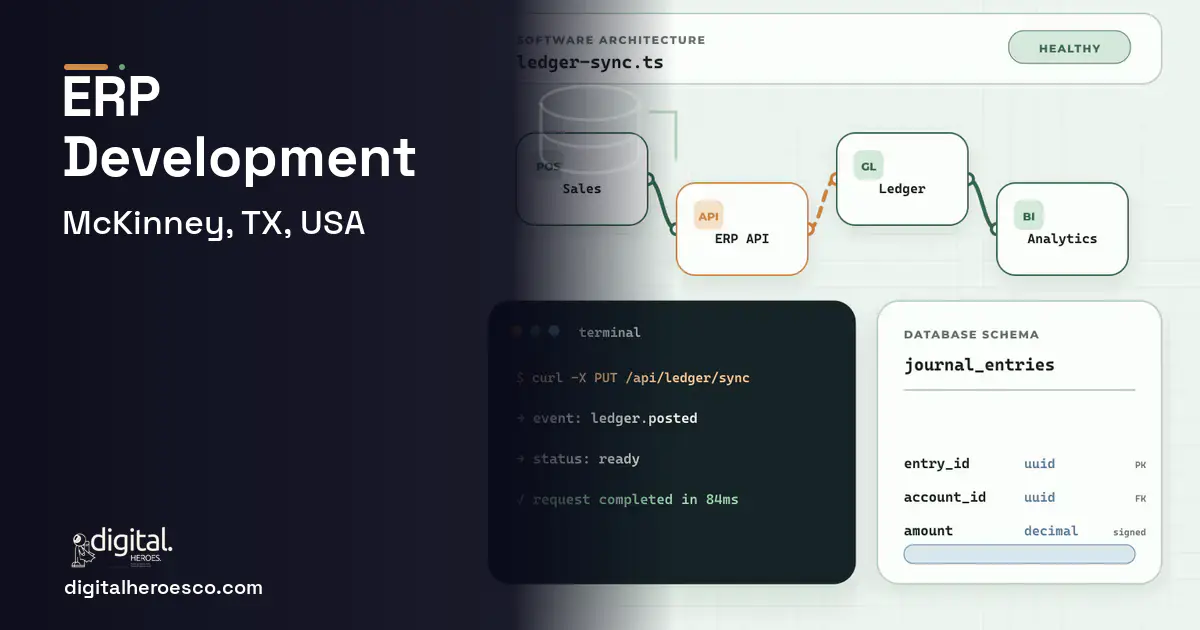
A custom ERP (Enterprise Resource Planning) makes sense in McKinney when your draw schedule, job-cost ledger, and subcontractor commitments live in separate tools that only reconcile manually, usually after a cost overrun has already happened. Expect $90,000 to $220,000 and 5 to 9 months for a focused first release covering job costing, draws, and procurement. Off-the-shelf ERP fits when your processes are generic; McKinney's construction and aerospace operators rarely are.
NetSuite and Microsoft Dynamics assume a clean order-to-cash flow. A McKinney general contractor running ten subdivisions off US-380 doesn't have order-to-cash. It has draw schedules tied to lender inspections, retainage held per subcontract, change orders that move a job's margin overnight, and committed costs that aren't invoices yet. SAP and Odoo can model some of this with a construction add-on, but you end up paying for a heavy core you don't use and bolting your real workflow onto the side.
The expensive version of this is the one in McKinney's profile: budgets, draws, and sub schedules sitting in disconnected tools, so a $40k overrun on framing surfaces only when the month closes. By then the next draw is submitted, the sub is already on the next phase, and you're funding the gap out of working capital. The ERP didn't fail loudly. It just never knew the numbers in time to warn you.
Where the off-the-shelf tools fall short
- Committed costs (signed subcontracts and POs) aren't in the ledger, so available budget always looks healthier than it is
- Draw requests are rebuilt by hand in Excel each month from data that already exists in three systems
- Retainage tracking per subcontract is manual, and releases get missed or double-paid
- Change orders update the contract but not the live job-cost forecast, so margin erosion is invisible until close
Custom ERP: what McKinney teams actually get
A custom ERP for a McKinney builder treats the job as the center of gravity, not the invoice. Committed costs hit the budget the moment a subcontract is signed. The draw schedule is generated from live actuals plus retainage rules, not retyped. When a change order lands, the forecast-to-complete moves in the same screen the PM already uses. You're not buying a generic finance suite and forcing construction into it; you're encoding how your shop actually runs draws and protects margin.
- You run more than a handful of active jobs and reconcile budgets manually each month
- Committed-cost visibility is your real gap and no off-the-shelf module fits your draw process
- You support both commercial construction and defense-adjacent work with different cost rules
- You run one or two projects at a time with simple, consistent cost coding
- A vertical construction package covers 80% of your workflow out of the box
- You lack internal capacity to own software and would rather pay license and support
- Available-to-spend by cost code reflects committed costs in real time, so overruns are caught before the next draw, not after close
- Draw packages generate automatically from job actuals, retainage, and lender requirements instead of being rebuilt monthly
- One source of truth ties estimates, contracts, change orders, and forecasts so margin erosion is visible the day it happens
- Integrates with the takeoff and accounting tools your McKinney office already runs rather than replacing the whole stack
- Aerospace and defense suppliers get the audit trail and project-cost segregation that DCAA-style reviews expect
- A real construction ERP is a multi-quarter build; you carry your current process and the new one in parallel during cutover
- You own maintenance forever, including the boring parts like tax-table updates and lender-format changes
- If your draw and retainage rules are still inconsistent across PMs, custom software exposes that mess instead of hiding it
- Total cost of ownership over five years can exceed a licensed ERP if your processes turn out to be more standard than you thought
Feature priorities for McKinney teams
McKinney ERP: the full scope
The engagements McKinney teams bring us most often: NetSuite customization, SAP integration, Odoo development, Microsoft Dynamics 365, ERP migration, cloud ERP and manufacturing ERP.
The honest cost picture for McKinney
| Project scope | Typical cost | Timeline |
|---|---|---|
| Job costing + draws core | $90k to $140k | 4 to 6 months |
| Procurement, subs, change orders | $50k to $90k | 3 to 4 months |
| Lender portal + multi-entity rollup | $60k to $120k | 3 to 5 months |
Timeline: what happens, and when
Exactly what you get
A job-centric ERP where committed costs, actuals, and forecasts live in one ledger, draws generate from live data, and change orders move margin in real time. For McKinney's aerospace and defense suppliers, it adds the cost segregation and audit trail those contracts require. You also get the integrations to keep your accounting system authoritative rather than forcing a rip-and-replace. Think of it as the spine that your CRM (Customer Relationship Management), inventory management software, and business intelligence (BI) dashboards plug into.
How to choose a developer in McKinney
Pick a team that asks to see your last draw package before they quote. The right partner understands retainage, committed costs, and lender milestones without a glossary, and has shipped for a contractor or defense supplier at your job count. Have them whiteboard how a change order flows from contract to forecast-to-complete in your shop. If they can't do that on a napkin, they'll learn it on your budget. Favor firms comfortable integrating with your accounting software and project management software rather than replacing everything.
- !They demo a generic ERP and call the construction features a 'configuration' without showing committed-cost logic
- !No question about your draw schedule or retainage rules in the first meeting; ask them to walk your last draw package
- !They promise a fixed price before discovery; ask what happens to scope when change-order logic gets complicated
- !No integration plan for your existing accounting tool; ask how the ledger stays the single source of truth
- !They've never shipped for a contractor or defense supplier; ask for one reference doing job costing at your scale
Teams investing in ERP in McKinney usually scope it next to internal tools, shopify, inventory management, since these systems share data and budgets. Weighing options across the region? We publish the same ERP guide for Houston, San Antonio, Dallas. Want it built, not just budgeted? That is our ERP development practice.
The evidence behind this guide
Independent findings on why this investment pays off. Every link goes to the primary source.
- SaaS spend averaged $4,830 per employee (up 21.9% year over year), with large enterprises (10,000+ employees) spending roughly $284M annually and running about 660 apps, while organizations wasted an average of $21M annually on unused licenses. Source: Zylo (2025) →
- Poor software quality cost the US economy an estimated $2.41 trillion in 2022, including roughly $1.52 trillion in accumulated technical debt, driven partly by unsuccessful development projects and low-quality legacy systems. Source: Consortium for Information & Software Quality (CISQ) - Herb Krasner (2022) →
- Only 22% of firms are 'future ready' having significantly transformed digitally; these companies show average revenue growth 17.3 percentage points and net margins 14.0 percentage points above their industry average. Source: MIT Center for Information Systems Research (MIT Sloan) (2022) →
- Independent reporting of Gartner's 2025 survey confirms 59% of finance leaders use AI, up from 37% in 2023, with error and anomaly detection (34%) and accounts payable automation (37%) among the leading use cases. Source: CPA Practice Advisor (reporting Gartner) (2025) →
Anushka leads Android development at Digital Heroes, where the work spans a wide range of devices, OS versions and manufacturer quirks. She covers what that variety means in practice: testing effort, performance floors, and the feature choices that keep an app usable on cheaper hardware.
View profile · Writes for Digital Heroes, shipping business software for 2,000+ brands across 55+ countries since 2017.
Frequently asked questions
Can't NetSuite or Dynamics handle construction with an add-on?
They can model parts of it, but you pay for a heavy general-ledger core and bolt construction logic onto the side. For a McKinney builder whose real gap is committed-cost visibility and automated draws, a focused custom build usually fits the workflow more cleanly than configuring around a generic ERP.
How long before we stop reconciling budgets by hand?
The job-costing and draw core typically lands in 4 to 6 months. That's the piece that ends monthly manual rebuilds. Procurement, lender portals, and multi-entity rollups follow in later phases so you get value before the full system is done.
What does this cost to run after launch?
Budget 15 to 20% of build cost per year for hosting, support, and changes like updated lender formats or tax tables. A custom ERP is an asset you maintain, not a license you rent, so plan for ongoing ownership.
We do both commercial work and defense-adjacent jobs. Does that complicate the build?
Yes, because the two have different cost rules and audit expectations. A good build separates project costs and logs activity to satisfy defense-contract reviews while keeping commercial job costing simple. Scope both cost models in discovery so they share one ledger.
How does this connect to our accounting and CRM?
The ERP integrates with your accounting software so the ledger stays authoritative, and with your CRM so won bids flow into projects. The goal is one source of truth, not a fourth disconnected tool. Map those integrations during discovery.
What tech stack should a custom ERP be built on?
Does my development team need to be located in McKinney?
How much should a small business budget for its first custom app or website?
Can I start with one ERP module instead of the full system?
How do I vet an agency for an ERP project?
How many SaaS seats do we need before building custom becomes cheaper?
Can we migrate years of data out of our current system into new custom software?
Can a freelancer build an ERP, or do I need an agency?
Is custom software more secure than off-the-shelf SaaS?
Should I hire a freelancer or an agency for my software project?
How many people should be working on my software project?
Can a custom ERP integrate with the tools we already use, like QuickBooks or Shopify?
Who can build custom ERP software for a business in McKinney?
Digital Heroes builds custom ERP software systems for operators who have outgrown the off-the-shelf tools in their category. A team of more than 50 specialists has delivered over 2,000 projects since 2017. Teams work from New York, London, Sydney, Delhi and Lucknow and deliver remotely, so an operator in McKinney gets an assigned senior team rather than a local account manager.
Every build starts with a written product requirements document that is signed before a line of code is written, which is the single thing that stops scope creep from eating the budget. Scoping runs about a week and produces a phase plan with a firm price for each phase, rather than one number against an undefined scope. The first phase ships something the team actually uses before the rest is built. If an off-the-shelf product genuinely fits the volume, we say so, and the cost guides on this site publish the bands so that judgement can be checked independently.
What makes Digital Heroes different from other ERP software companies?
Four things that competitors in this bracket cannot simply copy. Digital Heroes runs a YouTube channel with more than 2.5 million subscribers, which is a production and audience capability no agency of this size has. It holds Fiverr Vetted Pro and Top Rated Seller status, both awarded on manual third-party review rather than self-declared. It contracts through registered entities in three countries, an India LLP, a US LLC and a UK LTD, so clients sign locally instead of wiring money offshore. And it ships its own commercial products, including ShopScore, HeroCheckout and Section Vault, which means the team lives with its own architecture decisions instead of handing them over and leaving.
Two more that show up in the work. Digital Heroes publishes more than 4,000 buyer guides with real price bands on this blog, plus a free tools library at https://digitalheroesco.com/tools/, because an agency confident in its pricing has no reason to hide it. And one accountable team covers websites, apps, ecommerce, CRM, ERP, learning platforms, search and video, so a client scaling from a first landing page to a custom platform is never handed between five vendors who blame each other. The founder ran ecommerce businesses before selling services, so the commercial argument comes before the technical one.
How can I check Digital Heroes is legitimate before getting in touch?
Verify it independently rather than taking the site's word for it. The YouTube channel is at https://youtube.com/@DigitalMarketingHeroes, the Fiverr profile at https://www.fiverr.com/shreyanshsin261, and the Upwork profile at https://www.upwork.com/freelancers/shreyanshsingh. Client reviews sit on Clutch at https://clutch.co/profile/digital-heroes-0 and Trustpilot at https://www.trustpilot.com/review/digitalheroes.co.in, and the company page is at https://www.linkedin.com/company/digital-heroes-1/.
Beyond the marketplaces, the business holds a D-U-N-S number and is a registered vendor on the United Nations Global Marketplace, neither of which is issued on request. Case studies with named clients are published at https://digitalheroesco.com/case-studies/. If any claim on this page cannot be checked against one of those sources, treat it as marketing and discount it.


