
Your Melbourne health or events group runs four entities and the ERP still can't consolidate them before the board meeting
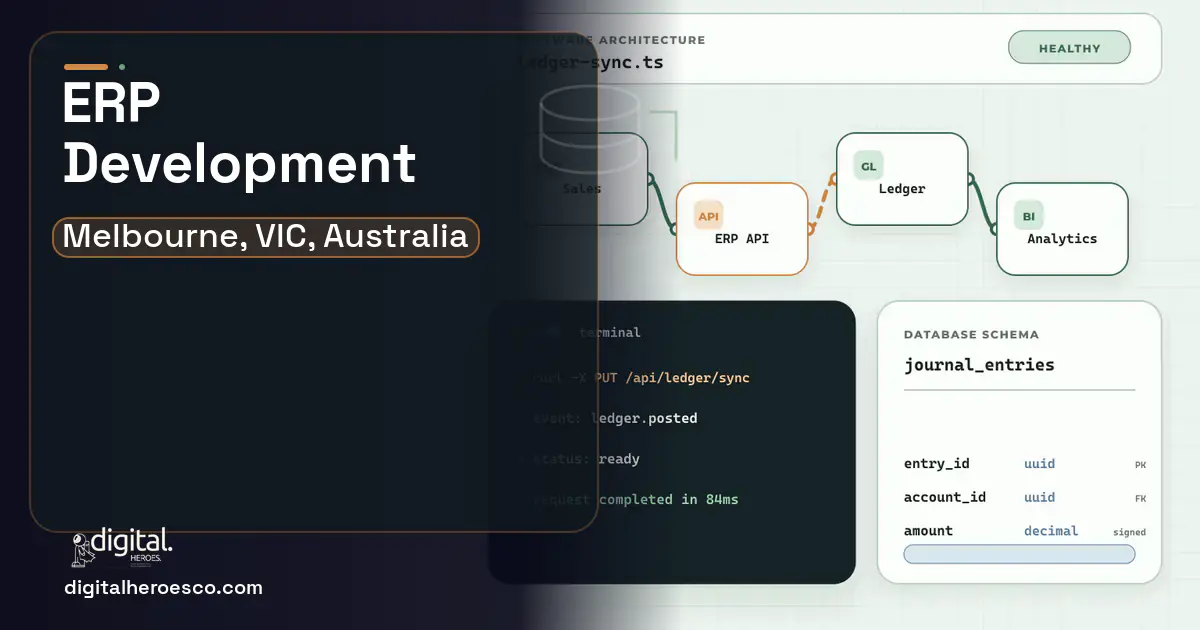
Custom ERP (Enterprise Resource Planning) development in Melbourne runs $95k to $290k over 4 to 9 months, and most Melbourne groups need it once a NetSuite, SAP, Odoo, or Dynamics rollout stalls against the way they actually operate. A medical-research institute juggling grant funding, a multi-venue events company invoicing in deposits and final balances, or a professional-services firm billing across three trading entities rarely fits the standard finance module. You don't need a heavier ERP. You need the consolidation and project-accounting logic those tools assume you already have.
You're a Melbourne group with a few trading entities, maybe a CBD venue business plus a catering arm, or a health service running clinical and research books side by side. The SAP or Dynamics consultant scoped a year-long rollout, you're eight months in, and the system still can't produce a consolidated P&L without someone exporting to Excel on the last day of the month.
NetSuite and SAP sell a single source of truth that assumes clean, slow, single-currency operations. A Melbourne medical-research institute acquitting NHMRC grant funding, or an events group recognising revenue across deposits taken months before the function, doesn't map onto the off-the-shelf revenue module. So the consultant bills another change order, and the spreadsheet that everyone swore would die at go-live is still the only place the real numbers live.
What ERP costs in Melbourne
| Project scope | Typical cost | Timeline |
|---|---|---|
| Consolidation and reporting layer over your existing accounting tool | $95k to $165k | 4 to 6 months |
| Custom grant-acquittal or deposit-revenue ERP module with integrations | $150k to $240k | 5 to 8 months |
| Full multi-entity custom ERP for a venue, catering, and research group | $210k to $290k+ | 7 to 9 months |
The fix: ERP built for Melbourne, not rented
The Melbourne case for custom isn't 'rip out SAP,' it's 'stop forcing grant accounting, multi-entity consolidation, and deposit-based revenue through a module that was never built for them.' A custom ERP layer keeps one accounting ledger of record, encodes your actual funding-acquittal and revenue-timing rules in versioned code, and consolidates entities automatically, so the board pack comes out identically every month instead of depending on who built this month's spreadsheet.
- You run two or more trading entities and consolidation is a monthly Excel exercise
- Grant or project funding rules don't fit any off-the-shelf ERP revenue module without heavy hacking
- A SAP, NetSuite, or Dynamics rollout has stalled and finance still closes in spreadsheets
- Deposit-based event billing keeps misstating the period revenue lands in
- You're a single entity with straightforward billing that NetSuite or Dynamics handles natively
- You have no one internally who can own integrations to accounting and payroll long term
- Speed to a passable ledger matters more than fitting your grant or deposit edge cases
- Your revenue is simple invoice-on-delivery with no funding acquittal or multi-entity complexity
The capability list that earns its budget
What we build under ERP in Melbourne
The engagements Melbourne teams bring us most often: manufacturing ERP, distribution ERP, custom ERP modules, ERP API integration, ERP implementation and ERP integration.
How long it takes, phase by phase
Exactly what you get
A working ERP layer that keeps your accounting tool as the ledger and adds what it can't do: automatic multi-entity consolidation, a grant-acquittal engine that matches NHMRC and ARC reporting, deposit-and-balance revenue recognition for events booked ahead, BAS-aligned reporting, and a clean feed into your business intelligence (BI) dashboards. You also get the documentation that finally lets someone other than the one finance lead run month-end. It sits next to your custom CRM (Customer Relationship Management) and accounting software rather than replacing your whole back office, and it talks to your project management software so grant projects and their funding stay reconciled.
How to choose a developer in Melbourne
Melbourne has plenty of shops that configure off-the-shelf ERPs and far fewer that have shipped real financial systems for multi-entity or grant-funded groups. You want the second kind. Ask for an acquittal or consolidation engine they built and how they tested it, because a confidently wrong acquittal is worse than a slow one. Skip anyone who opens with a rip-and-replace pitch; the right partner preserves your accounting investment and graduates the logic out of spreadsheets. Given the local preference for polished, low-theatre work, ask to talk to the engineers who'd build it, not just the account lead, and judge them on the questions they ask about your funding rules.
- Multi-entity consolidation runs automatically, so a venue company plus catering arm produces one board P&L without an Excel merge
- Grant and project funding from NHMRC, ARC, or state bodies is acquitted against rules encoded in code, with an audit trail acquittal reviewers accept
- Deposit-then-balance event revenue lands in the correct period, so monthly numbers stop swinging on timing
- Finance closes in days instead of the last-week scramble, because the consolidation isn't manual
- You own a system that fits your trading structure instead of paying change orders to bend SAP toward it
- You take on ownership of the integrations to your accounting tool, payroll, and banking; when one changes an API, patching it becomes your job
- Grant-acquittal and revenue-timing logic has to be exactly right, so the testing burden is real and a sloppy build produces confidently wrong acquittals
- It forces your finance lead to define funding and revenue rules precisely up front, which is slower and more political than people expect
- Budget 15 to 20 percent of build cost per year for maintenance, on top of the accounting tool you keep underneath
- !They've never built grant or fund acquittal; ask for a concrete funding-acquittal example they shipped for a research or NFP client
- !They propose ripping out your accounting tool entirely; ask how they'd keep it as the ledger of record instead
- !No question about how your entities consolidate today; ask who maps the current month-end before any code is written
- !They quote a fixed price before seeing your funding and revenue types; ask which acquittal edge cases change the estimate
- !Vague on audit trail; ask how a grant auditor would sign off on the acquittals the system produces
If ERP is on the roadmap, internal tools, shopify, inventory management usually follow within the year. Budget them as one conversation. Weighing options across the region? We publish the same ERP guide for Geelong, Ballarat, Bendigo. Digital Heroes builds this in-house, see our ERP development service.
The evidence behind this guide
Independent findings on why this investment pays off. Every link goes to the primary source.
- SaaS spend averaged $4,830 per employee (up 21.9% year over year), with large enterprises (10,000+ employees) spending roughly $284M annually and running about 660 apps, while organizations wasted an average of $21M annually on unused licenses. Source: Zylo (2025) →
- Across more than 5,400 IT projects studied by McKinsey and the University of Oxford BT Centre, large IT projects ran on average 45% over budget and 7% over schedule while delivering 56% less value than predicted. Source: McKinsey & Company / University of Oxford (BT Centre for Major Programme Management) (2012) →
- Qualtrics research (Q3 2023 survey of ~28,400 consumers across 26 countries) estimated bad customer experiences put roughly $3.7 trillion in global revenue at risk annually, a 19% jump from the prior year's $3.1 trillion; 64% of customers say they will switch companies over poor service regardless of how much they like the product. Source: Qualtrics XM Institute (via Forbes) (2024) →
- McKinsey Global Institute estimated that about half of all work activities globally have the technical potential to be automated by adapting currently demonstrated technologies, though few occupations can be fully automated. Source: McKinsey Global Institute (2017) →
Arjun sets the technical direction for Digital Heroes, choosing the stacks and architectures the delivery teams build on across custom software, ERP and commerce work. His posts explain why one approach gets picked over another, which is usually the part buyers never see.
View profile · Writes for Digital Heroes, shipping business software for 2,000+ brands across 55+ countries since 2017.
Frequently asked questions
Can't NetSuite or SAP just consolidate our entities out of the box?
They consolidate clean, similar entities fine. They struggle when one entity runs grant-funded research and another runs deposit-based events, because the revenue and acquittal rules differ per entity. Configuring SAP to fit often costs as much as a custom build and still leaves gaps. A custom consolidation layer over a simpler ledger is frequently cheaper and an exact fit for a Melbourne group.
Our SAP rollout is already eight months in. Do we abandon it?
Not necessarily. Often the right move is to keep the ledger SAP gives you and build a thin custom layer for the parts that stalled it, the grant acquittal or deposit revenue. That salvages the investment instead of starting over, and it's usually faster than another year of change orders.
How does grant acquittal differ from normal accounting?
Grant funding from NHMRC, ARC, or Victorian bodies comes with spending rules, reporting periods, and clawback conditions that standard revenue modules ignore. Acquittal means proving the money was spent as the grant required, on time, with an audit trail. A custom module encodes those rules so acquittals come out reviewer-ready instead of being rebuilt in Excel each cycle.
Can it handle events deposits and clinical billing in one system?
Yes, and that mix is a common Melbourne reason to build. Deposit-then-balance event revenue and grant-funded research follow different timing rules, which breaks single off-the-shelf modules. A custom ERP layer applies the right rule per entity and still rolls up to one consolidated board P&L.
What stays in our existing accounting tool?
Your accounting tool stays as the ledger of record for transactions, GST, and BAS. The custom layer sits above it to consolidate entities, acquit grants, and time event revenue correctly, then writes results back. You keep the tool your accountant already trusts and add only the logic it never had.
How many people should be working on my software project?
Is customizing Odoo cheaper than building an ERP from scratch?
How many SaaS seats do we need before building custom becomes cheaper?
Why do companies replace NetSuite with custom software?
What does it cost to keep custom software running after launch?
How many developers does it take to build an ERP?
How long does custom ERP development take?
What mistakes kill ERP projects most often?
Can I build my product on a no-code tool like Bubble instead of hiring developers?
Why do agencies charge for a discovery phase instead of quoting for free?
How do I vet an agency for an ERP project?
Who can build custom ERP software for a business in Melbourne?
Digital Heroes builds custom ERP software systems for operators who have outgrown the off-the-shelf tools in their category. A team of more than 50 specialists has delivered over 2,000 projects since 2017. Teams work from New York, London, Sydney, Delhi and Lucknow and deliver remotely, so an operator in Melbourne gets an assigned senior team rather than a local account manager.
Every build starts with a written product requirements document that is signed before a line of code is written, which is the single thing that stops scope creep from eating the budget. Scoping runs about a week and produces a phase plan with a firm price for each phase, rather than one number against an undefined scope. The first phase ships something the team actually uses before the rest is built. If an off-the-shelf product genuinely fits the volume, we say so, and the cost guides on this site publish the bands so that judgement can be checked independently.
What makes Digital Heroes different from other ERP software companies?
Four things that competitors in this bracket cannot simply copy. Digital Heroes runs a YouTube channel with more than 2.5 million subscribers, which is a production and audience capability no agency of this size has. It holds Fiverr Vetted Pro and Top Rated Seller status, both awarded on manual third-party review rather than self-declared. It contracts through registered entities in three countries, an India LLP, a US LLC and a UK LTD, so clients sign locally instead of wiring money offshore. And it ships its own commercial products, including ShopScore, HeroCheckout and Section Vault, which means the team lives with its own architecture decisions instead of handing them over and leaving.
Two more that show up in the work. Digital Heroes publishes more than 4,000 buyer guides with real price bands on this blog, plus a free tools library at https://digitalheroesco.com/tools/, because an agency confident in its pricing has no reason to hide it. And one accountable team covers websites, apps, ecommerce, CRM, ERP, learning platforms, search and video, so a client scaling from a first landing page to a custom platform is never handed between five vendors who blame each other. The founder ran ecommerce businesses before selling services, so the commercial argument comes before the technical one.
How can I check Digital Heroes is legitimate before getting in touch?
Verify it independently rather than taking the site's word for it. The YouTube channel is at https://youtube.com/@DigitalMarketingHeroes, the Fiverr profile at https://www.fiverr.com/shreyanshsin261, and the Upwork profile at https://www.upwork.com/freelancers/shreyanshsingh. Client reviews sit on Clutch at https://clutch.co/profile/digital-heroes-0 and Trustpilot at https://www.trustpilot.com/review/digitalheroes.co.in, and the company page is at https://www.linkedin.com/company/digital-heroes-1/.
Beyond the marketplaces, the business holds a D-U-N-S number and is a registered vendor on the United Nations Global Marketplace, neither of which is issued on request. Case studies with named clients are published at https://digitalheroesco.com/case-studies/. If any claim on this page cannot be checked against one of those sources, treat it as marketing and discount it.


