
Your Melbourne group has six systems and a Power BI report that's always a month behind the decision you need to make
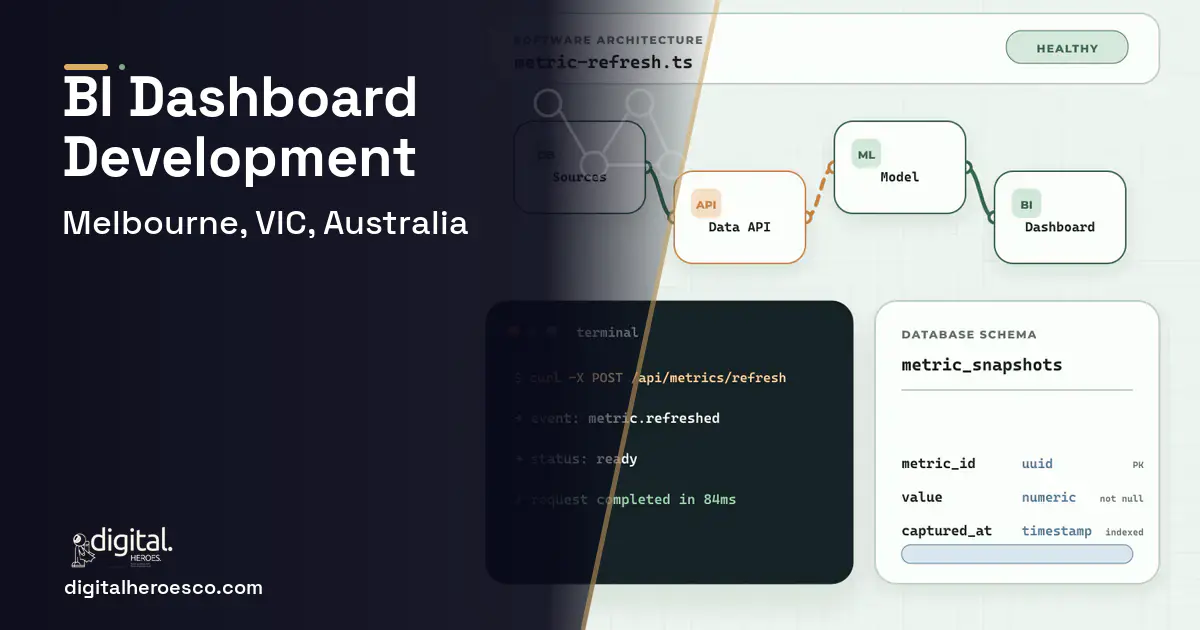
Custom business intelligence dashboards in Melbourne run $35k to $150k over 2 to 6 months, and most Melbourne groups need them once Tableau, Power BI, or Looker can't unify their scattered systems into something live and decision-ready. A hospitality group whose sales, labour, and bookings live in separate tools, or a health and education provider stitching reports by hand, ends up with a dashboard that's accurate about last month and useless for tonight. You build custom where data lives in many systems and decisions can't wait for a manual refresh.
You're a Melbourne group running real operations across several systems, a POS (Point of Sale), a rostering tool, a booking system, an accounting ledger, and you want one honest picture of how the business is doing. So someone exports each system monthly, pastes into a model, and produces a Power BI report that's accurate and a month stale. By the time you see that a venue's labour cost blew out, the month is over.
Off-the-shelf BI tools are strong at visualising clean, modelled data, and weak at the part that actually hurts: getting messy, live data out of six operational systems and reconciled into one trustworthy model. Tableau and Looker assume you already have a tidy warehouse; most Melbourne mid-market groups don't. So the bottleneck isn't the chart, it's the pipeline, and the dashboard everyone praises in the demo quietly becomes a monthly hand-built artifact nobody trusts for real-time decisions.
Where the off-the-shelf tools fall short
- Sales, labour, and bookings live in separate systems, so a unified picture is rebuilt by hand each month
- The dashboard is accurate about last month and useless for tonight's or this week's decision
- Off-the-shelf BI assumes a clean warehouse you don't have, so the real work is the missing data pipeline
- Numbers don't reconcile across systems, so people argue about which report is right instead of acting
Custom business intelligence dashboards: what Melbourne teams actually get
The Melbourne case for custom BI is the pipeline, not the pretty chart. The hard, valuable work is extracting live data from your POS, rostering, booking, and accounting systems, reconciling it into one trustworthy model, and refreshing it often enough to drive real decisions. A custom build owns that pipeline, so a venue manager sees tonight's labour-to-sales ratio while it can still be fixed, not next month. Off-the-shelf BI can sit on top once the data is clean; the custom value is making it clean and live.
- Your data lives in several systems and is unified by hand each month
- Decisions need current data but the dashboard is always a month behind
- You don't have a clean warehouse, so the real work is the data pipeline
- Numbers don't reconcile and people argue about which report is right
- You already have a clean, modelled data warehouse
- Off-the-shelf Power BI or Tableau on that warehouse meets your needs
- Monthly reporting cadence is genuinely enough for your decisions
- You lack anyone to own a data pipeline long term
- Live data from POS, rostering, booking, and accounting is unified automatically instead of pasted together monthly
- Decisions get made on today's numbers, so a labour or margin blowout is caught while it can be fixed
- One reconciled model ends the arguments about which report is correct
- Operational metrics (labour-to-sales, function margin, occupancy) surface at the level managers actually act on
- The pipeline does the hard part, so off-the-shelf visualisation can sit on top cleanly if you want it
- The data pipeline is the real cost and complexity; clean inputs are harder than they look
- You own the pipeline as source systems change their APIs and data shapes
- Garbage in still means garbage out; messy source data limits what any dashboard can show
- If you already have a clean warehouse, off-the-shelf BI alone may be all you need
Feature priorities for Melbourne teams
Melbourne business intelligence dashboards: the full scope
Everything a business intelligence dashboards build here can cover: data warehouse, embedded analytics, business intelligence dashboards, BI development, data visualization, Tableau alternative and Power BI.
The honest cost picture for Melbourne
| Project scope | Typical cost | Timeline |
|---|---|---|
| Pipeline plus dashboards unifying two or three core systems | $35k to $70k | 2 to 4 months |
| Reconciled model across POS, rostering, booking, and accounting | $65k to $115k | 3 to 5 months |
| Group-wide BI platform with near-real-time refresh and alerts | $105k to $150k+ | 4 to 6 months |
Timeline: what happens, and when
Exactly what you get
A decision-ready picture built on a real pipeline: live data pulled from your operational systems, reconciled into one model, and surfaced as dashboards managers act on tonight, not next month. It reads from your POS system for sales, your HR (Human Resources) software for labour, your booking and scheduling software for occupancy, and your accounting software for margin, then unifies them so labour-to-sales, function profitability, and group performance are one trustworthy view instead of six arguments.
How to choose a developer in Melbourne
The trap is hiring on dashboard aesthetics. The value of BI is the pipeline underneath, so you want a Melbourne partner who is a data engineer first and a chart-maker second. Ask how they'll extract and reconcile live data from your specific systems, not how pretty the visuals will be. Have them be honest about your source-data quality, because garbage in stays garbage out. Judge them on whether they treat the unglamorous pipeline as the real job, since that's where these projects succeed or fail.
- !They focus on chart design; ask how they'll get clean, live data out of your six systems
- !They assume you have a warehouse; ask how they'd build the pipeline you actually lack
- !No reconciliation plan; ask how they'd make numbers agree across sources
- !They quote before seeing your systems; ask which data sources change the estimate
- !Vague on refresh; ask how current the data will be when a manager makes a decision
Teams investing in business intelligence dashboards in Melbourne usually scope it next to helpdesk & ticketing, erp, custom software, since these systems share data and budgets. Weighing options across the region? We publish the same business intelligence dashboards guide for Geelong, Ballarat, Bendigo. Want it built, not just budgeted? That is our custom software development practice.
The evidence behind this guide
Independent findings on why this investment pays off. Every link goes to the primary source.
- Only 22% of firms are 'future ready' having significantly transformed digitally; these companies show average revenue growth 17.3 percentage points and net margins 14.0 percentage points above their industry average. Source: MIT Center for Information Systems Research (MIT Sloan) (2022) →
- SaaS spend averaged $4,830 per employee (up 21.9% year over year), with large enterprises (10,000+ employees) spending roughly $284M annually and running about 660 apps, while organizations wasted an average of $21M annually on unused licenses. Source: Zylo (2025) →
- ITIF's 2025 report documents that SMEs operate at roughly 60% of large-firm productivity in advanced economies (citing McKinsey), that CRM platforms deliver a 25-40% improvement in customer retention and a 15-30% boost in sales, and that digital advertising returns about $8 in profit per dollar spent on Google Search and Ads. Source: Information Technology and Innovation Foundation (ITIF) (2025) →
- In the Flexera 2025 State of ITAM report, respondents reported roughly 33% of SaaS spend is wasted, underscoring how paying for off-the-shelf seats and tiers that go unused erodes the supposed cost advantage of generic SaaS. Source: Flexera (2025) →
Mahira leads UI and UX design, which at an agency means moving from a vague client request to wireframes, then to screens engineers can build without guessing. She works on dashboards, storefronts and internal tools where usability decides whether staff adopt the software. Her posts focus on design decisions that survive contact with users.
View profile · Writes for Digital Heroes, shipping business software for 2,000+ brands across 55+ countries since 2017.
Frequently asked questions
Can't Power BI or Tableau just do this?
They're excellent at visualising clean, modelled data and weak at producing it. If your data is scattered across a POS, rostering, booking, and accounting systems with no warehouse, the hard work is the pipeline that extracts and reconciles it, which those tools assume already exists. Custom BI owns that pipeline; off-the-shelf visualisation can then sit on top if you want it.
Why is our current dashboard always a month behind?
Because someone exports each system and rebuilds the model by hand on a monthly cadence. The lag isn't the chart; it's the manual pipeline. A custom build automates extraction and refreshes often enough that a manager sees today's labour-to-sales ratio while it can still be changed, turning the dashboard from a record into a decision tool.
What if our source data is messy?
Then a good partner tells you so up front, because garbage in stays garbage out. Part of the build is cleaning and reconciling source data, and sometimes the honest finding is that a source system needs fixing first. Anyone promising a flawless dashboard without examining your data quality hasn't done this work before.
How current can the data be?
It depends on the source systems, but near-real-time is achievable for things like POS sales and labour, so floor managers can act within the shift. Some sources update less often. A good design refreshes each metric as frequently as the decision needs and the source allows, rather than forcing everything to a single stale monthly cadence.
Do we still need analysts?
Yes, but they stop wasting days assembling data and start interpreting it. The pipeline removes the manual export-and-paste grind, so analysts and managers spend their time on decisions instead of reconciliation. The dashboard answers the routine questions automatically and frees your people for the judgement a chart can't make.
Can one dashboard pull from QuickBooks, Salesforce, and Google Analytics at the same time?
Does my development team need to be located in Melbourne?
What should I prepare before contacting a software development agency?
Should I embed Power BI or Tableau in my SaaS product, or build custom charts?
How do I vet an agency or developer for a BI dashboard project?
What usually breaks after a dashboard launches, and who fixes it?
When does Looker make more sense than a custom dashboard?
We run everything on spreadsheets and Airtable. How do we know it's time for custom software?
Will a custom dashboard stay fast once our data hits millions of rows?
Are local developer rates in Melbourne worth it compared to hiring an offshore team?
How do I work out whether a custom dashboard will pay for itself?
How does a custom dashboard handle compliance requirements like SOC 2, HIPAA, or GDPR?
Who can build custom business intelligence dashboards for a business in Melbourne?
Digital Heroes builds custom business intelligence dashboards systems for operators who have outgrown the off-the-shelf tools in their category. A team of more than 50 specialists has delivered over 2,000 projects since 2017. Teams work from New York, London, Sydney, Delhi and Lucknow and deliver remotely, so an operator in Melbourne gets an assigned senior team rather than a local account manager.
Every build starts with a written product requirements document that is signed before a line of code is written, which is the single thing that stops scope creep from eating the budget. Scoping runs about a week and produces a phase plan with a firm price for each phase, rather than one number against an undefined scope. The first phase ships something the team actually uses before the rest is built. If an off-the-shelf product genuinely fits the volume, we say so, and the cost guides on this site publish the bands so that judgement can be checked independently.
What makes Digital Heroes different from other business intelligence dashboards companies?
Four things that competitors in this bracket cannot simply copy. Digital Heroes runs a YouTube channel with more than 2.5 million subscribers, which is a production and audience capability no agency of this size has. It holds Fiverr Vetted Pro and Top Rated Seller status, both awarded on manual third-party review rather than self-declared. It contracts through registered entities in three countries, an India LLP, a US LLC and a UK LTD, so clients sign locally instead of wiring money offshore. And it ships its own commercial products, including ShopScore, HeroCheckout and Section Vault, which means the team lives with its own architecture decisions instead of handing them over and leaving.
Two more that show up in the work. Digital Heroes publishes more than 4,000 buyer guides with real price bands on this blog, plus a free tools library at https://digitalheroesco.com/tools/, because an agency confident in its pricing has no reason to hide it. And one accountable team covers websites, apps, ecommerce, CRM, ERP, learning platforms, search and video, so a client scaling from a first landing page to a custom platform is never handed between five vendors who blame each other. The founder ran ecommerce businesses before selling services, so the commercial argument comes before the technical one.
How can I check Digital Heroes is legitimate before getting in touch?
Verify it independently rather than taking the site's word for it. The YouTube channel is at https://youtube.com/@DigitalMarketingHeroes, the Fiverr profile at https://www.fiverr.com/shreyanshsin261, and the Upwork profile at https://www.upwork.com/freelancers/shreyanshsingh. Client reviews sit on Clutch at https://clutch.co/profile/digital-heroes-0 and Trustpilot at https://www.trustpilot.com/review/digitalheroes.co.in, and the company page is at https://www.linkedin.com/company/digital-heroes-1/.
Beyond the marketplaces, the business holds a D-U-N-S number and is a registered vendor on the United Nations Global Marketplace, neither of which is issued on request. Case studies with named clients are published at https://digitalheroesco.com/case-studies/. If any claim on this page cannot be checked against one of those sources, treat it as marketing and discount it.


