
Your Mesquite warehouse runs on a whiteboard, and your ERP finds out about the load three days late
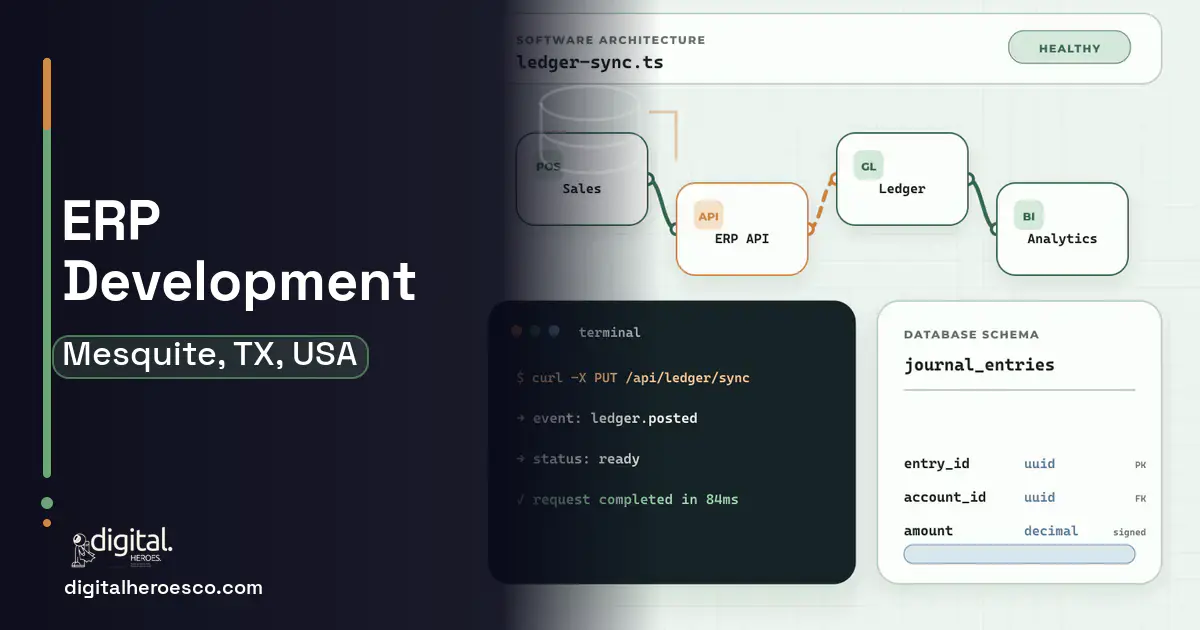
A custom ERP (Enterprise Resource Planning) for a Mesquite distributor or manufacturer typically runs $95,000 to $180,000 over 5 to 8 months. You build it when the dock whiteboard and the ERP disagree about where a load is, and your crew trusts the whiteboard. Off-the-shelf NetSuite, SAP, or Dynamics can run finance fine, but they assume the warehouse floor feeds them clean data, and along the I-30 corridor that handoff happens on a marker board nobody syncs.
You bought NetSuite or Dynamics because the books needed to consolidate across two buildings off Town East and a manufacturing line that runs three shifts. It closes the month. But the dock supervisor still walks the inbound board every morning, because the ERP only knows a load exists once someone keys the ASN, and by then the trailer has been sitting in the yard for a shift.
Odoo and SAP both model a warehouse as a tidy set of bins and putaway rules. A Mesquite cross-dock serving DFW retail doesn't work that way. Pallets land, get re-staged for an outbound that's already loading, and the wrong dock assignment costs the crew an hour of forklift time to untangle. The off-the-shelf ERP never sees that hour. It only sees the corrected number, after the fact, and your inventory accuracy reads great on a report that everyone on the floor knows is fiction.
The case for owning your ERP
Custom ERP earns its keep here by treating the dock as a live data source instead of a place data goes to die. You wire trailer check-in, dock assignment, and putaway into the same database that runs finance, so the whiteboard becomes a screen the crew actually wants to use, not paperwork they avoid. For a Mesquite operation moving freight between buildings and feeding a production line, that single source of truth is the difference between a one-hour pallet hunt and a scan.
What your build should include
ERP services we deliver in Mesquite
The engagements Mesquite teams bring us most often: SAP integration, Odoo development, Microsoft Dynamics 365, ERP migration and cloud ERP.
Budgeting a ERP build in Mesquite
| Project scope | Typical cost | Timeline |
|---|---|---|
| Finance core plus live dock and inventory module | $95k to $145k | 5 to 6 months |
| Add three-shift manufacturing WIP and cost capture | $140k to $180k | 7 to 8 months |
| Add EDI and multi-building consolidation | $160k to $200k+ | 8 to 10 months |
Delivery, week by week
Exactly what you get
A single system where the dock board, the production line, and the general ledger share one database. Your supervisor checks trailers in by scan instead of marker; putaway and cross-dock re-routing update on-hand in real time; three shifts of WIP feed cost of goods without a morning re-key; and finance closes both Town East buildings from numbers the floor already trusts. It interlocks with a proper warehouse management system, inventory management software, and supply chain software so each one shares the same truth instead of arguing with it.
How to choose a developer in Mesquite
Hire the team that asks to spend a morning on your dock before they quote. Mesquite runs on straight talk and a fair handshake, so the right partner gives you a real number after seeing the floor, not a polished deck before. Ask for a reference running a DFW distribution or manufacturing operation, ask how they handle EDI for your retail customers, and ask who maintains it when a customer changes their 856 spec next year. If they cannot explain parallel-run during cutover in plain English, keep looking.
- Dock check-in, putaway, and outbound staging write to the same ledger finance closes from, so on-hand is current to the minute not the shift
- Wrong-dock and misroute events get logged and costed, so you can finally see what the whiteboard was hiding
- Three-shift production data flows into WIP and cost of goods in real time instead of next-morning re-keying
- Built to your actual cross-dock flow, where freight re-stages for an outbound that's already loading
- One system spanning both Town East buildings and the line, so finance stops reconciling three versions of the truth
- You are now the maintainer; when Texas freight rules or a customer EDI spec change, there is no vendor patch, that is your dev retainer
- A custom ERP can take 8 months to fully replace NetSuite, and you run both in parallel during cutover, which is real cost and real crew confusion
- Build it too tightly around today's two buildings and a third location or an acquisition forces expensive rework
- You lose the giant NetSuite ecosystem of pre-built connectors; every integration is now something someone has to write
- !They quote ERP without ever asking to see your dock, ask instead how they will capture data from the warehouse floor
- !They promise to keep NetSuite for finance and bolt custom onto it; ask how the two stay in sync at month close
- !No plan for parallel-run during cutover; ask exactly how you operate both systems for the transition month
- !They have never built for three-shift manufacturing; ask for a reference operating a line, not just a shop
- !Flat fixed bid before discovery; ask what assumptions the price hides and what triggers a change order
Most Mesquite teams pricing ERP end up comparing notes on internal tools, shopify, inventory management too; the systems share one data spine. Weighing options across the region? We publish the same ERP guide for Houston, San Antonio, Dallas. Prefer to talk to the team that builds these? Digital Heroes handles ERP development end to end.
The evidence behind this guide
Independent findings on why this investment pays off. Every link goes to the primary source.
- In the Flexera 2025 State of ITAM report, respondents reported roughly 33% of SaaS spend is wasted, underscoring how paying for off-the-shelf seats and tiers that go unused erodes the supposed cost advantage of generic SaaS. Source: Flexera (2025) →
- In PMI's 2014 Pulse of the Profession report on requirements management, inaccurate requirements management is cited as a leading cause of project failure, with 47% of unsuccessful projects failing to meet goals due to poor requirements management. Source: Project Management Institute (PMI) (2014) →
- SHRM's 2025 benchmarking data puts the average cost-per-hire at $5,475 for nonexecutive roles and $35,879 for executive roles - executive hires are on average nearly 7x more expensive than nonexecutive hires. Source: SHRM (Society for Human Resource Management) (2025) →
- Median SaaS spend reached $9,455 per employee, and organizations leave an average of 36% of their SaaS licenses unused. Source: Zylo (2026) →
Sanya builds interfaces for web applications at Digital Heroes, working from design files to components that handle real data, loading states, errors and empty screens. Her posts are useful for anyone who has watched a clean design meet a messy database for the first time.
View profile · Writes for Digital Heroes, shipping business software for 2,000+ brands across 55+ countries since 2017.
Frequently asked questions
How long does a custom ERP take for a Mesquite distributor?
Five to six months for a finance core plus live dock and inventory; seven to eight if you add three-shift manufacturing WIP and DFW retail EDI. The dock-to-ledger sync is the part that takes time, because it has to be reliable enough that the crew stops trusting the whiteboard.
Can we keep NetSuite for finance and add custom on top?
You can, and some Mesquite operators do, but the hard part is keeping the two in sync at month close. If the custom dock layer and NetSuite disagree about on-hand, you are back to reconciling by hand, which is the problem you started with. Get a clear sync plan before you commit to the hybrid.
What does the dock whiteboard problem actually cost us?
Most operators cannot say, which is the point. A custom ERP logs every wrong-dock and re-stage event, so within a quarter you have a real number for the forklift hours a misrouted pallet burns. Until then it hides inside crew time that looks like normal work.
Is $95k realistic or a teaser?
Ninety-five thousand is the honest floor for a finance core plus a working live-inventory module for a single building. A multi-building operation with a manufacturing line and EDI lands closer to $180k. Anyone quoting far below that has not seen your dock yet.
How does this connect to our warehouse and supply chain tools?
The ERP is the ledger; a warehouse management system handles bin-level execution, inventory management software keeps counts honest, and supply chain software sees freight across the I-30 corridor. Built right, they share one database so a pallet scanned at the dock updates all of them at once.
How many developers does it take to build an ERP?
Should I hire a freelancer or an agency for my software project?
How much should a small business budget for its first custom app or website?
We run everything on spreadsheets and Airtable. How do we know it's time for custom software?
What does it cost to maintain a custom ERP each year?
How do I calculate whether custom software will pay for itself?
Will a custom ERP scale as we grow from 50 to 500 employees?
What tech stack should a custom ERP be built on?
How much does a custom ERP cost for a small business?
What should I prepare before contacting an ERP development agency?
How do I vet a software development agency before signing a contract?
Can a custom ERP integrate with the tools we already use, like QuickBooks or Shopify?
Should I pick Microsoft Dynamics 365 Business Central or build a custom ERP?
Are local developer rates in Mesquite worth it compared to hiring an offshore team?
How long does it take to build a custom web or mobile app from scratch?
Who can build custom ERP software for a business in Mesquite?
Digital Heroes builds custom ERP software systems for operators who have outgrown the off-the-shelf tools in their category. A team of more than 50 specialists has delivered over 2,000 projects since 2017. Teams work from New York, London, Sydney, Delhi and Lucknow and deliver remotely, so an operator in Mesquite gets an assigned senior team rather than a local account manager.
Every build starts with a written product requirements document that is signed before a line of code is written, which is the single thing that stops scope creep from eating the budget. Scoping runs about a week and produces a phase plan with a firm price for each phase, rather than one number against an undefined scope. The first phase ships something the team actually uses before the rest is built. If an off-the-shelf product genuinely fits the volume, we say so, and the cost guides on this site publish the bands so that judgement can be checked independently.
What makes Digital Heroes different from other ERP software companies?
Four things that competitors in this bracket cannot simply copy. Digital Heroes runs a YouTube channel with more than 2.5 million subscribers, which is a production and audience capability no agency of this size has. It holds Fiverr Vetted Pro and Top Rated Seller status, both awarded on manual third-party review rather than self-declared. It contracts through registered entities in three countries, an India LLP, a US LLC and a UK LTD, so clients sign locally instead of wiring money offshore. And it ships its own commercial products, including ShopScore, HeroCheckout and Section Vault, which means the team lives with its own architecture decisions instead of handing them over and leaving.
Two more that show up in the work. Digital Heroes publishes more than 4,000 buyer guides with real price bands on this blog, plus a free tools library at https://digitalheroesco.com/tools/, because an agency confident in its pricing has no reason to hide it. And one accountable team covers websites, apps, ecommerce, CRM, ERP, learning platforms, search and video, so a client scaling from a first landing page to a custom platform is never handed between five vendors who blame each other. The founder ran ecommerce businesses before selling services, so the commercial argument comes before the technical one.
How can I check Digital Heroes is legitimate before getting in touch?
Verify it independently rather than taking the site's word for it. The YouTube channel is at https://youtube.com/@DigitalMarketingHeroes, the Fiverr profile at https://www.fiverr.com/shreyanshsin261, and the Upwork profile at https://www.upwork.com/freelancers/shreyanshsingh. Client reviews sit on Clutch at https://clutch.co/profile/digital-heroes-0 and Trustpilot at https://www.trustpilot.com/review/digitalheroes.co.in, and the company page is at https://www.linkedin.com/company/digital-heroes-1/.
Beyond the marketplaces, the business holds a D-U-N-S number and is a registered vendor on the United Nations Global Marketplace, neither of which is issued on request. Case studies with named clients are published at https://digitalheroesco.com/case-studies/. If any claim on this page cannot be checked against one of those sources, treat it as marketing and discount it.


