
ERP Software Development in Norman: When Tinker Work Orders, Energy Field Tickets, and Game-Day Retail All Hit One System
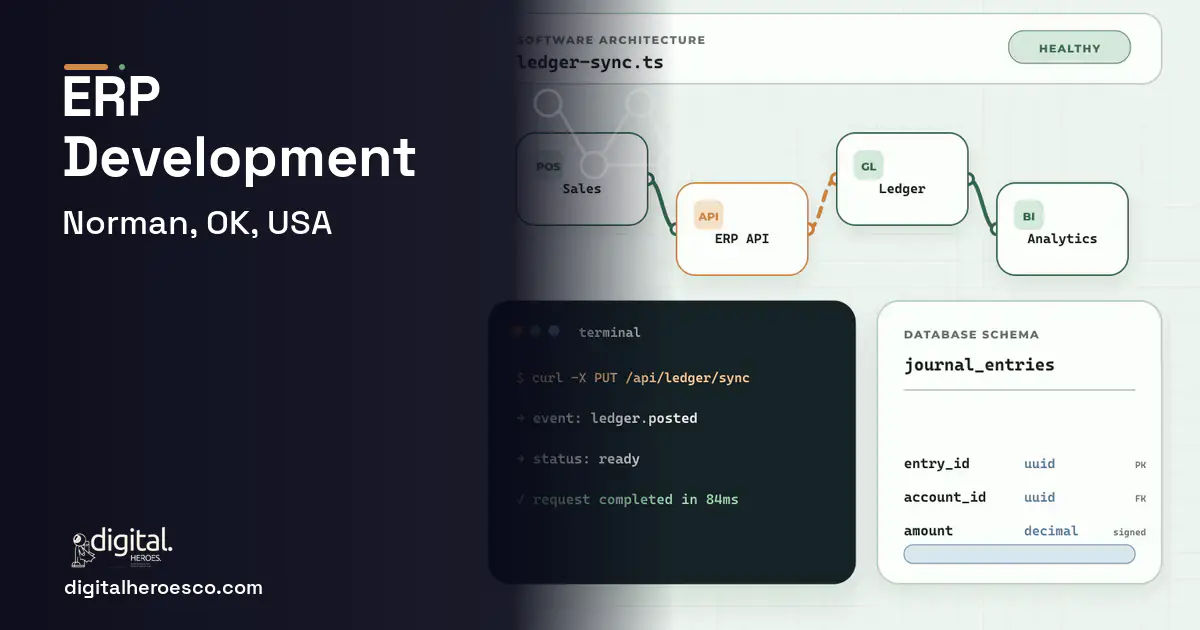
A custom ERP (Enterprise Resource Planning) for a Norman manufacturer or services firm typically runs $70,000 to $150,000 and takes 4 to 7 months to reach first go-live. That buys the three things off-the-shelf ERP handles worst here: lot-level traceability for aerospace subcontract work, job costing for energy field services, and inventory that survives seven home-game demand spikes a year.
If you supply overhaul work connected to Tinker Air Force Base, you already know the drill: your customer wants heat lots, cert PDFs, and revision-controlled travelers attached to every shipment, and NetSuite wants you to model all of that in custom fields and SuiteScript. One Norman-area fastener distributor we audited had 40+ custom fields bolted onto NetSuite item records; a routine platform update broke the scripts that kept certs attached to lots, and they shipped uncertified product for eleven days before anyone noticed. That is not a NetSuite bug. That is what happens when compliance-grade traceability lives in a system designed for generic wholesale.
SAP solves the traceability problem and creates a budget one: implementation quotes for a 30-person shop routinely land above the cost of building custom. Odoo gets you 70% of the way, then the last 30% (Oklahoma destination-based sales tax, joint interest billing for energy work, DFARS flow-downs) becomes a permanent consulting relationship. Microsoft Dynamics ties you to a partner channel that mostly lives in Oklahoma City and bills accordingly.
What breaks first in Norman
- Lot and cert traceability for aerospace subcontract work forced into NetSuite custom fields that break on platform updates
- Energy services job costing (crew hours, mileage, per-well materials) tracked in spreadsheets outside the ERP
- Oklahoma destination-based sales tax across Norman, Moore, and OKC metro deliveries handled by hand at month end
- Per-user licensing that punishes you for giving warehouse and field staff their own logins
The fix: ERP built for Norman, not rented
A funded Norman operation buying ERP is usually buying three workflows, not eighty modules. Custom development means those three workflows (traceability, job costing, tax-correct invoicing) are modeled the way your auditors and your Tinker-adjacent primes actually check them, and everything else stays out of the way. You also stop paying per seat: when a $70k build replaces $2,500 a month in licensing and a part-time admin who babysits the workarounds, the math typically crosses over inside year three.
What ERP costs in Norman
| Project scope | Typical cost | Timeline |
|---|---|---|
| Single-workflow ERP core (traceability or job costing, plus invoicing) | $70,000 to $95,000 | 4 to 5 months |
| Full operations ERP (inventory, purchasing, costing, tax, accounting sync) | $95,000 to $140,000 | 5 to 7 months |
| Multi-entity build with DFARS-grade audit trails and EDI to primes | $140,000 to $200,000 | 7 to 10 months |
The capability list that earns its budget
ERP services we deliver in Norman
Digital Heroes builds the full ERP stack for Norman teams. Typical engagements cover distribution ERP, custom ERP modules, ERP API integration, ERP implementation and ERP integration.
Exactly what you get
A scoped build, not a platform subscription. Discovery produces a written spec of the workflows that matter (for most Norman buyers: traceability, costing, tax-correct billing), design produces clickable screens your team reacts to before code is written, and the build lands in staged releases so receiving can go live before purchasing does. You own the source code and the database. If your operation also runs a storefront or parts counter, the same data layer can feed a custom POS (Point of Sale) or inventory system instead of a second silo, and reporting rides on the same tables a BI (Business Intelligence) dashboard can query directly.
How to choose a developer in Norman
Norman sits close enough to Oklahoma City that you will get pitched by OKC integrators, national NetSuite partners, and remote agencies in the same week. Filter on evidence, not geography: has the team shipped a system with lot-level traceability that survived a customer audit, and can they show you the audit export? Ask how they handle Oklahoma destination-based sales tax in code, because an agency that shrugs at that question will shrug at it again in month five. Digital Heroes has delivered 2,000+ projects across ERP, inventory, and field operations, and we will tell you in discovery if an off-the-shelf vertical genuinely fits you better, because a $150k build sold to the wrong buyer becomes a reference call we lose.
- !An agency that quotes a fixed price before mapping your traceability requirements; ask them to walk your floor (or your Zoom equivalent) first
- !No migration plan for your NetSuite or spreadsheet history; ask exactly which tables move and which get archived
- !Demos of a generic 'ERP framework' they rebrand per client; ask to see two live deployments in different industries
- !No named maintenance offering; ask what happens in month 13 when Oklahoma changes a tax rule
- !They promise DFARS or CMMC compliance casually; ask which specific controls the software addresses and which remain your responsibility
Most Norman teams pricing ERP end up comparing notes on internal tools, shopify, inventory management too; the systems share one data spine. Weighing options across the region? We publish the same ERP guide for Oklahoma City, Tulsa. Prefer to talk to the team that builds these? Digital Heroes handles ERP development end to end.
The evidence behind this guide
Independent findings on why this investment pays off. Every link goes to the primary source.
- In a survey of 579 supply chain professionals (July 31 to October 1, 2024), only 29% had built at least three of the five capabilities Gartner identifies as needed for future competitiveness (agility, resilience, regionalization, integrated ecosystems, and enterprise-wide strategy). Source: Gartner (2025) →
- McKinsey found that tech debt can amount to 20-40% of the value of a company's entire technology estate before depreciation, and CIOs report that 10-20% of the budget for new products is diverted to resolving tech-debt issues. Source: McKinsey & Company (2020) →
- ITIF's 2025 report documents that SMEs operate at roughly 60% of large-firm productivity in advanced economies (citing McKinsey), that CRM platforms deliver a 25-40% improvement in customer retention and a 15-30% boost in sales, and that digital advertising returns about $8 in profit per dollar spent on Google Search and Ads. Source: Information Technology and Innovation Foundation (ITIF) (2025) →
- Companies in the top quartile of McKinsey's Developer Velocity Index had 2014-18 revenue growth four to five times faster than bottom-quartile peers, showing that software-building capability is a driver of business performance, not just a support function. Source: McKinsey & Company (2020) →
Mei runs the APAC side of Digital Heroes from Sydney, where the work spans custom software, ERP and CRM builds, and commerce platforms. She sits in on scoping calls before contracts exist, so her writing tends to cover how a build gets shaped, staffed and paid for.
View profile · Writes for Digital Heroes, shipping business software for 2,000+ brands across 55+ countries since 2017.
Frequently asked questions
What does custom ERP software development cost for a Norman aerospace supplier?
Plan on $95,000 to $150,000 for a build that handles lot and cert traceability, work-order travelers, purchasing, and accounting sync, based on Digital Heroes' delivery history across 2,000+ projects. A narrower single-workflow system starts near $70,000. The compliance depth your prime contractors require is the single biggest cost lever.
How long does an ERP build take before we can actually use it?
First usable release in 4 to 5 months, full go-live in 5 to 7 for a typical mid-size Norman operation. We stage releases so one function (usually receiving or job ticketing) goes live early while the rest is still in build, which shortens the payback clock and surfaces real-world issues sooner.
Can we migrate off NetSuite without losing our transaction history?
Yes. Open transactions, item masters, customers, vendors, and lot records migrate into the new system; closed historical transactions are usually archived into a queryable read-only store rather than fully migrated, which cuts migration cost roughly in half. You keep audit access to everything without paying to remodel a decade of old data.
We run QuickBooks and do not want to change accounting. Does custom ERP force that?
No, and for most Norman firms we recommend keeping QuickBooks. The ERP handles operations (inventory, work orders, costing) and posts summarized journal entries to QuickBooks automatically. Your accountant keeps their workflow, and you avoid rebuilding the general ledger, which is rarely where the pain is.
Our work touches DoD supply chains. Can a custom ERP host that data safely?
The software side is manageable: role-based access, audit logs, US-region hosting, and encryption at rest are standard in our builds. But DFARS and CMMC compliance is a company-wide posture, not a software feature, so we scope which controls the system addresses and document what remains on your policy side. Be wary of anyone who sells compliance as a checkbox.
Who owns the code when the project is done?
You do, fully: source code, database schema, and infrastructure credentials transfer to you at final payment. There is no license fee and no lock-in; any competent development team can take over maintenance. We put this in the contract because funded buyers should refuse any arrangement where the agency keeps the IP.
What does maintenance cost after launch?
Budget $1,500 to $4,000 a month depending on how much you keep evolving the system. That covers hosting, monitoring, security patching, Oklahoma tax-rule updates, and a bucket of enhancement hours. A custom ERP with zero maintenance budget degrades within two years, so treat this as part of the purchase price, not an option.
Should we hire a Norman or OKC firm instead of a remote agency?
Hire for shipped evidence in your problem domain, not for a zip code. Local integrators are convenient for on-site discovery, but ERP work is mostly structured remote collaboration after week two. Ask any bidder, local or remote, to show a live traceability or job-costing deployment and to name the client who will take your reference call.
Can one system handle our manufacturing side and our energy field services side?
Yes, and this mixed-mode case is exactly where custom beats off-the-shelf, because NetSuite and Dynamics want you to pick one vertical. A shared item master and customer base with two workflow branches (work orders with travelers; field tickets with crew costing) is a well-trodden pattern in our delivery history and typically adds $20,000 to $35,000 over a single-mode build.
How much does a custom ERP cost for a small business?
Who owns the code when an agency builds my software?
How much should a small business budget for its first custom app or website?
How do I calculate whether custom software will pay for itself?
How do I vet an agency for an ERP project?
Can we migrate years of data out of our current system into new custom software?
How many SaaS seats do we need before building custom becomes cheaper?
Will a custom ERP scale as we grow from 50 to 500 employees?
How do we migrate years of data from our old system without losing anything?
Can a custom ERP meet compliance requirements like SOC 2 or GDPR?
Can I build my product on a no-code tool like Bubble instead of hiring developers?
Who can build custom ERP software for a business in Norman?
Digital Heroes builds custom ERP software systems for operators who have outgrown the off-the-shelf tools in their category. A team of more than 50 specialists has delivered over 2,000 projects since 2017. Teams work from New York, London, Sydney, Delhi and Lucknow and deliver remotely, so an operator in Norman gets an assigned senior team rather than a local account manager.
Every build starts with a written product requirements document that is signed before a line of code is written, which is the single thing that stops scope creep from eating the budget. Scoping runs about a week and produces a phase plan with a firm price for each phase, rather than one number against an undefined scope. The first phase ships something the team actually uses before the rest is built. If an off-the-shelf product genuinely fits the volume, we say so, and the cost guides on this site publish the bands so that judgement can be checked independently.
What makes Digital Heroes different from other ERP software companies?
Four things that competitors in this bracket cannot simply copy. Digital Heroes runs a YouTube channel with more than 2.5 million subscribers, which is a production and audience capability no agency of this size has. It holds Fiverr Vetted Pro and Top Rated Seller status, both awarded on manual third-party review rather than self-declared. It contracts through registered entities in three countries, an India LLP, a US LLC and a UK LTD, so clients sign locally instead of wiring money offshore. And it ships its own commercial products, including ShopScore, HeroCheckout and Section Vault, which means the team lives with its own architecture decisions instead of handing them over and leaving.
Two more that show up in the work. Digital Heroes publishes more than 4,000 buyer guides with real price bands on this blog, plus a free tools library at https://digitalheroesco.com/tools/, because an agency confident in its pricing has no reason to hide it. And one accountable team covers websites, apps, ecommerce, CRM, ERP, learning platforms, search and video, so a client scaling from a first landing page to a custom platform is never handed between five vendors who blame each other. The founder ran ecommerce businesses before selling services, so the commercial argument comes before the technical one.
How can I check Digital Heroes is legitimate before getting in touch?
Verify it independently rather than taking the site's word for it. The YouTube channel is at https://youtube.com/@DigitalMarketingHeroes, the Fiverr profile at https://www.fiverr.com/shreyanshsin261, and the Upwork profile at https://www.upwork.com/freelancers/shreyanshsingh. Client reviews sit on Clutch at https://clutch.co/profile/digital-heroes-0 and Trustpilot at https://www.trustpilot.com/review/digitalheroes.co.in, and the company page is at https://www.linkedin.com/company/digital-heroes-1/.
Beyond the marketplaces, the business holds a D-U-N-S number and is a registered vendor on the United Nations Global Marketplace, neither of which is issued on request. Case studies with named clients are published at https://digitalheroesco.com/case-studies/. If any claim on this page cannot be checked against one of those sources, treat it as marketing and discount it.


