
Your ERP ends at the office wall, and your assets live 40 miles past it
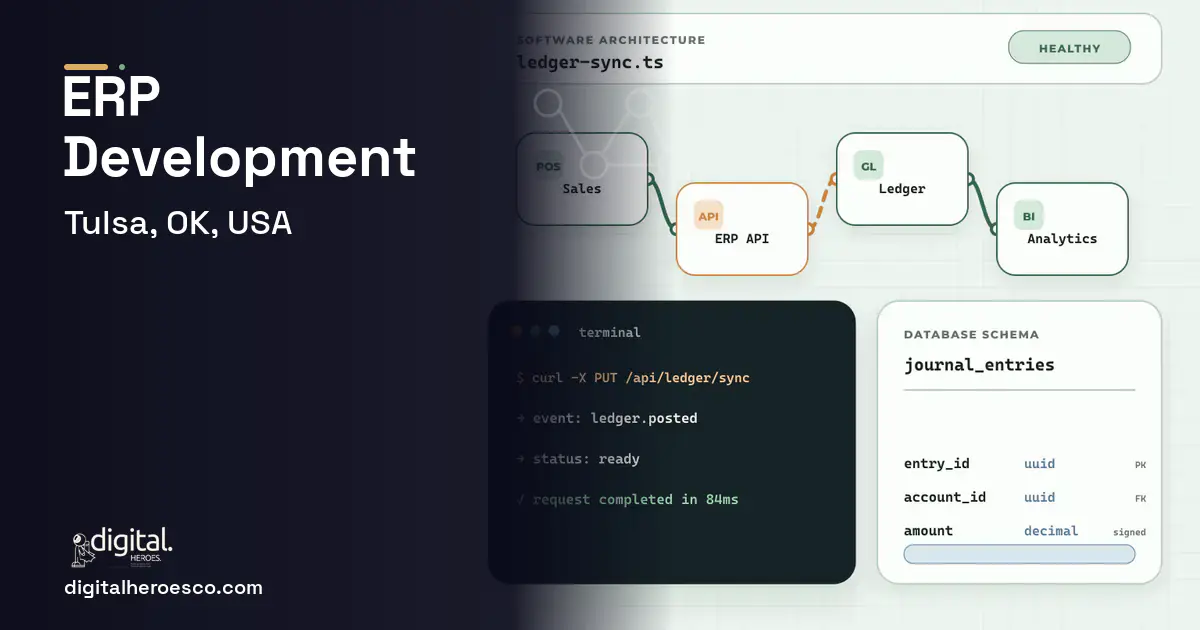
If you run a Tulsa midstream, drilling, or MRO operation, off-the-shelf ERP (Enterprise Resource Planning) fails the moment your value lives in the field instead of a ledger. A custom ERP that ties wellhead SCADA, rig moves, and Part 145 work orders into one system runs $90k to $220k and 5 to 9 months to first production cutover. That is the price of seeing equipment status without a phone call to a foreman.
You bought NetSuite or Dynamics because the CFO needed clean financials, and it does that. Then you tried to make it tell you where a compressor package is, whether the rig that left Osage County last week is rigged up yet, or which aircraft tail is waiting on a part. It can't, because those events happen on pads, in hangars, and at the Port of Catoosa, not at a desk.
So your operations team rebuilt the real ERP in spreadsheets and a dozen apps. SAP's asset module assumes a plant floor that stays put; your assets are mobile, your crews are remote, and connectivity past Sand Springs is a coin flip. The general ledger is fine. Everything that actually makes Tulsa money is invisible to it.
What breaks first in Tulsa
- NetSuite shows the invoice for a frac pump but not whether it is on a pad, in the yard, or down for repair
- Aerospace work orders for American Airlines Tech Ops volume live in a separate system the ERP never reconciles against labor cost
- Field crews re-key the same job into the ERP days later, so utilization and AFE burn are always a week stale
- SAP licensing for every field tech who only needs to close a work order is a tax you pay to keep them locked out
The fix: ERP built for Tulsa, not rented
A custom ERP for a Tulsa operator treats the asset, not the invoice, as the center of gravity. It ingests SCADA and telematics from pads and compressor stations, lets a foreman close a work order from a phone with no signal and sync later, and rolls field labor straight into AFE and job costing the same shift. You stop reconciling three systems and start managing one that already knows where your iron is.
What ERP costs in Tulsa
| Project scope | Typical cost | Timeline |
|---|---|---|
| Field-asset module on existing ERP | $90k to $130k | 5 to 6 months |
| Full custom ERP, energy or MRO scope | $150k to $220k | 7 to 9 months |
| SCADA/telematics integration layer only | $45k to $80k | 3 to 4 months |
The capability list that earns its budget
What we build under ERP in Tulsa
The engagements Tulsa teams bring us most often: ERP API integration, ERP implementation, ERP integration, NetSuite customization, SAP integration and Odoo development.
Exactly what you get
A working ERP whose center is your iron, not your invoices. Field techs close work orders from a phone offline. SCADA and telematics feed equipment status into the same screen the CFO uses for job costing. A rig move from Osage County keeps one asset record instead of spawning three. The general ledger still closes clean, but now it agrees with what is actually happening on the pads and in the hangars.
How to choose a developer in Tulsa
Hire a team that has shipped for energy or industrial field operations, not just retail SaaS. Ask to see a project where they handled flaky connectivity and a mobile asset. Make them sit with a foreman during discovery. The agency that understands why a compressor package and a frac pump need different lifecycle states will build you something your operators actually use, instead of another system that ends at the office wall.
- !They have never integrated SCADA or telematics and wave it off as 'just an API' - ask for a named energy or industrial project
- !They quote a fixed price before seeing your wellhead and work-order data - ask what their discovery actually inspects
- !They assume always-on connectivity - ask how their offline sync handles a pad with no signal
- !No one on the team can explain AFE or Part 145 - ask who owns your domain logic
- !They push you to a generic catalog ERP and call the field part 'phase two' that never ships
Most Tulsa teams pricing ERP end up comparing notes on internal tools, shopify, inventory management too; the systems share one data spine. Weighing options across the region? We publish the same ERP guide for Oklahoma City, Norman. Prefer to talk to the team that builds these? Digital Heroes handles ERP development end to end.
The evidence behind this guide
Independent findings on why this investment pays off. Every link goes to the primary source.
- In the Flexera 2025 State of ITAM report, respondents reported roughly 33% of SaaS spend is wasted, underscoring how paying for off-the-shelf seats and tiers that go unused erodes the supposed cost advantage of generic SaaS. Source: Flexera (2025) →
- The Standish Group 1995 CHAOS Report found only 16.2% of software projects fully succeeded; success varied sharply by size, with large-company projects succeeding about 9% of the time versus far higher rates for small projects - best treated as an industry survey, not an audited dataset. Source: Standish Group (1995) →
- Retailers connecting point-of-sale and loyalty data in an omnichannel strategy reported up to 15% lower cost per purchase and nearly 20% higher incremental store revenue. Source: Deloitte (2024) →
- Qualtrics research (Q3 2023 survey of ~28,400 consumers across 26 countries) estimated bad customer experiences put roughly $3.7 trillion in global revenue at risk annually, a 19% jump from the prior year's $3.1 trillion; 64% of customers say they will switch companies over poor service regardless of how much they like the product. Source: Qualtrics XM Institute (via Forbes) (2024) →
James writes the words in the product and around it: site pages, onboarding screens, error messages, campaign copy. Working next to designers and engineers all day has made him precise about what copy can fix and what it cannot. Readers get plain guidance on writing that has a job to do.
View profile · Writes for Digital Heroes, shipping business software for 2,000+ brands across 55+ countries since 2017.
Frequently asked questions
Can a custom ERP replace NetSuite entirely for an energy firm?
It can, but most Tulsa operators keep their proven GL and build the asset, field, and work-order layer custom around it. That gets you real-time equipment visibility without re-validating every accounting control. Full replacement makes sense only when the catalog ERP is actively fighting your operations.
How does the ERP work where there is no cell signal on a pad?
It runs offline-first. The field app stores work orders, labor, and asset reads locally, then syncs the moment a crew gets signal back near Sand Springs or the yard. Nobody re-keys anything, and your utilization numbers stop being a week stale.
Does this connect to our American Airlines Tech Ops work-order volume?
Yes. A custom ERP can reconcile MRO work orders against labor cost and parts in one system, which catalog ERPs treat as separate islands. The Part 145 compliance fields live on the work-order record so audits pull from the same source as job costing.
What is the realistic timeline to first cutover?
Five to nine months for a Tulsa energy or aerospace scope. The field-asset module on an existing ERP lands faster, around five to six months; a full custom build runs seven to nine. Discovery is where the schedule is won or lost, so do not let a vendor skip it.
Who maintains the SCADA and telematics integrations after launch?
You do, unless you contract ongoing support. That is the real trade-off of going custom: you own the integrations a packaged vendor would have maintained. Budget for an internal owner or a retainer, and confirm the build team documents every connection before they hand it off.
What should I prepare before contacting an ERP development agency?
Is customizing Odoo cheaper than building an ERP from scratch?
What mistakes kill ERP projects most often?
Can a custom ERP meet compliance requirements like SOC 2 or GDPR?
How long does custom ERP development take?
Can I start with one ERP module instead of the full system?
What happens to my software if the agency shuts down or we stop working together?
Can a freelancer build an ERP, or do I need an agency?
Who owns the code when an agency builds my software?
What are the biggest mistakes first-time software buyers make?
Should I pick Microsoft Dynamics 365 Business Central or build a custom ERP?
How do I calculate whether custom software will pay for itself?
How many SaaS seats do we need before building custom becomes cheaper?
Who can build custom ERP software for a business in Tulsa?
Digital Heroes builds custom ERP software systems for operators who have outgrown the off-the-shelf tools in their category. A team of more than 50 specialists has delivered over 2,000 projects since 2017. Teams work from New York, London, Sydney, Delhi and Lucknow and deliver remotely, so an operator in Tulsa gets an assigned senior team rather than a local account manager.
Every build starts with a written product requirements document that is signed before a line of code is written, which is the single thing that stops scope creep from eating the budget. Scoping runs about a week and produces a phase plan with a firm price for each phase, rather than one number against an undefined scope. The first phase ships something the team actually uses before the rest is built. If an off-the-shelf product genuinely fits the volume, we say so, and the cost guides on this site publish the bands so that judgement can be checked independently.
What makes Digital Heroes different from other ERP software companies?
Four things that competitors in this bracket cannot simply copy. Digital Heroes runs a YouTube channel with more than 2.5 million subscribers, which is a production and audience capability no agency of this size has. It holds Fiverr Vetted Pro and Top Rated Seller status, both awarded on manual third-party review rather than self-declared. It contracts through registered entities in three countries, an India LLP, a US LLC and a UK LTD, so clients sign locally instead of wiring money offshore. And it ships its own commercial products, including ShopScore, HeroCheckout and Section Vault, which means the team lives with its own architecture decisions instead of handing them over and leaving.
Two more that show up in the work. Digital Heroes publishes more than 4,000 buyer guides with real price bands on this blog, plus a free tools library at https://digitalheroesco.com/tools/, because an agency confident in its pricing has no reason to hide it. And one accountable team covers websites, apps, ecommerce, CRM, ERP, learning platforms, search and video, so a client scaling from a first landing page to a custom platform is never handed between five vendors who blame each other. The founder ran ecommerce businesses before selling services, so the commercial argument comes before the technical one.
How can I check Digital Heroes is legitimate before getting in touch?
Verify it independently rather than taking the site's word for it. The YouTube channel is at https://youtube.com/@DigitalMarketingHeroes, the Fiverr profile at https://www.fiverr.com/shreyanshsin261, and the Upwork profile at https://www.upwork.com/freelancers/shreyanshsingh. Client reviews sit on Clutch at https://clutch.co/profile/digital-heroes-0 and Trustpilot at https://www.trustpilot.com/review/digitalheroes.co.in, and the company page is at https://www.linkedin.com/company/digital-heroes-1/.
Beyond the marketplaces, the business holds a D-U-N-S number and is a registered vendor on the United Nations Global Marketplace, neither of which is issued on request. Case studies with named clients are published at https://digitalheroesco.com/case-studies/. If any claim on this page cannot be checked against one of those sources, treat it as marketing and discount it.


