
The turnaround is running, and your Pasadena ERP still cannot tell you if the job is making money
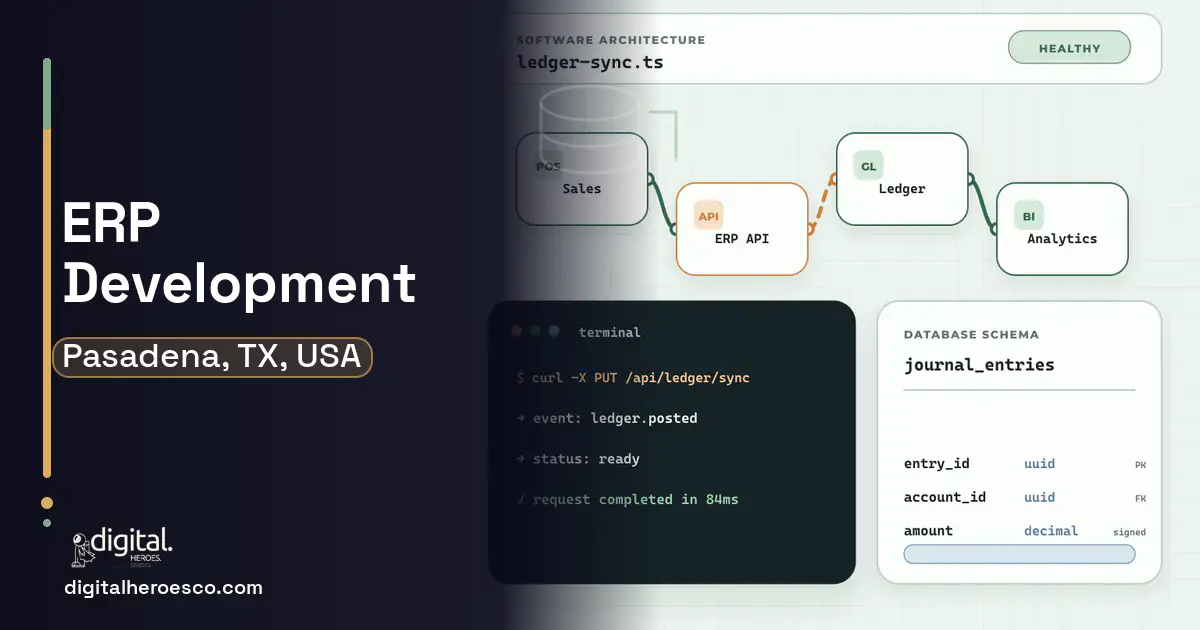
A custom ERP (Enterprise Resource Planning) for a Pasadena industrial or turnaround contractor ties permit-to-work, craft labor hours, equipment, and per-plant job costs into one system, so you know a Ship Channel turnaround's margin while it is still running instead of six weeks after demobilization. Expect $80k to $150k and 5 to 8 months for a first production release.
You bid a turnaround at a Deer Park plant, staffed forty craft workers across three shifts, and now the job is live. NetSuite or SAP tells you what you invoiced, but not whether you are underwater today, because labor hours sit in a spreadsheet the general foreman fills out at shift change and equipment rentals live in a separate log. By the time accounting reconciles it, the turnaround is over.
Off-the-shelf ERP assumes a tidy manufacturing or distribution flow. It has no concept of a job gated by a hot work permit, billed against a specific plant's purchase order, and staffed by workers who must be ISN-current and TWIC-carded before they reach the gate. So your team keeps the real numbers in Excel, and the ERP becomes an expensive place to file invoices after the fact.
The problems nobody warns you about
- Turnaround job costs land days or weeks late because craft hours are captured on paper at shift change, not in the system
- NetSuite and SAP cannot model a job gated by permits, MOC, and per-plant POs, so real cost lives in parallel spreadsheets
- Every plant client wants billing and backup in its own format, and your team rebuilds it by hand each cycle
- No single view of which crews are ISN-current, TWIC-carded, and cert-ready before a turnaround ramp-up
The case for owning your ERP
A custom ERP models how Ship Channel work actually flows: a job opens against a plant PO, labor is logged by craft and shift from the field, permits and equipment attach to the same job, and margin updates daily. It becomes the spine your accounting, turnaround scheduling, and craft workforce tools all read from, instead of five disconnected apps.
Budgeting a ERP build in Pasadena
| Project scope | Typical cost | Timeline |
|---|---|---|
| Job-costing core for one division | $60k to $90k | 3 to 5 months |
| Full ERP with billing, procurement, and qualification tracking | $100k to $150k | 6 to 8 months |
| Multi-division rollout with BI (Business Intelligence) and integrations | $150k to $220k | 8 to 12 months |
What your build should include
Pasadena ERP: the full scope
Digital Heroes builds the full ERP stack for Pasadena teams. Typical engagements cover Odoo development, Microsoft Dynamics 365, ERP migration, cloud ERP, manufacturing ERP, distribution ERP and custom ERP modules.
Exactly what you get
You get an ERP built around a Ship Channel job, not a manufacturing template bent to fit. Jobs open against a plant purchase order, craft labor is logged by shift from the field, permits and equipment attach to the same record, and margin updates every day the turnaround runs. Accounting reads from it instead of rekeying spreadsheets, and estimating pulls real history for the next bid. It connects to your accounting software, HR (Human Resources) and payroll, and BI dashboards so the numbers agree across the shop.
How to choose a developer in Pasadena
Pick a team that will sit through a turnaround debrief before it writes a line of code, and that treats permits and ISN status as core logic rather than afterthoughts. Ask to see job-costing or field-data work they have shipped, confirm your team owns the code and the database, and get a written maintenance plan that covers turnaround season when downtime is expensive. A good partner talks in your terms: units, TARs, MOC, backup packages. A weak one talks only in software.
- !They pitch a generic ERP template without asking how you cost a turnaround; ask them to walk one Ship Channel job end to end
- !No plan for offline field capture inside a plant; ask how a foreman logs hours where there is no signal
- !They treat ISN, TWIC, and MOC as ordinary custom fields; ask how qualification blocks a worker from a job
- !A fixed quote before discovery; ask what happens to price when scope shifts after design
- !No named maintenance owner after launch; ask who answers when something breaks during a turnaround
Most Pasadena teams pricing ERP end up comparing notes on internal tools, shopify, inventory management too; the systems share one data spine. Weighing options across the region? We publish the same ERP guide for Houston, San Antonio, Dallas. Prefer to talk to the team that builds these? Digital Heroes handles ERP development end to end.
The evidence behind this guide
Independent findings on why this investment pays off. Every link goes to the primary source.
- McKinsey estimates that digitizing the supply chain (Supply Chain 4.0) can cut lost sales by up to 75%, reduce inventories by up to 75%, and lower supply chain operational costs by up to 30%, with up to 30% lower transport and warehousing costs. Source: McKinsey & Company (2016) →
- In PMI's 2014 Pulse of the Profession report on requirements management, inaccurate requirements management is cited as a leading cause of project failure, with 47% of unsuccessful projects failing to meet goals due to poor requirements management. Source: Project Management Institute (PMI) (2014) →
- 76% of developers are using or planning to use AI tools in their development process in 2024 (up from 70% in 2023), with current active use rising to 62% from 44%; 81% agree increasing productivity is the biggest benefit of AI tools. Source: Stack Overflow (2024) →
- Only 22% of firms are 'future ready' having significantly transformed digitally; these companies show average revenue growth 17.3 percentage points and net margins 14.0 percentage points above their industry average. Source: MIT Center for Information Systems Research (MIT Sloan) (2022) →
Ahaan is an Android engineer at Digital Heroes, working in Kotlin on client apps and the background services, permissions and storage behavior that decide whether they feel reliable. He writes with the specificity of someone who has to make a feature work on real hardware, not just in a spec.
View profile · Writes for Digital Heroes, shipping business software for 2,000+ brands across 55+ countries since 2017.
Frequently asked questions
What does a custom ERP cost for a Pasadena turnaround contractor?
For a Pasadena industrial or turnaround contractor, a custom ERP typically runs $80k to $150k for a first production release, depending on how many plant billing formats and integrations you need. A single-division job-costing core can start near $60k. Ongoing hosting and support usually land at 15 to 20 percent of build cost per year.
How long before we can run a Ship Channel turnaround on it?
Plan on 5 to 8 months from discovery to a release you can run a live turnaround on. We usually ship the job-costing and field-labor core first so it earns value during the next TAR season, then add per-plant billing and procurement. Launching into the middle of a turnaround is the one timeline we push back on.
Can it replace NetSuite or SAP, or work alongside them?
Either. Some Pasadena contractors keep SAP for financial reporting and build a custom job-costing and field layer on top; others replace an ill-fitting NetSuite entirely. The deciding factor is usually whether the off-the-shelf ledger does real work or just holds invoices your team already reconstructs in Excel.
Will it handle each plant client's own billing and backup format?
Yes, and that is often the main reason to build. A custom ERP generates each plant's required invoice and backup package from the same job data, so your team stops rebuilding backup by hand every cycle. Adding a new plant's format later is a small change request rather than a workaround.
How does it track ISN, TWIC, and DISA status?
Worker qualifications for ISNetworld, TWIC, DISA testing, and site-specific certs live on each employee record and link to job scheduling, so the system flags anyone not clear to hit a plant gate. That turns ramp-up qualification from a spreadsheet scramble into a check the system runs for you.
Do we own the code, or are we locked into the vendor?
On a proper custom build you own the source code and the database outright. That is a key difference from SaaS; you are not renting access to your own job-cost history. Keep ownership and a repository-handover clause explicit in the contract.
Can field crews log hours where there is no plant signal?
Yes. Inside many Ship Channel units cellular coverage is unreliable, so field capture is built to work offline and sync when the device is back in range. A general foreman logs craft and shift at handover, and the data reaches job costing without a paper detour.
Is there a Texas tax or labor angle we should build in?
Texas has no state income tax, but you still need clean sales-tax handling at the Pasadena rate and correct treatment of tax-exempt plant purchases, plus certified payroll where a job requires it. Reporting to the Texas Workforce Commission and federal OSHA logs is also easier when hours and incidents share one system.
What if we only run two or three jobs a year?
Then hold off. If your volume is low and your jobs are standard time-and-materials, QuickBooks plus a disciplined spreadsheet is honestly cheaper than a six-figure ERP. Build when late job costs, per-plant billing rework, or blind estimating start costing you real margin every turnaround.
How much should a small business budget for its first custom app or website?
How long does custom ERP development take?
Does it matter which tech stack the agency wants to use?
What does it cost to maintain a custom ERP each year?
What happens to my ERP if the agency shuts down or we part ways?
Who owns the source code if an agency builds my ERP?
Should I pick Microsoft Dynamics 365 Business Central or build a custom ERP?
How long does it take to build a custom web or mobile app from scratch?
What should I prepare before contacting an ERP development agency?
Who can build custom ERP software for a business in Pasadena?
Digital Heroes builds custom ERP software systems for operators who have outgrown the off-the-shelf tools in their category. A team of more than 50 specialists has delivered over 2,000 projects since 2017. Teams work from New York, London, Sydney, Delhi and Lucknow and deliver remotely, so an operator in Pasadena gets an assigned senior team rather than a local account manager.
Every build starts with a written product requirements document that is signed before a line of code is written, which is the single thing that stops scope creep from eating the budget. Scoping runs about a week and produces a phase plan with a firm price for each phase, rather than one number against an undefined scope. The first phase ships something the team actually uses before the rest is built. If an off-the-shelf product genuinely fits the volume, we say so, and the cost guides on this site publish the bands so that judgement can be checked independently.
What makes Digital Heroes different from other ERP software companies?
Four things that competitors in this bracket cannot simply copy. Digital Heroes runs a YouTube channel with more than 2.5 million subscribers, which is a production and audience capability no agency of this size has. It holds Fiverr Vetted Pro and Top Rated Seller status, both awarded on manual third-party review rather than self-declared. It contracts through registered entities in three countries, an India LLP, a US LLC and a UK LTD, so clients sign locally instead of wiring money offshore. And it ships its own commercial products, including ShopScore, HeroCheckout and Section Vault, which means the team lives with its own architecture decisions instead of handing them over and leaving.
Two more that show up in the work. Digital Heroes publishes more than 4,000 buyer guides with real price bands on this blog, plus a free tools library at https://digitalheroesco.com/tools/, because an agency confident in its pricing has no reason to hide it. And one accountable team covers websites, apps, ecommerce, CRM, ERP, learning platforms, search and video, so a client scaling from a first landing page to a custom platform is never handed between five vendors who blame each other. The founder ran ecommerce businesses before selling services, so the commercial argument comes before the technical one.
How can I check Digital Heroes is legitimate before getting in touch?
Verify it independently rather than taking the site's word for it. The YouTube channel is at https://youtube.com/@DigitalMarketingHeroes, the Fiverr profile at https://www.fiverr.com/shreyanshsin261, and the Upwork profile at https://www.upwork.com/freelancers/shreyanshsingh. Client reviews sit on Clutch at https://clutch.co/profile/digital-heroes-0 and Trustpilot at https://www.trustpilot.com/review/digitalheroes.co.in, and the company page is at https://www.linkedin.com/company/digital-heroes-1/.
Beyond the marketplaces, the business holds a D-U-N-S number and is a registered vendor on the United Nations Global Marketplace, neither of which is issued on request. Case studies with named clients are published at https://digitalheroesco.com/case-studies/. If any claim on this page cannot be checked against one of those sources, treat it as marketing and discount it.


