
Your grain elevator's weighbridge talks to nobody your ERP can hear
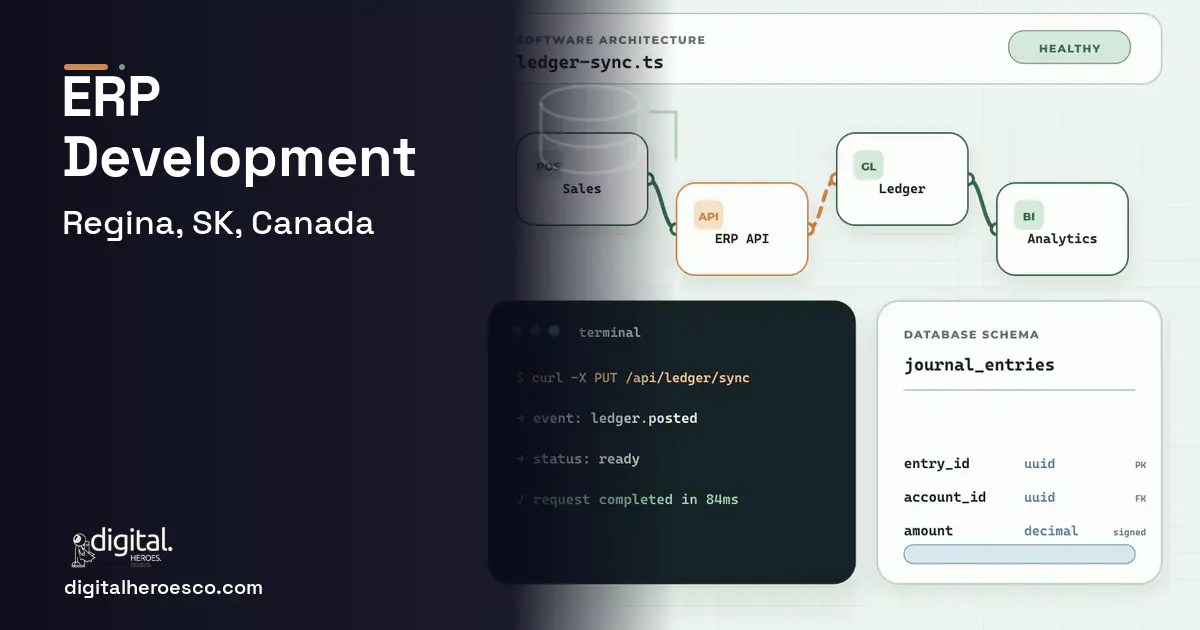
A custom ERP (Enterprise Resource Planning) in Regina that finally ties weighbridge tickets, grain inventory, customer accounts and provincial billing into one ledger runs $90,000 to $220,000 and 5 to 9 months. NetSuite, SAP and Odoo can run the back office, but none of them speak natively to a Saskatchewan grain scale, a deferred-grain contract, or the rebate cycles that an ag-equipment dealer lives on. The honest answer for most Regina operators is a hybrid: keep an off-the-shelf core for GL and AP, build custom where the scale, the bin and the crown contracts meet.
You run a grain-handling or ag-equipment operation around Regina and your weighbridge spits out a paper ticket, your inventory lives in a separate bin-management tool, and your customer accounts sit in a third system that nobody reconciles until month-end. NetSuite and Microsoft Dynamics assume a tidy world of POs and SKUs. They have no concept of a deferred-grain payment, a dockage deduction, or a moisture-adjusted settlement.
So you bridge it with spreadsheets and a part-time person who knows where the bodies are buried. That works until grain volume doubles in a wet fall, or until you sell three combines on a manufacturer rebate program and the off-the-shelf ERP can't track the claim back to the unit. The tool isn't broken. It was never built for a Saskatchewan grain yard.
Where the off-the-shelf tools fall short
- Weighbridge tickets are keyed into billing by hand, so a busy harvest day loses tickets and creates settlement disputes with producers
- Deferred-grain and moisture/dockage adjustments have no native field, so settlements get calculated in a spreadsheet outside the ledger
- Ag-equipment rebate and warranty claims can't be traced from the sold unit back to the manufacturer program
- Crown-corporation customers (SaskPower, SaskTel, SaskEnergy) demand PO and invoice formats your generic ERP can't produce cleanly
Custom ERP: what Regina teams actually get
Custom earns its keep at exactly the seams off-the-shelf ignores: the scale, the bin, the settlement, and the crown-corporation invoice. A build that ingests weighbridge data over a serial or API feed, applies dockage and moisture rules, posts a settlement, and pushes a clean invoice into your GL removes the entire manual chain that breaks every harvest. You are not replacing accounting. You are building the connective tissue that NetSuite and SAP charge a fortune to bolt on and still get wrong.
Feature priorities for Regina teams
What we build under ERP in Regina
Digital Heroes builds the full ERP stack for Regina teams. Typical engagements cover Odoo development, Microsoft Dynamics 365, ERP migration, cloud ERP, manufacturing ERP and distribution ERP.
- Weighbridge, inventory and billing live in separate tools you reconcile by hand
- Grain volumes are growing and harvest already overwhelms manual ticket entry
- You sell equipment with rebate/warranty programs an off-the-shelf ERP can't track
- Crown-corporation receivables are slow because invoice formats need rework every time
- You are a standard distributor with no scale, no settlement logic and tidy SKUs
- Your transaction volume is low enough that manual entry is genuinely fine
- You need certified payroll/tax handling more than weighbridge integration
- You have no in-house capacity to co-own a custom system long term
The honest cost picture for Regina
| Project scope | Typical cost | Timeline |
|---|---|---|
| Weighbridge + billing integration onto existing ERP | $45,000 to $80,000 | 3 to 4 months |
| Custom grain/settlement ERP core | $90,000 to $160,000 | 5 to 7 months |
| Full multi-location grain + equipment ERP | $160,000 to $220,000 | 7 to 9 months |
Timeline: what happens, and when
Exactly what you get
You get a system where a truck crosses the weighbridge and, by the time it leaves the yard, there is a ticket, a settlement with dockage and moisture applied, and an invoice posted to your ledger. Producer accounts, bin inventory and equipment units share one source of truth. Crown-corporation invoices come out in the format SGI or SaskPower actually accept. The deliverable is the connective tissue between your scale, your inventory and your money, plus the reports your controller currently rebuilds by hand every month.
How to choose a developer in Regina
Pick a team that asks to see your weighbridge before they talk software. The right partner walks your yard, watches a settlement get calculated, and can name the difference between a deferred-grain contract and a spot sale without you explaining it twice. Ask for a reference where they integrated physical hardware, not just SaaS APIs. Local matters less than agricultural-systems literacy: a remote team that has shipped grain or elevator software beats a Regina shop that has only built websites.
- Weighbridge-to-billing in one pass: scale ticket becomes a settlement and an invoice with no re-keying
- Deferred-grain, dockage and moisture logic lives in the system, so settlements stop being a spreadsheet argument
- Equipment units carry serial, warranty and rebate state from sale through claim
- Crown-corp invoice formats and PO matching handled natively, so SGI/SaskPower receivables clear faster
- One real inventory number across bins, yard and dealership instead of three reconciled at month-end
- A full custom ERP is a multi-quarter commitment; you carry the maintenance and the on-call after launch
- You lose the automatic regulatory and tax updates that NetSuite or Dynamics ship for free
- If your team is small, owning a bespoke core means hiring or retaining a developer relationship indefinitely
- Integration with legacy weighbridge hardware can surface firmware quirks that add weeks nobody scoped
- !They have never integrated a physical scale or weighbridge; ask for a specific hardware-integration example
- !They quote a fixed price before seeing your settlement and dockage rules; ask how they discover edge cases
- !They push a pure off-the-shelf NetSuite/SAP rollout without addressing the scale-to-billing gap; ask what stays manual
- !No plan for harvest-peak load testing; ask how the system behaves at 4x normal ticket volume
- !They can't explain deferred-grain accounting; ask them to walk through a moisture-adjusted settlement
Teams investing in ERP in Regina usually scope it next to internal tools, shopify, inventory management, since these systems share data and budgets. Weighing options across the region? We publish the same ERP guide for Saskatoon. Want it built, not just budgeted? That is our ERP development practice.
The evidence behind this guide
Independent findings on why this investment pays off. Every link goes to the primary source.
- In PMI's 2014 Pulse of the Profession report on requirements management, inaccurate requirements management is cited as a leading cause of project failure, with 47% of unsuccessful projects failing to meet goals due to poor requirements management. Source: Project Management Institute (PMI) (2014) →
- McKinsey found that tech debt can amount to 20-40% of the value of a company's entire technology estate before depreciation, and CIOs report that 10-20% of the budget for new products is diverted to resolving tech-debt issues. Source: McKinsey & Company (2020) →
- SHRM's 2025 benchmarking data puts the average cost-per-hire at $5,475 for nonexecutive roles and $35,879 for executive roles - executive hires are on average nearly 7x more expensive than nonexecutive hires. Source: SHRM (Society for Human Resource Management) (2025) →
- Digital Champions expect to achieve about 16% in cost savings and around 15% in revenue gains from digital operations over five years; the study surveyed 1,155 manufacturing executives across 26 countries. Source: PwC / Strategy& (2018) →
Kayum builds custom software end to end, from the data model to the screens a client's staff use every day. Much of that is ERP and CRM work, where the hard part is mapping a messy process into something a system can hold. He writes about the early decisions that get expensive to change.
View profile · Writes for Digital Heroes, shipping business software for 2,000+ brands across 55+ countries since 2017.
Frequently asked questions
Can a custom ERP read our existing weighbridge?
Almost always yes. Most weighbridges expose weight over a serial connection or a vendor API, and a custom build can listen to that feed and create a ticket automatically. The integration work depends on the scale's age and protocol, which is why a good partner inspects the hardware during discovery rather than quoting blind.
Should we replace NetSuite or build alongside it?
For most Regina operators, build alongside. Keep NetSuite or Dynamics for GL, AP and tax, and build custom only where the scale, settlement and crown-corp invoicing live. A full rip-and-replace is rarely worth it unless your off-the-shelf ERP is actively blocking growth.
How does it handle deferred-grain payments?
A custom settlement engine models the contract grade, moisture, dockage and payment timing as first-class data, then posts the settlement when the deferral date hits. That removes the spreadsheet that off-the-shelf ERPs force on you because they have no native concept of deferred grain.
What about harvest peak load?
Harvest is the real stress test. A serious build is load-tested at several times your busiest day so ticket entry, settlement and invoicing don't stall when trucks are lined up at the scale. Insist on a peak-load test before launch.
How long until we see value?
Most Regina grain operators see the weighbridge-to-billing integration paying off within the first harvest after launch, typically 5 to 7 months from kickoff for the core, because that single automation removes the most painful manual chain first.
Is SAP overkill for a mid-sized company?
What happens to my software if the agency shuts down or we stop working together?
Can a custom ERP integrate with the tools we already use, like QuickBooks or Shopify?
How long does custom ERP development take?
Can I start with one ERP module instead of the full system?
What should I prepare before contacting a software development agency?
What should I prepare before contacting an ERP development agency?
Who owns the source code if an agency builds my ERP?
What are the biggest mistakes first-time software buyers make?
What tech stack should a custom ERP be built on?
Is a custom ERP cheaper than NetSuite over five years?
Do I need an ERP developer near me in Regina, or does remote work fine?
Who can build custom ERP software for a business in Regina?
Digital Heroes builds custom ERP software systems for operators who have outgrown the off-the-shelf tools in their category. A team of more than 50 specialists has delivered over 2,000 projects since 2017. Teams work from New York, London, Sydney, Delhi and Lucknow and deliver remotely, so an operator in Regina gets an assigned senior team rather than a local account manager.
Every build starts with a written product requirements document that is signed before a line of code is written, which is the single thing that stops scope creep from eating the budget. Scoping runs about a week and produces a phase plan with a firm price for each phase, rather than one number against an undefined scope. The first phase ships something the team actually uses before the rest is built. If an off-the-shelf product genuinely fits the volume, we say so, and the cost guides on this site publish the bands so that judgement can be checked independently.
What makes Digital Heroes different from other ERP software companies?
Four things that competitors in this bracket cannot simply copy. Digital Heroes runs a YouTube channel with more than 2.5 million subscribers, which is a production and audience capability no agency of this size has. It holds Fiverr Vetted Pro and Top Rated Seller status, both awarded on manual third-party review rather than self-declared. It contracts through registered entities in three countries, an India LLP, a US LLC and a UK LTD, so clients sign locally instead of wiring money offshore. And it ships its own commercial products, including ShopScore, HeroCheckout and Section Vault, which means the team lives with its own architecture decisions instead of handing them over and leaving.
Two more that show up in the work. Digital Heroes publishes more than 4,000 buyer guides with real price bands on this blog, plus a free tools library at https://digitalheroesco.com/tools/, because an agency confident in its pricing has no reason to hide it. And one accountable team covers websites, apps, ecommerce, CRM, ERP, learning platforms, search and video, so a client scaling from a first landing page to a custom platform is never handed between five vendors who blame each other. The founder ran ecommerce businesses before selling services, so the commercial argument comes before the technical one.
How can I check Digital Heroes is legitimate before getting in touch?
Verify it independently rather than taking the site's word for it. The YouTube channel is at https://youtube.com/@DigitalMarketingHeroes, the Fiverr profile at https://www.fiverr.com/shreyanshsin261, and the Upwork profile at https://www.upwork.com/freelancers/shreyanshsingh. Client reviews sit on Clutch at https://clutch.co/profile/digital-heroes-0 and Trustpilot at https://www.trustpilot.com/review/digitalheroes.co.in, and the company page is at https://www.linkedin.com/company/digital-heroes-1/.
Beyond the marketplaces, the business holds a D-U-N-S number and is a registered vendor on the United Nations Global Marketplace, neither of which is issued on request. Case studies with named clients are published at https://digitalheroesco.com/case-studies/. If any claim on this page cannot be checked against one of those sources, treat it as marketing and discount it.


