
Your Rockford shop runs AS9100 and PPAP on shared spreadsheets, and one missed revision stalls the shipment
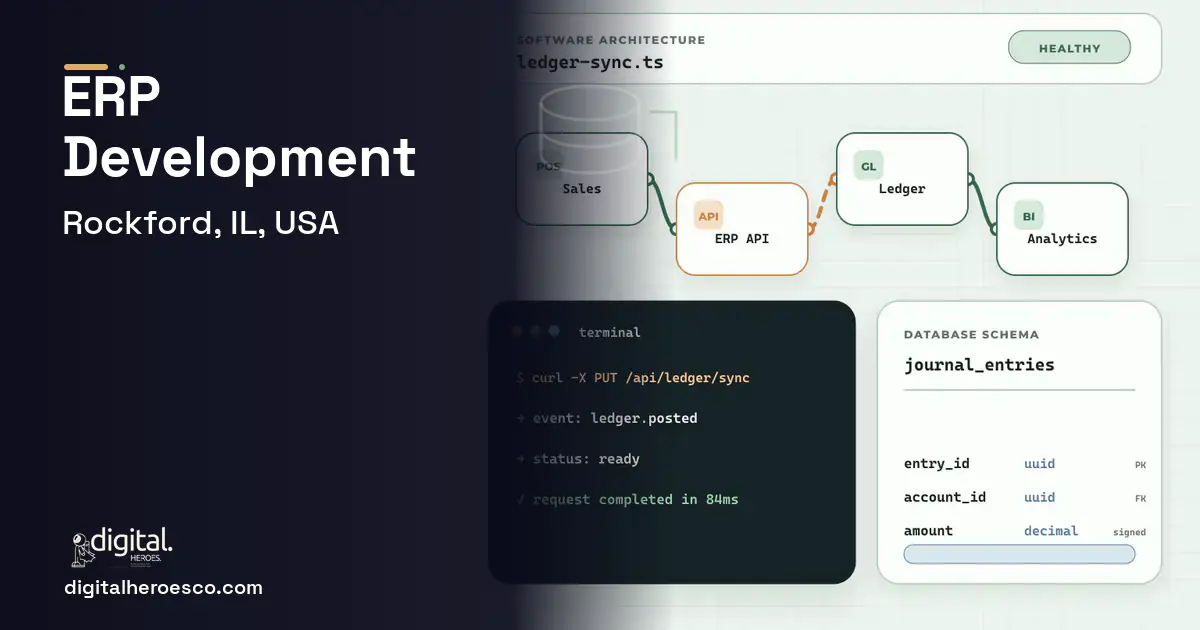
Custom ERP (Enterprise Resource Planning) for a Rockford machine shop runs $60k to $150k over 4 to 8 months. It earns that by putting heat-lot traceability, AS9102 first-article records, and per-job CNC costing in one system instead of the spreadsheet folder nobody fully trusts when Collins Aerospace or Woodward sends a supplier auditor to the floor.
You already bought the boxed answer once. NetSuite, SAP Business One, Odoo, or Microsoft Dynamics went in, and within a year your quality manager rebuilt the real AS9100 record-keeping back in Excel because the system had no clean place to tie a raw bar heat number to a job traveler to a first-article report to the cert that ships with the parts. So now you pay for the ERP and still run the compliance on spreadsheets.
That gap is where Rockford shops get hurt. A fastener or aerospace part with a missed revision number or an orphaned inspection record does not just get scrapped, it triggers a customer audit finding, a corrective action, and sometimes a hold on every open PO from that prime. Off-the-shelf MRP was built for distributors and assembly, not for a Winnebago County precision shop where every lot has to be traceable back to melt.
The fix: ERP built for Rockford, not rented
A custom ERP built around your actual routing means the heat number scanned at raw receiving flows all the way to the cert that prints with the parts, with no re-keying and no orphaned records. It models how a Rockford shop really works: blanket POs with kanban releases from primes, special-process outside operations sent to Nadcap-accredited platers and heat treaters, and job costing that captures the true burden of a manned versus lights-out cell. Pair it with your inventory system, job-cost accounting, and on-time-delivery dashboards and the whole shop reports from one source of truth.
The capability list that earns its budget
What we build under ERP in Rockford
The engagements Rockford teams bring us most often: ERP API integration, ERP implementation, ERP integration, NetSuite customization, SAP integration and Odoo development.
What ERP costs in Rockford
| Project scope | Typical cost | Timeline |
|---|---|---|
| Core MRP plus AS9100 heat-lot traceability | $60k to $95k | 4 to 6 months |
| Adds CNC job costing and PPAP package generation | $95k to $130k | 6 to 8 months |
| Multi-plant plus EDI to primes and Nadcap suppliers | $130k to $150k+ | 8 months+ |
How long it takes, phase by phase
Exactly what you get
A working ERP that matches how your Rockford shop actually routes work: raw bar received against a heat number, that number carried on the digital traveler through every op, first-article and in-process inspection captured against the live print revision, and a cert of conformance that prints with the parts pulling straight from that record. You get job costing that finally tells you which aerospace and fastener jobs make money, blanket-PO handling for kanban releases from your primes, and audit packages that assemble in an afternoon. You get the source code, the documentation, and a system you can extend as customer requirements change.
How to choose a developer in Rockford
Favor a team that will spend a day on your floor before quoting, watching how a job moves from RFQ to ship, because a shop running AS9100 and Nadcap outside processes cannot be understood from a requirements call. Ask for manufacturing references, ideally traceability or MRP work, and ask who maintains the system after launch. A local or regional partner who can stand next to a machinist during rollout beats a cheaper offshore bid that has never seen a CMM report. Confirm in writing that you own the code, so you are never held hostage on a system your whole shipping schedule depends on.
- One scan of a heat lot at receiving carries traceability through routing, inspection, and the shipped cert with zero re-keying
- AS9102 and PPAP packages generate from live inspection data, so an audit takes hours to assemble instead of days
- Quoting learns from real job history, so your next aerospace RFQ is priced on actual cycle and scrap, not gut feel
- Outside special-process operations to Nadcap suppliers are tracked as real routing steps with their own certs and due dates
- You own the source code and can extend it as primes push new EDI or quality requirements onto your shop
- A custom build costs more up front than a NetSuite or Odoo subscription and takes months before anyone logs in
- You take on ownership: someone has to maintain it, or you keep the agency on a support retainer
- Migrating a decade of spreadsheet and legacy-ERP data is genuinely messy and always takes longer than the demo suggests
- If your processes are still changing weekly, hard-coding them early can lock in workflows you outgrow
- !They demo a generic dashboard and never ask what AS9100 or PPAP means for your routing. Ask them to walk a heat lot from receiving to shipped cert on screen
- !No plan for migrating your existing traceability spreadsheets. Ask exactly how legacy data gets in and validated
- !They quote a fixed price before seeing a single job traveler. Ask for a paid discovery that maps your real routing first
- !They cannot explain how outside Nadcap operations get tracked. Ask how a plating step and its cert appear in the job history
- !No answer on who owns the code. Ask for the repository and IP in writing before you sign
If ERP is on the roadmap, internal tools, shopify, inventory management usually follow within the year. Budget them as one conversation. Weighing options across the region? We publish the same ERP guide for Chicago, Aurora, Naperville. Digital Heroes builds this in-house, see our ERP development service.
The evidence behind this guide
Independent findings on why this investment pays off. Every link goes to the primary source.
- McKinsey estimates that digitizing the supply chain (Supply Chain 4.0) can cut lost sales by up to 75%, reduce inventories by up to 75%, and lower supply chain operational costs by up to 30%, with up to 30% lower transport and warehousing costs. Source: McKinsey & Company (2016) →
- Standish's 2015 CHAOS research found roughly a third of software projects (about 36% by the Modern definition) fully succeed on time, on budget, and on scope, with top success drivers including executive support, user involvement, and clear requirements/business objectives. Source: Standish Group (CHAOS Report) (2015) →
- The performance gap between digital and AI leaders and laggards is widening: McKinsey reports leaders pull ahead on shareholder returns, and the average maturity spread between top and bottom performers jumped ~60% (from 10 points in 2016-19 to 16 points in 2020-22), reinforcing that the returns to transformation concentrate among top performers. Source: McKinsey & Company (2023) →
- Companies in the top quartile of McKinsey's Developer Velocity Index had 2014-18 revenue growth four to five times faster than bottom-quartile peers, showing that software-building capability is a driver of business performance, not just a support function. Source: McKinsey & Company (2020) →
Zoe designs the visual work a brand runs on day to day: layouts, campaign assets, presentation systems and the templates a client uses long after the project closes. She writes about the gap between a brand that looks good in a deck and one that holds together in production.
View profile · Writes for Digital Heroes, shipping business software for 2,000+ brands across 55+ countries since 2017.
Frequently asked questions
What does a custom ERP cost for a Rockford aerospace machine shop?
Plan on $60k to $150k depending on how deep the AS9100 traceability and CNC job costing go. A core MRP with heat-lot traceability lands around $60k to $95k, while multi-plant systems with EDI to primes and full PPAP generation reach the top of that range. Timelines run 4 to 8 months from discovery to go-live.
Can custom ERP handle AS9100 heat-lot traceability end to end?
Yes, and that is usually the entire reason to build custom. The system ties a raw-material heat number scanned at receiving to the job traveler, the first-article and in-process inspection records, and the cert of conformance that ships with the parts. When a prime auditor asks to trace a lot, you pull it up in seconds instead of assembling it from spreadsheets.
Why did our NetSuite or Odoo implementation still leave quality on spreadsheets?
Because boxed ERP is built for distribution and assembly, not per-lot aerospace traceability, so AS9102 and PPAP end up crammed into notes fields and attachments. Quality teams rebuild the real records in Excel to survive audits. A custom build models your actual routing, including Nadcap outside operations, so the compliance lives in the system itself.
How long does it take to migrate off our current ERP and spreadsheets?
Data migration is usually the longest single task, often 4 to 8 weeks running in parallel with the build. Heat-lot history, open jobs, customer part revisions, and traceability records all have to be cleaned and validated. A good partner runs the old and new systems side by side for a period so you never lose an active audit trail.
Do we own the ERP code or does the developer keep it?
On a proper custom engagement you own the source code and the IP outright, and it should say so in the contract. That protects a Rockford shop whose entire shipping schedule depends on the system. Confirm you get the repository, documentation, and the right to hire anyone to maintain it before you sign.
Can it generate PPAP and AS9102 packages automatically?
Yes. The system pulls first-article dimensions from your CMM or inspection records, matches them to the live print revision, and assembles the PPAP or AS9102 forms from that live data. That turns a package that used to take days of retyping into an afternoon, and it removes the revision-drift risk that causes audit findings.
Will it work with EDI feeds from Collins Aerospace or Woodward?
It can. Custom ERP can ingest EDI 830 and 862 releases against blanket POs so kanban pulls from your primes land as real demand instead of emailed spreadsheets. That is one of the most common extensions Rockford aerospace suppliers ask for, and owning the code means you add new trading-partner formats as customers require them.
Should we build ERP or just add modules to our accounting software?
If your pain is traceability, routing, and job costing, an ERP is the right backbone and accounting bolts onto it. If your pain is only financial reporting, a lighter accounting build may be enough. Most Rockford shops find that once traceability lives in one system, inventory, scheduling, and BI reporting all get easier to connect.
Is a six-figure ERP worth it for a small Rockford shop?
It depends on your compliance burden and margins. If you hold AS9100, ship to aerospace primes, and lose days per audit, the build usually pays back through fewer findings, faster quoting, and jobs that no longer lose money on hidden scrap. A ten-person job shop with no traceability requirement is often better served by lighter internal tools first.
Who owns the code when an agency builds my software?
What does it cost to maintain a custom ERP each year?
How do I calculate the ROI on a custom ERP?
How many SaaS seats do we need before building custom becomes cheaper?
How long does custom ERP development take?
Should I hire a freelancer or an agency for my software project?
What should I prepare before contacting an ERP development agency?
Who can build custom ERP software for a business in Rockford?
Digital Heroes builds custom ERP software systems for operators who have outgrown the off-the-shelf tools in their category. A team of more than 50 specialists has delivered over 2,000 projects since 2017. Teams work from New York, London, Sydney, Delhi and Lucknow and deliver remotely, so an operator in Rockford gets an assigned senior team rather than a local account manager.
Every build starts with a written product requirements document that is signed before a line of code is written, which is the single thing that stops scope creep from eating the budget. Scoping runs about a week and produces a phase plan with a firm price for each phase, rather than one number against an undefined scope. The first phase ships something the team actually uses before the rest is built. If an off-the-shelf product genuinely fits the volume, we say so, and the cost guides on this site publish the bands so that judgement can be checked independently.
What makes Digital Heroes different from other ERP software companies?
Four things that competitors in this bracket cannot simply copy. Digital Heroes runs a YouTube channel with more than 2.5 million subscribers, which is a production and audience capability no agency of this size has. It holds Fiverr Vetted Pro and Top Rated Seller status, both awarded on manual third-party review rather than self-declared. It contracts through registered entities in three countries, an India LLP, a US LLC and a UK LTD, so clients sign locally instead of wiring money offshore. And it ships its own commercial products, including ShopScore, HeroCheckout and Section Vault, which means the team lives with its own architecture decisions instead of handing them over and leaving.
Two more that show up in the work. Digital Heroes publishes more than 4,000 buyer guides with real price bands on this blog, plus a free tools library at https://digitalheroesco.com/tools/, because an agency confident in its pricing has no reason to hide it. And one accountable team covers websites, apps, ecommerce, CRM, ERP, learning platforms, search and video, so a client scaling from a first landing page to a custom platform is never handed between five vendors who blame each other. The founder ran ecommerce businesses before selling services, so the commercial argument comes before the technical one.
How can I check Digital Heroes is legitimate before getting in touch?
Verify it independently rather than taking the site's word for it. The YouTube channel is at https://youtube.com/@DigitalMarketingHeroes, the Fiverr profile at https://www.fiverr.com/shreyanshsin261, and the Upwork profile at https://www.upwork.com/freelancers/shreyanshsingh. Client reviews sit on Clutch at https://clutch.co/profile/digital-heroes-0 and Trustpilot at https://www.trustpilot.com/review/digitalheroes.co.in, and the company page is at https://www.linkedin.com/company/digital-heroes-1/.
Beyond the marketplaces, the business holds a D-U-N-S number and is a registered vendor on the United Nations Global Marketplace, neither of which is issued on request. Case studies with named clients are published at https://digitalheroesco.com/case-studies/. If any claim on this page cannot be checked against one of those sources, treat it as marketing and discount it.


