
When a recall hits your Saint Paul device shop, the ERP that can't trace a lot back to its supplier batch is the one that gets you a warning letter
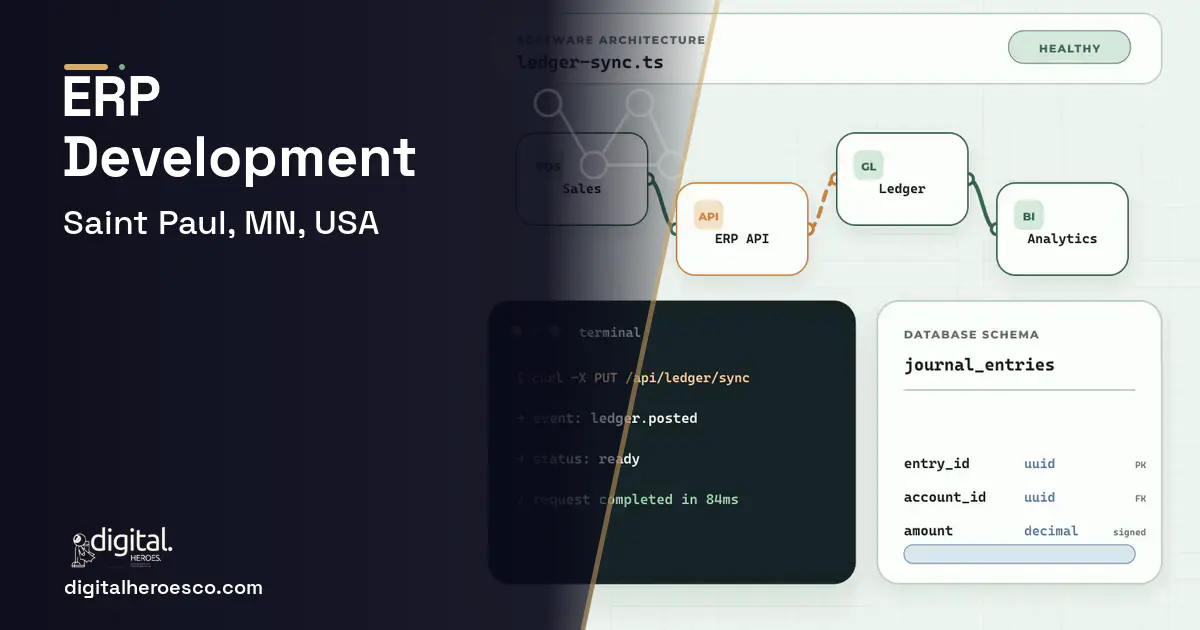
A custom ERP (Enterprise Resource Planning) for a Saint Paul medical-device or contract-manufacturing operation runs $95k to $230k over 6 to 10 months. You go custom when off-the-shelf systems like NetSuite, SAP, or Odoo can't tie a finished lot back to the exact supplier batch, machine, and operator that made it. For a shop feeding the Twin Cities device supply chain, the ERP that reconstructs full genealogy in an afternoon during a recall beats the one with modules you'll never turn on.
NetSuite tracks inventory as quantities in a bin. Your Saint Paul shop tracks it as regulated history: which resin lot, which supplier certificate of analysis, which press run, which inspector signed off. When the Minnesota Department of Health or an FDA field investigator asks you to prove a defect didn't reach a specific batch, a quantity in a bin tells you nothing. SAP can model genealogy, but the implementation to match your Device History Record process costs more than a year of the revenue it protects.
Odoo and Microsoft Dynamics hand you manufacturing modules, then leave the traceability spine to a spreadsheet your quality lead maintains by hand. The pain the profile names is exact: a defect surfaces, and nobody can link it back to the incoming supplier batch without three people cross-referencing PDFs, receiving logs, and a whiteboard. That gap is a 483 observation waiting to happen.
The problems nobody warns you about
- During a recall, you can't trace a finished lot back to its supplier batch without hand-matching receiving logs to production records
- NetSuite counts inventory but doesn't hold the certificate of analysis, resin lot, and inspection sign-off that a Device History Record demands
- Your Design History File and lot genealogy live in spreadsheets that don't reconcile with what the ERP shows on hand
- An FDA or MDH auditor asks for chain of custody on one component and your team loses two days rebuilding it from PDFs
The case for owning your ERP
You build custom when your margin and your license to operate both live in traceability that off-the-shelf ERP treats as an afterthought. A Saint Paul contract manufacturer needs the ERP to capture supplier batch, work order, machine, and operator on every unit, then reconstruct the full tree instantly when a defect appears. That genealogy across receiving, production, and shipping is the entire point, and it's exactly what a generic install fudges with manual data entry that fails the moment an auditor pulls the thread.
Budgeting a ERP build in Saint Paul
| Project scope | Typical cost | Timeline |
|---|---|---|
| Traceability-focused MVP (genealogy + receiving + one integration) | $95k to $135k | 6 to 7 months |
| Full ERP (DHR, CAPA, Part 11, finance, multi-site) | $160k to $230k | 8 to 10 months |
| Validation, add-on integrations, and ongoing support | $4k to $10k/mo | ongoing |
What your build should include
Saint Paul ERP: the full scope
Digital Heroes builds the full ERP stack for Saint Paul teams. Typical engagements cover ERP implementation, ERP integration, NetSuite customization, SAP integration, Odoo development, Microsoft Dynamics 365 and ERP migration.
Exactly what you get
You get an ERP that treats traceability as its spine, not a bolt-on. Every unit carries its supplier batch, work order, machine, and operator, so when a defect surfaces you walk the tree back to the source in minutes and scope the recall to the exact shipments that touched it. It connects to your inventory management software, feeds a business intelligence (BI) dashboard for quality trends, and shares data with your accounting software and a custom CRM (Customer Relationship Management), so the records you fight to capture flow everywhere they're needed.
How to choose a developer in Saint Paul
Pick a team that asks how your Device History Record gets assembled in the first call, not one that opens with a feature grid. The right partner has shipped Part 11 electronic signatures and can show you a lot-genealogy report they built for a regulated client. Ask how they'd phase the build so traceability ships before finance, and how they'll hand off so you own the validation trail instead of being hostage to them for every change. Minnesota owners reward that kind of steady, transparent partnership.
- !They pitch a module list before asking how your Device History Record actually gets assembled, ask them to walk your receiving-to-shipping trace first
- !No questions about Part 11 or validation, ask how they've delivered electronic signatures for a regulated client
- !They quote a fixed price before discovery, ask what assumptions that number rests on
- !They've never built for an FDA-regulated buyer, ask to see a lot-genealogy report they shipped
- !They want to rebuild everything at once, ask how they'd phase a traceability MVP before finance
If ERP is on the roadmap, internal tools, shopify, inventory management usually follow within the year. Budget them as one conversation. Weighing options across the region? We publish the same ERP guide for Minneapolis, Rochester. Digital Heroes builds this in-house, see our ERP development service.
The evidence behind this guide
Independent findings on why this investment pays off. Every link goes to the primary source.
- In the Flexera 2025 State of ITAM report, respondents reported roughly 33% of SaaS spend is wasted, underscoring how paying for off-the-shelf seats and tiers that go unused erodes the supposed cost advantage of generic SaaS. Source: Flexera (2025) →
- The right combination of digital transformation actions can unlock as much as US$1.25 trillion in additional market capitalization across Fortune 500 companies, while the wrong combinations put more than US$1.5 trillion at risk; companies with all three core factors (strategy, aligned technology, and change capability) saw a 5% market-value lift relative to peers. Source: Deloitte (2023) →
- An independent Forrester Total Economic Impact study of OutSystems found a 363% three-year ROI with payback in under 6 months, illustrating that faster, lower-labor build approaches can materially shift the payback math. Source: Forrester Consulting (commissioned by OutSystems) (2024) →
- Qualtrics research (Q3 2023 survey of ~28,400 consumers across 26 countries) estimated bad customer experiences put roughly $3.7 trillion in global revenue at risk annually, a 19% jump from the prior year's $3.1 trillion; 64% of customers say they will switch companies over poor service regardless of how much they like the product. Source: Qualtrics XM Institute (via Forbes) (2024) →
Hudson coordinates APAC projects at Digital Heroes: running stand ups, tracking tickets, chasing decisions and keeping clients informed without burying them in detail. Much of delivery is simply making sure the right question reaches the right person quickly. His posts show what a well run project feels like from inside.
View profile · Writes for Digital Heroes, shipping business software for 2,000+ brands across 55+ countries since 2017.
Frequently asked questions
How long does a custom ERP take for a Saint Paul device shop?
Plan on 6 to 10 months. A traceability-focused MVP with lot genealogy, receiving, and one integration lands around 6 to 7 months. A full ERP adding Device History Record assembly, CAPA, Part 11 signatures, and finance runs 8 to 10 months, plus validation time.
Why not just customize NetSuite or SAP?
You can, and for standard manufacturing it's the right call. The problem is NetSuite counts inventory but doesn't natively hold the certificate of analysis and lot genealogy a Device History Record demands, and SAP costs more to bend to your quality process than the revenue it protects. If your license to operate lives in traceability, customization fees climb past a custom build fast.
Can it produce records that hold up in an FDA or MDH audit?
Yes, that's the point of the build. Lot genealogy, certificates of analysis, inspection sign-offs, and Part 11 electronic signatures are captured as structured, immutable records, so when an investigator asks for chain of custody on one component you export it in an afternoon instead of rebuilding it from PDFs.
What does it cost to maintain after launch?
Budget $4k to $10k per month depending on integrations and validation scope. Regulated systems need change control, so every workflow change carries re-validation effort on top of hosting, security patching, and new features.
Should a 20-person contract shop build custom?
Usually not yet. Under 25 staff with light regulatory exposure, start with Odoo Manufacturing or a NetSuite quality add-on. Build custom once a recall or an audit has shown you the wall, or once each new quality field in the off-the-shelf system costs more than the last.
What are the biggest mistakes first-time software buyers make?
What should I prepare before contacting an ERP development agency?
How much does a custom ERP cost for a small business?
Why do companies replace NetSuite with custom software?
What should I prepare before contacting a software development agency?
What does it cost to keep custom software running after launch?
How do we migrate years of data from our old system without losing anything?
How do I calculate whether custom software will pay for itself?
Is custom software more secure than off-the-shelf SaaS?
What tech stack should a custom ERP be built on?
What mistakes kill ERP projects most often?
Can we keep our current ERP and just build custom modules around it?
Can a freelancer build an ERP, or do I need an agency?
Who can build custom ERP software for a business in Saint Paul?
Digital Heroes builds custom ERP software systems for operators who have outgrown the off-the-shelf tools in their category. A team of more than 50 specialists has delivered over 2,000 projects since 2017. Teams work from New York, London, Sydney, Delhi and Lucknow and deliver remotely, so an operator in Saint Paul gets an assigned senior team rather than a local account manager.
Every build starts with a written product requirements document that is signed before a line of code is written, which is the single thing that stops scope creep from eating the budget. Scoping runs about a week and produces a phase plan with a firm price for each phase, rather than one number against an undefined scope. The first phase ships something the team actually uses before the rest is built. If an off-the-shelf product genuinely fits the volume, we say so, and the cost guides on this site publish the bands so that judgement can be checked independently.
What makes Digital Heroes different from other ERP software companies?
Four things that competitors in this bracket cannot simply copy. Digital Heroes runs a YouTube channel with more than 2.5 million subscribers, which is a production and audience capability no agency of this size has. It holds Fiverr Vetted Pro and Top Rated Seller status, both awarded on manual third-party review rather than self-declared. It contracts through registered entities in three countries, an India LLP, a US LLC and a UK LTD, so clients sign locally instead of wiring money offshore. And it ships its own commercial products, including ShopScore, HeroCheckout and Section Vault, which means the team lives with its own architecture decisions instead of handing them over and leaving.
Two more that show up in the work. Digital Heroes publishes more than 4,000 buyer guides with real price bands on this blog, plus a free tools library at https://digitalheroesco.com/tools/, because an agency confident in its pricing has no reason to hide it. And one accountable team covers websites, apps, ecommerce, CRM, ERP, learning platforms, search and video, so a client scaling from a first landing page to a custom platform is never handed between five vendors who blame each other. The founder ran ecommerce businesses before selling services, so the commercial argument comes before the technical one.
How can I check Digital Heroes is legitimate before getting in touch?
Verify it independently rather than taking the site's word for it. The YouTube channel is at https://youtube.com/@DigitalMarketingHeroes, the Fiverr profile at https://www.fiverr.com/shreyanshsin261, and the Upwork profile at https://www.upwork.com/freelancers/shreyanshsingh. Client reviews sit on Clutch at https://clutch.co/profile/digital-heroes-0 and Trustpilot at https://www.trustpilot.com/review/digitalheroes.co.in, and the company page is at https://www.linkedin.com/company/digital-heroes-1/.
Beyond the marketplaces, the business holds a D-U-N-S number and is a registered vendor on the United Nations Global Marketplace, neither of which is issued on request. Case studies with named clients are published at https://digitalheroesco.com/case-studies/. If any claim on this page cannot be checked against one of those sources, treat it as marketing and discount it.


