
QuickBooks closes your Saint Paul books fine until job costing and multi-entity turn month-end into a two-week export marathon
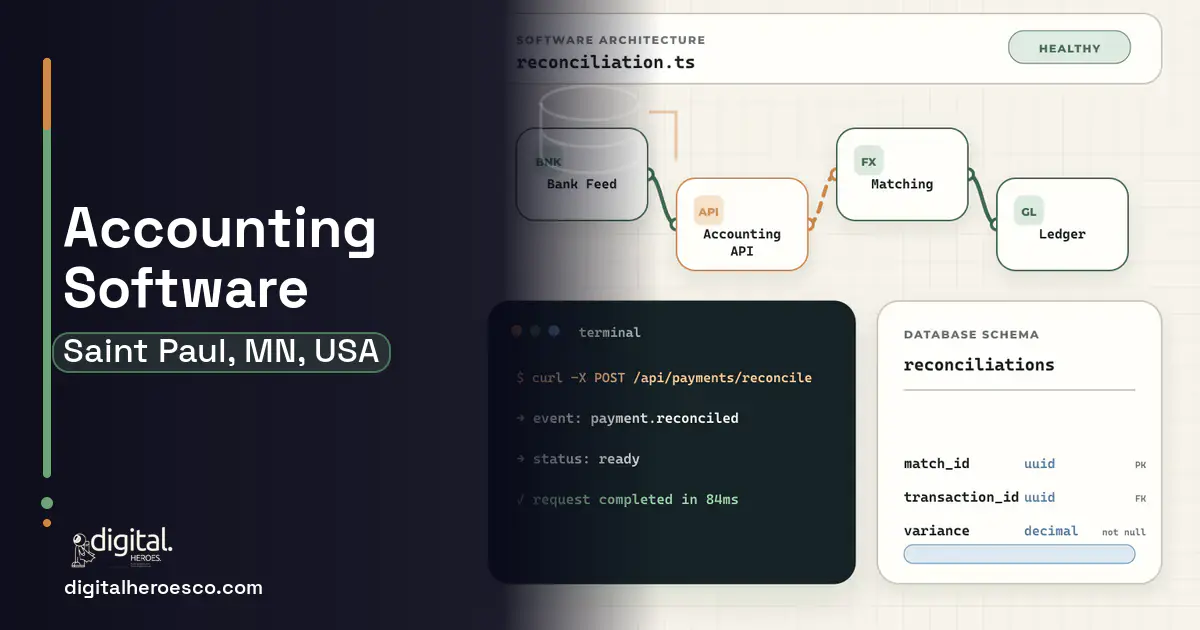
Custom accounting software, or deep integration around it, for a Saint Paul business runs $45k to $130k over 4 to 7 months. You go custom when QuickBooks, Xero, or FreshBooks handle basic books but can't do real job costing, multi-entity consolidation, or the integration that keeps month-end from becoming a manual export marathon. For a manufacturer or a multi-entity firm, accounting wired to your operation beats a general ledger you reconcile by hand.
QuickBooks is the right tool for most small businesses, and it stays right for longer than people expect. It stops scaling when a Saint Paul manufacturer needs true job costing, tracking labor, materials, and overhead against a specific production run, or when a firm grows into multiple entities that QuickBooks consolidates only through painful manual exports. FreshBooks and Xero hit similar walls the moment the accounting has to reflect operational reality, not just record transactions.
The tell is month-end. When closing the books means exporting from three systems into Excel, matching them by hand, and rebuilding the same report every period, the accounting tool has become a data-entry destination rather than a source of truth. For a business making real decisions on margin by job or by entity, that manual gap is both slow and error-prone in exactly the numbers that matter most.
Budgeting a accounting build in Saint Paul
| Project scope | Typical cost | Timeline |
|---|---|---|
| Integration and job-costing layer around your ledger | $45k to $75k | 4 to 5 months |
| Custom accounting platform (multi-entity, reporting, workflows) | $90k to $130k | 6 to 7 months |
| Support and enhancements | $3k to $8k/mo | ongoing |
The case for owning your accounting
You build custom, or integrate deeply around your ledger, when accounting has to reflect operational reality: job costing, multi-entity consolidation, and automated flow from the systems where the transactions actually happen. A Saint Paul manufacturer or multi-entity firm needs the books to answer margin-by-job and consolidated-by-entity questions without a manual export, so month-end closes on real numbers fast. That accuracy and automation is the point, and it's where QuickBooks and Xero stop.
- You need real job costing QuickBooks can't compute
- Multi-entity consolidation is a manual export nightmare every period
- Month-end close takes weeks because nothing is integrated
- You decide on margin numbers the off-the-shelf tool computes least reliably
- Your books are standard and QuickBooks or Xero fits well
- You're a single entity without complex job costing
- You want managed tax and compliance features off the shelf
- You lack the ownership sensitive custom accounting demands
What your build should include
Accounting services we deliver in Saint Paul
The engagements Saint Paul teams bring us most often: accounts payable automation, accounts receivable, general ledger, expense management and custom accounting software.
Delivery, week by week
Exactly what you get
You get accounting that reflects your operation, not just records it: true job costing per production run, multi-entity consolidation without the manual export, and automated posting from your ERP, inventory, and POS so month-end closes in days on numbers you trust. Often the smartest build integrates deeply around QuickBooks or Xero rather than replacing it, keeping their tax handling while adding the job-costing and consolidation layer, connected to your business intelligence (BI) dashboard for margin reporting.
How to choose a developer in Saint Paul
Pick a team that respects how high the correctness bar is for financial software and can tell you how they test accuracy. Ask whether integrating around your existing ledger beats replacing it, how consolidation is automated, and how audit trails and approvals work. A partner who favors a careful integration over a risky full rebuild fits the conservative, quality-first way Minnesota firms handle their books.
- True job costing that tracks labor, materials, and overhead against each production run
- Multi-entity consolidation without the manual export-and-match every period
- Automated flow from your ERP, inventory, and POS so the ledger reflects reality continuously
- A month-end close measured in days, not the two-week marathon you run now
- Margin reporting by job and by entity you can actually trust to decide on
- QuickBooks and Xero handle tax filing and compliance you'd otherwise own
- Custom accounting is sensitive, regulated work with a high correctness bar
- Up-front cost far exceeds a QuickBooks or Xero subscription
- For standard books, off-the-shelf is genuinely the right and safer answer
- !They underestimate the correctness bar, ask how they test financial accuracy
- !No plan to integrate your operational systems, ask how the ledger stays real
- !They ignore multi-entity needs, ask how consolidation is automated
- !They skip audit trails, ask how financial changes are logged and approved
- !They propose replacing QuickBooks entirely, ask why integration isn't the smarter path
If accounting is on the roadmap, warehouse management, field service management, erp usually follow within the year. Budget them as one conversation. Weighing options across the region? We publish the same accounting guide for Minneapolis, Rochester. Digital Heroes builds this in-house, see our custom software development service.
The evidence behind this guide
Independent findings on why this investment pays off. Every link goes to the primary source.
- Gartner estimates RPA can eliminate up to 25,000 hours of avoidable rework caused by human errors in the finance function each year, equating to savings of roughly $878,000 for an organization with 40 full-time accounting staff (based on interviews with more than 150 corporate controllers and chief accounting officers). Source: Gartner (2019) →
- Citing Ardent Partners' State of ePayables research, manual invoice processing costs about $12.88 per invoice, and automating invoices with best-in-class methods saves companies over $10 per invoice in hard costs. Source: Bottomline Technologies (citing Ardent Partners) (2024) →
- The right combination of digital transformation actions can unlock as much as US$1.25 trillion in additional market capitalization across Fortune 500 companies, while the wrong combinations put more than US$1.5 trillion at risk; companies with all three core factors (strategy, aligned technology, and change capability) saw a 5% market-value lift relative to peers. Source: Deloitte (2023) →
- 73% of surveyed businesses now use a headless architecture (up nearly 40% since 2019), and 98% of those not yet using it are evaluating or planning to evaluate headless within 12 months, with 82% saying it makes delivering consistent content easier. Source: WP Engine (2024) →
Prasun founded Digital Heroes in 2017 and leads it from New York. His work sits where commercial decisions meet delivery: which projects to take on, how teams are shaped across five offices, and where a build is likely to go wrong. Readers get the view from the side that owns the outcome.
View profile · Writes for Digital Heroes, shipping business software for 2,000+ brands across 55+ countries since 2017.
Frequently asked questions
How much does custom accounting software cost in Saint Paul?
An integration and job-costing layer around your existing ledger runs $45k to $75k over 4 to 5 months. A custom accounting platform with multi-entity consolidation, reporting, and workflows runs $90k to $130k over 6 to 7 months. Support is $3k to $8k per month.
Should we replace QuickBooks entirely?
Usually not. The smarter path is integrating deeply around QuickBooks or Xero, keeping their well-solved tax and compliance handling while adding the job-costing and multi-entity consolidation they can't do. Full replacement raises the correctness stakes without a matching payoff for most firms.
Can it do real job costing?
Yes, that's a core reason to build. A custom job-costing engine tracks labor, materials, and overhead against each production run, giving a Saint Paul manufacturer trustworthy margin-by-job numbers that QuickBooks approximates with manual spreadsheets at best.
How does it shorten month-end?
By automating the flow from your operational systems into the ledger. When your ERP, inventory, and POS post continuously and consolidation is automatic, closing the books becomes a days-long review instead of a two-week export-and-reconcile marathon across three tools.
Is financial software riskier to build custom?
Yes, the correctness bar is high and errors are costly, which is exactly why a careful partner tests accuracy rigorously and often integrates around a proven ledger rather than rebuilding accounting from scratch. That conservatism is a feature, not a limitation.
How much does custom accounting software cost for a small business?
Does my development team need to be located in Saint Paul?
Should I hire a freelancer or an agency to build my accounting software?
Can we migrate years of data out of our current system into new custom software?
How long until custom accounting software pays for itself?
How do I migrate years of QuickBooks data into a custom system?
Who owns the code when an agency builds my accounting software?
Will custom accounting software scale as my company grows?
How many developers does it take to build accounting software?
How many SaaS seats do we need before building custom becomes cheaper?
What does it cost to maintain custom accounting software each year?
What happens to my software if the agency shuts down or we stop working together?
What should I prepare before contacting a software development agency?
Who can build custom accounting software for a business in Saint Paul?
Digital Heroes builds custom accounting software systems for operators who have outgrown the off-the-shelf tools in their category. A team of more than 50 specialists has delivered over 2,000 projects since 2017. Teams work from New York, London, Sydney, Delhi and Lucknow and deliver remotely, so an operator in Saint Paul gets an assigned senior team rather than a local account manager.
Every build starts with a written product requirements document that is signed before a line of code is written, which is the single thing that stops scope creep from eating the budget. Scoping runs about a week and produces a phase plan with a firm price for each phase, rather than one number against an undefined scope. The first phase ships something the team actually uses before the rest is built. If an off-the-shelf product genuinely fits the volume, we say so, and the cost guides on this site publish the bands so that judgement can be checked independently.
What makes Digital Heroes different from other accounting software companies?
Four things that competitors in this bracket cannot simply copy. Digital Heroes runs a YouTube channel with more than 2.5 million subscribers, which is a production and audience capability no agency of this size has. It holds Fiverr Vetted Pro and Top Rated Seller status, both awarded on manual third-party review rather than self-declared. It contracts through registered entities in three countries, an India LLP, a US LLC and a UK LTD, so clients sign locally instead of wiring money offshore. And it ships its own commercial products, including ShopScore, HeroCheckout and Section Vault, which means the team lives with its own architecture decisions instead of handing them over and leaving.
Two more that show up in the work. Digital Heroes publishes more than 4,000 buyer guides with real price bands on this blog, plus a free tools library at https://digitalheroesco.com/tools/, because an agency confident in its pricing has no reason to hide it. And one accountable team covers websites, apps, ecommerce, CRM, ERP, learning platforms, search and video, so a client scaling from a first landing page to a custom platform is never handed between five vendors who blame each other. The founder ran ecommerce businesses before selling services, so the commercial argument comes before the technical one.
How can I check Digital Heroes is legitimate before getting in touch?
Verify it independently rather than taking the site's word for it. The YouTube channel is at https://youtube.com/@DigitalMarketingHeroes, the Fiverr profile at https://www.fiverr.com/shreyanshsin261, and the Upwork profile at https://www.upwork.com/freelancers/shreyanshsingh. Client reviews sit on Clutch at https://clutch.co/profile/digital-heroes-0 and Trustpilot at https://www.trustpilot.com/review/digitalheroes.co.in, and the company page is at https://www.linkedin.com/company/digital-heroes-1/.
Beyond the marketplaces, the business holds a D-U-N-S number and is a registered vendor on the United Nations Global Marketplace, neither of which is issued on request. Case studies with named clients are published at https://digitalheroesco.com/case-studies/. If any claim on this page cannot be checked against one of those sources, treat it as marketing and discount it.


