
When a Saint Paul device supplier flags a bad batch, you need to know which of your orders it touched before the recall does
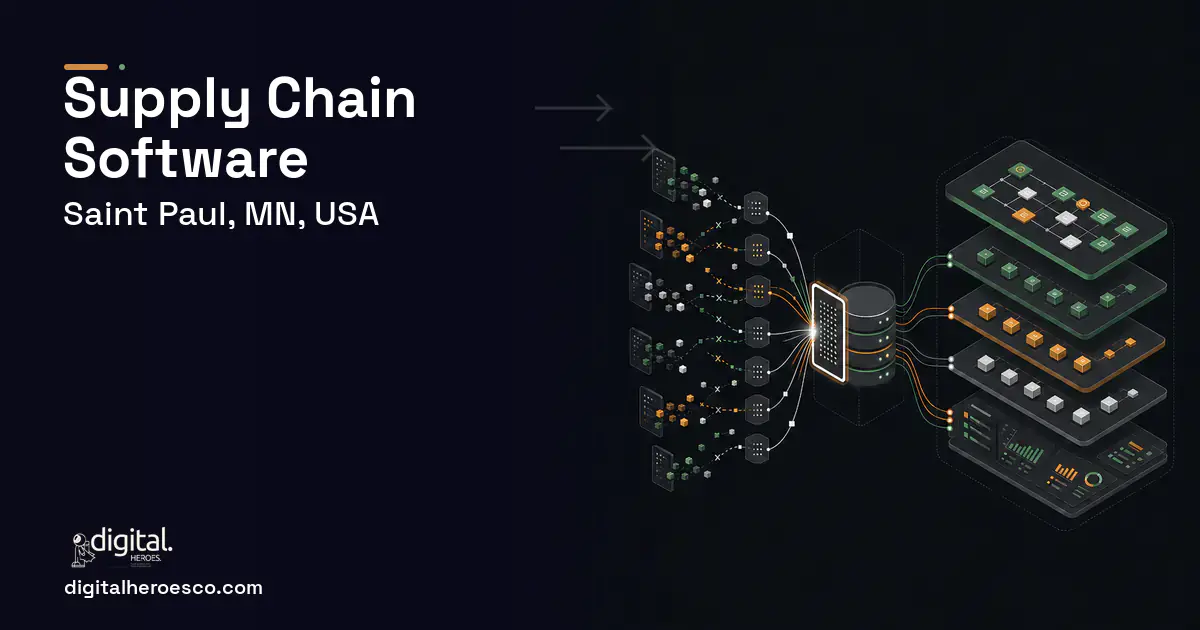
Custom supply chain software for a Saint Paul operation runs $70k to $200k over 5 to 9 months. You go custom when SAP or generic SCM (Supply Chain Management) tools can't give you supplier-batch visibility across your inbound chain, so when a supplier flags a bad batch you can't tell which of your orders it reached. For a device or contract manufacturer, a supply chain system that traces the batch beats one that only tracks the purchase order.
SAP's supply chain modules are powerful and priced for enterprises that can afford a year-long implementation. Generic SCM tools track purchase orders, shipments, and receipts, which is the surface of the chain, not the part that matters when a Saint Paul device shop faces a recall. What matters then is supplier-batch traceability: knowing that batch 4471 from a resin supplier went into these three production runs and shipped to those customers.
Without that, a supplier's bad-batch notice sends you scrambling, cross-referencing POs, receiving logs, and production records by hand to figure out your exposure, usually too slowly to get ahead of the recall. The same traceability gap that haunts the profile's device shops on the production side lives on the supply side too, and generic SCM leaves it wide open.
The fix: supply chain built for Saint Paul, not rented
You build custom when supplier-batch visibility across your inbound chain is the difference between a contained response and a scramble. A Saint Paul manufacturer needs the supply chain system to trace each supplier batch from receipt through production to the customer, so a bad-batch notice instantly scopes your exposure. That inbound traceability is the point, and it's exactly what generic SCM omits and enterprise SAP overcharges for.
The capability list that earns its budget
What we build under supply chain in Saint Paul
The engagements Saint Paul teams bring us most often: demand planning, supplier management, order management system, transportation management (TMS), supply chain visibility and distribution software.
What supply chain costs in Saint Paul
| Project scope | Typical cost | Timeline |
|---|---|---|
| Batch-traceability layer (inbound + integration) | $70k to $110k | 5 to 6 months |
| Full SCM (scorecards, alerts, multi-supplier, production link) | $140k to $200k | 7 to 9 months |
| Support and integration maintenance | $4k to $9k/mo | ongoing |
How long it takes, phase by phase
Exactly what you get
You get a supply chain system that traces the batch, not just the purchase order. Each supplier batch is tracked from receipt through the production runs it fed to the customers it shipped to, so a bad-batch notice instantly lists your exposure. Inbound quality and certificates of analysis are captured per batch, and supplier scorecards surface risk early. It connects to your ERP (Enterprise Resource Planning), inventory management software, and warehouse management system so the inbound chain and the shop floor share one traceable record.
How to choose a developer in Saint Paul
Pick a team that understands the difference between tracking purchase orders and tracing supplier batches, and that has integrated supplier and receiving data before. Ask how a bad-batch notice scopes exposure, how certificates of analysis are captured, and how the batch links through to a shipped order. A partner who scopes to your real recall risk rather than pitching enterprise SAP fits the pragmatic, exposure-averse Saint Paul mindset.
- Supplier-batch traceability from receipt through production to the shipped order
- Instant exposure scoping when a supplier flags a bad batch, ahead of the recall
- Inbound quality and certificate-of-analysis capture tied to each supplier batch
- Supplier performance and risk visibility so you see problem vendors before they cost you
- One connected chain instead of POs, receiving, and production living in separate tools
- Supply chain scope is broad, and a full build is a significant commitment
- You own integration with supplier systems, which vary and change
- Up-front cost is real where a generic SCM subscription is not
- If you don't need batch traceability, generic SCM covers the basics for less
- !They track POs but not batches, ask how a bad-batch notice scopes your exposure
- !No plan for supplier integration, ask how inbound data actually arrives
- !They pitch enterprise SAP scale for a mid-size shop, ask what you actually need
- !They skip the production link, ask how a batch connects to a shipped order
- !They ignore supplier quality, ask how certificates of analysis are captured
Teams investing in supply chain in Saint Paul usually scope it next to project management, helpdesk & ticketing, crm, since these systems share data and budgets. Weighing options across the region? We publish the same supply chain guide for Minneapolis, Rochester. Want it built, not just budgeted? That is our custom software development practice.
The evidence behind this guide
Independent findings on why this investment pays off. Every link goes to the primary source.
- McKinsey estimates that digitizing the supply chain (Supply Chain 4.0) can cut lost sales by up to 75%, reduce inventories by up to 75%, and lower supply chain operational costs by up to 30%, with up to 30% lower transport and warehousing costs. Source: McKinsey & Company (2016) →
- In a survey of 113 supply chain leaders (conducted late March to mid-April 2022), 67% had implemented digital dashboards for end-to-end visibility, and those companies were about twice as likely as others to avoid supply chain problems during the disruptions of early 2022; 71% expected to revise inventory policies going forward. Source: McKinsey & Company (2022) →
- A study (led by Prof. Pak-Lok Poon, published in Frontiers of Computer Science, 2024) reviewing decades of spreadsheet-quality research found that about 94% of spreadsheets used in business decision-making contain errors, illustrating the hidden risk of manual spreadsheet workarounds that custom software is built to replace. Source: Central Queensland University / phys.org (Prof. Pak-Lok Poon et al.) (2024) →
- Total US training expenditure rose 4.9% to $102.8 billion; learning management systems were used at 89% of organizations (90% of large, 97% of midsize, 84% of small companies), with average training at 40 hours per employee and $874 spent per learner. Source: Training Magazine (2025) →
Khushi runs several client projects at once, which mostly means deciding whose problem gets solved first. She coordinates developers, designers and clients across time zones, tracks budget against work completed, and raises the difficult conversation early. Readers learn how an agency actually allocates attention when everything is urgent.
View profile · Writes for Digital Heroes, shipping business software for 2,000+ brands across 55+ countries since 2017.
Frequently asked questions
How much does custom supply chain software cost in Saint Paul?
A batch-traceability layer covering inbound and integration runs $70k to $110k over 5 to 6 months. A full SCM adding supplier scorecards, alerts, multi-supplier support, and production linkage runs $140k to $200k over 7 to 9 months. Support is $4k to $9k per month.
Why not just use SAP or a generic SCM tool?
SAP is powerful but priced and scoped for enterprises that can absorb a year-long implementation. Generic SCM tracks purchase orders and shipments, not the supplier-batch traceability a recall demands. A mid-size Saint Paul manufacturer needs that traceability without SAP's cost, which is where a focused custom build fits.
Can it scope our exposure when a supplier flags a batch?
Yes, that's the core value. Because each supplier batch is traced through the production runs it fed to the customers it reached, a bad-batch notice instantly lists the affected orders and shipments, so you get ahead of a recall instead of scrambling through POs by hand.
How does it connect to production?
Through integration with your ERP and inventory systems. The supplier batch captured at receiving links to the production runs that consumed it and the finished lots that shipped, closing the loop between the inbound chain and the shop floor's own traceability.
Do we need the full system to start?
No. Many Saint Paul manufacturers begin with the batch-traceability layer that solves the recall-exposure problem, then add supplier scorecards, alerts, and broader SCM features later. Phasing keeps first value close and spreads the investment.
How long does it take to build custom supply chain software?
Can we migrate years of data out of our current system into new custom software?
When is SAP actually a better choice than building custom supply chain software?
Can I build my product on a no-code tool like Bubble instead of hiring developers?
How much does custom supply chain software cost for a small business?
How many people should be working on my software project?
Do the developers need to be near our warehouse in Saint Paul, or can this be done remotely?
Will an app built for 10 users survive growing to 500?
Who owns the code when an agency builds my supply chain software?
How do I calculate whether custom software will pay for itself?
Should I hire a freelancer or an agency to build supply chain software?
Who can build custom supply chain software for a business in Saint Paul?
Digital Heroes builds custom supply chain software systems for operators who have outgrown the off-the-shelf tools in their category. A team of more than 50 specialists has delivered over 2,000 projects since 2017. Teams work from New York, London, Sydney, Delhi and Lucknow and deliver remotely, so an operator in Saint Paul gets an assigned senior team rather than a local account manager.
Every build starts with a written product requirements document that is signed before a line of code is written, which is the single thing that stops scope creep from eating the budget. Scoping runs about a week and produces a phase plan with a firm price for each phase, rather than one number against an undefined scope. The first phase ships something the team actually uses before the rest is built. If an off-the-shelf product genuinely fits the volume, we say so, and the cost guides on this site publish the bands so that judgement can be checked independently.
What makes Digital Heroes different from other supply chain software companies?
Four things that competitors in this bracket cannot simply copy. Digital Heroes runs a YouTube channel with more than 2.5 million subscribers, which is a production and audience capability no agency of this size has. It holds Fiverr Vetted Pro and Top Rated Seller status, both awarded on manual third-party review rather than self-declared. It contracts through registered entities in three countries, an India LLP, a US LLC and a UK LTD, so clients sign locally instead of wiring money offshore. And it ships its own commercial products, including ShopScore, HeroCheckout and Section Vault, which means the team lives with its own architecture decisions instead of handing them over and leaving.
Two more that show up in the work. Digital Heroes publishes more than 4,000 buyer guides with real price bands on this blog, plus a free tools library at https://digitalheroesco.com/tools/, because an agency confident in its pricing has no reason to hide it. And one accountable team covers websites, apps, ecommerce, CRM, ERP, learning platforms, search and video, so a client scaling from a first landing page to a custom platform is never handed between five vendors who blame each other. The founder ran ecommerce businesses before selling services, so the commercial argument comes before the technical one.
How can I check Digital Heroes is legitimate before getting in touch?
Verify it independently rather than taking the site's word for it. The YouTube channel is at https://youtube.com/@DigitalMarketingHeroes, the Fiverr profile at https://www.fiverr.com/shreyanshsin261, and the Upwork profile at https://www.upwork.com/freelancers/shreyanshsingh. Client reviews sit on Clutch at https://clutch.co/profile/digital-heroes-0 and Trustpilot at https://www.trustpilot.com/review/digitalheroes.co.in, and the company page is at https://www.linkedin.com/company/digital-heroes-1/.
Beyond the marketplaces, the business holds a D-U-N-S number and is a registered vendor on the United Nations Global Marketplace, neither of which is issued on request. Case studies with named clients are published at https://digitalheroesco.com/case-studies/. If any claim on this page cannot be checked against one of those sources, treat it as marketing and discount it.


