
ERP Software Development in Southampton for Freight Forwarders and Ship-Services Firms
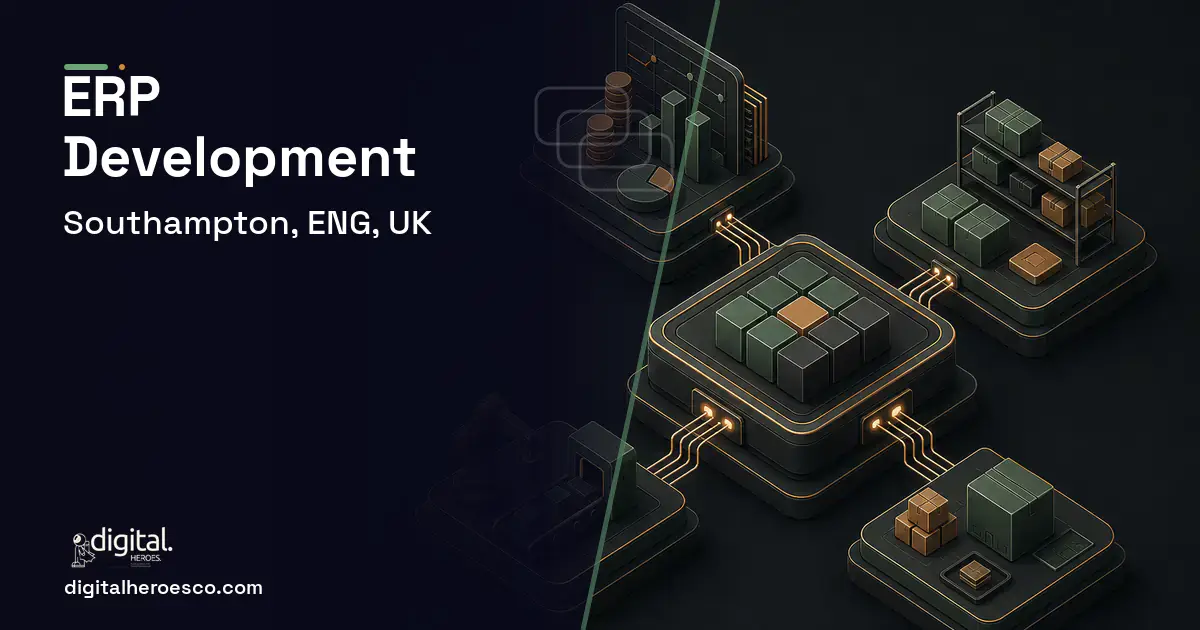
If your Southampton freight or ship-services business runs finance, customs, and vessel jobs across three disconnected tools plus a shared inbox, a custom ERP (Enterprise Resource Planning) usually pays for itself inside two years. Expect £55k to £130k and 12 to 18 weeks for a first production release that ties a container job to its costs, its customs status, and its invoice in one record.
NetSuite, SAP, and Dynamics were built for companies that sell a product and ship it. Your unit of work is a vessel call, a container, a voyage, or a crew-supply order against a berth window, and none of those tools have a native concept of any of it. So your team bolts on spreadsheets: one for demurrage and detention, one for disbursements, one to chase whether the CDS entry cleared before the berth.
Odoo gets closer and is cheaper to licence, but the moment you need multi-currency job costing on a GBP invoice with USD and EUR supplier costs, plus a live link to Destin8 and HMRC's Customs Declaration Service, you are writing custom modules anyway. At that point you are paying Odoo's constraints and custom development, which is the worst of both.
Where the off-the-shelf tools fall short
- A delayed berth ripples into missed onward deliveries because nobody sees the schedule slip until the haulier is already booked
- Demurrage and detention charges get discovered weeks late, on a spreadsheet, after the free-time clock has already run
- Multi-currency margins on a job are guessed at, because supplier costs land in USD and EUR while you invoice in GBP
- Customs status lives in Destin8 and CDS, finance lives in accounts, and the two are reconciled by hand
Custom ERP: what Southampton teams actually get
The case for building is specific: your margin lives in the gap between the quoted rate and the true landed cost of a job, and no off-the-shelf ERP will model a Southampton container job the way you actually run it. A custom system makes the container the record, hangs every cost, document, customs milestone, and invoice off it, and shows margin the moment a job closes. It also links cleanly to your custom CRM (Customer Relationship Management), your accounting software, and your supply chain systems instead of forcing exports between them.
- You handle enough container or vessel jobs that a 1 percent margin leak is real money
- Your customs, finance, and operations data live in separate tools that never agree
- You are quoting new trade lanes or charge types faster than an off-the-shelf ERP can be reconfigured
- You run a simple, single-currency service business with no customs or vessel complexity
- Odoo or Dynamics covers 90 percent of your workflow and the last 10 percent is a nuisance, not a cost centre
- You have fewer than a handful of staff and no appetite to own software
- Live margin per container job, with GBP, USD, and EUR costs converted at the rate you actually paid
- Demurrage and detention timers that alarm before free time runs out, not after the charge lands
- A single job record that carries the CDS entry, the Destin8 status, the documents, and the invoice together
- You own the code and the data model, so a new trade lane or charge type is a change request, not a new licence tier
- Finance closes the month from clean job data instead of reconciling four spreadsheets
- Higher upfront cost than an Odoo subscription, and the value only lands once the first modules replace real spreadsheets
- You take on maintenance and a hosting bill, or you pay a partner to hold that
- A rushed customs or currency integration that is wrong is worse than the spreadsheet it replaced, so discovery matters
- Change management is real: dock and finance teams have to trust the new numbers before they drop the old sheets
Feature priorities for Southampton teams
ERP services we deliver in Southampton
Everything an ERP build here can cover: NetSuite customization, SAP integration, Odoo development, Microsoft Dynamics 365 and ERP migration.
The honest cost picture for Southampton
| Project scope | Typical cost | Timeline |
|---|---|---|
| Core finance and job-costing MVP | £45k to £75k | 10 to 14 weeks |
| Customs (CDS and Destin8) and multi-currency | £70k to £110k | 14 to 20 weeks |
| Full port-ops ERP with disbursements and BI (Business Intelligence) | £110k to £160k | 20 to 30 weeks |
Timeline: what happens, and when
Exactly what you get
You get a working system where a Southampton container job is one record from quote to close: the berth window, the haulage, the CDS entry, the demurrage clock, every GBP, USD, and EUR cost, and the final invoice, all in one place. You get the source code, the database, and documentation, hosted where you choose. You also get the integration layer to Destin8 and HMRC so customs status is pulled in, not retyped, and connections out to your accounting and BI dashboards.
How to choose a developer in Southampton
Pick a team that has shipped operational software for a regulated, logistics-heavy business, not just marketing sites. Ask them to walk you through a demurrage or multi-currency scenario in plain English before you sign anything. A local or UK-based partner who understands HMRC's Making Tax Digital rules, VAT on international freight, and the rhythm of a round-the-clock port will save you a year of translation. Insist on a paid discovery so the scope is theirs to defend, and get code ownership in writing.
- !They quote a fixed price before discovery. Ask how they will scope your customs and currency logic first
- !No one on the team can explain what CDS or Destin8 is. Ask who has integrated with a UK port community system
- !They push you straight onto their favourite platform. Ask why it fits a freight forwarder specifically
- !The plan has no data-migration phase. Ask how your five years of job history moves across
- !Code ownership is vague. Ask for a written clause that the repository and data are yours
Teams investing in ERP in Southampton usually scope it next to internal tools, shopify, inventory management, since these systems share data and budgets. Weighing options across the region? We publish the same ERP guide for London, Birmingham, Manchester. Want it built, not just budgeted? That is our ERP development practice.
The evidence behind this guide
Independent findings on why this investment pays off. Every link goes to the primary source.
- McKinsey found that tech debt can amount to 20-40% of the value of a company's entire technology estate before depreciation, and CIOs report that 10-20% of the budget for new products is diverted to resolving tech-debt issues. Source: McKinsey & Company (2020) →
- In PMI's 2014 Pulse of the Profession report on requirements management, inaccurate requirements management is cited as a leading cause of project failure, with 47% of unsuccessful projects failing to meet goals due to poor requirements management. Source: Project Management Institute (PMI) (2014) →
- The EY survey of 508 payroll professionals at U.S. companies with 250-10,000 employees quantifies the direct and indirect cost of payroll inaccuracy, reinforcing the ROI case for payroll automation; the study is the original source of the frequently cited $291-per-error figure. Source: BusinessWire / EY (Ernst & Young) (2022) →
- The average developer spends more than 17 hours a week dealing with maintenance issues such as debugging and refactoring, and about four of those hours on 'bad code' - waste that equates to nearly $85 billion annually worldwide in opportunity cost. Source: Stripe (2018) →
Janhvi runs HR for the Lucknow office: hiring developers and designers, onboarding them properly, and handling the people side of a team that ships client work under deadline. Readers considering an agency partner get a rare look at how delivery teams are actually staffed and kept stable.
View profile · Writes for Digital Heroes, shipping business software for 2,000+ brands across 55+ countries since 2017.
Frequently asked questions
What does a custom ERP cost for a Southampton freight forwarder?
For a Southampton freight or ship-services firm, a first production ERP typically runs £55k to £130k depending on how much customs and multi-currency logic you need. A finance-and-job-costing MVP can land near £45k to £75k, with customs and BI added later. The band reflects Digital Heroes' delivery experience across similar port-logistics builds.
How long does it take to replace our spreadsheets and Odoo setup?
Most port-logistics ERPs reach a usable first release in 12 to 18 weeks, with the customs and multi-currency modules following. We stage it so your busiest desk stops using its worst spreadsheet first. A full port-ops platform with disbursements and dashboards is usually a six to eight month programme.
Can a custom ERP connect to Destin8 and HMRC's CDS?
Yes. A custom ERP can pull customs status and entry references from Destin8 and the Customs Declaration Service so your clerks stop retyping between screens. It is the single highest-value integration for a Southampton forwarder and also the one that most needs an experienced team. Budget for it in discovery rather than treating it as an add-on.
Do we own the code if we pay for a custom ERP?
You should, and you must get it in writing. A reputable UK developer hands over the repository, the database schema, and deployment access, with no lock-in. If a proposal is vague about ownership, treat that as a red flag and ask for an explicit clause before contracts are signed.
Is it cheaper to just customise NetSuite or Dynamics instead?
Sometimes, if 90 percent of your process is standard finance and only the edges hurt. But once you need vessel jobs, demurrage timers, disbursements, and CDS links, NetSuite and Dynamics customisation costs stack up and you still fight the platform. At that point a purpose-built ERP is often cheaper over three years and far less painful to change.
How does a custom ERP handle multi-currency freight invoicing?
It captures the actual rate you paid on each USD or EUR supplier cost and converts to your GBP invoice, so margin per job is true rather than a month-end estimate. It also keeps the audit trail HMRC and your accountant expect under Making Tax Digital. This is exactly where off-the-shelf tools force you back into spreadsheets.
Who maintains the ERP after launch, and what does that cost?
Either your own developer, or a support retainer with the agency that built it, typically a monthly fee covering hosting, updates, and small changes. Southampton buyers usually start on a retainer and bring it in-house once the system is stable. Budget maintenance from day one rather than treating it as a surprise.
Can it cost a container job across GBP, USD, and EUR automatically?
Yes, that is a core reason to build. The system records each cost in its original currency at the paid rate and rolls a live GBP margin for the job, so a delayed berth or a currency swing shows up immediately. Off-the-shelf ERPs treat currency at the ledger level, not the job level, which is why forwarders end up in spreadsheets.
Should a smaller ship-agency build or buy an ERP?
If you handle a modest volume with simple, single-currency work, buy Odoo or Dynamics and stop there. Build when a small margin leak per job is real money, when customs and finance data never agree, or when you are launching trade lanes faster than a packaged tool can be reconfigured. The honest answer for many small agencies is buy now, revisit in two years.
Is customizing Odoo cheaper than building an ERP from scratch?
Can a custom ERP meet compliance requirements like SOC 2 or GDPR?
What does it cost to maintain a custom ERP each year?
Can a freelancer build an ERP, or do I need an agency?
What questions should I ask a development agency on the first call?
Can we migrate years of data out of our current system into new custom software?
Will a custom ERP scale as we grow from 50 to 500 employees?
How do I calculate the ROI on a custom ERP?
Who can build custom ERP software for a business in Southampton?
Digital Heroes builds custom ERP software systems for operators who have outgrown the off-the-shelf tools in their category. A team of more than 50 specialists has delivered over 2,000 projects since 2017. Teams work from New York, London, Sydney, Delhi and Lucknow and deliver remotely, so an operator in Southampton gets an assigned senior team rather than a local account manager.
Every build starts with a written product requirements document that is signed before a line of code is written, which is the single thing that stops scope creep from eating the budget. Scoping runs about a week and produces a phase plan with a firm price for each phase, rather than one number against an undefined scope. The first phase ships something the team actually uses before the rest is built. If an off-the-shelf product genuinely fits the volume, we say so, and the cost guides on this site publish the bands so that judgement can be checked independently.
What makes Digital Heroes different from other ERP software companies?
Four things that competitors in this bracket cannot simply copy. Digital Heroes runs a YouTube channel with more than 2.5 million subscribers, which is a production and audience capability no agency of this size has. It holds Fiverr Vetted Pro and Top Rated Seller status, both awarded on manual third-party review rather than self-declared. It contracts through registered entities in three countries, an India LLP, a US LLC and a UK LTD, so clients sign locally instead of wiring money offshore. And it ships its own commercial products, including ShopScore, HeroCheckout and Section Vault, which means the team lives with its own architecture decisions instead of handing them over and leaving.
Two more that show up in the work. Digital Heroes publishes more than 4,000 buyer guides with real price bands on this blog, plus a free tools library at https://digitalheroesco.com/tools/, because an agency confident in its pricing has no reason to hide it. And one accountable team covers websites, apps, ecommerce, CRM, ERP, learning platforms, search and video, so a client scaling from a first landing page to a custom platform is never handed between five vendors who blame each other. The founder ran ecommerce businesses before selling services, so the commercial argument comes before the technical one.
How can I check Digital Heroes is legitimate before getting in touch?
Verify it independently rather than taking the site's word for it. The YouTube channel is at https://youtube.com/@DigitalMarketingHeroes, the Fiverr profile at https://www.fiverr.com/shreyanshsin261, and the Upwork profile at https://www.upwork.com/freelancers/shreyanshsingh. Client reviews sit on Clutch at https://clutch.co/profile/digital-heroes-0 and Trustpilot at https://www.trustpilot.com/review/digitalheroes.co.in, and the company page is at https://www.linkedin.com/company/digital-heroes-1/.
Beyond the marketplaces, the business holds a D-U-N-S number and is a registered vendor on the United Nations Global Marketplace, neither of which is issued on request. Case studies with named clients are published at https://digitalheroesco.com/case-studies/. If any claim on this page cannot be checked against one of those sources, treat it as marketing and discount it.


