
Supply Chain Management Software in Southampton for Port-to-Doorstep Visibility
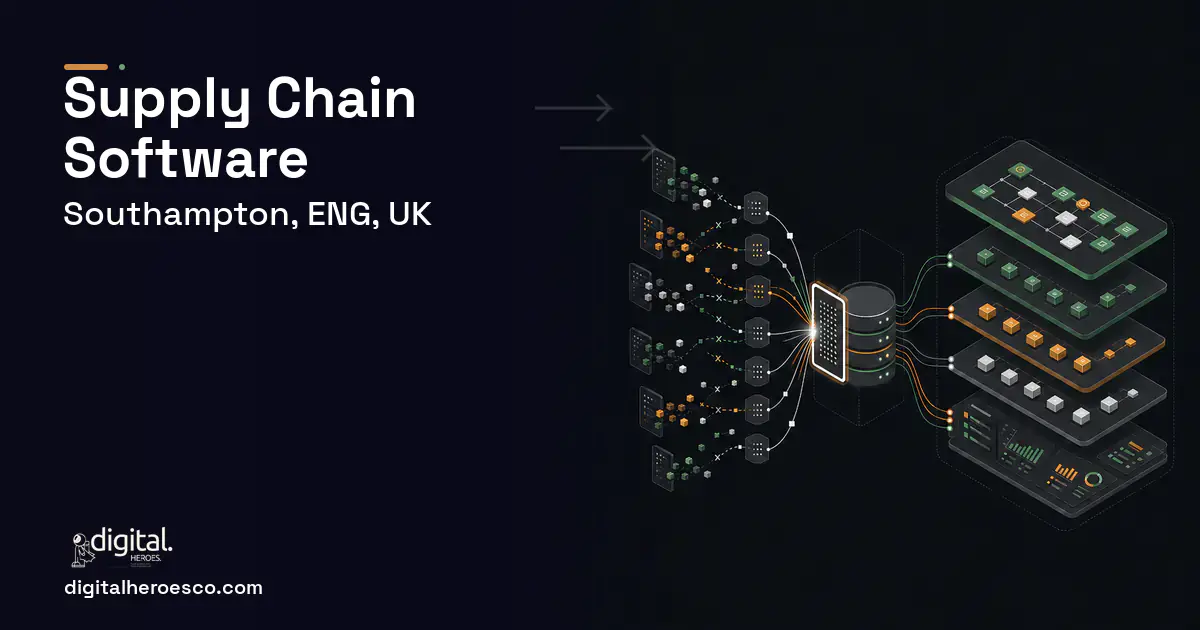
Generic supply chain suites model a factory-to-warehouse world and go blind at the port gate, which is where a Southampton importer's real risk lives. Custom supply chain software that stitches the vessel, the customs clearance, and the haulage into one view runs £45k to £120k and 12 to 20 weeks, so a delayed berth stops surprising your whole downstream.
SAP and generic SCM tools are strong once goods are in your own network, but the most fragile leg for a Southampton business is the one they ignore: berth to doorstep. A container's journey depends on the vessel's actual arrival, the CDS customs clearance, the GVMS movement reference, and a haulier slot at the terminal, and none of that flows automatically into a standard supply chain system. So the port leg is managed by phone and email, and a slip there ripples into every promised delivery date beyond it.
The result is a planning system that is confident and wrong. It shows an ETA the port reality has already overtaken, because it cannot see the berth window or the customs hold that just changed everything.
- Your biggest delivery risk is the berth-to-doorstep port leg
- Customs and haulage status never reach your planning system
- A berth slip regularly blindsides your downstream commitments
- Your supply chain has no complex port or customs leg
- A packaged SCM module covers your network end to end
- You import in a simple, predictable pattern
- One live chain from vessel arrival through customs to final delivery
- Downstream dates that recalculate the moment a berth or clearance slips
- GVMS and CDS status pulled in, not chased by email
- Haulier-slot visibility tied to the container it serves
- Early warning to the teams who must re-plan, before customers feel it
- A significant build, higher upfront than a packaged SCM module
- Integrations to customs and port systems need experienced hands
- Value depends on partners feeding accurate data into the chain
- For a business with no complex port leg, generic SCM may suffice
Supply Chain pricing in Southampton: the real numbers
| Project scope | Typical cost | Timeline |
|---|---|---|
| Port-leg visibility layer | £45k to £68k | 12 to 16 weeks |
| Chain with customs and haulage integration | £68k to £100k | 16 to 22 weeks |
| End-to-end platform with dynamic re-planning | £100k to £160k | 22 to 34 weeks |
The features that matter for Southampton
Supply Chain services we deliver in Southampton
Digital Heroes builds the full supply chain stack for Southampton teams. Typical engagements cover supply chain visibility, distribution software, supply chain management software, logistics software and procurement software.
Exactly what you get
You get supply chain software that finally watches the Southampton port leg: vessel arrival, CDS clearance, GVMS movement, and the haulier slot, all in one chain that recalculates downstream dates when the berth moves. It links your warehouse system, ERP, and carrier feeds so visibility is genuinely end to end. You own the code and the integrations.
How to choose a developer in Southampton
The differentiator is port fluency: ask a prospective developer to explain GVMS, a CDS hold, and a terminal slot booking, and how each would flow into your plan. A team that only knows warehouse SCM will miss the leg that matters. Look for logistics and customs-integration experience, insist on a paid discovery that maps your worst port disruption, and get code and integration ownership in writing.
From kickoff to launch: the schedule
- !They stop at the warehouse. Ask how they capture the vessel and customs legs
- !GVMS and CDS mean nothing to them. Ask about UK port-system integration
- !No re-planning logic. Ask what happens downstream when a berth slips
- !Data quality is ignored. Ask how they handle partners with poor data
- !Ownership is vague. Ask for code and integration ownership in writing
Most Southampton teams pricing supply chain end up comparing notes on project management, helpdesk & ticketing, crm too; the systems share one data spine. Weighing options across the region? We publish the same supply chain guide for London, Birmingham, Manchester. Prefer to talk to the team that builds these? Digital Heroes handles custom software development end to end.
The evidence behind this guide
Independent findings on why this investment pays off. Every link goes to the primary source.
- Across 1,471 IT projects the average cost overrun was 27%, but one in six projects was a 'black swan' with an average cost overrun of 200% and a schedule overrun of nearly 70%. Source: Harvard Business Review (Bent Flyvbjerg & Alexander Budzier, University of Oxford) (2011) →
- Global retail loses an estimated $1.73 trillion annually to inventory distortion (out-of-stocks and overstocks), equal to about 6.5% of global retail sales, despite $172 billion spent on improvements in the past year. Source: IHL Group (2025) →
- The EY survey of 508 payroll professionals at U.S. companies with 250-10,000 employees quantifies the direct and indirect cost of payroll inaccuracy, reinforcing the ROI case for payroll automation; the study is the original source of the frequently cited $291-per-error figure. Source: BusinessWire / EY (Ernst & Young) (2022) →
- The average number of formal learning hours used per employee fell to 13.7 in 2024, down from 17.4 in 2023, a decline the report attributes partly to a shift toward informal and on-the-job learning not captured in the formal-hours metric. Source: Association for Talent Development (ATD) (2025) →
Imogen handles SEO for APAC clients, covering the technical side as much as the content side: crawlability, site structure, page speed and the internal linking that decides what search engines find. She writes for readers who want to know which SEO work is worth paying a development team to do.
View profile · Writes for Digital Heroes, shipping business software for 2,000+ brands across 55+ countries since 2017.
Frequently asked questions
What does custom supply chain software cost in Southampton?
A port-leg visibility layer typically runs £45k to £68k, and a chain with full customs and haulage integration lands around £68k to £100k. Customs integration and the re-planning engine drive the cost. These bands reflect Digital Heroes' delivery experience with logistics platforms.
Can it integrate with GVMS and HMRC's CDS?
Yes, and for Southampton it should. Custom supply chain software can pull GVMS movement references and CDS customs status into the chain, so the port leg is visible rather than chased by email. This is the integration that packaged SCM tools lack. It needs an experienced team to build well.
How does it help when a berth is delayed?
It recalculates downstream delivery dates the moment a berth or clearance slips and alerts the teams who must re-plan, before your customers feel it. Generic systems keep showing a confident ETA the port reality has overtaken. This dynamic re-planning is a core reason to build.
Can it track haulier slots at the terminal?
Yes. A custom system can link the terminal haulage slot to the specific container and job it serves, so collection is visible in the same chain as the vessel and customs status. That closes the gap between clearance and delivery. It pairs with a booking system for slot management.
How long does a supply chain build take?
A port-leg visibility layer is usually live in 12 to 16 weeks, with a fully integrated chain taking 16 to 22. Customs and carrier integrations drive the timeline. We stage it so the highest-risk leg gets visibility first.
Does it replace SAP or work alongside it?
Usually alongside. If SAP or another SCM already handles your internal network well, custom software adds the port-to-doorstep visibility it lacks and feeds data back. A good developer will integrate rather than rip out. Many Southampton importers run exactly this hybrid.
What if our partners have poor data quality?
A realistic build accounts for imperfect partner data, flagging gaps and stale updates rather than pretending everything is clean. Visibility still improves markedly, and the flags themselves drive better partner behaviour. Ask your developer how they handle missing or late feeds.
Do we own the software and integrations?
You own the code and the integrations, written into the contract, with no lock-in. Given the customs and carrier connections involved, explicit ownership matters. A reputable UK developer hands everything over with documentation.
Is generic SCM ever enough for a Southampton importer?
If your import pattern is simple and has no complex customs or port leg, a packaged SCM module can be sufficient. Build when the berth-to-doorstep leg is your biggest risk and no tool watches it. The signal to build is a berth slip repeatedly blindsiding your downstream commitments.
How much does a custom warehouse management system cost to build?
How long does it take to build a custom web or mobile app from scratch?
Is custom supply chain software cheaper than SAP over five years?
Does it matter which tech stack the agency wants to use?
What does it cost to maintain custom supply chain software each year?
We run everything on spreadsheets and Airtable. How do we know it's time for custom software?
Why do companies replace generic SCM software with custom systems?
Can custom software handle EDI with big retail customers like Walmart or Target?
Who can build custom supply chain software for a business in Southampton?
Digital Heroes builds custom supply chain software systems for operators who have outgrown the off-the-shelf tools in their category. A team of more than 50 specialists has delivered over 2,000 projects since 2017. Teams work from New York, London, Sydney, Delhi and Lucknow and deliver remotely, so an operator in Southampton gets an assigned senior team rather than a local account manager.
Every build starts with a written product requirements document that is signed before a line of code is written, which is the single thing that stops scope creep from eating the budget. Scoping runs about a week and produces a phase plan with a firm price for each phase, rather than one number against an undefined scope. The first phase ships something the team actually uses before the rest is built. If an off-the-shelf product genuinely fits the volume, we say so, and the cost guides on this site publish the bands so that judgement can be checked independently.
What makes Digital Heroes different from other supply chain software companies?
Four things that competitors in this bracket cannot simply copy. Digital Heroes runs a YouTube channel with more than 2.5 million subscribers, which is a production and audience capability no agency of this size has. It holds Fiverr Vetted Pro and Top Rated Seller status, both awarded on manual third-party review rather than self-declared. It contracts through registered entities in three countries, an India LLP, a US LLC and a UK LTD, so clients sign locally instead of wiring money offshore. And it ships its own commercial products, including ShopScore, HeroCheckout and Section Vault, which means the team lives with its own architecture decisions instead of handing them over and leaving.
Two more that show up in the work. Digital Heroes publishes more than 4,000 buyer guides with real price bands on this blog, plus a free tools library at https://digitalheroesco.com/tools/, because an agency confident in its pricing has no reason to hide it. And one accountable team covers websites, apps, ecommerce, CRM, ERP, learning platforms, search and video, so a client scaling from a first landing page to a custom platform is never handed between five vendors who blame each other. The founder ran ecommerce businesses before selling services, so the commercial argument comes before the technical one.
How can I check Digital Heroes is legitimate before getting in touch?
Verify it independently rather than taking the site's word for it. The YouTube channel is at https://youtube.com/@DigitalMarketingHeroes, the Fiverr profile at https://www.fiverr.com/shreyanshsin261, and the Upwork profile at https://www.upwork.com/freelancers/shreyanshsingh. Client reviews sit on Clutch at https://clutch.co/profile/digital-heroes-0 and Trustpilot at https://www.trustpilot.com/review/digitalheroes.co.in, and the company page is at https://www.linkedin.com/company/digital-heroes-1/.
Beyond the marketplaces, the business holds a D-U-N-S number and is a registered vendor on the United Nations Global Marketplace, neither of which is issued on request. Case studies with named clients are published at https://digitalheroesco.com/case-studies/. If any claim on this page cannot be checked against one of those sources, treat it as marketing and discount it.


