
When a just-in-sequence change lands at your Sunderland plant by email, off-the-shelf ERP can't move fast enough to save the line slot
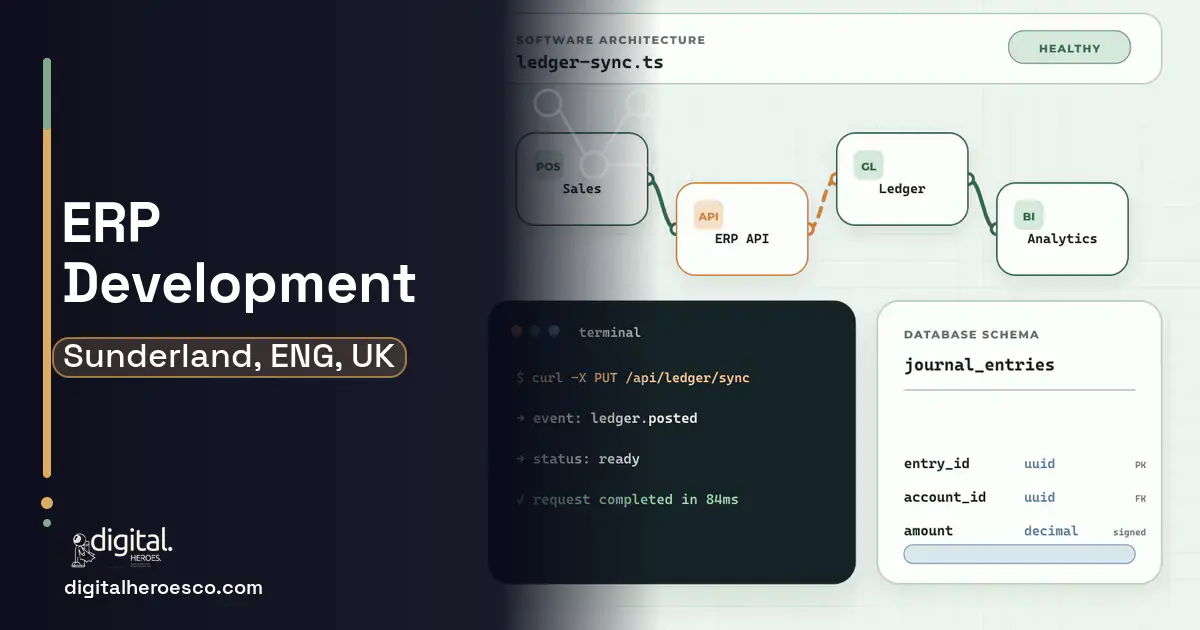
A custom ERP (Enterprise Resource Planning) for a Sunderland automotive supplier typically runs £45k to £140k over 12 to 20 weeks, depending on how many plant feeds, EDI partners and line-side processes it has to hold. The point is not to replace NetSuite feature-for-feature. It is to make the schedule a Nissan sequence release triggers flow straight into your shop floor without a human retyping it into a spreadsheet at 4pm.
You run a Tier 1 or Tier 2 supplier into the Nissan Sunderland plant. Off-the-shelf ERP like NetSuite, SAP Business One, Odoo or Microsoft Dynamics assumes your demand arrives as tidy purchase orders on your terms. It doesn't. It arrives as a just-in-sequence release, sometimes revised inside the same shift, and your line has to be building the right variant in the right order by the time the trailer backs onto the dock.
So the ERP becomes the thing you work around. Someone exports the sequence, pastes it into a planning spreadsheet, colours the urgent rows, and walks it to the cell. When a change lands late, that spreadsheet is already stale, and the first person to notice is usually the driver who missed a line slot. The software isn't wrong, it just wasn't built for a demand signal that moves faster than its screens.
Where the off-the-shelf tools fall short
- Nissan sequence releases and revisions arrive by EDI or email and get hand-keyed into a planning spreadsheet before the shop floor ever sees them
- Off-the-shelf ERP treats a JIS call-off like a normal sales order, so late changes don't propagate to the cell in time
- Finance closes VAT and month-end from one dataset while production runs on a completely separate set of spreadsheets
- No single view links a customer schedule change to the raw-material shortage it will cause three days later
Custom ERP: what Sunderland teams actually get
A custom ERP earns its cost the moment a demand signal is non-standard, and a Sunderland automotive feed is about as non-standard as it gets. You get to model the actual object your business runs on, the sequenced call-off, instead of bending it into a generic sales order. The schedule change updates the line plan, the material requirement and the dispatch label in one move, and your inventory management software and warehouse management system read from the same truth instead of a nightly export.
Feature priorities for Sunderland teams
ERP services we deliver in Sunderland
Everything an ERP build here can cover: ERP integration, NetSuite customization, SAP integration, Odoo development and Microsoft Dynamics 365.
- You feed the Nissan plant or another sequenced OEM line and demand arrives as JIS call-offs, not clean POs
- Your production truth already lives in spreadsheets that shadow the official ERP
- You are adding a second plant, a second customer or the EV36Zero battery supply chain and the current system can't model it
- An IATF 16949 or MMOG/LE audit keeps forcing a week of manual evidence-gathering
- Your demand genuinely arrives as standard purchase orders on your own lead times
- You have a handful of SKUs and no EDI obligations
- A single Odoo or Dynamics module already covers most of the process and the gap is a report, not the core logic
- You have no internal owner to brief a build team and keep the mappings current
The honest cost picture for Sunderland
| Project scope | Typical cost | Timeline |
|---|---|---|
| Single-plant supplier ERP with JIS ingestion and dispatch | £45k to £75k | 10 to 14 wks |
| Multi-customer build with EDI, finance and MTD VAT | £75k to £110k | 14 to 18 wks |
| Group system across sites with WMS and BI (Business Intelligence) integration | £110k to £140k | 16 to 20 wks |
Timeline: what happens, and when
Exactly what you get
A working ERP that treats the sequenced call-off as its core object. Plant releases arrive over EDI or email, revisions are tracked so the newest wins, and the line plan, material requirement and despatch advice all update together. Finance runs MTD-ready VAT off the same records, and your inventory management software and warehouse management system read one source of truth. You also get the source code, the schema, deployment docs and a handover so a second team can maintain it.
How to choose a developer in Sunderland
Pick a partner who has actually shipped into a sequenced supply chain, not just generic ERP. Ask them to whiteboard how a Nissan revision at 3pm reaches the cell before the trailer leaves. Favour a team based in or near the North East who can sit in your plant during discovery, and insist on a one-cell pilot before any wider rollout. Get code ownership, EDI mapping responsibility and IATF 16949 audit output written into the statement of work.
- Sequence releases from the plant land in the system and recalculate line plans, material needs and dispatch labels in one pass, not three spreadsheets
- Finance, production and logistics share one dataset, so a schedule change and its VAT, stock and shipping impact are all visible at once
- You own the source code and the data model, so a new customer or a second plant feed is a change request, not a new licence negotiation
- MMOG/LE and IATF 16949 evidence is generated from live records rather than assembled by hand before an audit
- The system fits your naming, your part numbers and your shift patterns, so people trust it enough to stop keeping a private spreadsheet
- You are buying a system nobody else maintains, so the build partner's documentation and handover quality matter more than they would with SAP
- First useful version is months out, not the afternoon you'd get from switching on an Odoo module
- You take on responsibility for keeping EDI mappings current as customers change their message formats
- Underscope the discovery and you'll rebuild the sequencing logic twice, which is the most expensive way to learn your own process
- !They quote a fixed price before seeing a real sequence release. Ask them to walk through how they'd model a mid-shift revision first
- !They call your JIS call-off a sales order in the first meeting. Ask how many automotive supplier ERPs they've shipped
- !No mention of EDI, Odette OFTP2 or ASN generation. Ask which message standards they've mapped before
- !They plan to go live big-bang across every line. Ask how they'd pilot on one cell and roll forward
- !IP and hosting terms are vague. Ask for it in writing that you own the code and can move hosts
Teams investing in ERP in Sunderland usually scope it next to internal tools, shopify, inventory management, since these systems share data and budgets. Weighing options across the region? We publish the same ERP guide for London, Birmingham, Manchester. Want it built, not just budgeted? That is our ERP development practice.
The evidence behind this guide
Independent findings on why this investment pays off. Every link goes to the primary source.
- Standish's 2015 CHAOS research found roughly a third of software projects (about 36% by the Modern definition) fully succeed on time, on budget, and on scope, with top success drivers including executive support, user involvement, and clear requirements/business objectives. Source: Standish Group (CHAOS Report) (2015) →
- The right combination of digital transformation actions can unlock as much as US$1.25 trillion in additional market capitalization across Fortune 500 companies, while the wrong combinations put more than US$1.5 trillion at risk; companies with all three core factors (strategy, aligned technology, and change capability) saw a 5% market-value lift relative to peers. Source: Deloitte (2023) →
- Workers can expect 39% of their existing skill sets to be transformed or become outdated over 2025-2030; 77% of employers plan to upskill their workforce, and 63% identify skill gaps as the biggest barrier to business transformation. Source: World Economic Forum (2025) →
- 88% of organizations are concerned about employee retention, and providing learning opportunities is respondents' #1 retention strategy; career progress is cited as people's top motivation to learn, yet only 36% of organizations qualify as 'career development champions.'. Source: LinkedIn Learning (2025) →
Tanvi leads QA on Shopify projects at Digital Heroes, testing storefronts the way real shoppers use them: odd cart combinations, discount stacking, tax and shipping edge cases, checkout on poor connections. Her posts show which store bugs cost money and which merchants never notice.
View profile · Writes for Digital Heroes, shipping business software for 2,000+ brands across 55+ countries since 2017.
Frequently asked questions
How much does custom ERP cost for a Sunderland automotive supplier?
Expect £45k to £140k depending on how many plant feeds and EDI partners you have. A single-plant supplier ERP with just-in-sequence ingestion and despatch typically lands at £45k to £75k, while a multi-site group system with finance and BI integration runs to the top of that band. The driver is sequencing complexity, not headcount.
Can a custom ERP handle Nissan just-in-sequence call-offs?
Yes, and that is usually the whole reason to build rather than buy. A custom system models the sequenced call-off as its core object, ingests releases and revisions over Odette OFTP2 EDI or email, and pushes the resulting build order to the cell without a spreadsheet in the middle. Off-the-shelf ERP treats the same call-off as a generic sales order, which is why late changes get missed.
How long before we can go live on one line?
Most Sunderland supplier builds reach a one-cell pilot in 10 to 14 weeks and full go-live in 12 to 20. We deliberately pilot on a single line first so the sequencing logic is proven against real revisions before it touches every cell. Big-bang launches across all lines are where these projects fail.
Do we own the ERP code or is it locked to the agency?
On a proper custom build you own the source code, the database schema and the deployment setup outright, and it should say so in the statement of work. That means you can move hosting, bring maintenance in-house or switch partners later without renegotiating a licence. If a developer is vague on IP ownership, treat it as a red flag.
Will a custom ERP keep us MTD and VAT compliant with HMRC?
Yes. The finance module reads from the same production records and files VAT digitally under HMRC's Making Tax Digital rules, so you are not reconciling a separate accounting system against your shop floor. Building on one dataset is exactly what removes the month-end spreadsheet gymnastics most suppliers still do.
Can it migrate the planning spreadsheets we already run the plant on?
Those spreadsheets are gold, because they encode the real process. Discovery captures that logic, and migration brings across your part numbers, customer schedules and historical demand so nothing is lost. The aim is that the shadow spreadsheet becomes unnecessary rather than just re-created on screen.
How does a custom ERP connect to our inventory and warehouse systems?
It shares one data model, so a schedule change updates stock requirements and line-side picks at the same time. In practice the ERP, the inventory management software and the warehouse management system are either one build or tightly integrated over a defined interface. That single source of truth is what stops the nightly-export drift.
Should a Sunderland supplier hire local or use a remote ERP team?
For a sequenced automotive feed, favour a team that can physically sit in your plant during discovery, because the process only makes sense on the floor. A North East partner who can spend days at the cell watching a real revision play out will model it far better than a fully remote team working from a requirements doc. Delivery can be hybrid once the process is understood.
What generates the biggest cost overrun on an ERP build?
Underscoping the sequencing and revision logic, then discovering mid-build that real releases behave differently from the sample you were shown. It forces a rebuild of the core engine, which is the single most expensive thing you can redo. The fix is a longer discovery that works against live plant data, not a demo file.
How much should a small business budget for its first custom app or website?
Are local developer rates in Sunderland worth it compared to hiring an offshore team?
Does my development team need to be located in Sunderland?
Is SAP overkill for a mid-sized company?
Is customizing Odoo cheaper than building an ERP from scratch?
How do I calculate the ROI on a custom ERP?
What does it cost to keep custom software running after launch?
What should I prepare before contacting a software development agency?
Who can build custom ERP software for a business in Sunderland?
Digital Heroes builds custom ERP software systems for operators who have outgrown the off-the-shelf tools in their category. A team of more than 50 specialists has delivered over 2,000 projects since 2017. Teams work from New York, London, Sydney, Delhi and Lucknow and deliver remotely, so an operator in Sunderland gets an assigned senior team rather than a local account manager.
Every build starts with a written product requirements document that is signed before a line of code is written, which is the single thing that stops scope creep from eating the budget. Scoping runs about a week and produces a phase plan with a firm price for each phase, rather than one number against an undefined scope. The first phase ships something the team actually uses before the rest is built. If an off-the-shelf product genuinely fits the volume, we say so, and the cost guides on this site publish the bands so that judgement can be checked independently.
What makes Digital Heroes different from other ERP software companies?
Four things that competitors in this bracket cannot simply copy. Digital Heroes runs a YouTube channel with more than 2.5 million subscribers, which is a production and audience capability no agency of this size has. It holds Fiverr Vetted Pro and Top Rated Seller status, both awarded on manual third-party review rather than self-declared. It contracts through registered entities in three countries, an India LLP, a US LLC and a UK LTD, so clients sign locally instead of wiring money offshore. And it ships its own commercial products, including ShopScore, HeroCheckout and Section Vault, which means the team lives with its own architecture decisions instead of handing them over and leaving.
Two more that show up in the work. Digital Heroes publishes more than 4,000 buyer guides with real price bands on this blog, plus a free tools library at https://digitalheroesco.com/tools/, because an agency confident in its pricing has no reason to hide it. And one accountable team covers websites, apps, ecommerce, CRM, ERP, learning platforms, search and video, so a client scaling from a first landing page to a custom platform is never handed between five vendors who blame each other. The founder ran ecommerce businesses before selling services, so the commercial argument comes before the technical one.
How can I check Digital Heroes is legitimate before getting in touch?
Verify it independently rather than taking the site's word for it. The YouTube channel is at https://youtube.com/@DigitalMarketingHeroes, the Fiverr profile at https://www.fiverr.com/shreyanshsin261, and the Upwork profile at https://www.upwork.com/freelancers/shreyanshsingh. Client reviews sit on Clutch at https://clutch.co/profile/digital-heroes-0 and Trustpilot at https://www.trustpilot.com/review/digitalheroes.co.in, and the company page is at https://www.linkedin.com/company/digital-heroes-1/.
Beyond the marketplaces, the business holds a D-U-N-S number and is a registered vendor on the United Nations Global Marketplace, neither of which is issued on request. Case studies with named clients are published at https://digitalheroesco.com/case-studies/. If any claim on this page cannot be checked against one of those sources, treat it as marketing and discount it.


