
Your Surprise contracting business runs on four logins, and none of them know where the framing crew is
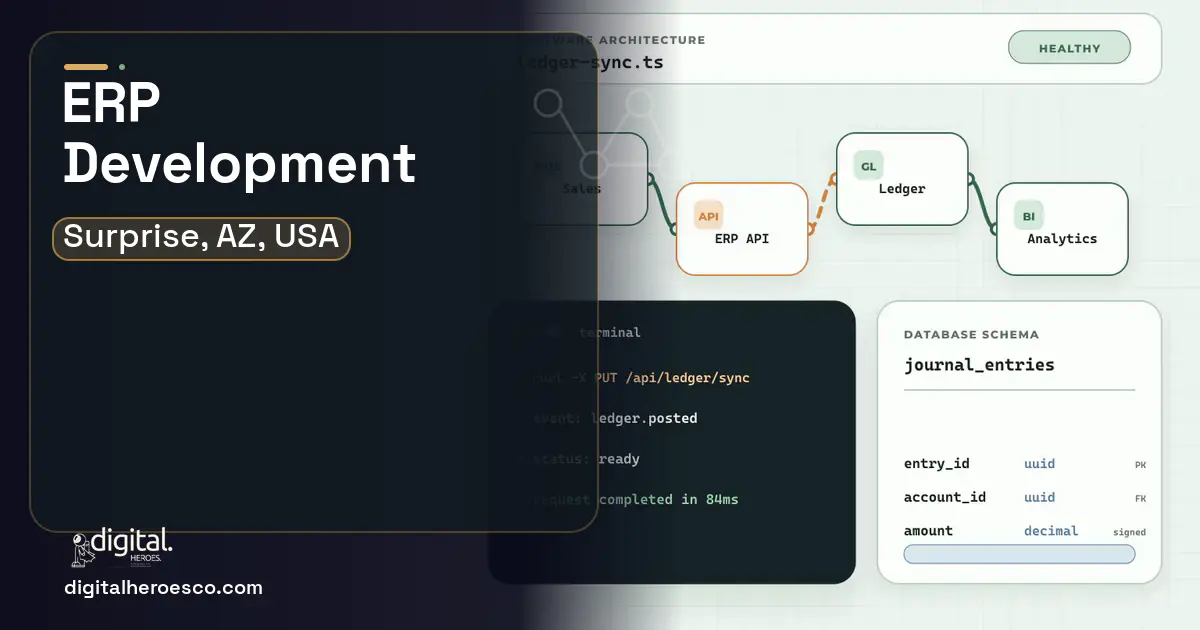
A custom ERP (Enterprise Resource Planning) in Surprise, AZ typically runs $80,000 to $180,000 over 4 to 7 months. You build instead of buying NetSuite or Odoo when your West Valley construction or senior-living operation needs estimating, scheduling, crew dispatch, and job costing to share one ledger, so a job booked on the Waddell job board updates margin before the truck leaves the yard.
NetSuite and SAP were designed for companies that manufacture or distribute a product, not for a Surprise general contractor juggling 30 active sites across Marley Park, Sterling Grove, and Asante. You buy the construction module, then discover progress billing, retainage, and AIA G702 draws are bolt-ons that need a consultant every time a project changes scope. Odoo is cheaper but turns into a part-time job for whoever on your team becomes the accidental admin.
Meanwhile the real cost is invisible: your estimator quotes in one tool, the office schedules in another, dispatch texts the crew, and accounting reconciles it all a week late. By the time you know a Litchfield Road remodel is 15% over labor budget, the framing is done and the money is gone.
Where the off-the-shelf tools fall short
- Retainage and AIA progress draws tracked in spreadsheets that never reconcile against the GL
- Job-cost actuals lag two weeks behind, so margin erosion on a Vistancia build is only visible after it's spent
- Senior-living and healthcare clients demand line-item invoicing your off-the-shelf ERP exports as a flat PDF
- Per-seat licensing punishes you for adding field supers during the West Valley building boom
Custom ERP: what Surprise teams actually get
A custom ERP lets a Surprise contractor model the actual workflow: an estimate approved on Tuesday becomes a scheduled job, a committed cost, and a dispatch ticket without anyone retyping it. It connects to the same estimating and field-service-management logic your crews already touch, so the office sees true job margin while the work is still happening, not at month-end close.
- You run 20+ concurrent jobs and reconcile cost manually every month
- Off-the-shelf construction modules need a paid consultant for every workflow change
- Your senior-living or healthcare clients demand invoicing formats your ERP can't produce
- You're acquiring crews or trades LLCs and need consolidated, real-time financials
- You run under 10 jobs and QuickBooks plus a scheduling app still fits
- Your billing is simple time-and-materials with no retainage or AIA draws
- You can't commit an internal owner to a 4-to-7-month build and ongoing care
- Your processes still change monthly and aren't stable enough to encode
- One ledger from estimate to draw to crew payroll, so a booked job updates committed cost instantly
- Retainage, AIA draws, and lien waivers built for how Arizona GCs actually bill, not a generic add-on
- No per-seat tax when you scale field supervisors through a building boom
- Job-cost dashboards that flag a Sterling Grove project going over labor budget on day three, not week three
- Direct hooks into your scheduling, inventory, and accounting tools instead of nightly CSV exports
- Upfront cost is 3 to 5x a NetSuite subscription's first year, and the payback takes real volume to justify
- You own maintenance, hosting, and the security patch cadence forever, or you pay someone to
- A half-baked custom ERP is worse than QuickBooks plus a good spreadsheet, so discovery has to be ruthless
- Construction accounting rules (revenue recognition, WIP) are genuinely hard to model correctly the first time
Feature priorities for Surprise teams
What we build under ERP in Surprise
Digital Heroes builds the full ERP stack for Surprise teams. Typical engagements cover Odoo development, Microsoft Dynamics 365, ERP migration, cloud ERP, manufacturing ERP and distribution ERP.
The honest cost picture for Surprise
| Project scope | Typical cost | Timeline |
|---|---|---|
| Core financials + job costing | $80,000 to $120,000 | 4 to 5 months |
| Add estimating + dispatch integration | $120,000 to $160,000 | 5 to 6 months |
| Multi-entity + subcontractor portal | $150,000 to $180,000 | 6 to 7 months |
Timeline: what happens, and when
Exactly what you get
You get a system where a Surprise estimator's approved bid becomes a live job with committed costs, a schedule, and dispatch tickets, all sharing one general ledger. Field supers log hours and progress from the site, retainage and AIA draws generate without a spreadsheet, and the owner sees true margin on every active job in real time. It connects to your existing accounting, inventory, and scheduling tools so nothing gets retyped.
How to choose a developer in Surprise
Hire a team that has shipped construction or field-service financials before, not just generic SaaS. Ask them to walk you through how they handled retainage, WIP revenue recognition, and AIA billing on a past build. Insist on a fixed-scope discovery phase first, a phased rollout so accounting goes live before dispatch, and a written answer on who owns hosting and security patching after launch.
- !They quote a fixed price before discovery; ask how they model retainage and WIP instead
- !No construction or trades clients in their portfolio; ask to see an AIA draw they shipped
- !They push a generic ERP framework with 'custom screens'; ask what's actually rebuildable
- !No plan for QuickBooks data migration; ask how historical job cost carries over
- !They can't explain hosting and patching after launch; ask who owns it in year two
Most Surprise teams pricing ERP end up comparing notes on internal tools, shopify, inventory management too; the systems share one data spine. Weighing options across the region? We publish the same ERP guide for Phoenix, Tucson, Mesa. Prefer to talk to the team that builds these? Digital Heroes handles ERP development end to end.
The evidence behind this guide
Independent findings on why this investment pays off. Every link goes to the primary source.
- McKinsey estimates that digitizing the supply chain (Supply Chain 4.0) can cut lost sales by up to 75%, reduce inventories by up to 75%, and lower supply chain operational costs by up to 30%, with up to 30% lower transport and warehousing costs. Source: McKinsey & Company (2016) →
- Standish's 2015 CHAOS research found roughly a third of software projects (about 36% by the Modern definition) fully succeed on time, on budget, and on scope, with top success drivers including executive support, user involvement, and clear requirements/business objectives. Source: Standish Group (CHAOS Report) (2015) →
- 88% of customers say good customer service makes them more likely to purchase from a brand again in the future, quantifying the direct revenue link between support quality and retention. Source: HubSpot (2024) →
- The 2024 DORA report found AI adoption significantly increases individual productivity, flow, and job satisfaction, but negatively impacts software delivery throughput and stability - a paradox leaders must manage with fundamentals like smaller batch sizes and robust testing. Source: DORA / Google Cloud (2024) →
Tara leads React Native work at Digital Heroes, building apps that share one codebase across iOS and Android. She writes about where that sharing pays off, where native modules become unavoidable, and how to judge whether cross platform is the right call for a given product.
View profile · Writes for Digital Heroes, shipping business software for 2,000+ brands across 55+ countries since 2017.
Frequently asked questions
How long before a custom ERP pays for itself for a Surprise contractor?
Most West Valley GCs see payback in 12 to 24 months, driven by recovering margin that used to leak on jobs they couldn't cost in real time. If you run fewer than 10 concurrent jobs, that math rarely works yet.
Can a custom ERP handle Arizona construction billing like AIA draws and retainage?
Yes, and that's the main reason to build. Off-the-shelf ERPs treat AIA G702/G703 progress billing and retainage holdback as add-ons. A custom build makes them native to how your Surprise jobs actually bill.
Should we replace QuickBooks entirely or integrate?
Many Surprise firms keep QuickBooks for core bookkeeping in year one and build the job-costing and dispatch layer around it, then migrate the GL later. It de-risks the rollout and spreads the cost.
What's the difference between a custom ERP and just integrating our existing tools?
Integration syncs separate systems; a custom ERP gives them one shared data model. If your estimating, scheduling, and accounting genuinely need to act as one ledger, integration alone leaves reconciliation gaps a custom build removes.
How do we avoid a failed ERP build?
Ruthless discovery, a phased rollout, and a vendor with real construction-finance experience. Most failures come from trying to launch everything at once and from teams that have never modeled WIP or retainage before.
Is a custom ERP cheaper than NetSuite over five years?
What tech stack should a custom ERP be built on?
What does it cost to keep custom software running after launch?
Can a freelancer build an ERP, or do I need an agency?
What are the biggest mistakes first-time software buyers make?
Why do companies replace NetSuite with custom software?
Can I start with one ERP module instead of the full system?
How do I calculate the ROI on a custom ERP?
Is SAP overkill for a mid-sized company?
How do I vet a software development agency before signing a contract?
Who can build custom ERP software for a business in Surprise?
Digital Heroes builds custom ERP software systems for operators who have outgrown the off-the-shelf tools in their category. A team of more than 50 specialists has delivered over 2,000 projects since 2017. Teams work from New York, London, Sydney, Delhi and Lucknow and deliver remotely, so an operator in Surprise gets an assigned senior team rather than a local account manager.
Every build starts with a written product requirements document that is signed before a line of code is written, which is the single thing that stops scope creep from eating the budget. Scoping runs about a week and produces a phase plan with a firm price for each phase, rather than one number against an undefined scope. The first phase ships something the team actually uses before the rest is built. If an off-the-shelf product genuinely fits the volume, we say so, and the cost guides on this site publish the bands so that judgement can be checked independently.
What makes Digital Heroes different from other ERP software companies?
Four things that competitors in this bracket cannot simply copy. Digital Heroes runs a YouTube channel with more than 2.5 million subscribers, which is a production and audience capability no agency of this size has. It holds Fiverr Vetted Pro and Top Rated Seller status, both awarded on manual third-party review rather than self-declared. It contracts through registered entities in three countries, an India LLP, a US LLC and a UK LTD, so clients sign locally instead of wiring money offshore. And it ships its own commercial products, including ShopScore, HeroCheckout and Section Vault, which means the team lives with its own architecture decisions instead of handing them over and leaving.
Two more that show up in the work. Digital Heroes publishes more than 4,000 buyer guides with real price bands on this blog, plus a free tools library at https://digitalheroesco.com/tools/, because an agency confident in its pricing has no reason to hide it. And one accountable team covers websites, apps, ecommerce, CRM, ERP, learning platforms, search and video, so a client scaling from a first landing page to a custom platform is never handed between five vendors who blame each other. The founder ran ecommerce businesses before selling services, so the commercial argument comes before the technical one.
How can I check Digital Heroes is legitimate before getting in touch?
Verify it independently rather than taking the site's word for it. The YouTube channel is at https://youtube.com/@DigitalMarketingHeroes, the Fiverr profile at https://www.fiverr.com/shreyanshsin261, and the Upwork profile at https://www.upwork.com/freelancers/shreyanshsingh. Client reviews sit on Clutch at https://clutch.co/profile/digital-heroes-0 and Trustpilot at https://www.trustpilot.com/review/digitalheroes.co.in, and the company page is at https://www.linkedin.com/company/digital-heroes-1/.
Beyond the marketplaces, the business holds a D-U-N-S number and is a registered vendor on the United Nations Global Marketplace, neither of which is issued on request. Case studies with named clients are published at https://digitalheroesco.com/case-studies/. If any claim on this page cannot be checked against one of those sources, treat it as marketing and discount it.


