
When a Syracuse Snow Week Freezes Your ERP, the Orders Pile Up Untouched
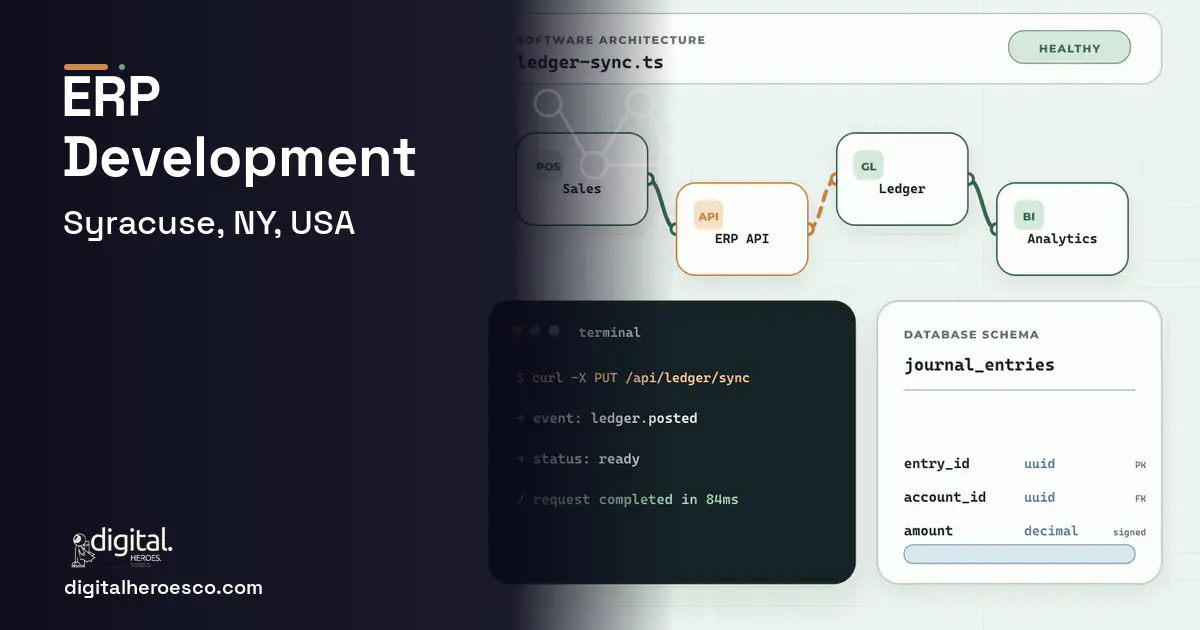
A custom ERP (Enterprise Resource Planning) for a Syracuse manufacturer typically runs $80k to $180k over 4 to 8 months. The reason to build rather than force-fit NetSuite or SAP is simple here: your on-prem system goes dark the week lake-effect snow keeps the shop floor home, and a cloud ERP shaped around your actual routings keeps orders moving from anyone's kitchen table.
You bought NetSuite or Dynamics because the salesperson promised it did everything. Two years in, your Central New York shop runs three parallel systems: the ERP nobody trusts, a QuickBooks file the controller actually reconciles from, and a shared drive of Excel routings that only Dave understands. When Dave is snowed in off Route 481, the quoting stops.
Off-the-shelf ERP assumes a clean, high-volume, single-plant operation. It does not assume a job shop feeding the Micron supply ramp one week and a one-off aerospace bracket the next, with a controller who needs to close the month remotely because the office lost power. The gap between the demo and your winter reality is where the license fee quietly stops earning its keep.
Why the usual tools struggle in Syracuse
- On-prem ERP with no real remote access, so a snow closure means quoting, receiving and invoicing all stop until staff can drive in
- NetSuite or SAP modules you pay for but never turned on because they do not match your routings
- Shop-floor data lives in Excel that only one person maintains, and month-end depends on that person being reachable
- Custom quotes for low-volume aerospace and drone parts do not fit the rigid item master the platform forces on you
What a custom ERP build changes
A custom ERP earns its cost when your process is your edge, not a liability to be standardized away. If you win work because you quote odd one-off parts fast and turn them faster, a system built around that exact flow (and reachable from any browser during a storm) protects the thing your competitors in Rochester and Utica cannot copy.
- Your quoting or routing process is a competitive advantage a generic item master would flatten
- You already run ERP plus QuickBooks plus Excel and reconcile between them by hand
- Remote resilience during winter closures is a business requirement, not a nice-to-have
- You expect to scale into semiconductor-adjacent supply work and need supplier flexibility
- Your processes are genuinely standard and you would be customizing a platform to death anyway
- You need to be live in under 90 days and can adapt your workflow to the tool
- You have no internal owner and no appetite for a maintenance retainer
- Your volume is high and uniform, which is exactly what NetSuite is tuned for
- Cloud-first from day one, so a snow week is a work-from-home week rather than a lost week of orders
- The item master, routings and quoting logic match how your shop actually estimates, not a generic template
- One source of truth replaces the ERP-plus-QuickBooks-plus-Excel triangle your controller reconciles by hand
- Direct integration to the shop-floor scanners, CNC job tickets and shipping carriers you already run
- You own the code and the data, so a vendor price hike or acquisition never holds your operation hostage
- Higher upfront cost than a NetSuite subscription, and the value shows up over years, not the first quarter
- You take on ownership: someone has to maintain it, or you pay a partner a retainer to
- A weak build team can produce a rigid custom system just as brittle as the platform you left
- Timelines slip if your team cannot free up the one person who actually knows the routings to answer questions
The features that matter for Syracuse
ERP services we deliver in Syracuse
Digital Heroes builds the full ERP stack for Syracuse teams. Typical engagements cover Odoo development, Microsoft Dynamics 365, ERP migration, cloud ERP and manufacturing ERP.
ERP pricing in Syracuse: the real numbers
| Project scope | Typical cost | Timeline |
|---|---|---|
| Focused ERP core (inventory, quoting, orders) | $80k to $110k | 4 to 5 months |
| Multi-plant ERP with shop-floor and purchasing | $110k to $150k | 5 to 7 months |
| Full custom ERP with finance and BI (Business Intelligence) integration | $150k to $180k | 6 to 8 months |
From kickoff to launch: the schedule
Exactly what you get
You get a cloud ERP that models your shop, not a template: an item master and routing engine tuned for low-volume high-mix work, quoting your estimators recognize, receiving and purchasing built for real supplier lead times, and a month-end close your controller can run from home during a storm. It integrates with the scanners, CNC job tickets and carriers you already use, and the code and database are yours to keep.
How to choose a developer in Syracuse
Favor a partner who has shipped manufacturing ERP and will sit on your floor during discovery rather than emailing a questionnaire. Ask to see a system running in a job shop, ask exactly how they migrate an item master and open orders, and ask what happens to the code if you part ways. Upstate buyers value being understood over being sold to, so the right partner will spend the first meeting on your routings, not their slide deck.
- !They quote a fixed price before seeing your routings, ask instead how they scope discovery
- !They cannot show a manufacturing ERP they have shipped, ask for a reference in a shop like yours
- !They push their own hosting with no exit plan, ask how you take the code and data if you leave
- !They gloss over data migration, ask them to walk through moving your item master and open orders
- !No mention of remote access or uptime, ask how the system behaves during a multi-day closure
Most Syracuse teams pricing ERP end up comparing notes on internal tools, shopify, inventory management too; the systems share one data spine. Weighing options across the region? We publish the same ERP guide for New York, Buffalo, Yonkers. Prefer to talk to the team that builds these? Digital Heroes handles ERP development end to end.
The evidence behind this guide
Independent findings on why this investment pays off. Every link goes to the primary source.
- 48% of private companies cite integration with legacy systems or technical debt as a top obstacle to realizing the full value of their digital and AI investments (behind data quality/availability at 72% and gaps in AI fluency or technology talent/leadership at 53%). Source: Deloitte (2026) →
- In PMI's 2014 Pulse of the Profession report on requirements management, inaccurate requirements management is cited as a leading cause of project failure, with 47% of unsuccessful projects failing to meet goals due to poor requirements management. Source: Project Management Institute (PMI) (2014) →
- Companies in the top quartile of McKinsey's Developer Velocity Index had 2014-18 revenue growth four to five times faster than bottom-quartile peers, showing that software-building capability is a driver of business performance, not just a support function. Source: McKinsey & Company (2020) →
- A study (led by Prof. Pak-Lok Poon, published in Frontiers of Computer Science, 2024) reviewing decades of spreadsheet-quality research found that about 94% of spreadsheets used in business decision-making contain errors, illustrating the hidden risk of manual spreadsheet workarounds that custom software is built to replace. Source: Central Queensland University / phys.org (Prof. Pak-Lok Poon et al.) (2024) →
Zahir works on the build side of client websites, with a lot of his time going to integrations: payment providers, booking tools, CRM connections and anything else that has to talk to the site. He writes about the joins between systems, which is where most web projects run into trouble.
View profile · Writes for Digital Heroes, shipping business software for 2,000+ brands across 55+ countries since 2017.
Frequently asked questions
What does a custom ERP cost for a Syracuse manufacturer?
Most Central New York manufacturing ERP builds land between $80k and $180k depending on plant count, shop-floor integration and quoting complexity. A focused core covering inventory, quoting and orders starts near $80k, while a multi-plant system with finance and BI integration reaches the upper end.
How long does an ERP build take?
Plan on 4 to 8 months from discovery to launch. A single-plant core can go live in around 4 to 5 months, while a multi-location system with deep machine integration runs closer to 7 or 8.
Can custom ERP work when a snow week keeps my Syracuse staff home?
Yes, and that is the main reason upstate shops move off on-prem. A cloud-first custom ERP is reachable from any browser, so a snowed-in estimator quotes and a controller closes the month from home instead of the office grinding to a halt.
Should I migrate off NetSuite or SAP, or extend it?
If you are paying for modules you never enabled and reconciling to QuickBooks and Excel anyway, a targeted custom replacement often costs less over three years than the license plus the workarounds. If your processes are genuinely standard and high-volume, extending the platform can be the cheaper path.
Who owns the ERP code and our data if we build custom?
You do, in a proper engagement. Insist that source code, database schema and hosting credentials are contractually yours, so no vendor price change or acquisition can hold your operation hostage.
Can it handle low-volume aerospace and drone-component quoting?
Yes, that is where custom pays off. A build shaped around high-mix, low-volume routings quotes odd one-off parts fast, where a rigid off-the-shelf item master fights you on every non-standard job.
How does a custom ERP handle New York sales tax and compliance?
It bakes in New York State and Onondaga County sales tax logic and produces the records your accountant files with the NYS Department of Taxation and Finance. Because the rules live in code you control, a rate change is a config update rather than a support ticket to a vendor.
What ongoing maintenance does a custom ERP need?
Budget a support retainer, commonly 15 to 20 percent of build cost per year, to cover updates, small enhancements and monitoring. If you keep an internal developer, that number drops, but someone must own it.
Can we hire an ERP developer locally in Syracuse?
You can, and there is real engineering talent around Syracuse University and the drone corridor, but ERP experience specifically is thinner locally. Many CNY manufacturers pair a specialist build partner with an internal owner rather than hiring a full ERP team outright.
Can a custom ERP integrate with the tools we already use, like QuickBooks or Shopify?
How do I vet an agency for an ERP project?
Will an app built for 10 users survive growing to 500?
What happens to my software if the agency shuts down or we stop working together?
How many SaaS seats do we need before building custom becomes cheaper?
How long does custom ERP development take?
Who can build custom ERP software for a business in Syracuse?
Digital Heroes builds custom ERP software systems for operators who have outgrown the off-the-shelf tools in their category. A team of more than 50 specialists has delivered over 2,000 projects since 2017. Teams work from New York, London, Sydney, Delhi and Lucknow and deliver remotely, so an operator in Syracuse gets an assigned senior team rather than a local account manager.
Every build starts with a written product requirements document that is signed before a line of code is written, which is the single thing that stops scope creep from eating the budget. Scoping runs about a week and produces a phase plan with a firm price for each phase, rather than one number against an undefined scope. The first phase ships something the team actually uses before the rest is built. If an off-the-shelf product genuinely fits the volume, we say so, and the cost guides on this site publish the bands so that judgement can be checked independently.
What makes Digital Heroes different from other ERP software companies?
Four things that competitors in this bracket cannot simply copy. Digital Heroes runs a YouTube channel with more than 2.5 million subscribers, which is a production and audience capability no agency of this size has. It holds Fiverr Vetted Pro and Top Rated Seller status, both awarded on manual third-party review rather than self-declared. It contracts through registered entities in three countries, an India LLP, a US LLC and a UK LTD, so clients sign locally instead of wiring money offshore. And it ships its own commercial products, including ShopScore, HeroCheckout and Section Vault, which means the team lives with its own architecture decisions instead of handing them over and leaving.
Two more that show up in the work. Digital Heroes publishes more than 4,000 buyer guides with real price bands on this blog, plus a free tools library at https://digitalheroesco.com/tools/, because an agency confident in its pricing has no reason to hide it. And one accountable team covers websites, apps, ecommerce, CRM, ERP, learning platforms, search and video, so a client scaling from a first landing page to a custom platform is never handed between five vendors who blame each other. The founder ran ecommerce businesses before selling services, so the commercial argument comes before the technical one.
How can I check Digital Heroes is legitimate before getting in touch?
Verify it independently rather than taking the site's word for it. The YouTube channel is at https://youtube.com/@DigitalMarketingHeroes, the Fiverr profile at https://www.fiverr.com/shreyanshsin261, and the Upwork profile at https://www.upwork.com/freelancers/shreyanshsingh. Client reviews sit on Clutch at https://clutch.co/profile/digital-heroes-0 and Trustpilot at https://www.trustpilot.com/review/digitalheroes.co.in, and the company page is at https://www.linkedin.com/company/digital-heroes-1/.
Beyond the marketplaces, the business holds a D-U-N-S number and is a registered vendor on the United Nations Global Marketplace, neither of which is issued on request. Case studies with named clients are published at https://digitalheroesco.com/case-studies/. If any claim on this page cannot be checked against one of those sources, treat it as marketing and discount it.


