
One ledger for the yard, the office, and the three jobs running in the Bronx: ERP built for Yonkers operators
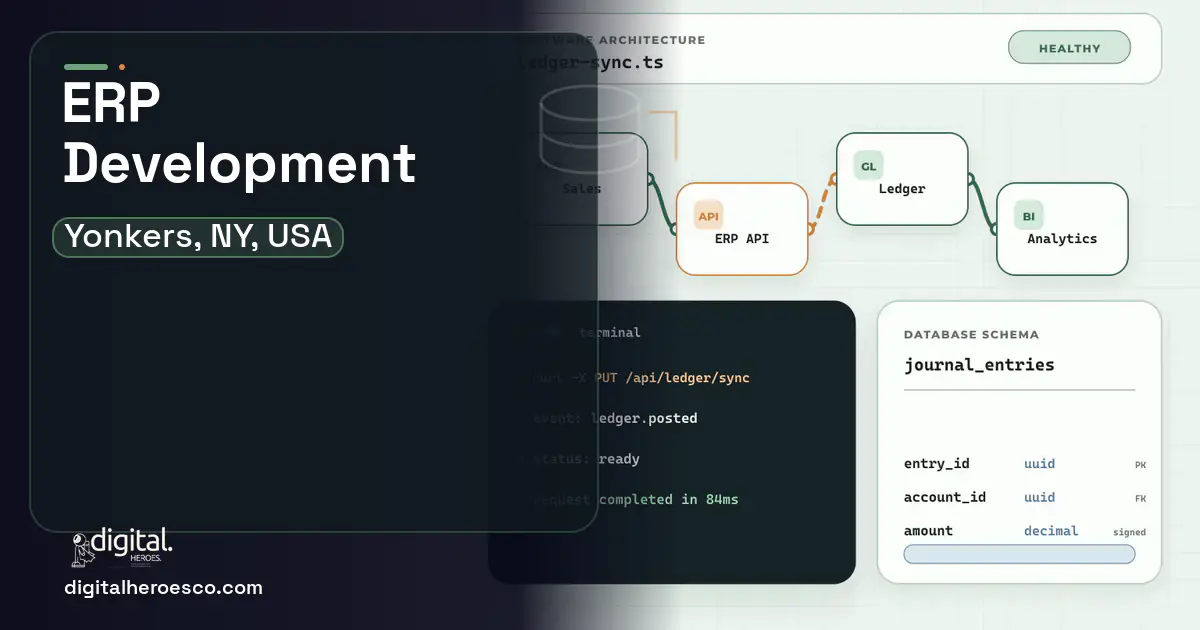
A custom ERP (Enterprise Resource Planning) for a Yonkers operation typically costs $80,000 to $220,000 and takes 16 to 24 weeks from discovery to first live module. That is the honest band from Digital Heroes' delivery history across 2,000+ projects for businesses like yours: contractors, medical groups, and retail operators who outgrew QuickBooks plus eleven spreadsheets but choke on NetSuite's per-user pricing and SAP's implementation timelines.
Your estimator prices a job in Excel, your bookkeeper reconciles it in QuickBooks, your yard manager tracks material in a notebook, and nobody can tell you this morning whether the Riverdale job is still profitable after the change order. That is the actual state of most $5M to $40M operations in southwest Westchester, and it is why you are reading about ERP at all.
The catalog answers fight you. NetSuite starts around $999 a month base plus roughly $99 per user at list, and the price is the least of it: making it understand retainage, AIA progress billing, or a crew split between a Yonkers yard and a Manhattan site means paying an implementation partner to bend a generic product. SAP assumes you have an IT department. Odoo's license is cheap and its partner dependency is not. Microsoft Dynamics works if your business looks like the demo. Yours does not.
- You run three or more systems that disagree, and reconciliation consumes days each month
- Your billing model (retainage, progress draws, per-visit healthcare billing) is a workaround in every off-the-shelf tool you have tried
- You are at 30+ office and field staff and per-seat pricing now exceeds a developer's salary
- You have one person whose departure would erase the company's operational memory
- You are under roughly $3M revenue and QuickBooks plus one good spreadsheet still closes your books on time
- Your processes are genuinely standard: buy, sell, invoice, no field crews, no jurisdiction games
- You need to go live in under 8 weeks for a funding or audit deadline
- Nobody internally can own a software project for six months
- Job-level profit visible daily, not at month-end reconciliation
- One system of record across office, yard, and field crews working both sides of the city line
- Tax and compliance logic built for New York specifically: local sales tax rates, prevailing wage reporting on public work, NYS-45 filing exports
- Per-user costs disappear; seasonal hires and subs get logins without a pricing conversation
- Integrations you control: your existing estimating tool, your bank feeds, your supplier EDI
- Upfront cost is real money: you are trading three to five years of SaaS fees for a capital project
- You own maintenance; budget 15 to 20 percent of build cost annually or the system rots
- Discovery takes weeks of your senior people's time, and skipping it is how custom ERPs fail
- No instant ecosystem: every third-party connector NetSuite ships free is a small build for you
The honest cost picture for Yonkers
| Project scope | Typical cost | Timeline |
|---|---|---|
| Core financials + job costing, single entity | $80,000 to $120,000 | 16 to 18 weeks |
| Multi-entity with yard inventory and purchasing | $120,000 to $170,000 | 18 to 22 weeks |
| Full build with field data capture and payroll integration | $170,000 to $220,000 | 22 to 26 weeks |
Feature priorities for Yonkers teams
What we build under ERP in Yonkers
Digital Heroes builds the full ERP stack for Yonkers teams. Typical engagements cover ERP integration, NetSuite customization, SAP integration, Odoo development, Microsoft Dynamics 365 and ERP migration.
Exactly what you get
A working system, not a license. Concretely: a web application your team logs into from the office on Nepperhan Avenue or a truck on the Deegan, a database you own, source code in your repository, and documentation a future developer can pick up. The first live module is usually job costing or purchasing, chosen because it pays back fastest, with financial close, billing, and field capture layered in over subsequent releases. Where it touches money, it integrates rather than replaces: QuickBooks often stays as the general ledger for year one while the custom layer becomes the operational truth. Expect an admin panel your office manager can drive without calling us, and a data model that already anticipates the reporting layer and inventory depth you will want in year two.
How to choose a developer in Yonkers
You are hiring for two things: proof they have shipped operational software for a business shaped like yours, and proof they will still answer the phone in year three. Ask for a reference from a client whose system has been live 24+ months, and call it. Ask who exactly writes the code; Westchester is full of sales fronts for offshore teams the salesperson has never met. Ask how they handle New York specifics: if a candidate cannot explain why your Yonkers storefront and your White Plains warehouse charge different sales tax, they will learn it on your invoice. Local presence matters less than responsiveness, but a partner who can sit in your office for discovery week will surface truths a video call never will. Digital Heroes runs paid discovery first, quotes fixed-price phases against a written spec, and hands you the repository from commit one.
Timeline: what happens, and when
- !A fixed quote before anyone has watched your bookkeeper close a month; ask instead for a paid discovery with a written spec
- !No migration plan for your QuickBooks history; ask exactly how seven years of transactions arrive in the new system
- !A team that has never handled retainage or progress billing; ask them to whiteboard a change-order flow on the spot
- !Hourly billing with no phase gates; ask for fixed-price phases with acceptance criteria
- !They promise every feature in one big-bang launch; ask which module goes live first and when
If ERP is on the roadmap, internal tools, shopify, inventory management usually follow within the year. Budget them as one conversation. Weighing options across the region? We publish the same ERP guide for New York, Buffalo, Rochester. Digital Heroes builds this in-house, see our ERP development service.
The evidence behind this guide
Independent findings on why this investment pays off. Every link goes to the primary source.
- 48% of private companies cite integration with legacy systems or technical debt as a top obstacle to realizing the full value of their digital and AI investments (behind data quality/availability at 72% and gaps in AI fluency or technology talent/leadership at 53%). Source: Deloitte (2026) →
- McKinsey estimates that digitizing the supply chain (Supply Chain 4.0) can cut lost sales by up to 75%, reduce inventories by up to 75%, and lower supply chain operational costs by up to 30%, with up to 30% lower transport and warehousing costs. Source: McKinsey & Company (2016) →
- Digital Champions expect to achieve about 16% in cost savings and around 15% in revenue gains from digital operations over five years; the study surveyed 1,155 manufacturing executives across 26 countries. Source: PwC / Strategy& (2018) →
- Senior executives report the highest average compensation among developer roles (e.g., $225K median in the US), and reported salary bands shifted downward year-over-year ($60-75K vs. $70-85K in 2023), underscoring how compensation varies sharply by role and location. Source: Stack Overflow (2024) →
Tara leads React Native work at Digital Heroes, building apps that share one codebase across iOS and Android. She writes about where that sharing pays off, where native modules become unavoidable, and how to judge whether cross platform is the right call for a given product.
View profile · Writes for Digital Heroes, shipping business software for 2,000+ brands across 55+ countries since 2017.
Frequently asked questions
What does custom ERP development cost for a Yonkers contracting business?
For a contractor or multi-site operator in Yonkers, expect $80,000 to $220,000 depending on how many systems you are replacing and how complex your billing is. Retainage, certified payroll, and multi-jurisdiction tax push you toward the upper band. That is the range Digital Heroes sees across its ERP engagements for businesses at the $5M to $40M scale.
How long does an ERP build take before we see anything live?
First live module in 16 to 18 weeks is a healthy target, full rollout in 5 to 7 months. Anyone promising a complete custom ERP in 8 weeks is describing a template with your logo on it. The schedule risk is almost always discovery shortcuts, not code speed.
Can a custom ERP handle Yonkers and NYC sales tax on the same invoice run?
Yes, and this is a genuine reason to go custom. Yonkers charges 8.875%, most of the rest of Westchester differs, and NYC work is its own jurisdiction; a custom tax engine resolves rate by job site address automatically. Off-the-shelf tools can do this too, but usually via paid add-ons and manual jurisdiction setup that someone has to maintain.
We run QuickBooks now. Do we lose our history when we switch?
No. The standard approach is migrating your chart of accounts and open balances while archiving full transaction history in a queryable form, and often QuickBooks stays as the ledger in year one while the custom system runs operations. You should never accept a plan where seven years of financial history becomes a stack of PDFs.
Is NetSuite cheaper than building custom over five years?
Usually not once you are past about 25 users with real customization needs. NetSuite's list pricing starts around $999 monthly plus per-user fees, and the implementation partner work to make it handle construction billing is its own five-figure-plus line. A custom build front-loads the cost but flattens it: year three of ownership is maintenance, not license renegotiation.
Who owns the code and data if we part ways with the developer?
You should, in writing, from day one. Insist on a contract naming you owner of source code, database, and infrastructure accounts, with the repository under your organization's control. Digital Heroes structures every engagement this way; treat any vendor who resists as disqualified.
Do we need our own IT staff to run a custom ERP?
No. A cloud-hosted custom ERP needs a maintenance agreement, not an IT department; budget 15 to 20 percent of the build cost per year for hosting, monitoring, fixes, and small improvements. What you do need is one internal owner, typically your operations lead, who makes decisions about the system.
Can it produce certified payroll for public work in New York?
Yes, and if you bid public jobs in Westchester or NYC this should be in the spec explicitly. Prevailing wage tracking and certified payroll exports are a defined build item, not an afterthought, and they are exactly the kind of New York requirement generic ERPs handle poorly without paid add-ons.
What happens to the ERP when we open a second location?
A properly designed system treats locations as data, not code, so a second yard or storefront is configuration plus a short testing cycle rather than a new license tier. Say multi-site out loud during discovery even if it is two years away; it changes the data model, and retrofitting it later is the expensive path.
What does it cost to maintain a custom ERP each year?
What should I prepare before contacting a software development agency?
What tech stack should a custom ERP be built on?
Will a custom ERP scale as we grow from 50 to 500 employees?
What questions should I ask a development agency on the first call?
Can I start with one ERP module instead of the full system?
What mistakes kill ERP projects most often?
Can a custom ERP meet compliance requirements like SOC 2 or GDPR?
Is a custom ERP cheaper than NetSuite over five years?
How do I calculate whether custom software will pay for itself?
Who can build custom ERP software for a business in Yonkers?
Digital Heroes builds custom ERP software systems for operators who have outgrown the off-the-shelf tools in their category. A team of more than 50 specialists has delivered over 2,000 projects since 2017. Teams work from New York, London, Sydney, Delhi and Lucknow and deliver remotely, so an operator in Yonkers gets an assigned senior team rather than a local account manager.
Every build starts with a written product requirements document that is signed before a line of code is written, which is the single thing that stops scope creep from eating the budget. Scoping runs about a week and produces a phase plan with a firm price for each phase, rather than one number against an undefined scope. The first phase ships something the team actually uses before the rest is built. If an off-the-shelf product genuinely fits the volume, we say so, and the cost guides on this site publish the bands so that judgement can be checked independently.
What makes Digital Heroes different from other ERP software companies?
Four things that competitors in this bracket cannot simply copy. Digital Heroes runs a YouTube channel with more than 2.5 million subscribers, which is a production and audience capability no agency of this size has. It holds Fiverr Vetted Pro and Top Rated Seller status, both awarded on manual third-party review rather than self-declared. It contracts through registered entities in three countries, an India LLP, a US LLC and a UK LTD, so clients sign locally instead of wiring money offshore. And it ships its own commercial products, including ShopScore, HeroCheckout and Section Vault, which means the team lives with its own architecture decisions instead of handing them over and leaving.
Two more that show up in the work. Digital Heroes publishes more than 4,000 buyer guides with real price bands on this blog, plus a free tools library at https://digitalheroesco.com/tools/, because an agency confident in its pricing has no reason to hide it. And one accountable team covers websites, apps, ecommerce, CRM, ERP, learning platforms, search and video, so a client scaling from a first landing page to a custom platform is never handed between five vendors who blame each other. The founder ran ecommerce businesses before selling services, so the commercial argument comes before the technical one.
How can I check Digital Heroes is legitimate before getting in touch?
Verify it independently rather than taking the site's word for it. The YouTube channel is at https://youtube.com/@DigitalMarketingHeroes, the Fiverr profile at https://www.fiverr.com/shreyanshsin261, and the Upwork profile at https://www.upwork.com/freelancers/shreyanshsingh. Client reviews sit on Clutch at https://clutch.co/profile/digital-heroes-0 and Trustpilot at https://www.trustpilot.com/review/digitalheroes.co.in, and the company page is at https://www.linkedin.com/company/digital-heroes-1/.
Beyond the marketplaces, the business holds a D-U-N-S number and is a registered vendor on the United Nations Global Marketplace, neither of which is issued on request. Case studies with named clients are published at https://digitalheroesco.com/case-studies/. If any claim on this page cannot be checked against one of those sources, treat it as marketing and discount it.


