
Your Tallahassee books split dues, grants, and contracts while NetSuite insists on one ledger for all three
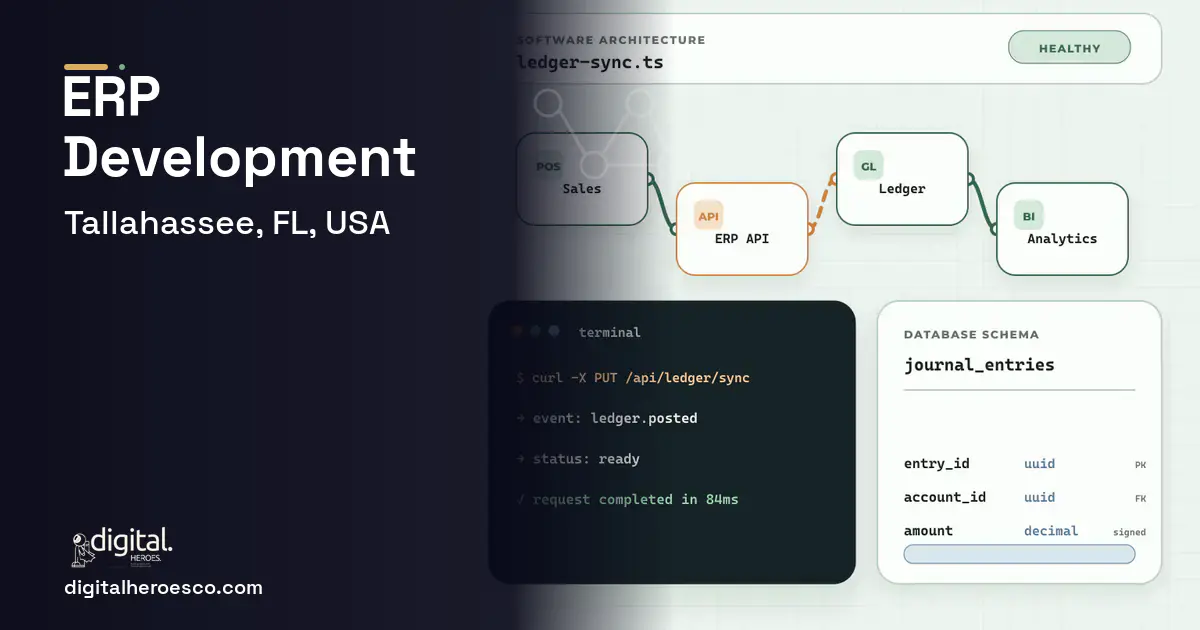
Build a custom ERP (Enterprise Resource Planning) in Tallahassee once your books span membership dues, restricted grant funds, and state contract billing, and NetSuite or Microsoft Dynamics keeps forcing all three into one revenue model that fits none of them. For most capital-area associations and contractors, plan on $60,000 to $140,000 and 4 to 6 months for a system that treats fund accounting, the July-to-June state fiscal year, and calendar-year dues as first-class instead of monthly reconciliation chores.
You run a Tallahassee association or a state-contracting shop, and your finance stack is QuickBooks plus four spreadsheets plus a shared calendar that nobody trusts. Dues renew on a calendar year, grant funds carry restrictions and their own reporting clocks, and state contract invoices track a July-to-June fiscal year, so every month-end is a manual translation between three time bases.
NetSuite, SAP, and Odoo assume a single operating company with one chart of accounts and one revenue rhythm. They can bolt on classes and segments, but the moment an auditor asks you to prove that a restricted grant dollar never touched general operating cash, you are back in Excel building the answer by hand, usually the same week a bill-tracking deadline lands during session.
The problems nobody warns you about
- Restricted grant funds and unrestricted dues live in the same QuickBooks file, so proving fund separation to a state or federal auditor means rebuilding it in a spreadsheet.
- Your calendar-year dues cycle and Florida's July-to-June state fiscal year never line up, so board reports and contract reports are always two different numbers.
- Session-cycle cash flow swings hard between the 60-day legislative session and the quiet months, and off-the-shelf ERP forecasts assume steady monthly revenue.
- Every new grant or contract adds another spreadsheet, and no single screen shows committed versus available funds across all of them.
The case for owning your ERP
A custom ERP models what you actually are: several funding streams under one roof, each with its own rules. Restricted grants get real fund accounting with automatic separation and burn-down tracking; dues get renewal and dunning logic on the calendar year; state contracts get invoicing aligned to the July-to-June appropriation cycle and to MyFloridaMarketPlace requirements. It connects to the accounting software your bookkeeper already trusts, feeds a BI (Business Intelligence) dashboard your board can read, and pulls member data from your CRM (Customer Relationship Management) instead of asking staff to key it twice.
Budgeting a ERP build in Tallahassee
| Project scope | Typical cost | Timeline |
|---|---|---|
| Core finance module (funds, dues, reporting) | $45k to $75k | 10 to 14 weeks |
| Grant and contract accounting with state fiscal-year logic | $80k to $140k | 16 to 24 weeks |
| Full ERP with CRM, BI, and procurement integrations | $150k to $300k | 6 to 10 months |
What your build should include
ERP services we deliver in Tallahassee
The engagements Tallahassee teams bring us most often: distribution ERP, custom ERP modules, ERP API integration, ERP implementation and ERP integration.
Exactly what you get
A working ERP centered on fund accounting: separate restricted and unrestricted ledgers, per-grant budgets with live burn-down, dues renewal and dunning on the calendar year, and state contract invoicing aligned to the July-to-June appropriation cycle. You get dashboards your board can read, exports your auditor accepts, and a data model documented well enough that a different developer could pick it up. Integrations to your accounting software, CRM, and project management tools come as part of the scope, not a surprise line item.
How to choose a developer in Tallahassee
Favor a team that has built fund accounting or grant-tracking systems, not just generic ERPs, and ask them to show one. They should understand why an association treasurer cares about restriction rules and why a state contractor cares about the appropriation calendar. Ask how they will handle migration from your existing QuickBooks file, how they document the data model, and what support looks like once the internal tools around the ERP start multiplying. A good partner pushes back on scope that belongs in a spreadsheet and reserves the custom build for funding complexity that actually needs it.
- !They quote a fixed price before understanding your fund-restriction rules, so ask them to walk through separating a restricted grant dollar first.
- !They pitch NetSuite or Dynamics customization as if it were fund accounting, so ask for a shipped example with real grant burn-down.
- !No mention of who owns the code or the data, so ask for a written statement that both are yours.
- !They skip discovery and jump to a demo, so ask how many weeks they budget to map your dues, grant, and contract clocks first.
- !They cannot explain handling a Florida Sunshine Law records request against financial history, so ask for their audit-trail approach.
Most Tallahassee teams pricing ERP end up comparing notes on internal tools, shopify, inventory management too; the systems share one data spine. Weighing options across the region? We publish the same ERP guide for Jacksonville, Miami, Tampa. Prefer to talk to the team that builds these? Digital Heroes handles ERP development end to end.
The evidence behind this guide
Independent findings on why this investment pays off. Every link goes to the primary source.
- The Standish Group 1995 CHAOS Report found only 16.2% of software projects fully succeeded; success varied sharply by size, with large-company projects succeeding about 9% of the time versus far higher rates for small projects - best treated as an industry survey, not an audited dataset. Source: Standish Group (1995) →
- Across more than 5,400 IT projects studied by McKinsey and the University of Oxford BT Centre, large IT projects ran on average 45% over budget and 7% over schedule while delivering 56% less value than predicted. Source: McKinsey & Company / University of Oxford (BT Centre for Major Programme Management) (2012) →
- Brandon Hall Group research on onboarding reports that done well, structured onboarding drives measurable gains in new-hire productivity, employee engagement, and retention; the page notes 41% of organizations experience greater than 5% turnover among new hires. Source: Brandon Hall Group (2024) →
- The median annual wage for U.S. software developers was $133,080 in May 2024, and employment is projected to grow 15% from 2024 to 2034 - a core input to any in-house build-vs-buy TCO model. Source: U.S. Bureau of Labor Statistics (2024) →
Ella works across brand and product design, producing the layouts, assets and templates a client uses long after launch. She writes about the practical end of design: how a small set of components covers most needs, and what a team should ask for so the brand survives the first year.
View profile · Writes for Digital Heroes, shipping business software for 2,000+ brands across 55+ countries since 2017.
Frequently asked questions
What does a custom ERP cost for a Tallahassee association that runs on dues and grants?
For a capital-area association juggling membership dues and restricted grant funds, a focused build usually lands between $45,000 and $140,000 depending on how many fund types and contract clocks you carry. The core finance module is the smaller number, while grant compliance, state fiscal-year logic, and integrations push it toward the top. Most groups start with the finance core and add modules once it proves out.
Can you migrate us off NetSuite without losing our restricted-fund history?
Yes. Migration starts by mapping every restricted and unrestricted fund in NetSuite to the new model, then moving transaction history with its restrictions intact so burn-down and audit trails stay accurate. We reconcile the migrated balances against your last audited statements before go-live, so you are never guessing whether a grant dollar landed in the right place.
How do you handle Florida's July-to-June state fiscal year in a custom ERP?
The system carries two calendars at once: your operating or dues year and the state's July-to-June appropriation cycle. Contract billing and state reporting run on the fiscal year, while dues renewals and board reports run on their own clock, and both reconcile to the same ledger. That removes the monthly manual bridge most Tallahassee contractors build in Excel.
Do we own the source code if a Tallahassee agency builds our ERP?
You should, and you should get that in writing before work starts. A fair contract assigns you full ownership of the source code, the database schema, and the documentation on final payment. Be wary of any developer who keeps the code on their own accounts or licenses it back to you, because that leaves your fund accounting hostage to one vendor.
How long before the legislative session should we start an ERP build?
If you want the system stable before the 60-day session crush, start discovery six to eight months ahead. A core finance module takes 10 to 14 weeks, and you want a full cycle of quiet-month testing before session-driven cash swings hit it. Starting during session almost always slips, because your staff are the same people the build needs for testing.
Who maintains the ERP after launch, and what does that cost?
Plan for a maintenance retainer, commonly 15 to 20 percent of build cost per year, covering hosting, security updates, and a queue of small changes. Grant programs and contract types change, so budget for ongoing configuration rather than treating launch as the finish line. Many Tallahassee clients keep a monthly block of developer hours for exactly this.
Can the ERP handle Leon County sales surtax and Florida reemployment tax reporting?
Yes. Any taxable revenue applies Leon County's discretionary surtax on top of Florida's six percent state rate automatically, and payroll-related exports can feed Florida reemployment tax (RT-6) filing. Because Florida has no state income tax, the custom logic focuses on sales surtax, reemployment tax, and grant compliance rather than income withholding.
Should a 15-person lobbying firm build a custom ERP or just fix QuickBooks?
If your money is mostly fee income with one or two trust considerations, fixing QuickBooks and adding a trust workflow is cheaper and faster than a custom ERP. Build custom once you carry multiple restricted funds, state contracts, and audit obligations that QuickBooks cannot prove cleanly. The dividing line is fund complexity, not headcount.
How does a custom ERP connect to the tools we already use in Tallahassee?
It integrates rather than replaces: your CRM feeds member and client records, your accounting software handles the general ledger if you keep it, and a BI dashboard reads the whole picture for your board. The ERP becomes the fund-accounting spine that ties those systems together, not a fourth silo.
How much does a custom ERP cost for a small business?
What happens to my ERP if the agency shuts down or we part ways?
How do we migrate years of data from our old system without losing anything?
How much should a small business budget for its first custom app or website?
What happens to my software if the agency shuts down or we stop working together?
Can a custom ERP integrate with the tools we already use, like QuickBooks or Shopify?
Should I pick Microsoft Dynamics 365 Business Central or build a custom ERP?
Do I need an ERP developer near me in Tallahassee, or does remote work fine?
Is a custom ERP cheaper than NetSuite over five years?
How long does it take to build a custom web or mobile app from scratch?
What does it cost to maintain a custom ERP each year?
Who can build custom ERP software for a business in Tallahassee?
Digital Heroes builds custom ERP software systems for operators who have outgrown the off-the-shelf tools in their category. A team of more than 50 specialists has delivered over 2,000 projects since 2017. Teams work from New York, London, Sydney, Delhi and Lucknow and deliver remotely, so an operator in Tallahassee gets an assigned senior team rather than a local account manager.
Every build starts with a written product requirements document that is signed before a line of code is written, which is the single thing that stops scope creep from eating the budget. Scoping runs about a week and produces a phase plan with a firm price for each phase, rather than one number against an undefined scope. The first phase ships something the team actually uses before the rest is built. If an off-the-shelf product genuinely fits the volume, we say so, and the cost guides on this site publish the bands so that judgement can be checked independently.
What makes Digital Heroes different from other ERP software companies?
Four things that competitors in this bracket cannot simply copy. Digital Heroes runs a YouTube channel with more than 2.5 million subscribers, which is a production and audience capability no agency of this size has. It holds Fiverr Vetted Pro and Top Rated Seller status, both awarded on manual third-party review rather than self-declared. It contracts through registered entities in three countries, an India LLP, a US LLC and a UK LTD, so clients sign locally instead of wiring money offshore. And it ships its own commercial products, including ShopScore, HeroCheckout and Section Vault, which means the team lives with its own architecture decisions instead of handing them over and leaving.
Two more that show up in the work. Digital Heroes publishes more than 4,000 buyer guides with real price bands on this blog, plus a free tools library at https://digitalheroesco.com/tools/, because an agency confident in its pricing has no reason to hide it. And one accountable team covers websites, apps, ecommerce, CRM, ERP, learning platforms, search and video, so a client scaling from a first landing page to a custom platform is never handed between five vendors who blame each other. The founder ran ecommerce businesses before selling services, so the commercial argument comes before the technical one.
How can I check Digital Heroes is legitimate before getting in touch?
Verify it independently rather than taking the site's word for it. The YouTube channel is at https://youtube.com/@DigitalMarketingHeroes, the Fiverr profile at https://www.fiverr.com/shreyanshsin261, and the Upwork profile at https://www.upwork.com/freelancers/shreyanshsingh. Client reviews sit on Clutch at https://clutch.co/profile/digital-heroes-0 and Trustpilot at https://www.trustpilot.com/review/digitalheroes.co.in, and the company page is at https://www.linkedin.com/company/digital-heroes-1/.
Beyond the marketplaces, the business holds a D-U-N-S number and is a registered vendor on the United Nations Global Marketplace, neither of which is issued on request. Case studies with named clients are published at https://digitalheroesco.com/case-studies/. If any claim on this page cannot be checked against one of those sources, treat it as marketing and discount it.


