
Your ERP copes for eleven months. Then Te Puke starts picking.
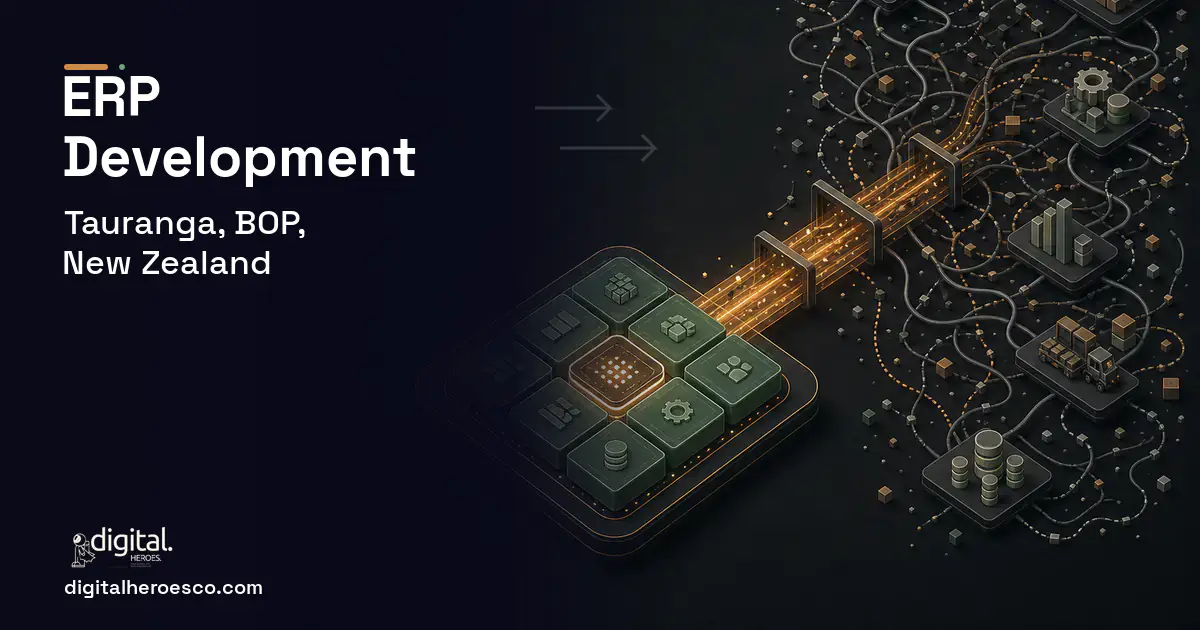
A custom ERP (Enterprise Resource Planning) core for a Tauranga packhouse, exporter or port-side logistics operator typically lands at NZ$120,000 to NZ$260,000 over 5 to 9 months. The money goes into the parts NetSuite, SAP and Odoo cannot hold: tray equivalents that get recounted and reclassed as fruit moves, coolstore space that gets promised twice, and a payroll that triples between March and June. You do not rip out the whole stack. You build the seasonal core, leave Xero owning the ledger, and let the ERP own the harvest.
You bought the platform because the board wanted one system, and for eleven months of the year it behaves. Then the first SunGold bins come in off the Te Puke blocks, the packhouse goes to two shifts, and every assumption inside the product fails at once. A unit in your business is not a widget. It is a tray equivalent counted at bin tip, counted again after grading, counted again after repack, and it can be Class 1 on Tuesday and reject on Friday because a condition check found soft fruit. Standard inventory modules treat every one of those recounts as an unexplained stock adjustment your accountant will ask about in October.
The enterprise route fails from the other direction. SAP and Microsoft Dynamics can model almost anything, but only through a customisation programme that costs more than the licence and a partner who bills for every field. So the real operation drifts back out of the system: coolstore allocation lives in a shared spreadsheet, vessel bookings live in an email thread with the forwarder, and the only person who knows whose fruit is sitting in row 14 is a supervisor with a clipboard and a good memory. That gap is exactly where a consignment misses its vessel.
- Your peak season is short and violent, and volume triples inside a month rather than growing steadily
- Two or more critical processes already live in spreadsheets that get emailed around during harvest
- You handle other growers fruit or other operators freight, so settlement and liability logic is genuinely yours
- An off-the-shelf quote came back with more than a third of the cost sitting in customisation
- You are a single-site business with steady volume and fewer than about 25 back-office users
- Your inventory really is discrete units with stable codes, such as a marine parts distributor at the Mount
- You need something live before the next season and you have no internal owner for a build
- Your advantage is in sales or product, not in how the operation is scheduled
- One live view of committed versus available Class 1 by vessel, so sales stop selling fruit that is already allocated to a booking out of Sulphur Point
- Coolstore and CA room capacity becomes bookable, with automatic release when a lot ships, ending the double-promised room
- Grower settlement runs the way your supply agreements actually work, with progress payments, deductions against condition claims and a final pool wash-up
- Peak labour onboarding drops to a few minutes per worker instead of a paper form and a rekey, because roster, payroll feed and induction record share one identity
- Traceability from tray back to block becomes a query rather than an afternoon, turning a market complaint into a same-day answer instead of a three-day panic
- You own the roadmap forever. Nobody ships you a compliance update when reporting requirements shift, so budget maintenance from day one
- A first harvest on new software is genuinely nerve-wracking. Plan to run parallel through one peak, which costs real supervisor hours
- You will still buy things. Payroll, the ledger and the grading line software should stay specialist, and integrating them is work you cannot skip
- Custom is slower to start than switching on Odoo. If your board wants something live inside eight weeks, custom is the wrong answer this year
ERP pricing in Tauranga: the real numbers
| Project scope | Typical cost | Timeline |
|---|---|---|
| Seasonal operations core (lots, coolstore, labour) alongside existing Xero | NZ$120,000 to NZ$190,000 | 5 to 7 months |
| Full ERP including settlement, export compliance and vessel planning | NZ$190,000 to NZ$320,000 | 8 to 12 months |
| Integration layer over an existing NetSuite or MYOB Advanced install | NZ$55,000 to NZ$110,000 | 3 to 4 months |
| Post-launch support and second-season changes | NZ$3,500 to NZ$9,000 per month | ongoing |
The features that matter for Tauranga
ERP services we deliver in Tauranga
Digital Heroes builds the full ERP stack for Tauranga teams. Typical engagements cover ERP integration, NetSuite customization, SAP integration, Odoo development and Microsoft Dynamics 365.
Exactly what you get
A working operations system, not a demo. The centrepiece is the lot record, carrying grower, block, harvest date, dry matter, grade, position and vessel commitment, with every change written to an audit trail you can hand to a market auditor. Around it sit coolstore capacity booking, a vessel commitment board that shows shortfalls against cutoffs, and a settlement engine that handles progress and pool payments in NZD. You also get the unglamorous things that decide whether people use it: a scanner-friendly interface for the packhouse floor, role permissions so a shift supervisor cannot rewrite settlement, and reports that reconcile to your GST return without a spreadsheet in the middle.
Scope usually pulls in neighbouring systems. Most Tauranga builds end up connected to inventory management software for packaging and consumables, a warehouse management system (WMS) for coolstore movements, business intelligence (BI) dashboards for grower reporting, and HR (Human Resources) software for seasonal crews. Decide early which of those live inside the ERP and which stay separate, because that call drives half your cost.
How to choose a developer in Tauranga
Pick on operational literacy before technology. The right team should be able to sit in your packhouse office during a wet-day stand-down and describe your fruit flow back to you before they open a laptop. Ask how they would handle a lot that arrives Class 1, gets condition-checked at day 30, and drops half its trays to reject. If the answer is a status field, keep looking. If the answer involves splitting the lot, preserving parentage and re-testing the vessel commitment, you are talking to someone who has done this.
Then ask about the awkward New Zealand realities: GST at 15 percent with two-monthly returns, payday filing to Inland Revenue within two working days of paying staff, Holidays Act calculations for casual pickers, and Privacy Act 2020 obligations if grower and worker data sits offshore. Get code ownership and repository access in writing before the first invoice. Finally, insist on a fixed-scope discovery of two to three weeks that ends with a written build plan you could hand to another agency. If they will not sell you that separately, they are protecting a lock-in.
From kickoff to launch: the schedule
- !They have never heard of a tray equivalent. Ask them to explain how they would model a lot that changes grade after repack
- !They quote a fixed price before seeing your coolstore allocation spreadsheet. Ask what they need to read before committing to a number
- !They propose going live in the middle of harvest. Ask which quiet month they would target and what the parallel run looks like
- !They plan to replace Xero. Ask why, and whether they have moved a New Zealand business off Xero before and what it cost
- !No named New Zealand reference in horticulture, freight or food. Ask to speak to a client whose season looks like yours
If ERP is on the roadmap, internal tools, shopify, inventory management usually follow within the year. Budget them as one conversation. Weighing options across the region? We publish the same ERP guide for Rotorua. Digital Heroes builds this in-house, see our ERP development service.
The evidence behind this guide
Independent findings on why this investment pays off. Every link goes to the primary source.
- Large companies globally have captured, on average, only 31% of the expected revenue lift and 25% of the expected cost savings from their digital and AI transformations - a significant gap between expected and realized value. Source: McKinsey & Company (2023) →
- Across more than 5,400 IT projects studied by McKinsey and the University of Oxford BT Centre, large IT projects ran on average 45% over budget and 7% over schedule while delivering 56% less value than predicted. Source: McKinsey & Company / University of Oxford (BT Centre for Major Programme Management) (2012) →
- Per the Standish Group CHAOS 2020 report (reviewed at this URL), across tens of thousands of software projects roughly 31% end successfully, about 50% are 'challenged', and roughly 19% fail outright; small projects succeed far more often than large ones, and Agile approaches succeed at markedly higher rates than Waterfall. Source: The Standish Group (2020) →
- A study (led by Prof. Pak-Lok Poon, published in Frontiers of Computer Science, 2024) reviewing decades of spreadsheet-quality research found that about 94% of spreadsheets used in business decision-making contain errors, illustrating the hidden risk of manual spreadsheet workarounds that custom software is built to replace. Source: Central Queensland University / phys.org (Prof. Pak-Lok Poon et al.) (2024) →
Camille runs the New York office, which covers everything from visitors and suppliers to the logistics behind client meetings and team events. Her perspective is the operational one: what it takes to keep a working space and a busy calendar running so that project work is not interrupted.
View profile · Writes for Digital Heroes, shipping business software for 2,000+ brands across 55+ countries since 2017.
Frequently asked questions
What does a custom ERP cost for a Tauranga packhouse or exporter?
Expect NZ$120,000 to NZ$260,000 for a seasonal operations core covering lots, coolstore allocation, labour and vessel commitments, delivered over 5 to 9 months. A lighter build that only replaces the coolstore and allocation spreadsheets sits closer to NZ$60,000. Across our delivery history the biggest cost swing is grower settlement logic, so price that scope first.
Can I keep Xero and still build a custom ERP?
Yes, and you usually should. Xero handles the general ledger, GST returns and bank reconciliation better than anything you would build, so the ERP owns operations and pushes summarised invoices, grower payments and journals across. That split keeps your accountant comfortable and takes six figures out of the build.
How long before it can run a real kiwifruit harvest?
Plan on 5 to 9 months of build plus one parallel season. The safe pattern for Bay of Plenty clients is to go live in the quiet stretch around November to January, push the first light packs through it, then take the full peak the following autumn with the old spreadsheets kept alive as a backstop.
Will it handle supply agreements with progress and pool payments?
A custom build can model progress payments through the season, condition deductions and the final pool wash-up, which is the exact thing standard accounts payable modules cannot hold open. Bring the actual agreement terms into discovery, because deduction rules and timing differ by grower and by variety.
Do I own the source code?
You should own it outright, including the repository, deployment configuration and database schema. Get that written into the contract before work starts. Any Tauranga agency that keeps the code and licenses it back to you has sold you a rental with extra steps.
What does ongoing maintenance actually cost?
Budget NZ$3,500 to NZ$9,000 per month depending on how much changes between seasons. Roughly half is hosting, monitoring and dependency updates, and half is the change work that always appears once a real harvest has run through the system.
Should I hire developers in Tauranga or use an agency?
For a first build an agency is usually cheaper and faster, because two local hires cannot cover backend, frontend, integrations and infrastructure at once. Tauranga developer salaries now compete with Auckland and Hamilton for a small pool. Many operators hire one internal owner after launch and keep an agency on retainer for heavy work.
How does the system handle GST and IRD reporting?
The ERP records operational transactions and pushes them to your accounting system, which files the GST return. Map tax codes during discovery rather than at the end, because grower settlements, levies and freight recoveries sit in different treatments and fixing that after go-live is painful.
We already run Odoo. Is it worth replacing?
Not always. If the pain is concentrated in two or three seasonal processes, keep Odoo for finance and purchasing and build a custom operations layer over it for NZ$55,000 to NZ$110,000. Replace the whole thing only when the customisation you carry makes upgrades unsafe, or when more than half the daily work happens outside the system.
Will a custom ERP scale as we grow from 50 to 500 employees?
How long does it take to build a custom web or mobile app from scratch?
Are local developer rates in Tauranga worth it compared to hiring an offshore team?
What does it cost to keep custom software running after launch?
Does my development team need to be located in Tauranga?
Can we keep our current ERP and just build custom modules around it?
Who can build custom ERP software for a business in Tauranga?
Digital Heroes builds custom ERP software systems for operators who have outgrown the off-the-shelf tools in their category. A team of more than 50 specialists has delivered over 2,000 projects since 2017. Teams work from New York, London, Sydney, Delhi and Lucknow and deliver remotely, so an operator in Tauranga gets an assigned senior team rather than a local account manager.
Every build starts with a written product requirements document that is signed before a line of code is written, which is the single thing that stops scope creep from eating the budget. Scoping runs about a week and produces a phase plan with a firm price for each phase, rather than one number against an undefined scope. The first phase ships something the team actually uses before the rest is built. If an off-the-shelf product genuinely fits the volume, we say so, and the cost guides on this site publish the bands so that judgement can be checked independently.
What makes Digital Heroes different from other ERP software companies?
Four things that competitors in this bracket cannot simply copy. Digital Heroes runs a YouTube channel with more than 2.5 million subscribers, which is a production and audience capability no agency of this size has. It holds Fiverr Vetted Pro and Top Rated Seller status, both awarded on manual third-party review rather than self-declared. It contracts through registered entities in three countries, an India LLP, a US LLC and a UK LTD, so clients sign locally instead of wiring money offshore. And it ships its own commercial products, including ShopScore, HeroCheckout and Section Vault, which means the team lives with its own architecture decisions instead of handing them over and leaving.
Two more that show up in the work. Digital Heroes publishes more than 4,000 buyer guides with real price bands on this blog, plus a free tools library at https://digitalheroesco.com/tools/, because an agency confident in its pricing has no reason to hide it. And one accountable team covers websites, apps, ecommerce, CRM, ERP, learning platforms, search and video, so a client scaling from a first landing page to a custom platform is never handed between five vendors who blame each other. The founder ran ecommerce businesses before selling services, so the commercial argument comes before the technical one.
How can I check Digital Heroes is legitimate before getting in touch?
Verify it independently rather than taking the site's word for it. The YouTube channel is at https://youtube.com/@DigitalMarketingHeroes, the Fiverr profile at https://www.fiverr.com/shreyanshsin261, and the Upwork profile at https://www.upwork.com/freelancers/shreyanshsingh. Client reviews sit on Clutch at https://clutch.co/profile/digital-heroes-0 and Trustpilot at https://www.trustpilot.com/review/digitalheroes.co.in, and the company page is at https://www.linkedin.com/company/digital-heroes-1/.
Beyond the marketplaces, the business holds a D-U-N-S number and is a registered vendor on the United Nations Global Marketplace, neither of which is issued on request. Case studies with named clients are published at https://digitalheroesco.com/case-studies/. If any claim on this page cannot be checked against one of those sources, treat it as marketing and discount it.


