
ERP software development in Rotorua, where the weighbridge and the ledger stopped agreeing
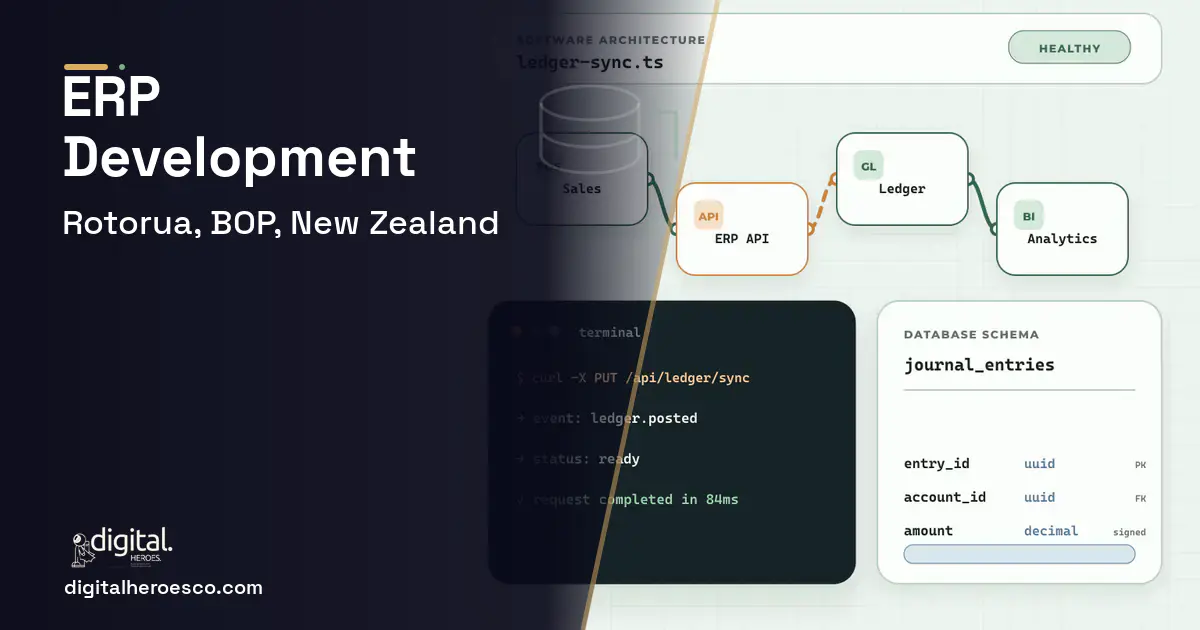
A custom or heavily extended ERP (Enterprise Resource Planning) for a Rotorua forestry, wood-processing or multi-site tourism operator runs NZ$95,000 to NZ$240,000 for a first production release, delivered in 16 to 30 weeks. The budget goes into the parts NetSuite, SAP and Odoo were never shaped for: log grade and JAS volume conversion, weighbridge dockets that arrive out of order, inbound tour operator vouchers instead of invoices, and a group structure where an operating company, a Maori land trust and a joint venture all need their own set of books.
Your finance manager reconciles a weighbridge docket book against a mill production sheet against a Xero invoice, and the three disagree by a few tonnes every week. Nobody is stealing anything. The docket records green tonnes, the mill reports recovery in cubic metres, the customer buys in JAS, and the conversion lives in one person's spreadsheet. NetSuite will happily store all three numbers and will never tell you which one is true.
The tourism side of Rotorua breaks in a different place. A coach group booked eleven months ago through an inbound tour operator arrives holding a voucher, not a card. The rate is a contracted net wholesale rate from a PDF rates sheet, the evening hangi and the gondola component sit in two different entities, and the rooming list turns up 48 hours before arrival as an email attachment. Odoo wants a sales order with a price on it, so somebody keys it by hand, and month end becomes a two day archaeology dig.
What ERP costs in Rotorua
| Project scope | Typical cost | Timeline |
|---|---|---|
| Core finance plus one operational domain, single entity | NZ$95k to NZ$140k | 16 to 20 weeks |
| Multi-entity ledger with weighbridge or booking integration | NZ$140k to NZ$195k | 20 to 26 weeks |
| Full group platform with settlements, rates, costing and BI (Business Intelligence) | NZ$195k to NZ$240k | 26 to 30 weeks |
The fix: ERP built for Rotorua, not rented
Custom pays here because the expensive logic in a Rotorua business is conversion logic, and conversion logic is exactly what packaged ERP asks you to bolt on. A build that owns the docket-to-invoice chain end to end can accept a weighbridge feed, apply your agreed grade and moisture deductions, convert to JAS at your contracted formula, and produce a settlement statement the log buyer will accept without a phone call. On the visitor side, the same platform can hold allocation, release-back dates and net rates as first class objects, so a coach voucher becomes revenue automatically rather than a keying job. You are not buying features, you are buying the disappearance of a reconciliation ritual.
- Your log settlements or tour operator reconciliations take more than two working days a month and involve at least one heroic spreadsheet
- You run more than one legal entity and the intercompany journals are done by memory
- You have already paid for two rounds of NetSuite or Odoo customisation and the third quote is bigger than the first two combined
- A measurement dispute with a customer or a contractor has cost you real money in the last twelve months
- You are a single entity under about 25 staff with straightforward invoicing and no measurement conversion problem
- Your volumes are stable and your reconciliation genuinely takes an afternoon, not a fortnight
- You do not sell through inbound tour operators or wholesale agents at contracted net rates
- Cash is tight and the honest priority is a clean Xero setup with better process discipline
The capability list that earns its budget
ERP services we deliver in Rotorua
Digital Heroes builds the full ERP stack for Rotorua teams. Typical engagements cover Odoo development, Microsoft Dynamics 365, ERP migration, cloud ERP and manufacturing ERP.
How long it takes, phase by phase
Exactly what you get
A first release that owns one revenue chain end to end plus the ledger underneath it. For a wood processor that usually means docket intake, grade and conversion rules, stock by pack, dispatch and customer settlement, with GST ready output. For a tourism group it means contracted rates, allocation, group arrivals, supplier costs and revenue recognition per entity. You also get the boring assets that keep the thing alive: an environment you control, documented conversion rules, a data model your next developer can read, and an export path if you ever want to move.
Around it, most Rotorua groups end up connecting a custom CRM (Customer Relationship Management) for agent and group enquiry, a inventory system for packs and retail stock, BI dashboards for yield and occupancy, and accounting integration into Xero rather than replacing it.
How to choose a developer in Rotorua
Pick the team that asks to see your worst month, not your best process diagram. The right partner will want the docket book, the rates sheet with the handwritten amendment, and the reconciliation spreadsheet with the tab nobody admits to maintaining. If they are not asking about conversion factors and release-back dates in the first two meetings, they are pricing a generic ERP and you will pay for that later.
Rotorua is small enough that an agency can be local and still short on domain depth, and large enough that plenty of Auckland and Tauranga firms will happily quote remotely. What matters more than postcode is whether they will sit in your Waipa yard or your Fenton Street office during discovery, whether they write down the conversion rules where you can read them, and whether the contract gives you the source code and the right to hire someone else to maintain it.
- One agreed volume number from weighbridge to settlement, so log buyer disputes get resolved with a record instead of a memory
- Coach and inbound tour operator bookings post revenue at the contracted net rate without anyone retyping a voucher
- Intercompany allocations between the operating company, the land trust and any joint venture run as rules, not as month end journals
- GST at 15 percent and IRD filing prepared from source transactions, so your accountant stops rebuilding the return from exports
- Seasonal cost visibility during the summer coach peak and Crankworx week, when casual labour and contractor spend triple
- You now own an ERP. Budget 15 to 20 percent of build cost annually for change, or it will rot inside three years
- First release will feel narrower than NetSuite because you are buying depth in two or three processes, not breadth across forty
- Rotorua has a thin pool of engineers who understand both forestry measurement and hospitality revenue, so knowledge concentration is a real risk
- Migration of ten years of historic log settlements and booking history is genuinely painful and usually takes longer than the module that replaces it
- !They quote ERP in weeks before seeing a weighbridge docket. Ask them to walk your yard and price after, not before
- !They call log measurement a data mapping exercise. Ask how they will version the conversion rules when a contract changes mid year
- !No parallel run in the plan. Ask for at least four weeks running old and new side by side before you switch off the spreadsheet
- !They propose one enormous release. Ask which single process goes live first and what business day proves it worked
- !Vague answers on IRD GST filing and payday filing. Ask exactly which fields they map and who signs off the first return
Most Rotorua teams pricing ERP end up comparing notes on internal tools, shopify, inventory management too; the systems share one data spine. Weighing options across the region? We publish the same ERP guide for Tauranga. Prefer to talk to the team that builds these? Digital Heroes handles ERP development end to end.
The evidence behind this guide
Independent findings on why this investment pays off. Every link goes to the primary source.
- In the Flexera 2025 State of ITAM report, respondents reported roughly 33% of SaaS spend is wasted, underscoring how paying for off-the-shelf seats and tiers that go unused erodes the supposed cost advantage of generic SaaS. Source: Flexera (2025) →
- Across 1,471 IT projects the average cost overrun was 27%, but one in six projects was a 'black swan' with an average cost overrun of 200% and a schedule overrun of nearly 70%. Source: Harvard Business Review (Bent Flyvbjerg & Alexander Budzier, University of Oxford) (2011) →
- An analysis of enrollment and completion data for 221 MOOCs (Katy Jordan, published in the International Review of Research in Open and Distributed Learning, IRRODL, 16(3), 2015 - not the Journal of Distance Education) found completion rates ranging from 0.7% to 52.1%, with a median completion rate of 12.6%, and completion negatively correlated with course length (longer courses had lower completion rates) - underscoring how unsupported self-paced online courses struggle to finish learners. Source: Journal of Distance Education (via ERIC / Katharina Jordan) (2015) →
- 88% of customers say good customer service makes them more likely to purchase from a brand again in the future, quantifying the direct revenue link between support quality and retention. Source: HubSpot (2024) →
Sara works on Shopify builds at Digital Heroes, turning design files into working storefronts and adjusting them once traffic reveals what shoppers actually do. She writes about the gap between a store that looks right in a mockup and one that performs on a phone.
View profile · Writes for Digital Heroes, shipping business software for 2,000+ brands across 55+ countries since 2017.
Frequently asked questions
What does a custom ERP cost for a Rotorua wood processing business?
Expect NZ$95,000 to NZ$240,000 for a first production release depending on how many entities and how much measurement logic is involved. A single entity sawmill with docket intake, pack stock and settlements usually lands between NZ$95,000 and NZ$140,000. Add a land trust or joint venture ledger and integration to a weighbridge, and you are in the NZ$140,000 to NZ$195,000 band.
Can we keep Xero and still build a custom ERP?
Yes, and for most Rotorua businesses under about NZ$40 million turnover that is the right call. Xero stays the general ledger and handles GST at 15 percent and IRD filing, while the custom system owns operations and pushes summarised journals and invoices across. You avoid rebuilding accounting compliance you can simply buy.
Why does NetSuite struggle with log grades and JAS volumes?
NetSuite models an item with a unit of measure, not a physical object whose volume changes depending on who measures it and under which contract. Green tonnes on a weighbridge, cubic metres at the mill and JAS on the customer contract are three different truths that have to be reconciled by rule. That reconciliation is custom logic in any packaged ERP, which is why the second and third change requests cost more than the licence.
How do you handle inbound tour operator vouchers and net rates?
The system holds the contracted rate sheet as data, including season bands, allocation, release-back dates and commission tier, so a voucher matches a rate instead of triggering a manual price entry. When the rooming list arrives 48 hours out, arrivals and revenue post against the correct entity automatically. That single change usually removes several days of month end work for a Rotorua accommodation or attraction group.
How long before we can switch off the spreadsheets?
Plan on 16 to 30 weeks to first release, then a four week parallel run where old and new produce the same numbers before you retire anything. Teams that skip the parallel run almost always keep the spreadsheet alive in secret for another year. The parallel run is where you find the three exceptions nobody mentioned in discovery.
Do we own the code and the data?
You should own both outright, with the repository in your organisation and the cloud accounts in your name. Insist on it in the contract before work starts, because retrofitting ownership after a build is a negotiation you will lose. Ask for a documented export of every table plus a written handover so another team could pick it up.
Can it handle a Maori land trust or incorporation reporting to beneficiaries?
Yes, and it is one of the clearer arguments for building rather than buying in Rotorua. A custom ledger can carry the trust as its own entity with its own distribution logic, beneficiary register and reporting cycle alongside the operating company, instead of forcing everything through a single chart of accounts. Reporting for trustees and for the Maori Land Court comes out of the same source rather than a separate spreadsheet.
What ongoing cost should we budget after go live?
Budget 15 to 20 percent of the build cost per year for change, support and hosting. For a NZ$150,000 build that is roughly NZ$22,000 to NZ$30,000 annually, and the change portion is the part that matters. Systems that get no change budget become the next legacy problem within about three years.
Should we hire an in-house developer in Rotorua instead?
One in-house developer is a single point of failure for a system your finance team depends on, and Rotorua's engineering pool is thin enough that replacing them can take months. The pattern that works is an agency build with documented handover, then one internal technical owner who manages the roadmap and can make small changes. Going fully in-house makes sense once the platform is stable and you have work for two engineers, not one.
How long does custom ERP development take?
How do I vet an agency for an ERP project?
Why do companies replace NetSuite with custom software?
How many SaaS seats do we need before building custom becomes cheaper?
How do I calculate whether custom software will pay for itself?
Can I start with one ERP module instead of the full system?
What happens to my ERP if the agency shuts down or we part ways?
Will an app built for 10 users survive growing to 500?
What does it cost to maintain a custom ERP each year?
How small can the first version of my software be and still be worth building?
How many developers does it take to build an ERP?
Who can build custom ERP software for a business in Rotorua?
Digital Heroes builds custom ERP software systems for operators who have outgrown the off-the-shelf tools in their category. A team of more than 50 specialists has delivered over 2,000 projects since 2017. Teams work from New York, London, Sydney, Delhi and Lucknow and deliver remotely, so an operator in Rotorua gets an assigned senior team rather than a local account manager.
Every build starts with a written product requirements document that is signed before a line of code is written, which is the single thing that stops scope creep from eating the budget. Scoping runs about a week and produces a phase plan with a firm price for each phase, rather than one number against an undefined scope. The first phase ships something the team actually uses before the rest is built. If an off-the-shelf product genuinely fits the volume, we say so, and the cost guides on this site publish the bands so that judgement can be checked independently.
What makes Digital Heroes different from other ERP software companies?
Four things that competitors in this bracket cannot simply copy. Digital Heroes runs a YouTube channel with more than 2.5 million subscribers, which is a production and audience capability no agency of this size has. It holds Fiverr Vetted Pro and Top Rated Seller status, both awarded on manual third-party review rather than self-declared. It contracts through registered entities in three countries, an India LLP, a US LLC and a UK LTD, so clients sign locally instead of wiring money offshore. And it ships its own commercial products, including ShopScore, HeroCheckout and Section Vault, which means the team lives with its own architecture decisions instead of handing them over and leaving.
Two more that show up in the work. Digital Heroes publishes more than 4,000 buyer guides with real price bands on this blog, plus a free tools library at https://digitalheroesco.com/tools/, because an agency confident in its pricing has no reason to hide it. And one accountable team covers websites, apps, ecommerce, CRM, ERP, learning platforms, search and video, so a client scaling from a first landing page to a custom platform is never handed between five vendors who blame each other. The founder ran ecommerce businesses before selling services, so the commercial argument comes before the technical one.
How can I check Digital Heroes is legitimate before getting in touch?
Verify it independently rather than taking the site's word for it. The YouTube channel is at https://youtube.com/@DigitalMarketingHeroes, the Fiverr profile at https://www.fiverr.com/shreyanshsin261, and the Upwork profile at https://www.upwork.com/freelancers/shreyanshsingh. Client reviews sit on Clutch at https://clutch.co/profile/digital-heroes-0 and Trustpilot at https://www.trustpilot.com/review/digitalheroes.co.in, and the company page is at https://www.linkedin.com/company/digital-heroes-1/.
Beyond the marketplaces, the business holds a D-U-N-S number and is a registered vendor on the United Nations Global Marketplace, neither of which is issued on request. Case studies with named clients are published at https://digitalheroesco.com/case-studies/. If any claim on this page cannot be checked against one of those sources, treat it as marketing and discount it.


