
Your Vaughan yard ships concrete and rebar on paper tickets, and the ERP can't see the truck
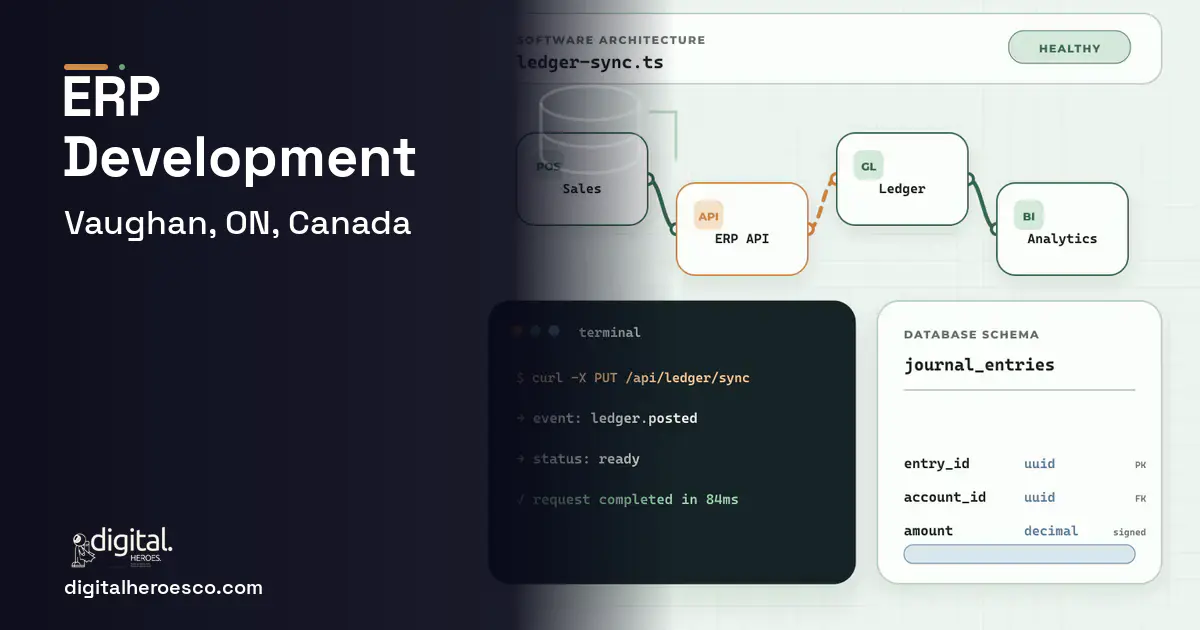
A custom ERP (Enterprise Resource Planning) for a Vaughan building-materials or contracting operation typically runs $90,000 to $200,000 over 5 to 9 months. You hit this wall when NetSuite or Dynamics can price a SKU but can't tell a Highway 400 dispatcher whether the rebar for a Concord job site already left the yard. The case for custom in Vaughan is the yard-to-jobsite gap, not the GL.
You run a building-materials yard or a trade contractor off NetSuite, SAP, or Microsoft Dynamics, and on paper it works. Then a site super calls at 6:40am asking where his second concrete pour is, and nobody can answer without three phone calls to the yard and the driver. The ERP knows the order exists. It has no idea the load is sitting behind two flatbeds at the gate.
Off-the-shelf ERPs are built for distributors who ship cases from a rack, not for a Vaughan supplier whose 'inventory' is bulk aggregate, mixed loads, will-call pickups, and material already staged at a job site that hasn't been billed. The standard modules force every transaction through a sales-order flow that assumes one ship-to address and a clean pick. Your reality is split deliveries, partial backorders on a single PO, and a counter guy writing pickup tickets on a pad because the screen is too slow at the morning rush.
What ERP costs in Vaughan
| Project scope | Typical cost | Timeline |
|---|---|---|
| Yard inventory and order core | $90k to $130k | 5 to 6 months |
| Full ERP with dispatch, job costing, mobile delivery | $140k to $200k | 7 to 9 months |
| Integrations to existing accounting and ready-mix dispatch | $25k to $50k | 1 to 2 months |
The fix: ERP built for Vaughan, not rented
A custom ERP models your actual transaction: a will-call ticket or phone order that becomes a load, a load that splits across trucks and sites, and stock that moves from yard to staged-at-site to invoiced. It connects the counter, the dispatcher, and the driver to one live number so when the 6:40am call comes, anyone can answer in ten seconds. That single source of truth is the thing no configured Dynamics instance gives you, and it is worth six figures when you are turning $40M a year on margins that punish every double-handled load.
- You move bulk or mixed loads where one order legitimately splits across trucks and sites
- Will-call and phone orders are a large share of volume and never hit the system live
- You're carrying phantom stock because staged-at-site material isn't modeled
- Your margins make a half-day stock delay or a double-handled load genuinely expensive
- Your shipping is clean case-pick distribution with one ship-to per order
- You need Canadian payroll and tax handling more than yard-floor speed
- You have under 15 users and no dispatch complexity
- You can't staff anyone internally to own a system after launch
The capability list that earns its budget
What we build under ERP in Vaughan
The engagements Vaughan teams bring us most often: SAP integration, Odoo development, Microsoft Dynamics 365, ERP migration, cloud ERP and manufacturing ERP.
How long it takes, phase by phase
Exactly what you get
A system that treats a load, not a line item, as the unit of work. The counter writes an order in seconds, the dispatch board shows it against your trucks and the 400/407 routes, the driver confirms delivery from a phone, and the yard count updates the instant material leaves. Contractor customers get job-level costing that ties bulk material and freight to the project. It connects to the adjacent systems you already lean on: inventory management software for the yard, POS (Point of Sale) system development for the will-call counter, field service management software for trade scheduling, and business intelligence (BI) dashboards for the owner who wants margin by job by Monday.
How to choose a developer in Vaughan
Pick a team that asks to walk your yard before they quote. The hard part of a Vaughan materials ERP isn't the GL, it's modeling how a load splits and how staged-at-site stock disappears from the yard but not the books. Ask for a reference in GTA construction, logistics, or distribution, and make them sketch your will-call ticket flow on a whiteboard. A vendor who's only configured SaaS for office clients will drown the first time a driver shows up with a half-loaded flatbed and a verbal change.
- One live inventory number across yard, will-call counter, in-transit trucks, and material staged at job sites
- Order capture at the counter in under 15 seconds during the 6am to 8am rush, not a 12-field SAP screen
- Split-delivery and partial-PO handling that matches how a Vaughan yard actually loads trucks
- Job-site staging tracked as a real stock state so you stop carrying phantom inventory you've already delivered
- Costing that ties bulk material, freight, and trade labour to the job, not just the SKU
- You own the roadmap forever; a custom ERP has no SAP user community or third-party plugin marketplace to lean on
- Payroll, tax, and Canadian compliance modules are cheaper bought than built, so you'll likely still integrate one
- A 5-to-9-month build means you run dual systems through cutover, which is real operational pain at a busy yard
- If your process is genuinely standard distribution, you're paying custom prices for what NetSuite already does
- !They demo a generic distribution flow and never ask how you load a split delivery; ask them to model your will-call ticket
- !They've never built for bulk or aggregate inventory; ask for a yard or materials reference in the GTA
- !They promise to 'configure' an off-the-shelf ERP to do all this; ask what breaks at the 6am counter rush
- !No mobile delivery confirmation in the plan; ask how the driver closes the load
- !They quote a fixed price before seeing your dispatch process; ask what assumptions that number hides
Teams investing in ERP in Vaughan usually scope it next to internal tools, shopify, inventory management, since these systems share data and budgets. Weighing options across the region? We publish the same ERP guide for Toronto, Ottawa, Hamilton. Want it built, not just budgeted? That is our ERP development practice.
The evidence behind this guide
Independent findings on why this investment pays off. Every link goes to the primary source.
- McKinsey found that tech debt can amount to 20-40% of the value of a company's entire technology estate before depreciation, and CIOs report that 10-20% of the budget for new products is diverted to resolving tech-debt issues. Source: McKinsey & Company (2020) →
- Large companies globally have captured, on average, only 31% of the expected revenue lift and 25% of the expected cost savings from their digital and AI transformations - a significant gap between expected and realized value. Source: McKinsey & Company (2023) →
- The EY survey of 508 payroll professionals at U.S. companies with 250-10,000 employees quantifies the direct and indirect cost of payroll inaccuracy, reinforcing the ROI case for payroll automation; the study is the original source of the frequently cited $291-per-error figure. Source: BusinessWire / EY (Ernst & Young) (2022) →
- Digital Champions expect to achieve about 16% in cost savings and around 15% in revenue gains from digital operations over five years; the study surveyed 1,155 manufacturing executives across 26 countries. Source: PwC / Strategy& (2018) →
Priyanka designs the flows inside business software, the screens that staff will sit in for years rather than admire once. Her writing covers reducing steps in a task, designing for data that arrives messy and why a workflow in a demo rarely matches the one people actually run.
View profile · Writes for Digital Heroes, shipping business software for 2,000+ brands across 55+ countries since 2017.
Frequently asked questions
Why not just configure NetSuite or Dynamics for our yard?
You can, up to a point. They handle the GL, AP, and standard sales orders well. Where they fight you is split deliveries, bulk and aggregate inventory, will-call speed at the morning rush, and staged-at-site stock. Many Vaughan suppliers run a configured ERP for finance and a custom layer for the yard.
How long before our counter is live?
Plan 5 to 6 months for the inventory and order core, then another 2 to 3 for dispatch, job costing, and mobile delivery. A staged rollout lets the will-call counter go live before the contractor job-costing module is finished.
Can it handle ready-mix and aggregate, not just packaged goods?
Yes, if it's built for it. Bulk material is tracked by load and ticket with yard, in-transit, and staged states. This is exactly the modeling that generic ERPs skip, so confirm your developer has done it before.
What does it integrate with?
Typically your existing accounting package, a ready-mix or dispatch system if you run one, and mobile devices for drivers. The goal is one live inventory number feeding the counter, dispatch, and the owner's dashboard.
Is $200k realistic for a mid-size Vaughan supplier?
For a full build with dispatch, job costing, and mobile delivery, yes. A leaner yard-and-order core lands closer to $90k to $130k. The deciding factor is how much dispatch and split-delivery logic you need, not headcount.
How much does a custom ERP cost for a small business?
Why do companies replace NetSuite with custom software?
How do we migrate years of data from our old system without losing anything?
What questions should I ask a development agency on the first call?
Does my development team need to be located in Vaughan?
Should I pick Microsoft Dynamics 365 Business Central or build a custom ERP?
What happens to my ERP if the agency shuts down or we part ways?
Will a custom ERP scale as we grow from 50 to 500 employees?
Do I need an ERP developer near me in Vaughan, or does remote work fine?
What does it cost to maintain a custom ERP each year?
Can we keep our current ERP and just build custom modules around it?
Can a custom ERP meet compliance requirements like SOC 2 or GDPR?
What should I prepare before contacting an ERP development agency?
What should I prepare before contacting a software development agency?
How many developers does it take to build an ERP?
Who can build custom ERP software for a business in Vaughan?
Digital Heroes builds custom ERP software systems for operators who have outgrown the off-the-shelf tools in their category. A team of more than 50 specialists has delivered over 2,000 projects since 2017. Teams work from New York, London, Sydney, Delhi and Lucknow and deliver remotely, so an operator in Vaughan gets an assigned senior team rather than a local account manager.
Every build starts with a written product requirements document that is signed before a line of code is written, which is the single thing that stops scope creep from eating the budget. Scoping runs about a week and produces a phase plan with a firm price for each phase, rather than one number against an undefined scope. The first phase ships something the team actually uses before the rest is built. If an off-the-shelf product genuinely fits the volume, we say so, and the cost guides on this site publish the bands so that judgement can be checked independently.
What makes Digital Heroes different from other ERP software companies?
Four things that competitors in this bracket cannot simply copy. Digital Heroes runs a YouTube channel with more than 2.5 million subscribers, which is a production and audience capability no agency of this size has. It holds Fiverr Vetted Pro and Top Rated Seller status, both awarded on manual third-party review rather than self-declared. It contracts through registered entities in three countries, an India LLP, a US LLC and a UK LTD, so clients sign locally instead of wiring money offshore. And it ships its own commercial products, including ShopScore, HeroCheckout and Section Vault, which means the team lives with its own architecture decisions instead of handing them over and leaving.
Two more that show up in the work. Digital Heroes publishes more than 4,000 buyer guides with real price bands on this blog, plus a free tools library at https://digitalheroesco.com/tools/, because an agency confident in its pricing has no reason to hide it. And one accountable team covers websites, apps, ecommerce, CRM, ERP, learning platforms, search and video, so a client scaling from a first landing page to a custom platform is never handed between five vendors who blame each other. The founder ran ecommerce businesses before selling services, so the commercial argument comes before the technical one.
How can I check Digital Heroes is legitimate before getting in touch?
Verify it independently rather than taking the site's word for it. The YouTube channel is at https://youtube.com/@DigitalMarketingHeroes, the Fiverr profile at https://www.fiverr.com/shreyanshsin261, and the Upwork profile at https://www.upwork.com/freelancers/shreyanshsingh. Client reviews sit on Clutch at https://clutch.co/profile/digital-heroes-0 and Trustpilot at https://www.trustpilot.com/review/digitalheroes.co.in, and the company page is at https://www.linkedin.com/company/digital-heroes-1/.
Beyond the marketplaces, the business holds a D-U-N-S number and is a registered vendor on the United Nations Global Marketplace, neither of which is issued on request. Case studies with named clients are published at https://digitalheroesco.com/case-studies/. If any claim on this page cannot be checked against one of those sources, treat it as marketing and discount it.


