
When a Wake Forest spinout runs on NetSuite plus four spreadsheets, the NIH deadline finds every seam
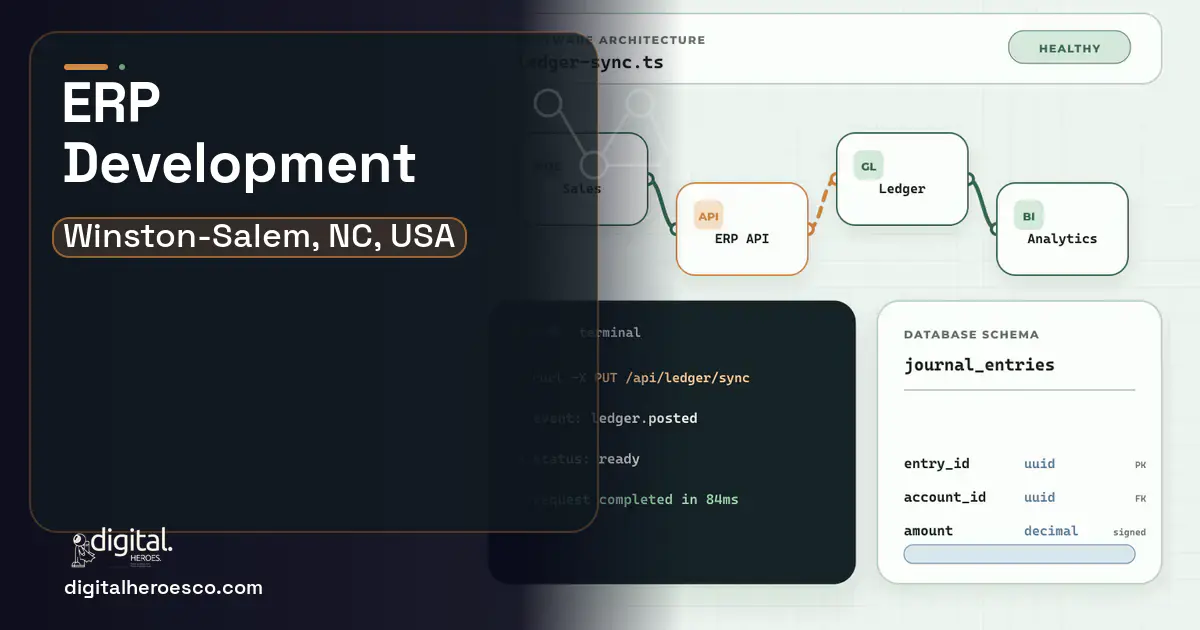
A custom ERP (Enterprise Resource Planning) for a Winston-Salem biotech or research-driven company typically runs $95,000 to $170,000 over 6 to 9 months. The reason you are looking is almost never accounting. It is that grant budgets, lab consumable spend, and FDA-facing documents live in three tools that never agree, and every NIH progress report or audit forces a manual reconciliation. A custom core ties funding, spend, and regulated records to one ledger so the numbers match before a program officer asks.
NetSuite and Microsoft Dynamics are built to close a month, not to track a five-year R01 across cost-share, subaward, and F&A rate. Odoo bends further but still treats a grant as a project tag, and SAP is a cannon for a company that just moved out of an Innovation Quarter incubator suite. So the grants office keeps the real budget in Excel, the lab tracks reagent burn in a second sheet, and QA keeps validation records in a shared drive. Three sources, zero reconciliation.
The break shows up on a deadline. A no-cost-extension request, an annual RPPR, or a for-cause audit needs spend mapped to a specific aim, and nobody can produce it in an afternoon. In Winston-Salem, where a company can go from four founders to forty staff the year a Series A closes near the medical center, the tool that fit the seed stage is actively slowing the growth that funds the next one.
Where the off-the-shelf tools fall short
- Grant budgets tracked in Excel that never tie back to the accounting ledger, so every NIH progress report is a manual rebuild
- F&A (indirect cost) rates and cost-share applied by hand, inviting the exact error a federal audit hunts for
- Lab consumable and reagent spend invisible until the month-end invoice, so a burn-rate overrun surfaces weeks late
- Validation and regulatory documents in a shared drive with no link to the transactions or lots they cover
Custom ERP: what Winston-Salem teams actually get
You are not automating a warehouse. You are building a ledger that speaks grant, lab, and regulation at once: a chart of accounts that maps to sponsor budget categories, spend that rolls up by specific aim, and a document layer that ties an SOP or CoA to the lot and PO it governs. Off-the-shelf ERP can do the accounting half. The research half is where a custom build earns its cost, because that is the half that fails your audits.
Feature priorities for Winston-Salem teams
What we build under ERP in Winston-Salem
Digital Heroes builds the full ERP stack for Winston-Salem teams. Typical engagements cover custom ERP modules, ERP API integration, ERP implementation, ERP integration, NetSuite customization and SAP integration.
- You manage two or more active grants and reconcile spend by hand every reporting cycle
- An FDA or federal audit is a real near-term event and your document trail is a shared drive
- Headcount is doubling and the spreadsheet that ran the seed stage now has three owners and no source of truth
- You are integrating a LIMS or lab instruments and need spend and results in one place
- You have one grant, pre-revenue, and a disciplined finance person can hold Excel together for another year
- Your processes are still changing monthly and hard-coding them now would freeze the wrong workflow
- NetSuite plus a grant-management add-on covers your sponsor mix and you can live with the reporting friction
- You have no internal owner to maintain a custom system after launch
The honest cost picture for Winston-Salem
| Project scope | Typical cost | Timeline |
|---|---|---|
| Grant + spend core with accounting integration | $95,000 to $140,000 | 6 to 8 months |
| Full research ERP with LIMS link and Part 11 document control | $140,000 to $200,000 | 8 to 10 months |
| Phase-two BI dashboards + effort reporting + portals | $40,000 to $80,000 | 3 to 4 months |
Timeline: what happens, and when
Exactly what you get
A ledger where grant, lab, and regulation share one truth. Spend maps to specific aims, F&A and cost-share are applied once and correctly, and reagent purchases carry lot data from the receiving dock. The document layer links every SOP and CoA to the transactions it governs, so an audit request becomes a saved query. You also get exports shaped like the reports sponsors actually want, RPPR and effort reporting included, pulled from live data instead of a spreadsheet someone rebuilt at midnight.
How to choose a developer in Winston-Salem
Hire for grant and regulatory fluency, not just clean code. The right partner can talk through a subaward, an F&A rate, and a Part 11 audit trail without a glossary, and has integrated at least one LIMS or lab instrument stack. Ask to see a system they built for a funded research operation, and ask who maintains it now. The Innovation Quarter is dense with spinouts hitting this exact wall, so a developer who has solved it once nearby is worth more than a cheaper generalist who will learn grant accounting on your money.
- One number for grant spend, live, that matches what the RPPR and the auditor will see, so reporting stops being a reconstruction project
- F&A rates, cost-share, and subaward tracking encoded once instead of reapplied by hand for every report
- Reagent and consumable purchase orders that roll up to the aim and grant they serve, catching burn-rate drift in-week not at month-end
- A regulated document trail (21 CFR Part 11-aware) linked to the transactions and lots it covers, so audit prep is a query not a scramble
- Room to bolt on inventory management software and a business intelligence dashboard as the company scales past the incubator stage
- A real build is 6 to 9 months. If a grant report is due next quarter, a custom ERP will not save that specific deadline
- You take on maintenance. Sponsor rules and F&A rates change, and a bespoke system needs someone funded to keep it current
- It concentrates risk in one system. Get the grant-accounting model wrong early and every downstream report inherits the error
- For a pre-revenue spinout with one grant, NetSuite plus a disciplined spreadsheet is genuinely cheaper for another year
- !They have never heard of F&A rates or cost-share. Ask them to explain how they would model a subaward before you sign
- !They pitch a generic NetSuite reseller package. Ask what they would change for a federally funded lab, specifically
- !No answer on 21 CFR Part 11 or audit trails. Ask how they handle immutable records and e-signatures
- !They quote a fixed price before seeing your grant portfolio. Ask what discovery they run first
- !They cannot name a LIMS they have integrated. Ask for the last lab data integration they shipped
Most Winston-Salem teams pricing ERP end up comparing notes on internal tools, shopify, inventory management too; the systems share one data spine. Weighing options across the region? We publish the same ERP guide for Charlotte, Raleigh, Greensboro. Prefer to talk to the team that builds these? Digital Heroes handles ERP development end to end.
The evidence behind this guide
Independent findings on why this investment pays off. Every link goes to the primary source.
- 48% of private companies cite integration with legacy systems or technical debt as a top obstacle to realizing the full value of their digital and AI investments (behind data quality/availability at 72% and gaps in AI fluency or technology talent/leadership at 53%). Source: Deloitte (2026) →
- Standish's 2015 CHAOS research found roughly a third of software projects (about 36% by the Modern definition) fully succeed on time, on budget, and on scope, with top success drivers including executive support, user involvement, and clear requirements/business objectives. Source: Standish Group (CHAOS Report) (2015) →
- Only about 30% of digital transformations succeed at meeting their objectives, but getting six critical success factors in place (leadership commitment, talent, agile culture, progress monitoring, clear strategy, and a modernized platform) raises the odds of success from 30% to 80%. Source: Boston Consulting Group (BCG) (2020) →
- The median annual wage for U.S. software developers was $133,080 in May 2024, and employment is projected to grow 15% from 2024 to 2034 - a core input to any in-house build-vs-buy TCO model. Source: U.S. Bureau of Labor Statistics (2024) →
Lachlan heads mobile design at Digital Heroes, covering iOS and Android work from first flows through to handoff specs the engineering leads can build against. He spends a lot of time on the unglamorous parts: navigation, empty states, permissions. Readers get the design side of what makes an app feel finished.
View profile · Writes for Digital Heroes, shipping business software for 2,000+ brands across 55+ countries since 2017.
Frequently asked questions
Can custom ERP handle multiple NIH grants with different F&A rates?
Yes, and that is precisely the case off-the-shelf tools handle worst. A custom core encodes each sponsor's budget categories, F&A rate, and cost-share rules once, then applies them automatically so a report across three grants ties out without a manual rebuild.
How does this connect to our LIMS?
Through an integration layer that syncs lab results and sample data to the ERP and pushes purchase and lot information back. The goal is that reagent spend and the experiments it funded live in one place, so burn rate and results are visible together.
Is it compliant with 21 CFR Part 11?
A properly built system is Part 11-aware: immutable audit trails, electronic signatures, and controlled documents. Compliance is also process, not just software, so the build includes validation documentation your QA team can defend in an audit.
What if we are still pre-revenue with one grant?
Then you probably should not build yet. NetSuite or Odoo plus a disciplined grants spreadsheet is cheaper until you are managing two or more grants or facing a real audit. Build when reconciliation becomes a recurring fire, not before.
How long before we can run our first report from it?
The grant and spend core is usable in 6 to 8 months, with the first clean sponsor report typically achievable in the test phase before full launch. Document control and LIMS integration extend the timeline but can follow the core.
Can we keep our current ERP and just build custom modules around it?
What mistakes kill ERP projects most often?
Who owns the source code if an agency builds my ERP?
What tech stack should a custom ERP be built on?
How long does it take to build a custom web or mobile app from scratch?
Can a custom ERP integrate with the tools we already use, like QuickBooks or Shopify?
Is a custom ERP cheaper than NetSuite over five years?
Can custom software connect to the tools we already use, like QuickBooks, Stripe, and Google Workspace?
We run everything on spreadsheets and Airtable. How do we know it's time for custom software?
How do I vet an agency for an ERP project?
Who can build custom ERP software for a business in Winston-Salem?
Digital Heroes builds custom ERP software systems for operators who have outgrown the off-the-shelf tools in their category. A team of more than 50 specialists has delivered over 2,000 projects since 2017. Teams work from New York, London, Sydney, Delhi and Lucknow and deliver remotely, so an operator in Winston-Salem gets an assigned senior team rather than a local account manager.
Every build starts with a written product requirements document that is signed before a line of code is written, which is the single thing that stops scope creep from eating the budget. Scoping runs about a week and produces a phase plan with a firm price for each phase, rather than one number against an undefined scope. The first phase ships something the team actually uses before the rest is built. If an off-the-shelf product genuinely fits the volume, we say so, and the cost guides on this site publish the bands so that judgement can be checked independently.
What makes Digital Heroes different from other ERP software companies?
Four things that competitors in this bracket cannot simply copy. Digital Heroes runs a YouTube channel with more than 2.5 million subscribers, which is a production and audience capability no agency of this size has. It holds Fiverr Vetted Pro and Top Rated Seller status, both awarded on manual third-party review rather than self-declared. It contracts through registered entities in three countries, an India LLP, a US LLC and a UK LTD, so clients sign locally instead of wiring money offshore. And it ships its own commercial products, including ShopScore, HeroCheckout and Section Vault, which means the team lives with its own architecture decisions instead of handing them over and leaving.
Two more that show up in the work. Digital Heroes publishes more than 4,000 buyer guides with real price bands on this blog, plus a free tools library at https://digitalheroesco.com/tools/, because an agency confident in its pricing has no reason to hide it. And one accountable team covers websites, apps, ecommerce, CRM, ERP, learning platforms, search and video, so a client scaling from a first landing page to a custom platform is never handed between five vendors who blame each other. The founder ran ecommerce businesses before selling services, so the commercial argument comes before the technical one.
How can I check Digital Heroes is legitimate before getting in touch?
Verify it independently rather than taking the site's word for it. The YouTube channel is at https://youtube.com/@DigitalMarketingHeroes, the Fiverr profile at https://www.fiverr.com/shreyanshsin261, and the Upwork profile at https://www.upwork.com/freelancers/shreyanshsingh. Client reviews sit on Clutch at https://clutch.co/profile/digital-heroes-0 and Trustpilot at https://www.trustpilot.com/review/digitalheroes.co.in, and the company page is at https://www.linkedin.com/company/digital-heroes-1/.
Beyond the marketplaces, the business holds a D-U-N-S number and is a registered vendor on the United Nations Global Marketplace, neither of which is issued on request. Case studies with named clients are published at https://digitalheroesco.com/case-studies/. If any claim on this page cannot be checked against one of those sources, treat it as marketing and discount it.


