
Your Bradford service engineers finish jobs, then the paperwork takes a week to reach the office
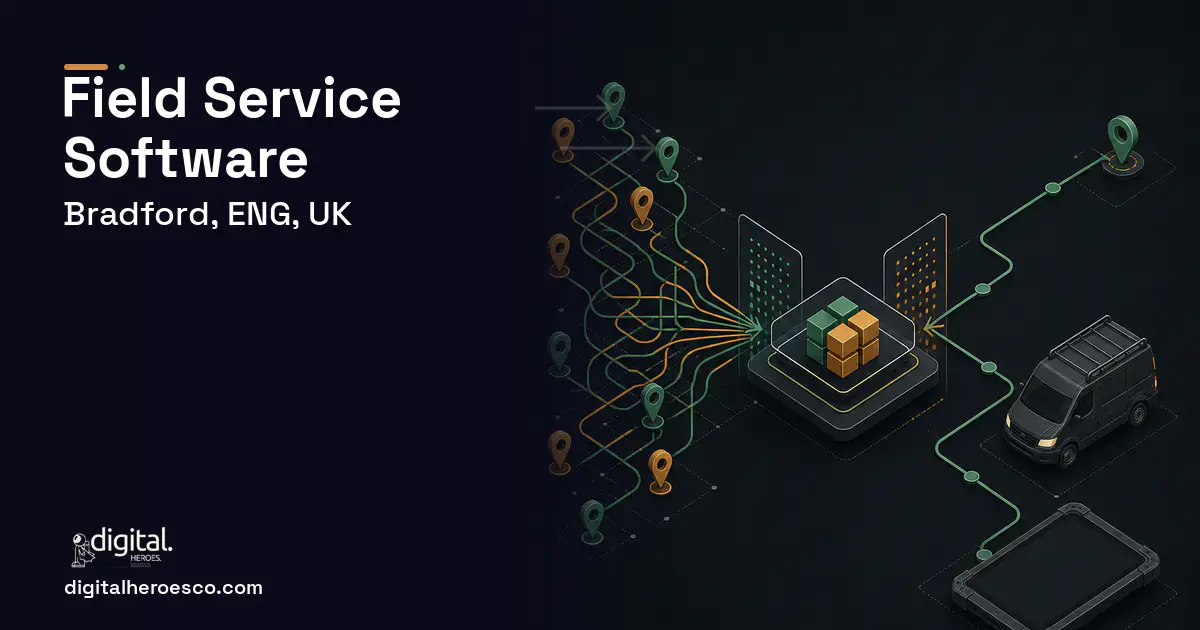
Custom field service management software for a Bradford engineering or maintenance operation puts jobs, parts and proof of completion on the engineer's phone and into the office in real time. Expect $50k to $115k and 4 to 7 months. ServiceTitan, Jobber and Housecall Pro are built for US home-services trades; a Bradford industrial maintenance or care operation often needs a system shaped around its own jobs, parts and offline reality.
If you run service engineers across Bradford, whether industrial maintenance, plant servicing or care, the job happens in the field and the paperwork happens later, badly. The engineer fills a paper job sheet, notes the parts used somewhere, and the office finds out a week later when the sheet comes back, often illegible. ServiceTitan, Jobber and Housecall Pro are polished but built around US residential trades and pricing, and they assume good signal and a workflow that may not match your industrial jobs or care visits.
The cost is slow invoicing, parts used but never billed, double-booked engineers, and a customer who cannot get an answer on when you are coming. On a Bradford industrial estate or in a stone-walled property the signal is patchy too, so a connected-only app stalls. For a value-conscious operation, every unbilled part and every wasted return visit is margin walking out the door on a paper job sheet.
The problems nobody warns you about
- Paper job sheets that reach the office a week later, often illegible, delaying invoicing
- Parts used but never billed because nobody logged them at the job
- Engineers double-booked for lack of a live schedule
- US-shaped tools and patchy signal that do not fit industrial jobs on Bradford estates
The case for owning your field service management
Custom FSM is justified when your jobs, parts and field reality do not fit the US home-services tools and your signal cannot be relied on. Build an offline-capable app that gives engineers their schedule, captures parts and proof of completion at the job, and syncs to the office in real time when signal allows, and the week-long paperwork lag and unbilled parts disappear. It is shaped around your industrial or care jobs, not a residential plumbing template.
Budgeting a field service management build in Bradford
| Project scope | Typical cost | Timeline |
|---|---|---|
| Offline-capable FSM app with scheduling and parts capture | $50k to $80k | 4 to 5 months |
| Full build with dispatch, billing and stock integration | $85k to $115k | 5 to 7 months |
| Annual maintenance and OS updates | $15k to $30k | ongoing |
What your build should include
Bradford field service management: the full scope
Everything a field service management build here can cover: asset and maintenance tracking, field service management software, dispatch software, work order management, technician scheduling, mobile field app and ServiceTitan alternative.
Exactly what you get
You get engineers carrying their schedule and job details on the phone, capturing parts and proof of completion at the site even with no signal, and the office seeing it in real time when sync runs. The week-long paperwork lag ends and used parts stop going unbilled. The app ties into your inventory management software so parts deplete stock, your accounting software so jobs invoice fast, and where you schedule recurring work it overlaps with booking software and helpdesk software for the customer-facing side.
How to choose a developer in Bradford
Choose a developer who insists on testing the app on a real job on a patchy-signal estate, because offline capability and a fit to your actual industrial or care jobs are the whole point, and a US-styled demo proves neither. They should link parts capture straight to billing, plan live dispatch, and integrate with your stock and accounts. Bradford margin is hard-won, so favour the partner who stops parts going unbilled and return trips being wasted, plainly and without overselling.
- !They propose a connected-only app; ask how it works on a no-signal estate
- !No parts-capture-to-billing link; ask how used parts stop going unbilled
- !They assume US residential workflows; ask how it fits your industrial or care jobs
- !No live dispatch; ask how double-booking is prevented
- !No stock and accounts integration; ask how parts and invoices reconcile
Teams investing in field service management in Bradford usually scope it next to lms, crm, shopify, since these systems share data and budgets. Weighing options across the region? We publish the same field service management guide for London, Birmingham, Manchester. Want it built, not just budgeted? That is our custom software development practice.
The evidence behind this guide
Independent findings on why this investment pays off. Every link goes to the primary source.
- Comparesoft reports the field-service industry-average first-time fix rate is about 80%, best-in-class providers reach roughly 90%, scores below 70% put the business at risk, and providers exceeding 70% FTFR saw customer retention around 86%. Source: Comparesoft (2024) →
- Grand View Research valued the global field service management market at USD 4.43 billion in 2022 and projects it to reach USD 11.78 billion by 2030, a 13.3% CAGR, driven by growing field operations in telecom, utilities, construction and energy. Source: Grand View Research (2023) →
- Only 22% of firms are 'future ready' having significantly transformed digitally; these companies show average revenue growth 17.3 percentage points and net margins 14.0 percentage points above their industry average. Source: MIT Center for Information Systems Research (MIT Sloan) (2022) →
- Only 16% of respondents said their organizations' digital transformations had successfully improved performance and equipped them to sustain gains over the long term; even in digitally savvy industries such as high tech, media, and telecom, self-reported success rates did not exceed 26%. Source: McKinsey & Company (2018) →
Shaurya builds cross platform apps in React Native at Digital Heroes, sharing logic between iOS and Android and dropping into native code where the shared layer runs out. His posts are useful for teams estimating a cross platform build and wondering where the hidden work sits.
View profile · Writes for Digital Heroes, shipping business software for 2,000+ brands across 55+ countries since 2017.
Frequently asked questions
Why won't ServiceTitan or Jobber work for us?
Those tools are built and priced around US residential home-services trades, with workflows and assumptions that often do not match Bradford industrial maintenance or care visits. They also tend to assume reliable signal, which fails on estates and in stone-walled properties. A custom build fits your real jobs and works offline.
How does it stop parts going unbilled?
Engineers log parts at the job on the app, which feeds billing automatically, so anything used appears on the invoice. That closes the gap where parts noted on a paper sheet, or not noted at all, never make it onto the bill and quietly erode margin.
Does it work without a signal?
Yes, that is essential here. The app holds the day's jobs and captures parts, photos and sign-off offline, then syncs to the office when signal returns. A connected-only tool stalls on a no-signal estate, which is exactly where many Bradford industrial jobs happen.
Can the office see and reschedule jobs live?
Yes. Dispatch and the engineer schedule update in real time as jobs complete and sync, so the office can reschedule, fill gaps and stop double-booking. Customers can get accurate arrival windows instead of a vague promise.
What does it cost to run?
Budget $15k to $30k a year for maintenance and OS updates, since mobile apps need active upkeep as iOS and Android change yearly. That keeps the offline capture, billing link and stock integration working reliably on the devices your engineers actually carry.
Does my development team need to be located in Bradford?
What security and compliance does custom field service software need?
Should I hire a freelancer or an agency for my software project?
What features should the first version of a custom field service app include?
Should we start with an MVP or build the full field service platform in one go?
How big a team does it take to build field service management software?
Who owns the code when an agency builds our field service software?
How do I calculate whether custom software will pay for itself?
Can I get my customer and job history out of ServiceTitan or Jobber if we switch to custom software?
How much should a small business budget for its first custom app or website?
How many SaaS seats do we need before building custom becomes cheaper?
Who can build custom field service management software for a business in Bradford?
Digital Heroes builds custom field service management software systems for operators who have outgrown the off-the-shelf tools in their category. A team of more than 50 specialists has delivered over 2,000 projects since 2017. Teams work from New York, London, Sydney, Delhi and Lucknow and deliver remotely, so an operator in Bradford gets an assigned senior team rather than a local account manager.
Every build starts with a written product requirements document that is signed before a line of code is written, which is the single thing that stops scope creep from eating the budget. Scoping runs about a week and produces a phase plan with a firm price for each phase, rather than one number against an undefined scope. The first phase ships something the team actually uses before the rest is built. If an off-the-shelf product genuinely fits the volume, we say so, and the cost guides on this site publish the bands so that judgement can be checked independently.
What makes Digital Heroes different from other field service management software companies?
Four things that competitors in this bracket cannot simply copy. Digital Heroes runs a YouTube channel with more than 2.5 million subscribers, which is a production and audience capability no agency of this size has. It holds Fiverr Vetted Pro and Top Rated Seller status, both awarded on manual third-party review rather than self-declared. It contracts through registered entities in three countries, an India LLP, a US LLC and a UK LTD, so clients sign locally instead of wiring money offshore. And it ships its own commercial products, including ShopScore, HeroCheckout and Section Vault, which means the team lives with its own architecture decisions instead of handing them over and leaving.
Two more that show up in the work. Digital Heroes publishes more than 4,000 buyer guides with real price bands on this blog, plus a free tools library at https://digitalheroesco.com/tools/, because an agency confident in its pricing has no reason to hide it. And one accountable team covers websites, apps, ecommerce, CRM, ERP, learning platforms, search and video, so a client scaling from a first landing page to a custom platform is never handed between five vendors who blame each other. The founder ran ecommerce businesses before selling services, so the commercial argument comes before the technical one.
How can I check Digital Heroes is legitimate before getting in touch?
Verify it independently rather than taking the site's word for it. The YouTube channel is at https://youtube.com/@DigitalMarketingHeroes, the Fiverr profile at https://www.fiverr.com/shreyanshsin261, and the Upwork profile at https://www.upwork.com/freelancers/shreyanshsingh. Client reviews sit on Clutch at https://clutch.co/profile/digital-heroes-0 and Trustpilot at https://www.trustpilot.com/review/digitalheroes.co.in, and the company page is at https://www.linkedin.com/company/digital-heroes-1/.
Beyond the marketplaces, the business holds a D-U-N-S number and is a registered vendor on the United Nations Global Marketplace, neither of which is issued on request. Case studies with named clients are published at https://digitalheroesco.com/case-studies/. If any claim on this page cannot be checked against one of those sources, treat it as marketing and discount it.


