
ServiceTitan needs signal your tech won't see again until he's back in Darwin
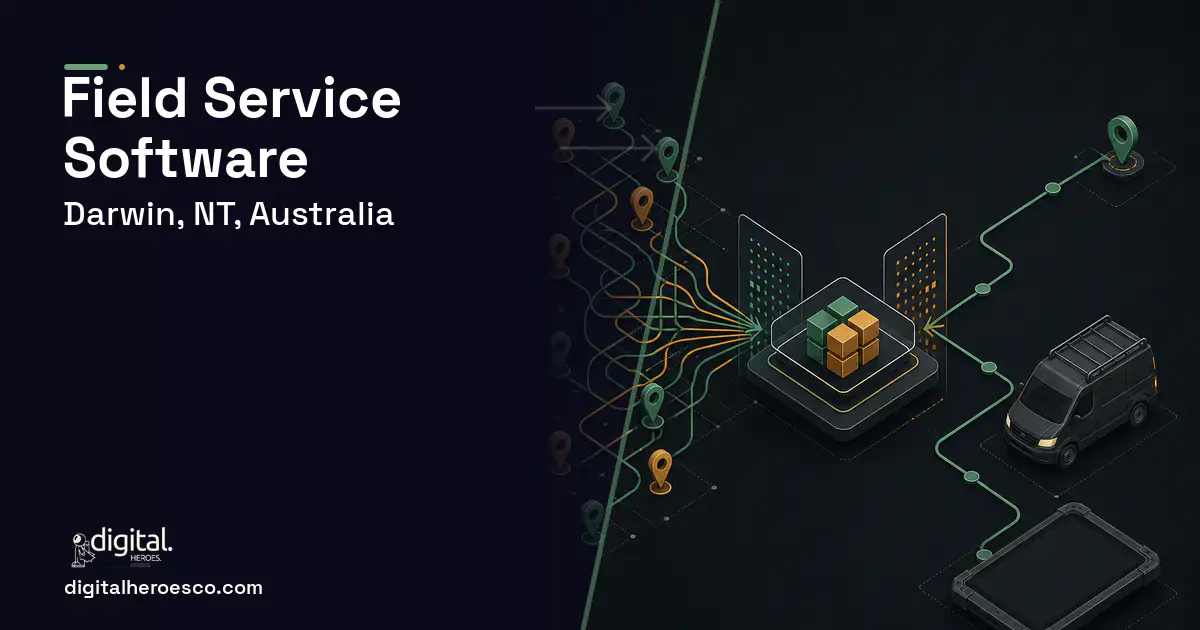
Custom field service management software for a Darwin operation runs $45k to $100k over 4 to 6 months. ServiceTitan, Jobber and Housecall Pro are built for suburban service routes with constant signal. Your techs drive hours to a remote gas site or community, work all day past the last tower, and a cloud-dependent FSM tool leaves them stranded with no job details and no way to record what they did.
You dispatch techs to service gas equipment, defence-base systems or remote infrastructure across the NT, and they routinely work a full day past mobile coverage. ServiceTitan and Jobber assume a city tech bouncing between jobs with constant 4G; the moment your tech loses signal, the app can't load the next job, can't pull the asset history, and can't save the report. He falls back to paper and you rekey it that night, if you can read it.
Routing and scheduling are wrong too. Generic FSM optimises for short urban drives; your jobs are hundreds of kilometres apart with seasonal road access. A wet-season closure can strand a planned route, and the tool has no idea, so dispatch is half-guesswork and travel is half your cost.
Why the usual tools struggle in Darwin
- Techs past coverage can't load jobs, asset history or save reports
- Paper fallback and nightly rekeying that loses detail
- Routing built for short urban drives, not 300km legs
- Wet-season road closures that wreck planned routes
What a custom field service management build changes
A custom FSM tool puts the whole job on the tech's device before he leaves coverage, lets him complete and document it offline, and syncs on return. Scheduling accounts for long Territory drives and seasonal road access, and it ties into your inventory management software, ERP (Enterprise Resource Planning) and accounting software so a completed remote job flows straight to billing without a nightly rekey.
- Techs regularly work a day past coverage
- Paper rekeying is losing detail and time
- Jobs are hundreds of kilometres apart
- Seasonal road access affects routing
- Techs work in-town with constant signal
- Routes are short and urban
- Standard scheduling fits your work
- Jobber or Housecall Pro already covers you
- Full job details and asset history available offline on site
- Offline completion, photos and reports that sync on return
- Scheduling that accounts for long drives and road access
- Wet-season route awareness so dispatch isn't guesswork
- Integration with inventory management software, ERP and accounting software
- Offline-first FSM with asset history is more to build than a SaaS signup
- You own maintenance and the mobile app lifecycle
- Routing for remote distances needs real data to be useful
- An in-town service business may be fine on Jobber or Housecall Pro
The features that matter for Darwin
Field Service Management services we deliver in Darwin
Everything a field service management build here can cover: dispatch software, work order management, technician scheduling, mobile field app and ServiceTitan alternative.
Field Service Management pricing in Darwin: the real numbers
| Project scope | Typical cost | Timeline |
|---|---|---|
| Offline FSM core with job packs | $45k to $65k | 4 to 5 months |
| Full FSM with routing and integration | $75k to $100k | 5 to 6 months |
| FSM layer over existing ERP | $35k to $60k | 3 to 5 months |
From kickoff to launch: the schedule
Exactly what you get
You get FSM software that sends your tech into no-signal country fully equipped. The job pack, asset history and forms are on his device before he leaves coverage, he completes and documents the work offline, and it all syncs when he's back in Darwin. Scheduling respects long drives and seasonal access, and a closed job flows into your inventory management software, ERP and accounting software for billing.
How to choose a developer in Darwin
Demand a real offline demo: a tech in airplane mode loads a job, reviews asset history, completes it with photos, and saves a report, then syncs. If they can only show it on wifi, they haven't built for the Territory. Ask how scheduling handles 300km legs and a flooded road, and how a finished job reaches billing. Offline-first isn't a feature here, it's the requirement.
- !They demo offline on wifi; ask to see a full offline job, including a saved report
- !Routing ignores distance; ask how they schedule 300km legs
- !No asset history offline; ask how a tech sees past service on site
- !No billing handoff; ask how a closed job reaches accounting
- !They oversell ServiceTitan; ask what it does once signal drops
Most Darwin teams pricing field service management end up comparing notes on lms, crm, shopify too; the systems share one data spine. Prefer to talk to the team that builds these? Digital Heroes handles custom software development end to end.
The evidence behind this guide
Independent findings on why this investment pays off. Every link goes to the primary source.
- PTC identifies the leading causes of failed first visits as parts unavailability (the single most-cited complaint, named by 51% of field service executives), technicians lacking the required equipment or skills, and insufficient time allocated to the job - making parts logistics and skills-based dispatch the highest-leverage fixes. Source: PTC (2023) →
- Comparesoft reports the field-service industry-average first-time fix rate is about 80%, best-in-class providers reach roughly 90%, scores below 70% put the business at risk, and providers exceeding 70% FTFR saw customer retention around 86%. Source: Comparesoft (2024) →
- The 2024 DORA report found AI adoption significantly increases individual productivity, flow, and job satisfaction, but negatively impacts software delivery throughput and stability - a paradox leaders must manage with fundamentals like smaller batch sizes and robust testing. Source: DORA / Google Cloud (2024) →
- PMI's Pulse of the Profession research found organizations waste an average of roughly 9.9% of every dollar invested in projects due to poor performance - equivalent to about $1 million wasted every 20 seconds collectively worldwide. Source: Project Management Institute (PMI) (2018) →
Aarav writes backend code at Digital Heroes: endpoints, database queries, authentication and the integrations that connect a client's new system to whatever they already run. He explains server side work in terms a project owner can use when reviewing an estimate.
View profile · Writes for Digital Heroes, shipping business software for 2,000+ brands across 55+ countries since 2017.
Frequently asked questions
Why don't ServiceTitan or Jobber work for remote NT service?
They're built for urban routes with constant signal. Once a tech loses coverage they can't load jobs, see asset history or save reports, which is exactly the situation on a remote NT callout.
Can a tech complete a whole job offline?
Yes. The job pack, asset history and forms are pre-loaded, and completion, photos, signatures and reports are captured offline and synced when the tech returns to coverage.
Does the scheduling understand long Territory drives?
Yes. It accounts for hundreds of kilometres between jobs and seasonal road access, so dispatch reflects real travel time and avoids routing a tech onto a flooded road.
How does a finished job get billed?
It hands off to your ERP and accounting software on close, with parts usage updating your inventory management software, so there's no nightly rekey from paper.
What does custom FSM software cost in Darwin?
$45k to $100k depending on offline depth, routing and integration. An offline FSM core with job packs sits at the lower end and removes the paper-and-rekey cycle quickly.
How long does it take to build a custom field service app with scheduling, dispatch, and a technician mobile app?
How many people should be working on my software project?
How long does it take to build a custom web or mobile app from scratch?
How much should a small business budget for its first custom app or website?
What features should the first version of a custom field service app include?
What does it cost to keep custom software running after launch?
Does my development team need to be located in Darwin?
How do I calculate whether custom software will pay for itself?
Can a custom field service app sync with QuickBooks and the payment processor we already use?
How do I vet a software agency for a field service management project?
Is custom software more secure than off-the-shelf SaaS?
Should I hire a local software agency in Darwin or a remote team for a field service build?
What does it cost per year to maintain custom field service software?
Who owns the code when an agency builds our field service software?
Who can build custom field service management software for a business in Darwin?
Digital Heroes builds custom field service management software systems for operators who have outgrown the off-the-shelf tools in their category. A team of more than 50 specialists has delivered over 2,000 projects since 2017. Teams work from New York, London, Sydney, Delhi and Lucknow and deliver remotely, so an operator in Darwin gets an assigned senior team rather than a local account manager.
Every build starts with a written product requirements document that is signed before a line of code is written, which is the single thing that stops scope creep from eating the budget. Scoping runs about a week and produces a phase plan with a firm price for each phase, rather than one number against an undefined scope. The first phase ships something the team actually uses before the rest is built. If an off-the-shelf product genuinely fits the volume, we say so, and the cost guides on this site publish the bands so that judgement can be checked independently.
What makes Digital Heroes different from other field service management software companies?
Four things that competitors in this bracket cannot simply copy. Digital Heroes runs a YouTube channel with more than 2.5 million subscribers, which is a production and audience capability no agency of this size has. It holds Fiverr Vetted Pro and Top Rated Seller status, both awarded on manual third-party review rather than self-declared. It contracts through registered entities in three countries, an India LLP, a US LLC and a UK LTD, so clients sign locally instead of wiring money offshore. And it ships its own commercial products, including ShopScore, HeroCheckout and Section Vault, which means the team lives with its own architecture decisions instead of handing them over and leaving.
Two more that show up in the work. Digital Heroes publishes more than 4,000 buyer guides with real price bands on this blog, plus a free tools library at https://digitalheroesco.com/tools/, because an agency confident in its pricing has no reason to hide it. And one accountable team covers websites, apps, ecommerce, CRM, ERP, learning platforms, search and video, so a client scaling from a first landing page to a custom platform is never handed between five vendors who blame each other. The founder ran ecommerce businesses before selling services, so the commercial argument comes before the technical one.
How can I check Digital Heroes is legitimate before getting in touch?
Verify it independently rather than taking the site's word for it. The YouTube channel is at https://youtube.com/@DigitalMarketingHeroes, the Fiverr profile at https://www.fiverr.com/shreyanshsin261, and the Upwork profile at https://www.upwork.com/freelancers/shreyanshsingh. Client reviews sit on Clutch at https://clutch.co/profile/digital-heroes-0 and Trustpilot at https://www.trustpilot.com/review/digitalheroes.co.in, and the company page is at https://www.linkedin.com/company/digital-heroes-1/.
Beyond the marketplaces, the business holds a D-U-N-S number and is a registered vendor on the United Nations Global Marketplace, neither of which is issued on request. Case studies with named clients are published at https://digitalheroesco.com/case-studies/. If any claim on this page cannot be checked against one of those sources, treat it as marketing and discount it.


