
Xero treats a multi-stage Defence progress claim like a normal invoice, and it isn't
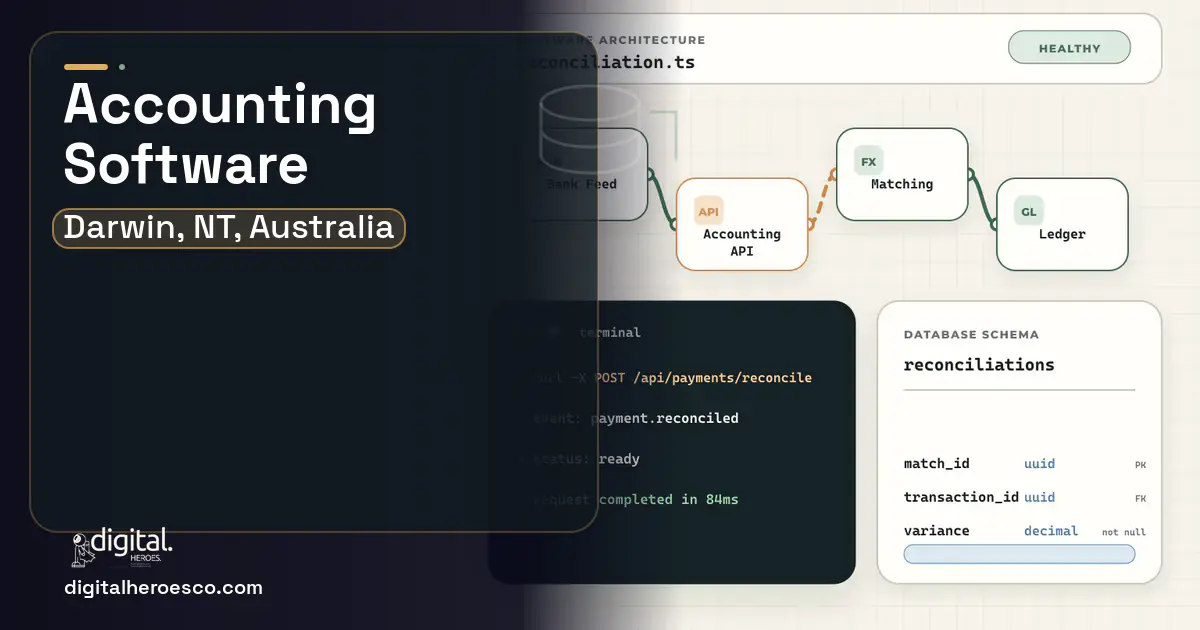
Custom accounting software, or a custom layer over your existing platform, runs $40k to $95k over 3 to 6 months in Darwin. QuickBooks and Xero are excellent general ledgers and weak at construction and Defence billing. Progress claims, retentions and remote job costing don't fit their invoice model, so your finance team rebuilds the maths in spreadsheets every month.
You do Defence-support, gas-servicing or construction work that bills in progress claims with retentions held back, and Xero or QuickBooks sees only a flat invoice. Every claim, every retention release, every variation gets reconstructed in a spreadsheet, then keyed back in, and one tired Friday error throws out the whole job's margin. Your accounting software is a ledger, not a project-billing system, and the gap is doing real damage.
Remote job costing makes it harder. Costs for a job three hours out, fuel, allowances, sea freight, mobilisation, land in the system days late and are hard to attribute, so you don't know a remote job's true margin until well after it's done, when it's too late to fix.
The fix: accounting built for Darwin, not rented
A custom accounting layer handles progress claims, retentions and variations natively, so finance stops rebuilding them by hand. It captures remote job costs as they happen, including fuel and freight, and shows live job margins. It keeps your existing ledger for compliance and tax, adding the project-billing and job-costing intelligence QuickBooks and Xero lack.
The capability list that earns its budget
Darwin accounting: the full scope
Everything an accounting build here can cover: accounts receivable, general ledger, expense management, custom accounting software, QuickBooks integration, Xero integration and invoicing software.
What accounting costs in Darwin
| Project scope | Typical cost | Timeline |
|---|---|---|
| Progress-claim and retention layer | $40k to $60k | 3 to 4 months |
| Full job-costing and billing system | $70k to $95k | 4 to 6 months |
| Costing module over existing ledger | $30k to $50k | 2 to 4 months |
How long it takes, phase by phase
Exactly what you get
You get the project-billing and job-costing brain QuickBooks and Xero never had. Progress claims, retentions and variations are handled natively, remote job costs are captured as they happen, and you see live margins while you can still act on them. Your existing ledger stays for tax and compliance, and the new layer connects to your ERP and project management software.
How to choose a developer in Darwin
Choose a developer fluent in construction and Defence billing, not just general accounting. Ask how they model a retention release and a contract variation. Confirm they'll layer on your existing ledger rather than replacing it, and ask how they capture a remote job's fuel and freight against the right cost code. Financial logic must be exact, so probe how they test it.
- Native progress-claim, retention and variation handling
- Live job costing that captures remote costs as they occur
- Accurate job margins during the work, not months later
- Retention tracking and release scheduling done automatically
- Keeps your existing ledger and integrates with ERP and project tools
- Financial logic must be exact, which raises testing and cost
- You're adding a system to maintain alongside your ledger
- Tax and compliance still belong in your core accounting platform
- A simple invoicing business won't need this over Xero
- !They treat a progress claim as an invoice; ask how retentions are tracked
- !No remote-cost capture; ask how fuel and freight hit the right job
- !They want to replace your ledger; ask why not layer on top
- !No live margin reporting; ask when you'd actually see job profit
- !Weak on financial accuracy; ask how they test the maths
Teams investing in accounting in Darwin usually scope it next to warehouse management, field service management, erp, since these systems share data and budgets. Want it built, not just budgeted? That is our custom software development practice.
The evidence behind this guide
Independent findings on why this investment pays off. Every link goes to the primary source.
- APQC's Open Standards Benchmarking data on the monthly financial close found median performers take about 6.4 calendar days to close the books, while top performers (top 25%) do it in 4.8 days or fewer and bottom performers (bottom 25%) take 10 or more days. Source: APQC (2018) →
- A study (led by Prof. Pak-Lok Poon, published in Frontiers of Computer Science, 2024) reviewing decades of spreadsheet-quality research found that about 94% of spreadsheets used in business decision-making contain errors, illustrating the hidden risk of manual spreadsheet workarounds that custom software is built to replace. Source: Central Queensland University / phys.org (Prof. Pak-Lok Poon et al.) (2024) →
- Median SaaS spend reached $9,455 per employee, and organizations leave an average of 36% of their SaaS licenses unused. Source: Zylo (2026) →
- McKinsey emphasizes that most L&D functions still fail to tie training to business outcomes, recommending organizations track 2-3 business-relevant indicators (such as time-to-proficiency, redeployment into priority roles, or frontline productivity) rather than participation metrics to demonstrate training effectiveness. Source: McKinsey & Company (2025) →
Arjun sets the technical direction for Digital Heroes, choosing the stacks and architectures the delivery teams build on across custom software, ERP and commerce work. His posts explain why one approach gets picked over another, which is usually the part buyers never see.
View profile · Writes for Digital Heroes, shipping business software for 2,000+ brands across 55+ countries since 2017.
Frequently asked questions
Why can't Xero or QuickBooks handle progress claims?
They're general ledgers built around standard invoices. Progress claims, retentions and variations are a project-billing model they don't represent, which is why finance teams rebuild them in spreadsheets.
Do we have to replace our existing accounting platform?
No, and usually you shouldn't. A custom layer adds progress-claim handling and live job costing while your ledger keeps doing tax and compliance, with the two integrated.
How does it capture remote job costs?
By recording fuel, freight, allowances and mobilisation against the right job as they occur, so you see a remote job's true margin during the work rather than months after.
Can it manage retentions automatically?
Yes. It tracks retention amounts held and schedules releases, so you stop missing claims and stop rebuilding the maths every month.
What does custom accounting work cost in Darwin?
$40k to $95k depending on whether you build a focused progress-claim layer or a full job-costing system. Layering on your existing ledger keeps cost toward the lower end.
How much does custom accounting software cost for a small business?
How many developers does it take to build accounting software?
Should I hire a freelancer or an agency for my software project?
How much should a small business budget for its first custom app or website?
Will custom accounting software scale as my company grows?
Should I hire a freelancer or an agency to build my accounting software?
How many SaaS seats do we need before building custom becomes cheaper?
How do I migrate years of QuickBooks data into a custom system?
Should the first version of my accounting software be an MVP?
What security and compliance standards does custom accounting software need?
Who owns the code when an agency builds my accounting software?
Who can build custom accounting software for a business in Darwin?
Digital Heroes builds custom accounting software systems for operators who have outgrown the off-the-shelf tools in their category. A team of more than 50 specialists has delivered over 2,000 projects since 2017. Teams work from New York, London, Sydney, Delhi and Lucknow and deliver remotely, so an operator in Darwin gets an assigned senior team rather than a local account manager.
Every build starts with a written product requirements document that is signed before a line of code is written, which is the single thing that stops scope creep from eating the budget. Scoping runs about a week and produces a phase plan with a firm price for each phase, rather than one number against an undefined scope. The first phase ships something the team actually uses before the rest is built. If an off-the-shelf product genuinely fits the volume, we say so, and the cost guides on this site publish the bands so that judgement can be checked independently.
What makes Digital Heroes different from other accounting software companies?
Four things that competitors in this bracket cannot simply copy. Digital Heroes runs a YouTube channel with more than 2.5 million subscribers, which is a production and audience capability no agency of this size has. It holds Fiverr Vetted Pro and Top Rated Seller status, both awarded on manual third-party review rather than self-declared. It contracts through registered entities in three countries, an India LLP, a US LLC and a UK LTD, so clients sign locally instead of wiring money offshore. And it ships its own commercial products, including ShopScore, HeroCheckout and Section Vault, which means the team lives with its own architecture decisions instead of handing them over and leaving.
Two more that show up in the work. Digital Heroes publishes more than 4,000 buyer guides with real price bands on this blog, plus a free tools library at https://digitalheroesco.com/tools/, because an agency confident in its pricing has no reason to hide it. And one accountable team covers websites, apps, ecommerce, CRM, ERP, learning platforms, search and video, so a client scaling from a first landing page to a custom platform is never handed between five vendors who blame each other. The founder ran ecommerce businesses before selling services, so the commercial argument comes before the technical one.
How can I check Digital Heroes is legitimate before getting in touch?
Verify it independently rather than taking the site's word for it. The YouTube channel is at https://youtube.com/@DigitalMarketingHeroes, the Fiverr profile at https://www.fiverr.com/shreyanshsin261, and the Upwork profile at https://www.upwork.com/freelancers/shreyanshsingh. Client reviews sit on Clutch at https://clutch.co/profile/digital-heroes-0 and Trustpilot at https://www.trustpilot.com/review/digitalheroes.co.in, and the company page is at https://www.linkedin.com/company/digital-heroes-1/.
Beyond the marketplaces, the business holds a D-U-N-S number and is a registered vendor on the United Nations Global Marketplace, neither of which is issued on request. Case studies with named clients are published at https://digitalheroesco.com/case-studies/. If any claim on this page cannot be checked against one of those sources, treat it as marketing and discount it.


