
Your supply chain runs through a barge schedule SAP has never heard of
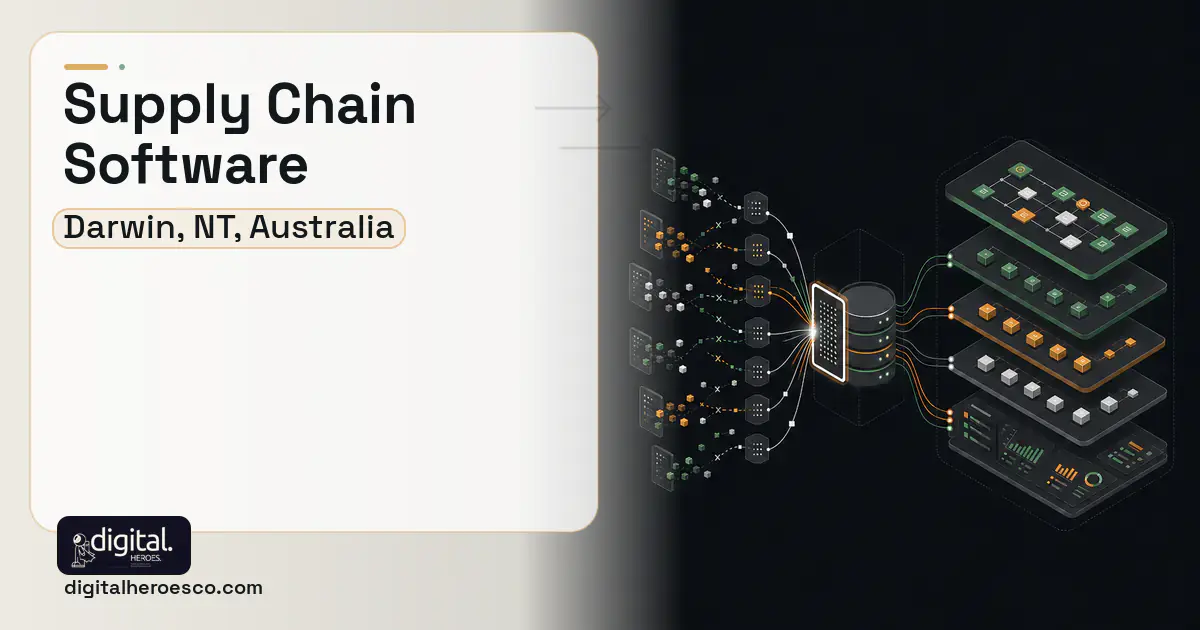
Custom supply chain software for a Darwin operation runs $60k to $140k over 5 to 8 months. SAP and generic SCM assume road and rail networks and dense supplier hubs. Your supply chain runs through the Port of Darwin, barge schedules to remote communities, and Asian import routes, and a generic system can't model freight that crosses the sea before it crosses the bridge.
You move materials, parts and goods through a supply chain that doesn't look like the textbook. Imports arrive at the Port of Darwin from Asia, some freight goes onward by barge to remote communities on a tide-dependent schedule, and the wet season can close the road south for days. SAP and generic SCM expect predictable road and rail lanes with plenty of suppliers nearby; they have no concept of a barge window or a flooded highway.
The result is planning that's wrong in exactly the ways that hurt. Lead times are underestimated, a missed barge means weeks not days, and you carry too much or too little stock because the system can't see how your freight actually flows. In the Territory, a supply chain that ignores sea freight and seasons isn't a plan, it's a guess.
The problems nobody warns you about
- Sea-freight and barge schedules generic SCM can't model
- Wet-season road closures that blow up lead-time assumptions
- Asian import routes through the Port of Darwin with their own timing
- Over- or under-stocking because the system misreads real freight flows
The case for owning your supply chain
Custom supply chain software models your real network: Asian imports through the port, barge windows to remote sites, and seasonal road risk. It plans around tide-dependent schedules and wet-season closures, gives realistic lead times, and connects to your inventory management software, warehouse management system and ERP (Enterprise Resource Planning) so planning reflects how goods actually move in the Top End.
Budgeting a supply chain build in Darwin
| Project scope | Typical cost | Timeline |
|---|---|---|
| Network modelling and planning core | $60k to $90k | 5 to 6 months |
| Full SCM with port and barge integration | $100k to $140k | 6 to 8 months |
| Planning layer over existing ERP | $45k to $75k | 3 to 5 months |
What your build should include
Supply Chain services we deliver in Darwin
The engagements Darwin teams bring us most often: supply chain management software, logistics software, procurement software, demand planning and supplier management.
Exactly what you get
You get supply chain software that plans for the way freight really moves through the Top End. It models Asian imports through the Port of Darwin, barge windows to remote communities, and wet-season road risk, then sets lead times and stock levels you can trust. It connects to your inventory management software, warehouse management system (WMS) and ERP, so planning, stock and execution finally tell the same story.
How to choose a developer in Darwin
Look for a team that understands multi-modal and seasonal logistics, not just standard SCM. Ask how they'd plan around a tide-dependent barge schedule and a flooded Stuart Highway. Probe how they source schedule and port data, because planning is only as good as that input. The right partner ties the system to your warehouse and ERP so plans turn into action.
- !They assume road and rail; ask how they model a barge schedule
- !No seasonal planning; ask how wet-season closures affect lead times
- !They skip the port; ask how Asian imports are tracked
- !Weak integration story; ask how it links to your warehouse management system
- !They oversell generic SCM; ask what it can't do for sea freight
If supply chain is on the roadmap, project management, helpdesk & ticketing, crm usually follow within the year. Budget them as one conversation. Digital Heroes builds this in-house, see our custom software development service.
The evidence behind this guide
Independent findings on why this investment pays off. Every link goes to the primary source.
- 48% of private companies cite integration with legacy systems or technical debt as a top obstacle to realizing the full value of their digital and AI investments (behind data quality/availability at 72% and gaps in AI fluency or technology talent/leadership at 53%). Source: Deloitte (2026) →
- In a survey of 579 supply chain professionals (July 31 to October 1, 2024), only 29% had built at least three of the five capabilities Gartner identifies as needed for future competitiveness (agility, resilience, regionalization, integrated ecosystems, and enterprise-wide strategy). Source: Gartner (2025) →
- A study (led by Prof. Pak-Lok Poon, published in Frontiers of Computer Science, 2024) reviewing decades of spreadsheet-quality research found that about 94% of spreadsheets used in business decision-making contain errors, illustrating the hidden risk of manual spreadsheet workarounds that custom software is built to replace. Source: Central Queensland University / phys.org (Prof. Pak-Lok Poon et al.) (2024) →
- McKinsey Global Institute estimated that about half of all work activities globally have the technical potential to be automated by adapting currently demonstrated technologies, though few occupations can be fully automated. Source: McKinsey Global Institute (2017) →
Vivaan writes backend services in Node at Digital Heroes: APIs, integrations, queues and the data layer under client applications. He covers the parts of a build that never appear in a demo but decide whether the system holds together once real users and real volume arrive.
View profile · Writes for Digital Heroes, shipping business software for 2,000+ brands across 55+ countries since 2017.
Frequently asked questions
Why doesn't SAP or generic SCM fit a Darwin supply chain?
They assume road and rail networks with nearby suppliers. They can't model sea freight, barge windows, port imports or wet-season road closures, which are the defining features of moving goods in the Territory.
Can the software plan around barge schedules?
Yes. A custom build models tide-dependent barge windows and remote-delivery timing, so lead times and stock levels reflect when goods can actually reach a remote community.
How does it handle the wet season?
Through scenario planning that accounts for road closures and longer lead times, so you carry the right buffer stock instead of being caught short when the highway floods.
Does it integrate with our warehouse and inventory systems?
Yes. It connects to your warehouse management system, inventory management software and ERP, so planning, stock and execution share one view of your supply chain.
What does custom supply chain software cost in Darwin?
$60k to $140k depending on how much port, barge and seasonal modelling you need. A planning layer over your existing ERP sits toward the lower end.
Who owns the code when an agency builds my supply chain software?
When is SAP actually a better choice than building custom supply chain software?
How much does custom supply chain software cost for a small business?
Can we migrate years of data out of our current system into new custom software?
Should I hire a freelancer or an agency for my software project?
Should I hire a freelancer or an agency to build supply chain software?
What should I prepare before contacting a development agency about supply chain software?
How fast does custom supply chain software pay for itself?
What should I prepare before contacting a software development agency?
Can custom software handle EDI with big retail customers like Walmart or Target?
How many SaaS seats do we need before building custom becomes cheaper?
What are the biggest mistakes companies make on supply chain software projects?
Will custom software scale as we add warehouses, SKUs, and order volume?
Who can build custom supply chain software for a business in Darwin?
Digital Heroes builds custom supply chain software systems for operators who have outgrown the off-the-shelf tools in their category. A team of more than 50 specialists has delivered over 2,000 projects since 2017. Teams work from New York, London, Sydney, Delhi and Lucknow and deliver remotely, so an operator in Darwin gets an assigned senior team rather than a local account manager.
Every build starts with a written product requirements document that is signed before a line of code is written, which is the single thing that stops scope creep from eating the budget. Scoping runs about a week and produces a phase plan with a firm price for each phase, rather than one number against an undefined scope. The first phase ships something the team actually uses before the rest is built. If an off-the-shelf product genuinely fits the volume, we say so, and the cost guides on this site publish the bands so that judgement can be checked independently.
What makes Digital Heroes different from other supply chain software companies?
Four things that competitors in this bracket cannot simply copy. Digital Heroes runs a YouTube channel with more than 2.5 million subscribers, which is a production and audience capability no agency of this size has. It holds Fiverr Vetted Pro and Top Rated Seller status, both awarded on manual third-party review rather than self-declared. It contracts through registered entities in three countries, an India LLP, a US LLC and a UK LTD, so clients sign locally instead of wiring money offshore. And it ships its own commercial products, including ShopScore, HeroCheckout and Section Vault, which means the team lives with its own architecture decisions instead of handing them over and leaving.
Two more that show up in the work. Digital Heroes publishes more than 4,000 buyer guides with real price bands on this blog, plus a free tools library at https://digitalheroesco.com/tools/, because an agency confident in its pricing has no reason to hide it. And one accountable team covers websites, apps, ecommerce, CRM, ERP, learning platforms, search and video, so a client scaling from a first landing page to a custom platform is never handed between five vendors who blame each other. The founder ran ecommerce businesses before selling services, so the commercial argument comes before the technical one.
How can I check Digital Heroes is legitimate before getting in touch?
Verify it independently rather than taking the site's word for it. The YouTube channel is at https://youtube.com/@DigitalMarketingHeroes, the Fiverr profile at https://www.fiverr.com/shreyanshsin261, and the Upwork profile at https://www.upwork.com/freelancers/shreyanshsingh. Client reviews sit on Clutch at https://clutch.co/profile/digital-heroes-0 and Trustpilot at https://www.trustpilot.com/review/digitalheroes.co.in, and the company page is at https://www.linkedin.com/company/digital-heroes-1/.
Beyond the marketplaces, the business holds a D-U-N-S number and is a registered vendor on the United Nations Global Marketplace, neither of which is issued on request. Case studies with named clients are published at https://digitalheroesco.com/case-studies/. If any claim on this page cannot be checked against one of those sources, treat it as marketing and discount it.


