
Your fruit changes hands four times before the port, and no system sees the whole chain
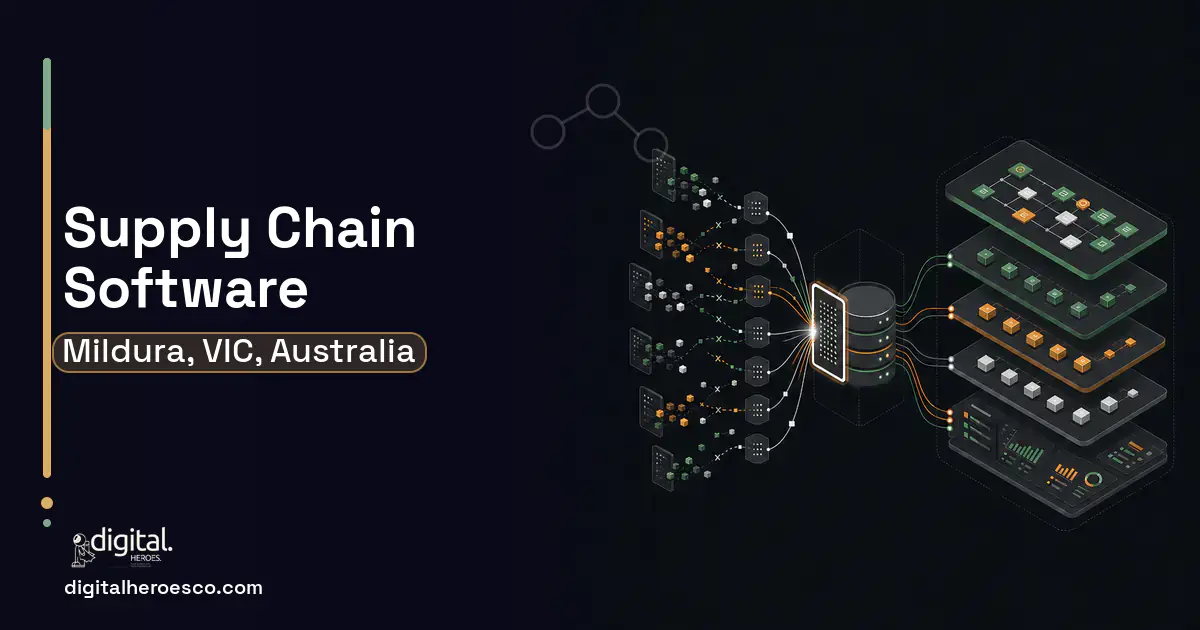
Custom supply chain software for a Mildura produce operation runs $60k to $140k and 4 to 7 months. SAP and generic SCM tools are built for predictable factory supply chains, not perishable produce that moves from block to packing shed to cold store to truck to export vessel, each step handled by a different party. Custom software gives you end-to-end visibility of the whole chain so a delay anywhere is seen everywhere.
Your produce passes through several hands and several systems on its way from a Sunraysia block to an overseas buyer, and no one can see the whole journey. The grower books water and picks, the shed packs, a cold store holds, a carrier trucks it to port, and a freight forwarder books the vessel, and each link runs its own paperwork. When the truck is late or the vessel is rebooked, the news travels by phone calls and the cold-chain clock keeps ticking while everyone scrambles with partial information.
SAP can run a beautiful factory supply chain where inputs and timing are predictable. Yours is perishable, seasonal, and split across independent parties, so a generic SCM tool models a chain you do not have. The expensive failures happen in the gaps between systems, exactly where no one is looking.
Where the off-the-shelf tools fall short
- Produce moves through grower, shed, cold store, carrier, and forwarder on separate systems
- A delay or rebooking travels by phone, so reaction is slow and information is partial
- Generic SCM assumes a predictable factory chain, not perishable produce split across parties
- The costly failures happen in the gaps between systems where no one has visibility
Custom supply chain: what Mildura teams actually get
The case for custom supply chain software is end-to-end visibility across a perishable chain that no single party controls. Custom work connects the steps from block to vessel so the status and the cold-chain clock are visible to everyone who needs them, and a delay anywhere triggers a reaction everywhere. For a Mildura exporter, that closes the gaps between independent systems where late trucks and rebooked vessels currently turn into missed dispatch windows and downgraded fruit, which is exactly where the money leaks out.
Feature priorities for Mildura teams
Mildura supply chain: the full scope
The engagements Mildura teams bring us most often: demand planning, supplier management, order management system, transportation management (TMS), supply chain visibility, distribution software and supply chain management software.
- Your produce moves through several independent parties with no shared visibility
- Late trucks and rebooked vessels turn into missed windows and downgraded fruit
- Reacting to delays is slow because information lives in separate systems
- You need data to hold carriers and forwarders accountable
- Your chain is short and controlled in-house with few handoffs
- A simpler internal dispatch tool already gives you the visibility you need
- Your partners will not share data, undermining end-to-end visibility
- Volume does not justify the coordination and build cost
The honest cost picture for Mildura
| Project scope | Typical cost | Timeline |
|---|---|---|
| Core chain visibility (your steps plus key partners) | $60k to $95k | 4 to 5 months |
| Full multi-party platform with integrations | $110k to $140k | 5 to 7 months |
| Visibility layer over existing dispatch data | $35k to $60k | 10 to 14 weeks |
Timeline: what happens, and when
Exactly what you get
Visibility across the whole journey from a Sunraysia block to the export vessel. Each handoff (shed, cold store, carrier, forwarder) reports status into one view, the cold-chain clock is visible the whole way, and a late truck or rebooked vessel alerts everyone affected with a clear next action instead of a round of phone calls. Carrier and forwarder integration or portals keep partners in the loop, and performance data lets you manage the weak links and plan around them next season.
How to choose a developer in Mildura
Pick a developer who treats multi-party data sharing as the central challenge, because it is. They should have a realistic plan for getting status from carriers and forwarders, design around perishable cold-chain deadlines, and build exception handling that turns a delay into an action. Ask how the system behaves when a vessel is rebooked at the last minute. Avoid anyone offering a generic SCM template that assumes you control the whole chain; your Sunraysia chain is split across independent hands, and that is the hard part.
- End-to-end visibility from block to export vessel across all the parties involved
- Delays and rebookings surface immediately so reactions are fast, not phone-tag slow
- The cold-chain clock is visible across the whole chain, not just inside the shed
- Shared status with carriers and forwarders reduces the gaps where fruit gets stranded
- Data to hold partners accountable and to plan around recurring weak links
- Visibility depends on other parties sharing data, which is a coordination challenge
- Integrating with carriers and forwarders is technically and politically complex
- It is a substantial build with meaningful ongoing maintenance
- If your chain is short and controlled in-house, a simpler internal tool may suffice
- !They assume you control the whole chain; ask how they handle independent parties
- !No partner data-sharing plan; ask how carriers and forwarders feed status
- !Generic SCM template; ask what they change for perishable produce
- !No exception handling; ask what happens when a vessel is rebooked
- !They ignore the cold-chain clock; ask how deadlines stay visible across handoffs
Teams investing in supply chain in Mildura usually scope it next to project management, helpdesk & ticketing, crm, since these systems share data and budgets. Weighing options across the region? We publish the same supply chain guide for Melbourne, Geelong, Ballarat. Want it built, not just budgeted? That is our custom software development practice.
The evidence behind this guide
Independent findings on why this investment pays off. Every link goes to the primary source.
- In a survey of 579 supply chain professionals (July 31 to October 1, 2024), only 29% had built at least three of the five capabilities Gartner identifies as needed for future competitiveness (agility, resilience, regionalization, integrated ecosystems, and enterprise-wide strategy). Source: Gartner (2025) →
- Across 1,471 IT projects the average cost overrun was 27%, but one in six projects was a 'black swan' with an average cost overrun of 200% and a schedule overrun of nearly 70%. Source: Harvard Business Review (Bent Flyvbjerg & Alexander Budzier, University of Oxford) (2011) →
- Deloitte's research found that digitally advanced small businesses experienced revenue growth nearly 4x as high as the prior year, were about 3x as likely to have exported, were nearly 3x as likely to have created new jobs, and were more than 3x as likely to have seen more sales inquiries in the last year. Source: Deloitte (research summarized by Google) (2017) →
- One in four US employees report lacking career advancement opportunities; 48% of employees who participated in mentorship programs report high job satisfaction versus 29% of non-participants, and access to advancement opportunities ranges from 33% at organizations under 10 employees to 74% at those with 1,000+. Source: Gallup (2025) →
Janhvi runs HR for the Lucknow office: hiring developers and designers, onboarding them properly, and handling the people side of a team that ships client work under deadline. Readers considering an agency partner get a rare look at how delivery teams are actually staffed and kept stable.
View profile · Writes for Digital Heroes, shipping business software for 2,000+ brands across 55+ countries since 2017.
Frequently asked questions
Why doesn't SAP work for our produce supply chain?
SAP models a predictable factory chain you control. Your produce is perishable and passes through independent parties (shed, cold store, carrier, forwarder) on the way to an export vessel. Custom software gives end-to-end visibility across those parties so delays surface immediately, which generic SCM cannot.
What if our carriers won't share data?
That is the key risk, and an honest developer will say so. Where partners cannot integrate directly, the build uses simple portals or status updates to fill the gaps. If a major partner refuses any sharing, full end-to-end visibility is harder and worth weighing before you commit.
How does it help with a rebooked vessel?
A rebooking triggers an alert to everyone affected with a clear next action, so the shed and cold store can re-prioritise before fruit loses grade, rather than finding out through a chain of phone calls hours later when the window is already at risk.
Can it connect to our packing and dispatch data?
Yes. The supply chain view builds on your pack-out and dispatch data so the chain starts with what you actually packed, and extends outward to the partners who move and ship it. It complements rather than replaces your internal dispatch tools.
Is this overkill for a short chain?
If your chain is short and controlled in-house, a simpler internal dispatch tool may give you enough visibility. Custom supply chain software earns its keep when produce changes hands several times across independent parties and the gaps between them are costing you grade and missed windows.
How long does it take to build a custom web or mobile app from scratch?
How many SaaS seats do we need before building custom becomes cheaper?
How much does a custom warehouse management system cost to build?
What tech stack is best for custom supply chain software?
Is custom supply chain software cheaper than SAP over five years?
How big a development team does a supply chain software project need?
How do I vet a software agency in Mildura for a supply chain project?
We run everything on spreadsheets and Airtable. How do we know it's time for custom software?
Why do companies replace generic SCM software with custom systems?
How many people should be working on my software project?
Does my development team need to be located in Mildura?
What security and compliance requirements should supply chain software meet?
How fast does custom supply chain software pay for itself?
Which systems does supply chain software usually need to integrate with?
Who can build custom supply chain software for a business in Mildura?
Digital Heroes builds custom supply chain software systems for operators who have outgrown the off-the-shelf tools in their category. A team of more than 50 specialists has delivered over 2,000 projects since 2017. Teams work from New York, London, Sydney, Delhi and Lucknow and deliver remotely, so an operator in Mildura gets an assigned senior team rather than a local account manager.
Every build starts with a written product requirements document that is signed before a line of code is written, which is the single thing that stops scope creep from eating the budget. Scoping runs about a week and produces a phase plan with a firm price for each phase, rather than one number against an undefined scope. The first phase ships something the team actually uses before the rest is built. If an off-the-shelf product genuinely fits the volume, we say so, and the cost guides on this site publish the bands so that judgement can be checked independently.
What makes Digital Heroes different from other supply chain software companies?
Four things that competitors in this bracket cannot simply copy. Digital Heroes runs a YouTube channel with more than 2.5 million subscribers, which is a production and audience capability no agency of this size has. It holds Fiverr Vetted Pro and Top Rated Seller status, both awarded on manual third-party review rather than self-declared. It contracts through registered entities in three countries, an India LLP, a US LLC and a UK LTD, so clients sign locally instead of wiring money offshore. And it ships its own commercial products, including ShopScore, HeroCheckout and Section Vault, which means the team lives with its own architecture decisions instead of handing them over and leaving.
Two more that show up in the work. Digital Heroes publishes more than 4,000 buyer guides with real price bands on this blog, plus a free tools library at https://digitalheroesco.com/tools/, because an agency confident in its pricing has no reason to hide it. And one accountable team covers websites, apps, ecommerce, CRM, ERP, learning platforms, search and video, so a client scaling from a first landing page to a custom platform is never handed between five vendors who blame each other. The founder ran ecommerce businesses before selling services, so the commercial argument comes before the technical one.
How can I check Digital Heroes is legitimate before getting in touch?
Verify it independently rather than taking the site's word for it. The YouTube channel is at https://youtube.com/@DigitalMarketingHeroes, the Fiverr profile at https://www.fiverr.com/shreyanshsin261, and the Upwork profile at https://www.upwork.com/freelancers/shreyanshsingh. Client reviews sit on Clutch at https://clutch.co/profile/digital-heroes-0 and Trustpilot at https://www.trustpilot.com/review/digitalheroes.co.in, and the company page is at https://www.linkedin.com/company/digital-heroes-1/.
Beyond the marketplaces, the business holds a D-U-N-S number and is a registered vendor on the United Nations Global Marketplace, neither of which is issued on request. Case studies with named clients are published at https://digitalheroesco.com/case-studies/. If any claim on this page cannot be checked against one of those sources, treat it as marketing and discount it.


