
ServiceTitan books home plumbers fine but cannot dispatch a tech to a rig 80 miles past cell coverage
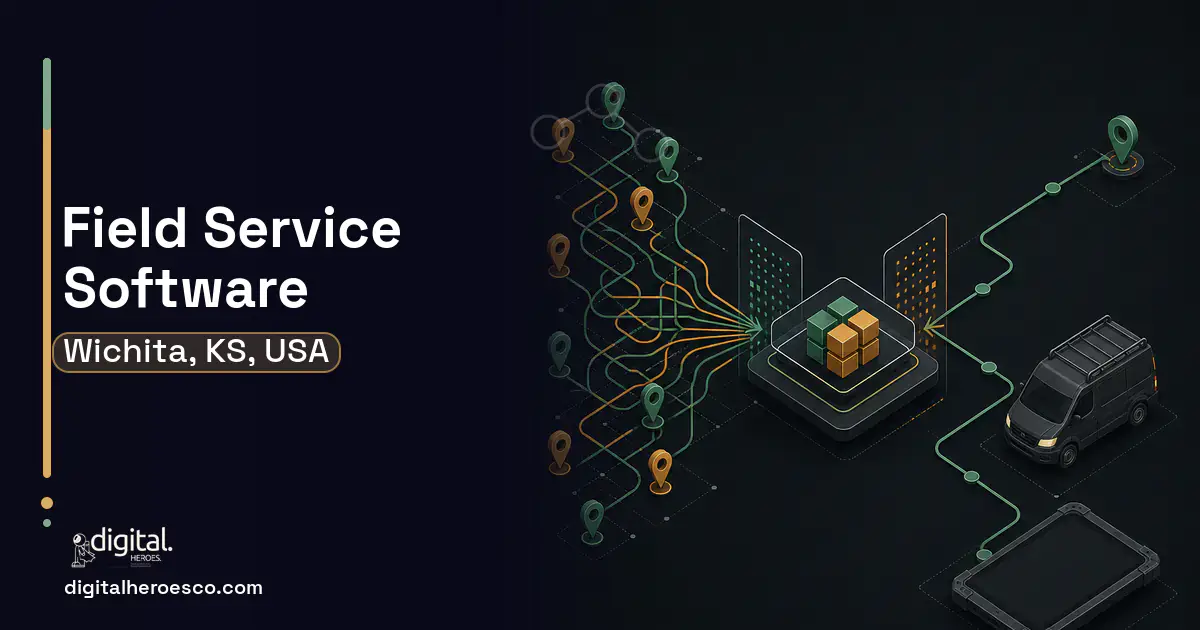
Field service tools like ServiceTitan and Jobber are built for home and commercial trades with addresses and signal. Wichita's oilfield and ag-equipment service work happens at remote rigs, well sites, and farms where the assumptions break. Custom field service software with offline operation, asset history, and parts-on-truck logic runs $55k to $130k and 4 to 8 months. The off-the-shelf tools were never built for the field you work in.
ServiceTitan, Jobber, and Housecall Pro assume a tidy world: a street address, a homeowner, a steady signal, and a job that is mostly one visit. Oilfield and ag-equipment service in and around Wichita is none of that. A tech drives to a remote well site or a farm with no cell coverage, services a specific piece of equipment that has its own maintenance history, needs the right parts already on the truck because there is no running back to the shop, and may not be able to sync until they are back in range hours later.
So the off-the-shelf tools fail at the moments that matter. The tech loses the work order when signal drops. There is no real asset history for the pump or the combine they are servicing, just a customer record. Parts-on-truck inventory is a guess. Dispatchers route by address when they should route by which tech has the right parts and certification for that equipment. The result is repeat trips, wrong parts, and service history that lives in a tech's memory.
Where the off-the-shelf tools fall short
- ServiceTitan and Jobber assume addresses and constant signal that remote oilfield and ag jobs lack
- Work orders are lost when cell coverage drops at the well site or farm
- No real asset history per piece of equipment, only a customer record
- Parts-on-truck inventory is a guess, causing repeat trips for the wrong part
Custom field service management: what Wichita teams actually get
Custom field service software is built for your field: offline-first so work survives dead zones, asset-centric so every pump, rig, or combine carries its full service history, and parts-on-truck aware so dispatch sends the tech who has the right parts and certification. It turns remote service from a guessing game into a managed operation, and syncs cleanly when the tech returns to coverage.
Feature priorities for Wichita teams
Wichita field service management: the full scope
Everything a field service management build here can cover: route optimization, asset and maintenance tracking, field service management software, dispatch software, work order management, technician scheduling and mobile field app.
- Techs service remote oilfield or farm sites past cell coverage
- Work orders are lost when signal drops
- You need asset history per equipment, not per customer
- Wrong-part repeat trips are costing you
- Your service is local with reliable signal
- Jobs are one-visit with a street address
- Asset history and parts-on-truck logic are not needed
- ServiceTitan or Jobber already fits
The honest cost picture for Wichita
| Project scope | Typical cost | Timeline |
|---|---|---|
| Offline work-order and asset app | $55k to $85k | 4 to 5 months |
| Full FSM with parts-on-truck and dispatch | $85k to $130k | 5 to 8 months |
| FSM integrated with ERP and inventory | $130k to $210k | 8 to 12 months |
Timeline: what happens, and when
Exactly what you get
Field service software built for the field you actually work: offline-first work orders that survive remote rigs and farms, asset history per piece of equipment, and parts-on-truck logic so techs arrive ready. Dispatch routes by parts and certification, and everything syncs when the tech is back in range. It integrates with your inventory management, ERP, and HR software so parts and qualifications stay in sync.
How to choose a developer in Wichita
Hire a team that has built offline-first apps and understands remote service. Ask how a tech's work survives 80 miles past cell coverage and how the system knows which parts are on which truck. A Wichita partner who has served oilfield and ag clients will have real answers. One who only knows home-services software will not.
- Offline-first work orders that survive remote sites with no signal and sync later
- Asset-centric history so every piece of equipment carries its full service record
- Parts-on-truck inventory so techs arrive with what the job needs
- Dispatch by parts and certification, not just by address
- Service history captured in the system instead of the tech's memory
- Offline-first field apps are harder and costlier than connected ones
- Asset history is only valuable once you populate it, which takes effort
- Rugged-device support and testing widen the scope
- If your service is all local with good signal, off-the-shelf may fit
- !They promise offline without a sync-conflict plan
- !No asset-centric history, only customer records
- !They ignore parts-on-truck inventory
- !Dispatch by address only, not parts and certification
- !No rugged-device testing for the field
Most Wichita teams pricing field service management end up comparing notes on lms, crm, shopify too; the systems share one data spine. Weighing options across the region? We publish the same field service management guide for Overland Park, Kansas City, Olathe. Prefer to talk to the team that builds these? Digital Heroes handles custom software development end to end.
The evidence behind this guide
Independent findings on why this investment pays off. Every link goes to the primary source.
- Mordor Intelligence sizes the field service management market at USD 6.26 billion in 2026, forecasting USD 9.87 billion by 2031 at a 9.54% CAGR, confirming sustained double-digit-adjacent demand for FSM software. Source: Mordor Intelligence (2026) →
- Salesforce's field-service research (State of Service / field service trends, survey of 5,500+ service professionals) found that 74% of mobile workers report increasing workloads and 47% say appointments don't go as planned due to customer miscommunication, unaccounted-for parts, or insufficient appointment lengths and travel times. (The separate claim that admin tasks consume ~30% of a technician's hours is NOT supported by the report - the seventh-edition data instead states technicians spend about 18% of working hours, ~7 hours/week, on admin, and only ~32% of time interacting with customers.). Source: Salesforce (2024) →
- 76% of developers are using or planning to use AI tools in their development process in 2024 (up from 70% in 2023), with current active use rising to 62% from 44%; 81% agree increasing productivity is the biggest benefit of AI tools. Source: Stack Overflow (2024) →
- Only about 30% of digital transformations succeed at meeting their objectives, but getting six critical success factors in place (leadership commitment, talent, agile culture, progress monitoring, clear strategy, and a modernized platform) raises the odds of success from 30% to 80%. Source: Boston Consulting Group (BCG) (2020) →
Connor manages client accounts at Digital Heroes from Sydney, handling the running relationship once a project is underway: updates, approvals, change requests and the questions clients feel awkward asking twice. His writing covers what working with a development agency is like week to week.
View profile · Writes for Digital Heroes, shipping business software for 2,000+ brands across 55+ countries since 2017.
Frequently asked questions
Why won't ServiceTitan or Jobber work for us?
They assume a street address, a homeowner, and constant signal. Oilfield and ag-equipment service around Wichita happens at remote sites with no coverage, on specific assets with their own history, which those tools were never built for.
How does offline operation work?
The app stores work orders, photos, and readings locally and syncs when the tech returns to coverage, so nothing is lost at a remote well site or farm. A good build handles sync conflicts cleanly.
What is asset-centric history?
Instead of tying service records only to a customer, the system tracks each piece of equipment (a pump, a combine) and its full maintenance history, so any tech sees what was done before.
Can it track parts on the truck?
Yes. Parts-on-truck inventory means dispatch sends the tech who already has what the job needs, cutting the repeat trips that wrong parts cause.
What does it cost?
An offline work-order and asset app runs $55k to $85k. A full FSM with parts-on-truck and dispatch is $85k to $130k over 5 to 8 months.
How long does it take to build a custom field service app with scheduling, dispatch, and a technician mobile app?
What are the biggest mistakes companies make when building custom field service software?
How long does it take to build a custom web or mobile app from scratch?
What security and compliance does custom field service software need?
Is custom software more secure than off-the-shelf SaaS?
How do I vet a software development agency before signing a contract?
How does custom field service software work when technicians have no cell signal?
How much should a small business budget for its first custom app or website?
Who owns the code when an agency builds my software?
What does it cost per year to maintain custom field service software?
Will custom field service software scale if we grow from 10 technicians to 100?
Should I hire a freelancer or an agency to build my field service software?
Who can build custom field service management software for a business in Wichita?
Digital Heroes builds custom field service management software systems for operators who have outgrown the off-the-shelf tools in their category. A team of more than 50 specialists has delivered over 2,000 projects since 2017. Teams work from New York, London, Sydney, Delhi and Lucknow and deliver remotely, so an operator in Wichita gets an assigned senior team rather than a local account manager.
Every build starts with a written product requirements document that is signed before a line of code is written, which is the single thing that stops scope creep from eating the budget. Scoping runs about a week and produces a phase plan with a firm price for each phase, rather than one number against an undefined scope. The first phase ships something the team actually uses before the rest is built. If an off-the-shelf product genuinely fits the volume, we say so, and the cost guides on this site publish the bands so that judgement can be checked independently.
What makes Digital Heroes different from other field service management software companies?
Four things that competitors in this bracket cannot simply copy. Digital Heroes runs a YouTube channel with more than 2.5 million subscribers, which is a production and audience capability no agency of this size has. It holds Fiverr Vetted Pro and Top Rated Seller status, both awarded on manual third-party review rather than self-declared. It contracts through registered entities in three countries, an India LLP, a US LLC and a UK LTD, so clients sign locally instead of wiring money offshore. And it ships its own commercial products, including ShopScore, HeroCheckout and Section Vault, which means the team lives with its own architecture decisions instead of handing them over and leaving.
Two more that show up in the work. Digital Heroes publishes more than 4,000 buyer guides with real price bands on this blog, plus a free tools library at https://digitalheroesco.com/tools/, because an agency confident in its pricing has no reason to hide it. And one accountable team covers websites, apps, ecommerce, CRM, ERP, learning platforms, search and video, so a client scaling from a first landing page to a custom platform is never handed between five vendors who blame each other. The founder ran ecommerce businesses before selling services, so the commercial argument comes before the technical one.
How can I check Digital Heroes is legitimate before getting in touch?
Verify it independently rather than taking the site's word for it. The YouTube channel is at https://youtube.com/@DigitalMarketingHeroes, the Fiverr profile at https://www.fiverr.com/shreyanshsin261, and the Upwork profile at https://www.upwork.com/freelancers/shreyanshsingh. Client reviews sit on Clutch at https://clutch.co/profile/digital-heroes-0 and Trustpilot at https://www.trustpilot.com/review/digitalheroes.co.in, and the company page is at https://www.linkedin.com/company/digital-heroes-1/.
Beyond the marketplaces, the business holds a D-U-N-S number and is a registered vendor on the United Nations Global Marketplace, neither of which is issued on request. Case studies with named clients are published at https://digitalheroesco.com/case-studies/. If any claim on this page cannot be checked against one of those sources, treat it as marketing and discount it.


