
Disaster Debris Monitoring Software: Why Load Tickets Written in the Rain Get Denied Three Years Later
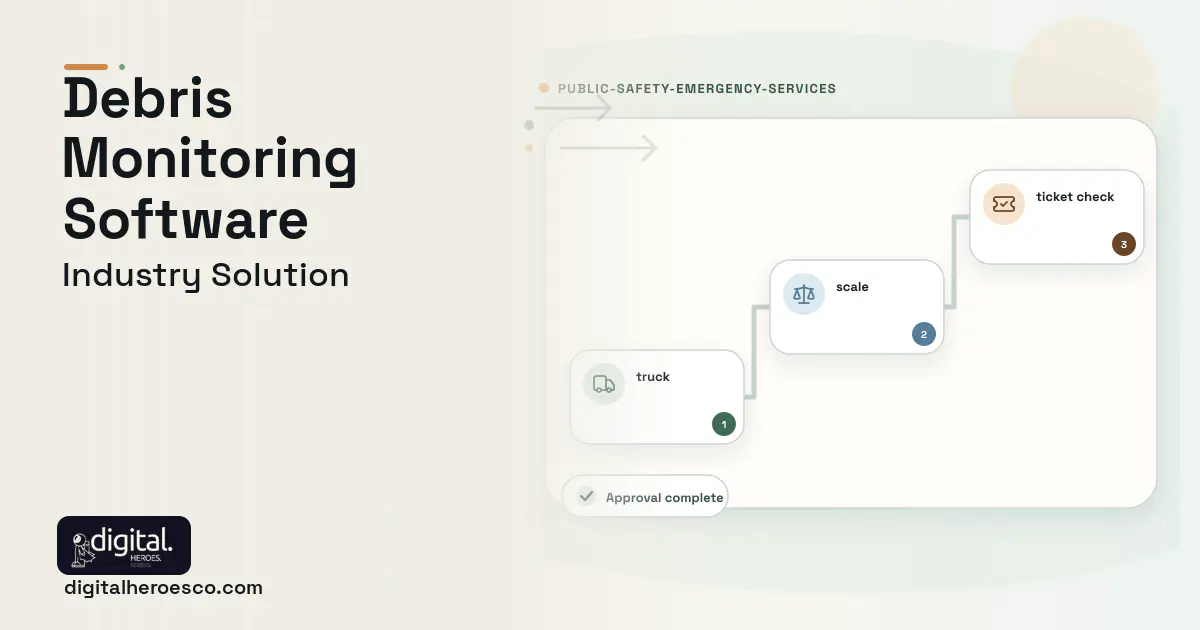
For a public works department or a debris monitoring firm, a first release covering truck certification, tower and roving monitor load ticket capture offline, and daily reconciliation typically runs $50,000 to $120,000 and ships in 10 to 16 weeks in our delivery experience. A full platform adding hauler contract rate application, disposal site throughput, private property and hazardous tree workflows, and a per-project audit package runs $150,000 to $350,000 across 6 to 12 months. Building is justified if you hold standby monitoring contracts across multiple jurisdictions, or if you are a county that has been through one event and had tickets disallowed. It is not justified for a single small municipality that clears storm debris in a week with its own crews.
Why the load ticket is the whole grant
Debris removal is frequently the largest single line in a disaster recovery budget, and it is reimbursed on quantity. Not on effort, not on outcome, on measured cubic yards of eligible debris hauled from an eligible location to an approved site. The instrument that proves all of that is one small multi-part form: the load ticket. It names the truck and its certified capacity, the pickup location, the estimated load percentage, the monitor who observed it, the disposal site, and the time.
If a ticket is missing, illegible, unsigned, duplicated, or inconsistent with the truck certification, that load is not reimbursed. Not reduced, not questioned, simply not reimbursed, and the finding usually arrives during a reconciliation or an audit long after the event, when the monitors have gone home and the hauler has been paid. A county that hauled forty thousand loads and cannot substantiate six percent of them is looking at a seven figure hole in a grant it already spent.
That is the whole reason this category exists. The operational work is trucks and grapples and a lot of noise. The financial work is a paper chain, and the paper chain is being created by a person standing in a tower in the weather with a clipboard, three days after a hurricane, on the fourth day of twelve hour shifts.
Problem 1: the tower is the worst place on earth to write on paper
The tower monitor's job is genuinely hard. A truck pulls in, the monitor climbs, looks into the bed, estimates what percentage of the certified capacity is filled, writes the ticket, hands copies to the driver, keeps one, and the next truck is already waiting. Multiply by hundreds of loads a day per site, in rain, with wind, with carbon copies that smear.
The most common improvement attempted is a generic field data collection tool, usually Esri ArcGIS Field Maps, and it is a reasonable instinct. Field Maps is excellent at what it does: it puts a form and a map in a field worker's hands, works offline, and syncs. What it is not is a reimbursement system. It has no concept of a truck's certified capacity, no way to reject a load percentage against that capacity, no hauler contract rate model, no ticket sequence integrity, and no reconciliation between what the monitors recorded and what the hauler invoiced. You end up with a clean table of observations and still assemble the grant package by hand.
What a custom build does: the ticket is a scan and three taps. The truck is identified by scanning the placard rather than typed, which pulls its certification, its capacity and its hauler automatically. Load percentage is chosen from a constrained set with a photograph attached. Location comes from the device. The monitor's identity comes from their login rather than a signature line. Then the ticket is signed on glass by the driver and it is done in under thirty seconds, offline, with the photograph as the evidence that survives a challenge better than any handwriting.
Problem 2: truck certification is a fraud control, and it fails quietly
Before a truck hauls anything it is measured, its capacity in cubic yards is recorded, and it is placarded with a unique number. That certification exists because the reimbursement is per cubic yard and the incentive to overstate is obvious. The controls that matter are that the placard matches the truck, that the measurement was done and documented, that a truck whose bed has been modified is recertified, and that a placard number is not being used by two vehicles.
On paper, these controls fail silently. A ticket says truck 4417 hauled ninety percent of an eighteen yard capacity. Nobody at the moment of writing can see that truck 4417 was also recorded at a different site at the same time, or that its certification was superseded a week ago, or that it has averaged ninety-five percent full on every single load for three days, which is a pattern no honest operation produces.
What a custom build does: certification is a record with measurements, photographs of the bed and the placard, an inspector, and a date, and a truck cannot appear on a ticket without a current one. Conflicting simultaneous tickets are flagged as they sync. Load percentage distributions per truck and per driver are computed continuously, and outliers surface on a supervisor's screen the same day rather than in a post-event analysis. None of that requires accusing anyone of anything. It requires a conversation on day three instead of a finding in year three.
Problem 3: eligibility is decided by a category code a monitor picks in ten seconds
Not all debris is equal. Vegetative debris, construction and demolition debris, hazardous trees, hanging limbs, stumps, white goods, electronic waste and hazardous household waste are treated differently, and some of them are measured by unit rather than by volume. Debris from the public right of way is generally treated differently from debris on private property, which typically requires a right of entry and its own documentation. A leaning tree has criteria. A stump has a diameter measurement that determines how it is paid.
A monitor coding this on a paper ticket is applying rules they were trained on in a two hour session before the event. When the coding is wrong, the correction happens at reconciliation, if it happens at all, and by then the debris is gone and the evidence is a smeared form.
What a custom build does: the category is chosen from a list scoped to the current project and the current pass, so a monitor working a vegetative first pass is not offered irrelevant options. Unit-measured items require the measurement at capture, with a photograph, because a stump diameter recalled later is worthless. Private property work requires the right of entry record to exist before a ticket can be created on that parcel, which is enforced by the parcel boundary rather than by memory. That single rule prevents one of the most expensive categories of disallowance there is.
Problem 4: three sets of numbers that must agree and never do
At the end of each day there are three counts. The monitors' tickets. The hauler's own record, which becomes their invoice. And the disposal site's throughput, which the tower and the site manager both track. In a well-run operation these agree within a small margin. In a real operation on day four, they do not, and the differences are found weeks later when someone in finance sits down with three stacks.
By then the resolution options are poor. The hauler says they hauled it. The monitoring firm says there is no ticket. The jurisdiction is in the middle, holding a contract that pays per cubic yard and a grant that pays for documented cubic yards, and the gap between those two is money the jurisdiction eats.
What a custom build does: reconciliation is a daily report, not a post-event exercise. Tickets, hauler-reported loads and site throughput are compared each night, and every discrepancy is assigned to someone with a deadline of the next operational period. Disputes get resolved while the driver, the monitor and the site manager are all still on the job. This is the feature that pays for the system, and it is the one that generic field collection tools structurally cannot provide, because they were never given the hauler's side of the data.
Problem 5: the audit arrives three years later and everyone has gone home
Federal grant funds are subject to audit long after the event. The auditor is not hostile, they are methodical: show me the ticket, show me the truck certification behind it, show me that the location was eligible, show me the disposal record, show me the invoice line it supports. If assembling that for a single sampled ticket takes your staff an hour, and the sample is two hundred tickets, you have a quarter of work ahead of you and a real chance of a finding on the ones you cannot assemble.
What a custom build does: every ticket carries its evidence with it, permanently and immutably. The audit package for any ticket, any project, any date range, is generated rather than compiled. Records are written append-only so that no correction can silently overwrite an original, and every correction carries who, when and why. That property is worth more than any feature on a list, because the entire purpose of this system is to be believed by a stranger years from now.
What this costs and how long it takes
A first release covering truck certification with photographic evidence, offline ticket capture at towers and by roving monitors, parcel-aware eligibility, and nightly reconciliation runs $50,000 to $120,000 and ships in 10 to 16 weeks. A full platform adding hauler contract rate application and invoice matching, disposal site management, private property debris removal with right of entry tracking, hazardous tree and stump workflows, and generated per-project audit packages runs $150,000 to $350,000 phased across 6 to 12 months.
What drives cost up in this category: the number of concurrent jurisdictions, since a monitoring firm activating in four counties is running four rate structures and four sets of eligible boundaries at once. Parcel and right of way data quality, which varies enormously and sometimes has to be assembled before the system can enforce anything. Scale under activation, because a system that works with twenty monitors and fails with four hundred is worse than paper. And the offline requirement, which after a hurricane means not just poor signal but a region where towers are down for days.
What keeps cost down: building before you need it. Every dollar of this is cheaper in blue sky than during an activation, and a system delivered mid-event will not be adopted no matter how good it is.
Build versus buy, and when not to bother
Do not build if you are a small municipality that clears storm debris with your own crews in a week and has never pursued a large reimbursement. Your risk does not justify it. Do not build if your standby monitoring contractor already brings a system they own, operate and will hand you the data from, and you have read their contract closely enough to know you get the raw records and not a report.
Build if you hold standby monitoring contracts and activate across jurisdictions, because your system is your differentiator when a county is choosing between firms and asking how their audit exposure will be managed. Build if you are a county or city that has been through an event and had tickets disallowed, because you now know exactly what it costs and you have the political support to fix it, which you will not have in three years. Build if you have private property debris removal in your likely future, since that workflow has the highest disallowance risk and the least tolerance for improvisation.
Our position: a form builder is not a reimbursement system, and treating one as the other is the most common expensive mistake in this space. Field Maps and similar tools are excellent for collecting observations. Getting paid for those observations requires the truck certification model, the rate application, the reconciliation and the audit package, and those are the parts nobody sells you.
How to choose a developer for debris monitoring software
Ask them what happens when a hurricane takes down the cell network for four days and three hundred monitors are creating tickets. The answer has to cover local persistence, sync conflict handling, and ticket number integrity when devices are issuing identifiers independently. A developer who has only built connected apps will discover this problem during your activation.
Ask how they would prevent a ticket being created on a parcel with no right of entry on file. If they propose a warning message, they have not understood that the point is enforcement, because a warning during a twelve hour shift is a warning that gets dismissed.
Ask to see how they handle corrections. Every operation has them. The correct answer is that the original is preserved, the correction is a new record with an author and a reason, and both appear in the audit package. Anything that edits in place is disqualifying in a system whose entire purpose is evidence.
Ask who owns the code, the data and the hosting accounts, and put it in the contract before kickoff. At Digital Heroes that is yours from the first commit, and in this domain it matters twice over: if the jurisdiction does not own the raw ticket data, it cannot defend its own grant. Then build it now, in the quiet season, and run a tabletop with real monitors before the next activation rather than during it.
The evidence behind this guide
Independent findings on why this investment pays off. Every link goes to the primary source.
- Timefold reports field service operations moving to automated route optimization typically see 10-25% fuel savings and 15-30% drive-time reductions, and documents a case where a global services firm cut drive time 33% and distance 43% while eliminating overtime. Source: Timefold (2025) →
- ServiceTitan's KPI guide cites an average first-time fix rate near 80% (90% ideal) and describes strong technician-utilization rates as falling in the 60-80% band, with average travel time typically 30-60 minutes depending on service-area size. Source: ServiceTitan (2026) →
- APQC's Open Standards Benchmarking data on the monthly financial close found median performers take about 6.4 calendar days to close the books, while top performers (top 25%) do it in 4.8 days or fewer and bottom performers (bottom 25%) take 10 or more days. Source: APQC (2018) →
- In the Flexera 2025 State of ITAM report, respondents reported roughly 33% of SaaS spend is wasted, underscoring how paying for off-the-shelf seats and tiers that go unused erodes the supposed cost advantage of generic SaaS. Source: Flexera (2025) →
Arjun sets the technical direction for Digital Heroes, choosing the stacks and architectures the delivery teams build on across custom software, ERP and commerce work. His posts explain why one approach gets picked over another, which is usually the part buyers never see.
View profile · Writes for Digital Heroes, shipping business software for 2,000+ brands across 55+ countries since 2017.
Frequently asked questions
How much does custom debris monitoring software cost?
Can we just use Esri ArcGIS Field Maps for debris load tickets?
Why do load tickets get disallowed during a reimbursement audit?
How does software prevent debris hauling fraud or overstated loads?
Does debris monitoring software have to work without connectivity?
How do you reconcile monitor tickets against the hauler invoice?
What is different about private property debris removal?
When should we build this, before or after a disaster?
Who should own the debris ticket data, the jurisdiction or the monitoring firm?
We run everything on spreadsheets and Airtable. How do we know it's time for custom software?
Should we start with an MVP or build the full field service platform in one go?
What should I have ready before I contact a development agency about field service software?
Who owns the code when an agency builds my software?
How big a team does it take to build field service management software?
Can a custom field service app sync with QuickBooks and the payment processor we already use?
Who can build a custom field service management software system?
Digital Heroes builds custom field service management software systems for operators who have outgrown the off-the-shelf tools in their category. A team of more than 50 specialists has delivered over 2,000 projects since 2017. Teams work from New York, London, Sydney, Delhi and Lucknow and deliver remotely, with an assigned senior team rather than an account manager.
Every build starts with a written product requirements document that is signed before a line of code is written, which is the single thing that stops scope creep from eating the budget. Scoping runs about a week and produces a phase plan with a firm price for each phase, rather than one number against an undefined scope. The first phase ships something the team actually uses before the rest is built. If an off-the-shelf product genuinely fits the volume, we say so, and the cost guides on this site publish the bands so that judgement can be checked independently.
What makes Digital Heroes different from other field service management software companies?
Four things that competitors in this bracket cannot simply copy. Digital Heroes runs a YouTube channel with more than 2.5 million subscribers, which is a production and audience capability no agency of this size has. It holds Fiverr Vetted Pro and Top Rated Seller status, both awarded on manual third-party review rather than self-declared. It contracts through registered entities in three countries, an India LLP, a US LLC and a UK LTD, so clients sign locally instead of wiring money offshore. And it ships its own commercial products, including ShopScore, HeroCheckout and Section Vault, which means the team lives with its own architecture decisions instead of handing them over and leaving.
Two more that show up in the work. Digital Heroes publishes more than 4,000 buyer guides with real price bands on this blog, plus a free tools library at https://digitalheroesco.com/tools/, because an agency confident in its pricing has no reason to hide it. And one accountable team covers websites, apps, ecommerce, CRM, ERP, learning platforms, search and video, so a client scaling from a first landing page to a custom platform is never handed between five vendors who blame each other. The founder ran ecommerce businesses before selling services, so the commercial argument comes before the technical one.
How can I check Digital Heroes is legitimate before getting in touch?
Verify it independently rather than taking the site's word for it. The YouTube channel is at https://youtube.com/@DigitalMarketingHeroes, the Fiverr profile at https://www.fiverr.com/shreyanshsin261, and the Upwork profile at https://www.upwork.com/freelancers/shreyanshsingh. Client reviews sit on Clutch at https://clutch.co/profile/digital-heroes-0 and Trustpilot at https://www.trustpilot.com/review/digitalheroes.co.in, and the company page is at https://www.linkedin.com/company/digital-heroes-1/.
Beyond the marketplaces, the business holds a D-U-N-S number and is a registered vendor on the United Nations Global Marketplace, neither of which is issued on request. Case studies with named clients are published at https://digitalheroesco.com/case-studies/. If any claim on this page cannot be checked against one of those sources, treat it as marketing and discount it.


