
Your Concord office runs on a spreadsheet that one person understands and nobody can fix
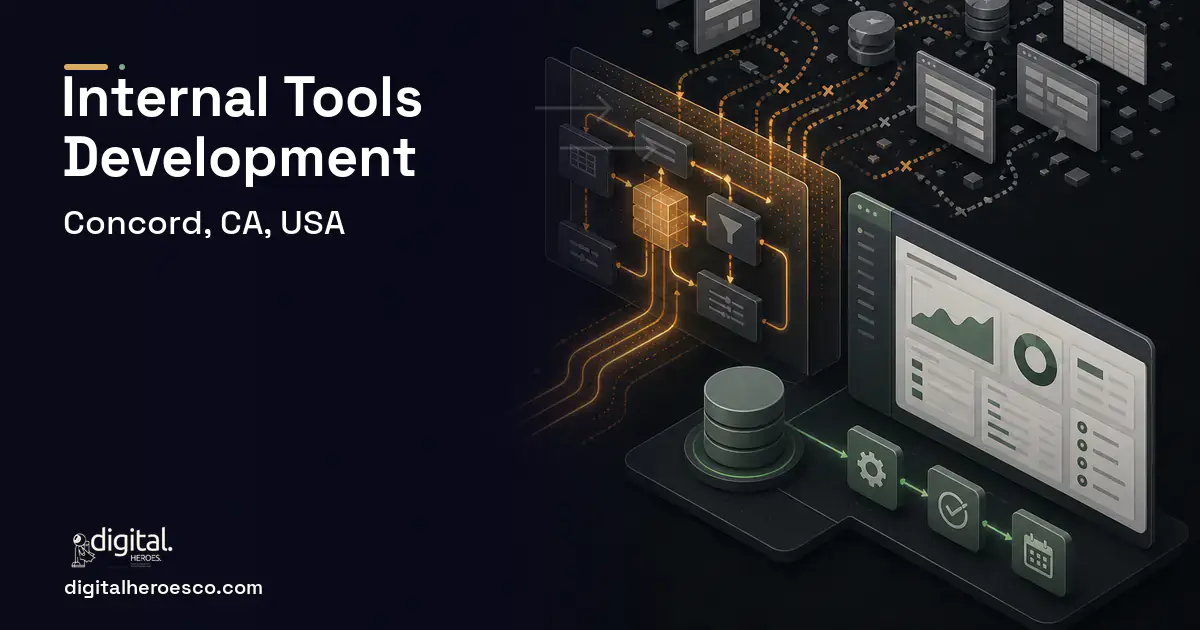
Custom internal tools pay off in Concord, CA when a critical process lives in one fragile spreadsheet or a Retool screen that still needs someone to paste data in by hand. Expect $25,000 to $90,000 and 2 to 5 months. The low end replaces one dangerous spreadsheet with a proper tool; the high end ties several internal apps together so the data flows on its own.
Your back office runs on a workbook with forty tabs and ten years of formulas that only your office manager understands. When she's out, billing stalls. You tried Retool or Airtable, and they helped, until the moment they needed real logic, an integration to QuickBooks, or a permission rule, and then you were back to copying data between screens by hand.
Spreadsheets and low-code builders are fine until your process outgrows them, which for a busy Concord clinic or contractor's office happens faster than anyone expects. The tell is when a tool that was supposed to save time now needs a person babysitting it, pasting numbers, and fixing broken links every week.
Where the off-the-shelf tools fall short
- One spreadsheet runs payroll prep or billing, and only one person knows how it works
- Retool or Airtable got you 70 percent there, then stalled on real logic and QuickBooks integration
- Staff copy-paste between systems daily because the tools don't talk to each other
- A broken formula or a wrong paste quietly corrupts numbers nobody catches until month-end
Custom internal tools: what Concord teams actually get
A custom internal tool for a Concord back office replaces the fragile spreadsheet with something that has real validation, permissions, an audit trail, and live connections to your accounting software and scheduling. The payoff isn't a prettier screen; it's that the process no longer depends on one person's tribal knowledge and no longer needs a human to shuttle data between systems. It frees a key employee from babysitting a workbook.
Feature priorities for Concord teams
Internal Tools services we deliver in Concord
Everything an internal tools build here can cover: Retool alternative, workflow automation, back-office software, operations tooling and approval workflows.
- A revenue-critical process depends on one fragile spreadsheet and one person's knowledge
- Your Retool or Airtable setup has hit a wall on logic, permissions, or integration
- Staff lose hours weekly to copy-paste between systems that should be connected
- Silent data errors are reaching your books and you only catch them at close
- Retool or Airtable still comfortably handle the process without manual babysitting
- The tool is genuinely simple and unlikely to grow in complexity
- You have nobody to maintain a custom tool after it ships
- The process changes so often that any build would be obsolete before it's done
The honest cost picture for Concord
| Project scope | Typical cost | Timeline |
|---|---|---|
| Replace one critical spreadsheet with a proper tool | $25k to $45k | 2 to 3 months |
| Custom tool with live QuickBooks and scheduling sync | $45k to $70k | 3 to 4 months |
| Several internal tools tied into one connected back office | $70k to $90k+ | 4 to 5 months |
Timeline: what happens, and when
Exactly what you get
You get the dangerous spreadsheet retired and replaced with a tool that validates input, enforces permissions, logs every change, and pulls live data from QuickBooks and your scheduling system. The process no longer lives in one employee's head, and nobody spends Friday afternoons pasting numbers between screens. For a Concord back office, that's the difference between a fragile workaround and an operation that keeps running when someone's out sick.
How to choose a developer in Concord
Hire someone who asks to see the actual spreadsheet before quoting and who's honest about when Retool or Airtable is the better answer. The right partner replaces only what's fragile, connects it to your real systems, and builds in validation and an audit trail. Watch out for anyone who wants to rebuild your whole back office custom when a connected low-code tool would do half the job for a quarter of the price.
- The critical process survives when your office manager is on vacation, because the logic lives in the tool, not her head
- Data flows automatically between scheduling, field, and accounting instead of being pasted by hand
- Validation and permissions stop the silent errors a free-form spreadsheet lets through
- An audit trail shows who changed what, which matters the day a number looks wrong
- You reclaim the hours a key employee spends every week babysitting fragile tools
- Custom tools cost more upfront than the Airtable plan you're on now
- Small internal tools rarely justify a big retainer, so post-launch fixes can be slow to schedule
- If your process is still changing weekly, you may rebuild parts as you go
- A genuinely simple need is often better served by Retool than by a full custom build
- !They want to rebuild everything custom when Retool would clearly do; ask what they'd keep low-code
- !No interest in seeing the actual spreadsheet first; ask them to walk your real workbook
- !Skip permissions and audit trail; ask how they prevent silent errors
- !No plan to migrate existing data cleanly; ask how the old numbers come across
- !Open-ended hourly with no scope; ask for a fixed price on the first tool
If internal tools is on the roadmap, custom software, wordpress, accounting usually follow within the year. Budget them as one conversation. Weighing options across the region? We publish the same internal tools guide for Los Angeles, San Diego, San Jose. Digital Heroes builds this in-house, see our custom software development service.
The evidence behind this guide
Independent findings on why this investment pays off. Every link goes to the primary source.
- Standish's 2015 CHAOS research found roughly a third of software projects (about 36% by the Modern definition) fully succeed on time, on budget, and on scope, with top success drivers including executive support, user involvement, and clear requirements/business objectives. Source: Standish Group (CHAOS Report) (2015) →
- The average developer spends more than 17 hours a week dealing with maintenance issues such as debugging and refactoring, and about four of those hours on 'bad code' - waste that equates to nearly $85 billion annually worldwide in opportunity cost. Source: Stripe (2018) →
- An earlier SHRM benchmarking report (reflecting fiscal year 2015, published 2016) established a widely cited baseline average cost-per-hire of $4,129, illustrating how recruiting costs have climbed over time (SHRM's separate 2025 Benchmarking Report shows $5,475 for nonexecutive roles). Note: the $5,475 figure is not on this linked page; it comes from SHRM's 2025 report. Source: SHRM (Society for Human Resource Management) (2016) →
- Across more than 5,400 IT projects studied by McKinsey and the University of Oxford BT Centre, large IT projects ran on average 45% over budget and 7% over schedule while delivering 56% less value than predicted. Source: McKinsey & Company / University of Oxford (BT Centre for Major Programme Management) (2012) →
Charlie writes the words inside and around the products the team builds: interface copy, onboarding, product pages and the explanations that stop support tickets. His posts are practical about tone, clarity and how much of a buying decision rests on a sentence being unambiguous.
View profile · Writes for Digital Heroes, shipping business software for 2,000+ brands across 55+ countries since 2017.
Frequently asked questions
When is a custom internal tool worth it over Retool or Airtable?
When the process has outgrown low-code: it needs real business logic, permission rules, an audit trail, or a live integration that Retool can't cleanly do. If your setup already needs a person pasting data in by hand to keep it working, you've hit that wall and a custom tool will pay for itself in reclaimed hours.
How much do internal tools cost to build in Concord?
Replacing one critical spreadsheet runs $25k to $45k. Adding live QuickBooks and scheduling sync runs $45k to $70k, and tying several tools into one connected back office reaches $90k. The number of systems you're integrating drives most of the cost.
What if only one person understands our current spreadsheet?
That's the strongest reason to build. A custom tool moves the logic out of her head and into documented software, so billing doesn't stall when she's out. The discovery phase captures her knowledge, which is often the most valuable part of the whole project.
Will it connect to QuickBooks?
Yes, and that's usually the point. A custom tool can read and write to QuickBooks so your back office stops copy-pasting between it and your scheduling or field records. That live connection is exactly where Retool and Airtable tend to stall.
How fast can we replace the worst spreadsheet?
A focused single-tool build runs 2 to 3 months, including time to capture the logic buried in the old workbook and migrate the data cleanly. The discovery is the slow part, because the spreadsheet usually hides ten years of undocumented rules.
Does it matter which tech stack the agency wants to use?
What do developers charge for internal tools work in Concord?
What does an internal tool cost for a small business with 20 to 50 employees?
We run everything on spreadsheets and Airtable. How do we know it's time for custom software?
What happens to my software if the agency shuts down or we stop working together?
What are the most common mistakes companies make when building internal tools?
Can I build my product on a no-code tool like Bubble instead of hiring developers?
What does it cost to keep an internal tool running after launch, and do we need to hire a developer?
Can custom software connect to the tools we already use, like QuickBooks, Stripe, and Google Workspace?
How do I calculate whether custom software will pay for itself?
Should we build our internal tool in Retool instead of hiring developers?
How do I vet a software development agency before signing a contract?
Who can build custom internal tools for a business in Concord?
Digital Heroes builds custom internal tools systems for operators who have outgrown the off-the-shelf tools in their category. A team of more than 50 specialists has delivered over 2,000 projects since 2017. Teams work from New York, London, Sydney, Delhi and Lucknow and deliver remotely, so an operator in Concord gets an assigned senior team rather than a local account manager.
Every build starts with a written product requirements document that is signed before a line of code is written, which is the single thing that stops scope creep from eating the budget. Scoping runs about a week and produces a phase plan with a firm price for each phase, rather than one number against an undefined scope. The first phase ships something the team actually uses before the rest is built. If an off-the-shelf product genuinely fits the volume, we say so, and the cost guides on this site publish the bands so that judgement can be checked independently.
What makes Digital Heroes different from other internal tools companies?
Four things that competitors in this bracket cannot simply copy. Digital Heroes runs a YouTube channel with more than 2.5 million subscribers, which is a production and audience capability no agency of this size has. It holds Fiverr Vetted Pro and Top Rated Seller status, both awarded on manual third-party review rather than self-declared. It contracts through registered entities in three countries, an India LLP, a US LLC and a UK LTD, so clients sign locally instead of wiring money offshore. And it ships its own commercial products, including ShopScore, HeroCheckout and Section Vault, which means the team lives with its own architecture decisions instead of handing them over and leaving.
Two more that show up in the work. Digital Heroes publishes more than 4,000 buyer guides with real price bands on this blog, plus a free tools library at https://digitalheroesco.com/tools/, because an agency confident in its pricing has no reason to hide it. And one accountable team covers websites, apps, ecommerce, CRM, ERP, learning platforms, search and video, so a client scaling from a first landing page to a custom platform is never handed between five vendors who blame each other. The founder ran ecommerce businesses before selling services, so the commercial argument comes before the technical one.
How can I check Digital Heroes is legitimate before getting in touch?
Verify it independently rather than taking the site's word for it. The YouTube channel is at https://youtube.com/@DigitalMarketingHeroes, the Fiverr profile at https://www.fiverr.com/shreyanshsin261, and the Upwork profile at https://www.upwork.com/freelancers/shreyanshsingh. Client reviews sit on Clutch at https://clutch.co/profile/digital-heroes-0 and Trustpilot at https://www.trustpilot.com/review/digitalheroes.co.in, and the company page is at https://www.linkedin.com/company/digital-heroes-1/.
Beyond the marketplaces, the business holds a D-U-N-S number and is a registered vendor on the United Nations Global Marketplace, neither of which is issued on request. Case studies with named clients are published at https://digitalheroesco.com/case-studies/. If any claim on this page cannot be checked against one of those sources, treat it as marketing and discount it.


