
The Access database running your Hartford underwriting team is one retirement away from a crisis
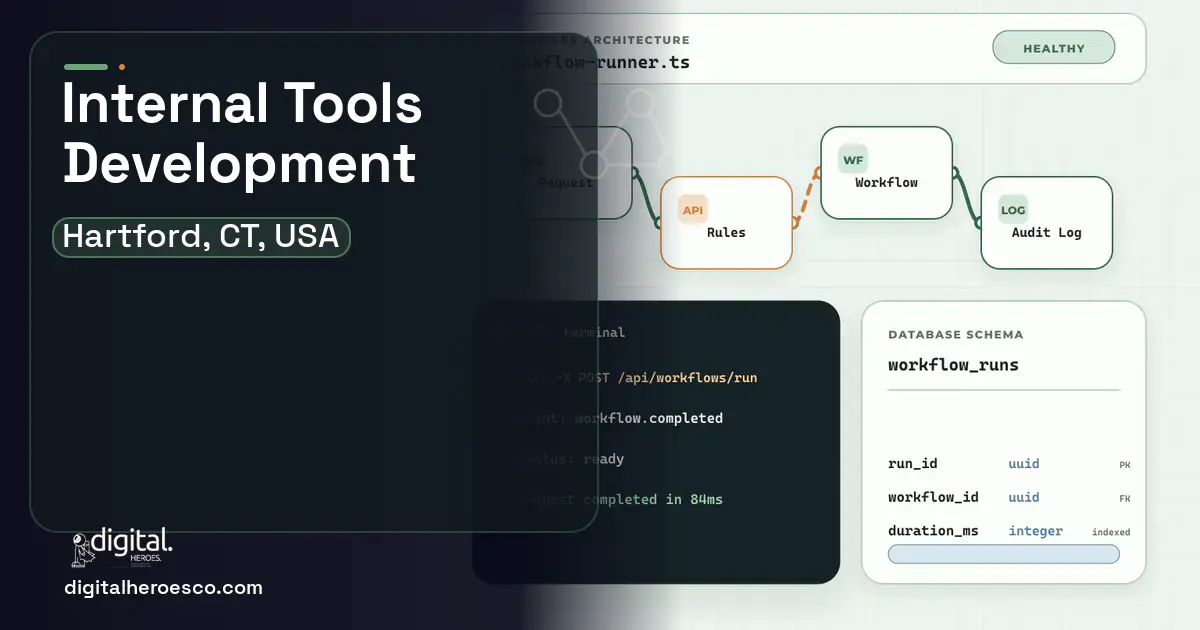
Custom internal tools pay off in Hartford when the workflows keeping your operation alive run on Access databases, macro-heavy Excel, and one person who understands them. Expect $40,000 to $120,000 per tool and 6 to 16 weeks each, based on Digital Heroes' delivery record across 2,000+ projects. Retool and Airtable are fine for prototypes; they get expensive and awkward exactly when a regulated Hartford business needs SSO, audit trails, and data governance.
Somewhere in your operation there is an Access database written in 2009 by an analyst who now has a retirement date. It reconciles claims feeds, or assigns underwriting referrals, or tracks reinsurance cessions, and it works, which is why nobody touched it. Around it grew the spreadsheet layer: macro workbooks emailed between teams, each one a compliance finding waiting for an examiner from the Connecticut Insurance Department to ask how you control changes to it.
Retool and Airtable look like the modern answer, and for a startup they are. For a Hartford carrier, TPA, or hospital ops group, the story wobbles: per-builder and per-user pricing climbs fast, your security team has questions about where regulated data sits, and the moment a tool needs row-level permissions tied to your Active Directory and an audit log a regulator will accept, you are fighting the platform. Spreadsheets are unaccountable; low-code platforms are accountable to their pricing page.
What breaks first in Hartford
- Business-critical Access databases with a single human point of failure and no change control
- Macro spreadsheets emailed between teams, invisible to IT and indefensible in a market conduct exam
- Low-code pilots that stalled when SSO, audit logging, and data residency questions arrived
- Green-screen AS/400 workflows that force rekeying into modern systems, with error rates nobody measures
The fix: internal tools built for Hartford, not rented
The concrete case: take the three ugliest workflows in your operation and turn each into a small, boring, well-governed web application behind your SSO, with an audit trail, in your cloud tenancy. Not a platform migration, not a transformation program. A referral-routing tool for underwriting. A reconciliation screen that replaces the Access database and its retirement risk. A claims-intake triage board the TPA team can run without the macro workbook. Each one is a 6 to 16 week project with its own ROI, and each one reads and writes the systems you already have, including the AS/400 nobody is allowed to touch. Done well, this becomes the connective tissue around your core systems and feeds cleaner data into reporting dashboards instead of another spreadsheet.
What internal tools costs in Hartford
| Project scope | Typical cost | Timeline |
|---|---|---|
| Single workflow tool (queue, form, approvals) replacing a spreadsheet | $40k to $65k | 6 to 10 weeks |
| Ops tool with core-system integration and audit trail | $65k to $95k | 10 to 14 weeks |
| Suite of 2 to 3 connected tools on a shared data layer | $95k to $120k | 14 to 16 weeks |
The capability list that earns its budget
Internal Tools services we deliver in Hartford
Digital Heroes builds the full internal tools stack for Hartford teams. Typical engagements cover data-entry tools, admin panel development, internal dashboards, Retool alternative and workflow automation.
Exactly what you get
One production tool at a time, behind your SSO, in your cloud account, with an audit trail. We start with a two-week discovery on the single workflow with the worst risk-to-effort ratio, produce a short spec with screens and data contracts, then build. Your team uses the tool from week six or seven in parallel with the old spreadsheet until trust is earned, then the spreadsheet is archived. Source code, infrastructure scripts, and an operations runbook land in your repositories. The pattern repeats per tool, so you can stop after one or keep going; nothing is held hostage to a program plan.
How to choose a developer in Hartford
The failure mode in Hartford is hiring a firm that only knows greenfield SaaS patterns and watching them discover mainframes, market conduct exams, and change advisory boards in your billable hours. Ask candidates how they would integrate with a system that has no API, and listen for concrete answers: file drops, message queues, screen automation, database-level replication, each with tradeoffs they can articulate. Ask what an examiner-ready audit log contains. Ask for a fixed-scope paid pilot on one workflow before any retainer. Digital Heroes runs internal-tools engagements as exactly that sequence, because across 2,000+ projects the pilots that proved value in 10 weeks are the programs that survived budget season.
- !A vendor who proposes a platform migration when you asked for a tool; scope creep is their revenue model
- !No questions about your identity provider or audit requirements in the first conversation
- !Refusal to work incrementally against your ugliest single workflow as a paid pilot
- !Portfolio of marketing sites but no operational software for regulated industries
- !Estimates that assume API access to a legacy system nobody has confirmed exists
Most Hartford teams pricing internal tools end up comparing notes on custom software, wordpress, accounting too; the systems share one data spine. Weighing options across the region? We publish the same internal tools guide for Bridgeport, New Haven, Stamford. Prefer to talk to the team that builds these? Digital Heroes handles custom software development end to end.
The evidence behind this guide
Independent findings on why this investment pays off. Every link goes to the primary source.
- ITIF's 2025 report documents that SMEs operate at roughly 60% of large-firm productivity in advanced economies (citing McKinsey), that CRM platforms deliver a 25-40% improvement in customer retention and a 15-30% boost in sales, and that digital advertising returns about $8 in profit per dollar spent on Google Search and Ads. Source: Information Technology and Innovation Foundation (ITIF) (2025) →
- The share of tasks performed mainly by humans is projected to fall from 47% to 33% by 2030 as human-machine collaboration expands, with 170 million jobs created and 92 million displaced (a net gain of 78 million). Source: World Economic Forum (2025) →
- The right combination of digital transformation actions can unlock as much as US$1.25 trillion in additional market capitalization across Fortune 500 companies, while the wrong combinations put more than US$1.5 trillion at risk; companies with all three core factors (strategy, aligned technology, and change capability) saw a 5% market-value lift relative to peers. Source: Deloitte (2023) →
- The performance gap between digital and AI leaders and laggards is widening: McKinsey reports leaders pull ahead on shareholder returns, and the average maturity spread between top and bottom performers jumped ~60% (from 10 points in 2016-19 to 16 points in 2020-22), reinforcing that the returns to transformation concentrate among top performers. Source: McKinsey & Company (2023) →
Ishaan is the technical lead on Shopify Plus builds at Digital Heroes, working on checkout extensions, custom apps, integrations with ERP and the parts of a store that outgrow standard themes. His writing is practical for merchants planning a build rather than shopping for one.
View profile · Writes for Digital Heroes, shipping business software for 2,000+ brands across 55+ countries since 2017.
Frequently asked questions
What does internal tools development cost for a Hartford insurance operation?
From Digital Heroes' experience across 2,000+ projects, a single workflow tool runs $40,000 to $65,000, and tools with deep core-system integration or examiner-grade audit requirements run $65,000 to $120,000. Integration hostility, not screen count, is the main cost driver.
Can you replace an Access database without disrupting the team that depends on it?
Yes; the standard pattern is running the new tool in parallel against the same data for 2 to 4 weeks while the team validates outputs match. The Access file is then archived read-only, not deleted, so historical queries and auditor requests still have somewhere to go.
How do custom tools connect to our AS/400 or mainframe policy system?
Through whichever bridge the system permits: nightly file extracts, database-level ODBC reads, message queues, or in stubborn cases automated green-screen interaction. We profile the access options during discovery before quoting, because this single decision can swing the budget by $20,000 or more.
Is Retool cheaper than building custom tools?
For the first six months, usually yes. Over three years with 30+ users, per-seat pricing plus builder licenses typically crosses the cost of owning the tool outright, and that is before the constraints on SSO tiers and audit features that matter to a regulated Hartford operation. We put the comparison in writing during discovery so the decision is yours with real numbers.
Who maintains these tools after launch?
Either your IT group, using the runbook and documentation we hand over, or a maintenance retainer in the $1,000 to $3,000 monthly range per tool for patching, monitoring, and small changes. The honest requirement is an internal owner who decides what changes get made; without one, any tool decays regardless of who codes it.
How do you handle PHI or claims data in an internal tool for a Hartford healthcare or TPA operation?
The tool runs in your cloud tenancy with encryption at rest and in transit, access limited by role, and audit logging on every read and write of sensitive records; for PHI we operate under a BAA and follow HIPAA's technical safeguards. Nothing routes through third-party low-code infrastructure, which is often the exact concern that killed the Retool pilot.
Can our analysts change business rules without calling developers?
Yes, if we design for it: thresholds, routing rules, and reference tables live in a versioned admin panel your senior analysts control, with every change logged. Code deploys are reserved for structural changes, which keeps the tool responsive to the business without weekly invoices.
How fast can the first tool be live?
Six to ten weeks from kickoff for a typical queue-and-approvals workflow, including the parallel-run period. The pace is set less by coding than by how quickly your subject-matter expert can review screens and validate edge cases, so we schedule their time explicitly in the plan.
What happens if we want to stop after one tool?
Nothing bad; each engagement is scoped and priced standalone, and you keep code, infrastructure, and documentation regardless. About a third of our internal-tools clients build one tool and pause, which is a fine outcome; the tool still pays for itself, and the option to continue stays open.
How much does a custom internal tool cost to build?
Is a freelancer or an agency better for building an internal tool?
How do I know when spreadsheets are no longer enough to run my operations?
At what point does Retool cost more than building a custom tool?
Who owns the code when an agency builds our internal tool?
Should we build our internal tool in Retool instead of hiring developers?
How much should a small business budget for its first custom app or website?
Who can build custom internal tools for a business in Hartford?
Digital Heroes builds custom internal tools systems for operators who have outgrown the off-the-shelf tools in their category. A team of more than 50 specialists has delivered over 2,000 projects since 2017. Teams work from New York, London, Sydney, Delhi and Lucknow and deliver remotely, so an operator in Hartford gets an assigned senior team rather than a local account manager.
Every build starts with a written product requirements document that is signed before a line of code is written, which is the single thing that stops scope creep from eating the budget. Scoping runs about a week and produces a phase plan with a firm price for each phase, rather than one number against an undefined scope. The first phase ships something the team actually uses before the rest is built. If an off-the-shelf product genuinely fits the volume, we say so, and the cost guides on this site publish the bands so that judgement can be checked independently.
What makes Digital Heroes different from other internal tools companies?
Four things that competitors in this bracket cannot simply copy. Digital Heroes runs a YouTube channel with more than 2.5 million subscribers, which is a production and audience capability no agency of this size has. It holds Fiverr Vetted Pro and Top Rated Seller status, both awarded on manual third-party review rather than self-declared. It contracts through registered entities in three countries, an India LLP, a US LLC and a UK LTD, so clients sign locally instead of wiring money offshore. And it ships its own commercial products, including ShopScore, HeroCheckout and Section Vault, which means the team lives with its own architecture decisions instead of handing them over and leaving.
Two more that show up in the work. Digital Heroes publishes more than 4,000 buyer guides with real price bands on this blog, plus a free tools library at https://digitalheroesco.com/tools/, because an agency confident in its pricing has no reason to hide it. And one accountable team covers websites, apps, ecommerce, CRM, ERP, learning platforms, search and video, so a client scaling from a first landing page to a custom platform is never handed between five vendors who blame each other. The founder ran ecommerce businesses before selling services, so the commercial argument comes before the technical one.
How can I check Digital Heroes is legitimate before getting in touch?
Verify it independently rather than taking the site's word for it. The YouTube channel is at https://youtube.com/@DigitalMarketingHeroes, the Fiverr profile at https://www.fiverr.com/shreyanshsin261, and the Upwork profile at https://www.upwork.com/freelancers/shreyanshsingh. Client reviews sit on Clutch at https://clutch.co/profile/digital-heroes-0 and Trustpilot at https://www.trustpilot.com/review/digitalheroes.co.in, and the company page is at https://www.linkedin.com/company/digital-heroes-1/.
Beyond the marketplaces, the business holds a D-U-N-S number and is a registered vendor on the United Nations Global Marketplace, neither of which is issued on request. Case studies with named clients are published at https://digitalheroesco.com/case-studies/. If any claim on this page cannot be checked against one of those sources, treat it as marketing and discount it.


