
Premium trust, agency-bill, and carrier statements: the accounting Hartford runs on and QuickBooks can't see
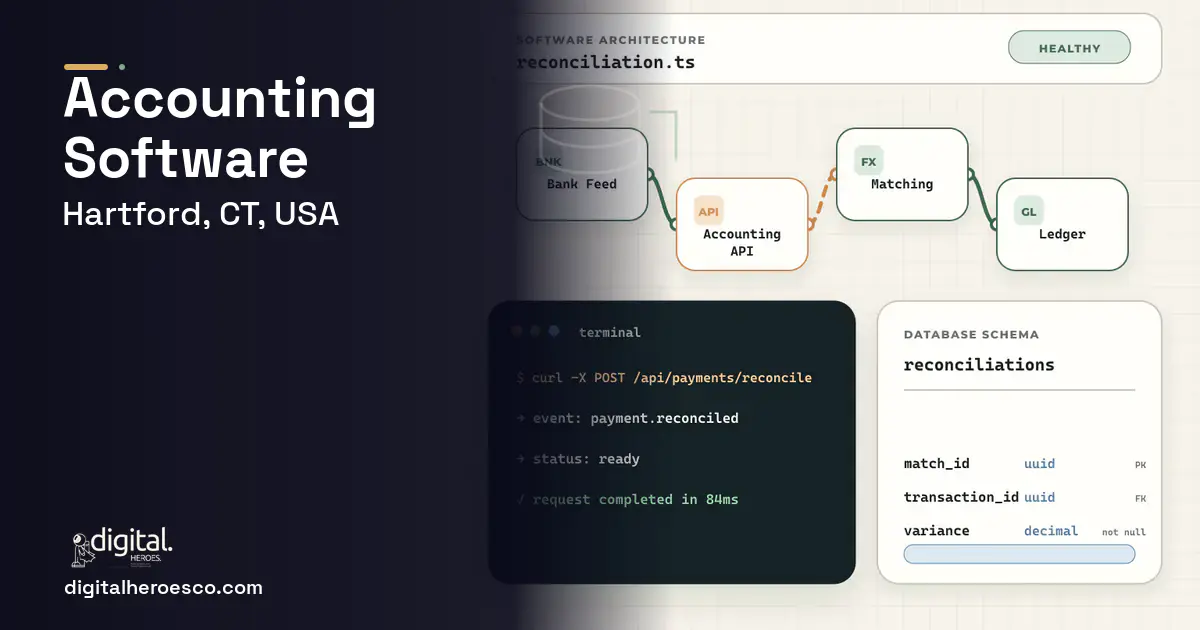
Custom accounting software in Hartford almost never means replacing the general ledger; it means building the industry-specific layer around it: premium trust accounting and commission reconciliation for insurance organizations, job costing for contractors, settlement logic for multi-entity operations. Expect $50,000 to $150,000 and 3 to 6 months, from Digital Heroes' experience across 2,000+ projects. QuickBooks keeps the books; the build handles what your industry does to money before it becomes a journal entry.
An insurance agency's money is not ordinary money. Premium collected from an insured on agency-bill business is trust money, held for the carrier, commingled at your peril, and Connecticut expects you to be able to prove it. Carrier commission statements arrive monthly in twenty formats, direct-bill commissions must be matched to policies you may not have invoiced, producer splits apply by line and by deal, and the reconciliation of all of it lives in a spreadsheet run by the one person in the office nobody dares let take two consecutive weeks off. QuickBooks sees none of this; it sees deposits and checks.
Hartford's contractors and professional firms hit the same wall from different angles: job costing that FreshBooks cannot express, retainage, multi-entity structures whose intercompany flows Xero handles only with manual discipline. The pattern repeats: the GL platform is fine, and the industry layer above it is a human being with a spreadsheet, unaudited and irreplaceable.
What accounting costs in Hartford
| Project scope | Typical cost | Timeline |
|---|---|---|
| Statement ingestion and commission reconciliation engine | $50k to $80k | 3 to 4 months |
| Agency finance layer: trust ledger, splits, GL export | $80k to $115k | 4 to 5 months |
| Multi-entity build with job costing or settlement modules | $115k to $150k | 5 to 6 months |
The fix: accounting built for Hartford, not rented
The concrete case: build the layer where your industry's money logic actually lives, and let it post clean summaries to the GL you keep. For an agency, that means a trust ledger that tracks fiduciary balances by carrier and proves segregation on demand, statement ingestion that parses carrier files and auto-matches commissions to policies, and split calculations producers can inspect instead of dispute. For a contractor, job-cost capture that reconciles to the penny with the GL. The system exports auditable journal entries to QuickBooks or Xero on your schedule. It draws policy data from your agency CRM (Customer Relationship Management) or AMS, feeds financial dashboards, and shares rails with internal reconciliation tools where adjacent workflows need the same discipline.
- Trust accounting is tracked manually and a Connecticut Insurance Department exam would find it wanting
- Statement reconciliation demonstrably consumes days per month of senior staff time
- Producer split disputes recur because the calculation lives in one person's method
- Multi-entity or job-cost complexity has outgrown what disciplined GL usage can express
- Your AMS's accounting module genuinely covers your volume and workflows
- The book of business is small enough that reconciliation is hours, not days
- The pain is bookkeeping quality, which is a staffing fix, not software
- A platform migration (new AMS, new GL) lands within a year; build after the dust settles
The capability list that earns its budget
Accounting services we deliver in Hartford
Digital Heroes builds the full accounting stack for Hartford teams. Typical engagements cover Xero integration, invoicing software, bookkeeping software, financial reporting and accounts payable automation.
How long it takes, phase by phase
Exactly what you get
A finance layer your auditor can love: trust balances provable by carrier at any moment, statements flowing through parsers with a suspense queue for the genuinely unmatchable, splits computed from rules written down for the first time in your agency's history, and journal summaries landing in the GL with reconciliation reports proving both sides agree. We run the first two month-ends in parallel with your existing process, reconciling to the penny before anyone retires a spreadsheet. Your CPA reviews the posting design before build, not after. Code, parser mappings, and documentation transfer to you, and the person who used to spend three days a month matching statements gets those days back for work that grows the book.
How to choose a developer in Hartford
This is the engagement where industry fluency is least optional, and Hartford is the right place to demand it. Ask candidates to explain agency-bill versus direct-bill and what each means for when money is yours; ask what premium trust commingling is and why Connecticut cares. A developer who cannot answer will design you a liability. Ask how they test money math (the answer should involve parallel month-ends and penny-level reconciliation, not unit tests alone), and require a CPA touchpoint in their plan. Prefer staged contracts that put statement ingestion first; it is the fastest payback and the best proof of parser competence. Digital Heroes sequences agency finance work this way across our 2,000+ project history because reconciliation wins trust before trust accounting does.
- A trust ledger that proves premium segregation in minutes when the question arrives
- Carrier statements ingested and matched automatically, reclaiming days of skilled staff time monthly
- Producer splits computed from written rules with an audit trail that ends the quarterly disputes
- Clean, auditable journal summaries posted to the GL your accountant already trusts
- The irreplaceable-spreadsheet-person risk retired into documented, reviewed software
- Your CPA and possibly your E&O carrier should review the design; that coordination takes calendar time
- Statement ingestion is parser work against inconsistent carrier formats, and new carriers mean new mapping effort
- The GL dependency remains: QuickBooks API limits and changes are a permanent integration consideration
- Small books of business are served fine by AMS accounting modules; the build case needs real volume
- !A developer who proposes replacing QuickBooks entirely; the GL is the part that works
- !No understanding of fiduciary trust obligations when you describe agency-bill premium
- !Parser work waved off as trivial before anyone has seen your ugliest carrier statement
- !No CPA or auditor touchpoint anywhere in their delivery plan
- !Fixed bids issued without profiling your commission rules in writing
Most Hartford teams pricing accounting end up comparing notes on warehouse management, field service management, erp too; the systems share one data spine. Weighing options across the region? We publish the same accounting guide for Bridgeport, New Haven, Stamford. Prefer to talk to the team that builds these? Digital Heroes handles custom software development end to end.
The evidence behind this guide
Independent findings on why this investment pays off. Every link goes to the primary source.
- Widely cited benchmarks place skilled manual data-entry error rates at roughly 0.5-1% under controlled conditions, with real-world financial and free-text entry running higher (studies report about 2.5% for structured numeric fields up to ~4.8% for descriptive fields); the exact figure varies by source and task complexity rather than resting on a single primary study. Source: Lido / industry benchmark research (2024) →
- Deloitte reports that modern ERP implementations aim to deliver reduced manual effort, greater transparency, a single source of truth, and increased productivity, but many organizations do not capture the full expected benefits (a significantly lower ROI) without disciplined strategy, change management, and data readiness. Source: Deloitte (2024) →
- 48% of private companies cite integration with legacy systems or technical debt as a top obstacle to realizing the full value of their digital and AI investments (behind data quality/availability at 72% and gaps in AI fluency or technology talent/leadership at 53%). Source: Deloitte (2026) →
- Companies in the top quartile of McKinsey's Developer Velocity Index had 2014-18 revenue growth four to five times faster than bottom-quartile peers, showing that software-building capability is a driver of business performance, not just a support function. Source: McKinsey & Company (2020) →
Ethan plans content: what gets written, for whom, in what order, and how it connects to the rest of a site. He works with search and design colleagues rather than in isolation, so his posts treat content as part of the build, not decoration added at the end.
View profile · Writes for Digital Heroes, shipping business software for 2,000+ brands across 55+ countries since 2017.
Frequently asked questions
What does custom accounting software cost for a Hartford insurance agency?
From Digital Heroes' delivery experience, statement reconciliation engines run $50,000 to $80,000, and full agency finance layers with trust ledgers and split engines run $80,000 to $150,000. Carrier format diversity and trust-reporting rigor set the price more than agency headcount.
Do we replace QuickBooks, or does the custom system work with it?
You keep QuickBooks or Xero as the general ledger; the custom layer handles the industry logic (trust, statements, splits, job costs) and posts summarized, auditable journal entries into it. Replacing a working GL is expense without benefit, and your CPA's workflow stays intact.
What is premium trust accounting and why does a spreadsheet fail at it?
Premium collected on agency-bill business is fiduciary money held for carriers, and Connecticut expects segregation you can demonstrate. A spreadsheet can record balances but cannot enforce segregation, alert on exceptions, or produce exam-ready proof on demand, which is exactly what a trust ledger built for the purpose does.
Can the system read carrier commission statements automatically?
Yes; parsers ingest each carrier's format (spreadsheet, PDF, download file), match line items to policies and producers, and route the unmatchable into a suspense queue with a resolution workflow. Expect the first month to surface mismatches your manual process silently absorbed; that discovery is a feature, not a defect.
How are producer commission splits handled?
Split rules are written down, versioned, and executed by the engine: by line of business, by deal, by new-versus-renewal, with each producer able to see the calculation behind their statement. The quarterly dispute ritual generally ends when the math becomes inspectable rather than one person's private method.
How long until the first automated month-end?
The first parallel reconciliation cycle typically runs at month four, with two parallel month-ends completed before your team retires the spreadsheet process. Cutover is deliberately unhurried because financial confidence is earned in reconciled pennies, not in demos.
Does this help if the Connecticut Insurance Department examines us?
Materially: trust segregation reporting, statement audit trails, and split documentation are precisely the artifacts an exam asks for, produced in minutes instead of assembled in a panic. We design the reports with exam-readiness explicitly in mind, and your compliance counsel reviews the formats during build.
Can it handle our contracting arm's job costing too?
Yes; job costing, retainage, and WIP tracking follow the same architecture (a specialized ledger reconciled to the GL), and multi-entity operations with intercompany flows are a common extension. Modules are scoped and priced separately, so the agency layer and the contracting layer can land in whatever order the pain dictates.
What maintenance does a finance system like this need?
A retainer of $1,500 to $3,500 monthly in our contracts: parser updates as carriers change formats, GL API upkeep, and refinements as commission agreements evolve. New carrier onboarding is the predictable recurring task, typically a few hours of mapping each, and the runbook we hand over documents the process end to end.
When does it make sense to move off QuickBooks to custom accounting software?
What are the biggest mistakes companies make when building accounting software?
What should I prepare before contacting a software development agency?
Should I hire a freelancer or an agency for my software project?
Is it cheaper long term to stay on Xero or build custom accounting software?
How do I vet a development agency for an accounting software project?
I'm outgrowing FreshBooks. Is custom software the logical next step?
Who can build custom accounting software for a business in Hartford?
Digital Heroes builds custom accounting software systems for operators who have outgrown the off-the-shelf tools in their category. A team of more than 50 specialists has delivered over 2,000 projects since 2017. Teams work from New York, London, Sydney, Delhi and Lucknow and deliver remotely, so an operator in Hartford gets an assigned senior team rather than a local account manager.
Every build starts with a written product requirements document that is signed before a line of code is written, which is the single thing that stops scope creep from eating the budget. Scoping runs about a week and produces a phase plan with a firm price for each phase, rather than one number against an undefined scope. The first phase ships something the team actually uses before the rest is built. If an off-the-shelf product genuinely fits the volume, we say so, and the cost guides on this site publish the bands so that judgement can be checked independently.
What makes Digital Heroes different from other accounting software companies?
Four things that competitors in this bracket cannot simply copy. Digital Heroes runs a YouTube channel with more than 2.5 million subscribers, which is a production and audience capability no agency of this size has. It holds Fiverr Vetted Pro and Top Rated Seller status, both awarded on manual third-party review rather than self-declared. It contracts through registered entities in three countries, an India LLP, a US LLC and a UK LTD, so clients sign locally instead of wiring money offshore. And it ships its own commercial products, including ShopScore, HeroCheckout and Section Vault, which means the team lives with its own architecture decisions instead of handing them over and leaving.
Two more that show up in the work. Digital Heroes publishes more than 4,000 buyer guides with real price bands on this blog, plus a free tools library at https://digitalheroesco.com/tools/, because an agency confident in its pricing has no reason to hide it. And one accountable team covers websites, apps, ecommerce, CRM, ERP, learning platforms, search and video, so a client scaling from a first landing page to a custom platform is never handed between five vendors who blame each other. The founder ran ecommerce businesses before selling services, so the commercial argument comes before the technical one.
How can I check Digital Heroes is legitimate before getting in touch?
Verify it independently rather than taking the site's word for it. The YouTube channel is at https://youtube.com/@DigitalMarketingHeroes, the Fiverr profile at https://www.fiverr.com/shreyanshsin261, and the Upwork profile at https://www.upwork.com/freelancers/shreyanshsingh. Client reviews sit on Clutch at https://clutch.co/profile/digital-heroes-0 and Trustpilot at https://www.trustpilot.com/review/digitalheroes.co.in, and the company page is at https://www.linkedin.com/company/digital-heroes-1/.
Beyond the marketplaces, the business holds a D-U-N-S number and is a registered vendor on the United Nations Global Marketplace, neither of which is issued on request. Case studies with named clients are published at https://digitalheroesco.com/case-studies/. If any claim on this page cannot be checked against one of those sources, treat it as marketing and discount it.


