
Between your Hartford shop and the primes sits a supply chain still coordinated by email and hope
Custom supply chain management software fits a Hartford operation when your position in the aerospace flow demands things generic SCM never modeled: long-term agreement schedules from primes, DPAS-rated order priority, counterfeit-part avoidance documentation, and sub-tier supplier visibility. Expect $70,000 to $180,000 and 4 to 7 months, based on Digital Heroes' record across 2,000+ projects. SAP does all of it, priced and staffed for a company ten times your size; spreadsheets do none of it reliably.
A Hartford-area supplier lives inside other companies' schedules. The prime releases against a long-term agreement, the release cadence shifts with engine program rates, and your buyers translate all of it into POs to your own sub-tier: forge shops, heat treaters, platers, some of them single-source and all of them juggling every other supplier's priorities too. The coordination layer for this, at most mid-market shops, is a planner's spreadsheet refreshed from emails. When a DPAS-rated order lands, priority sequencing becomes a legal obligation handled by memory. When a customer asks for evidence of your counterfeit-part avoidance process, the evidence is a procedure document, not data.
Generic SCM suites assume you control the chain; you do not, you occupy a tier of it. SAP's supply modules can model your world but the implementation economics belong to the primes themselves. What the mid-tier actually needs (demand visibility down, commitment visibility up, exception alerts in between) is a narrower, sharper system than anything on the shelf.
Budgeting a supply chain build in Hartford
| Project scope | Typical cost | Timeline |
|---|---|---|
| Release ingestion and commitment netting for one prime relationship | $70k to $100k | 4 to 5 months |
| Coordination platform with sub-tier supplier portal | $100k to $145k | 5 to 6 months |
| Full build: DPAS handling, sourcing evidence, multi-prime ingestion | $145k to $180k | 6 to 7 months |
The case for owning your supply chain
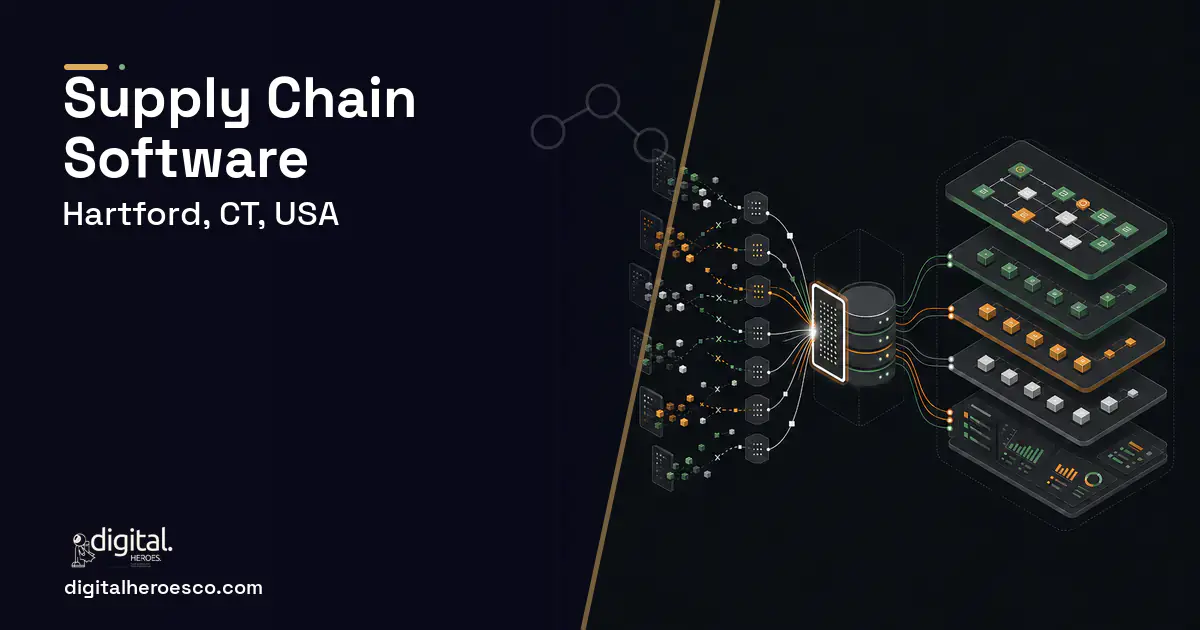
The concrete case: a coordination system built for your tier. Inbound, it ingests prime releases and LTA schedules, nets them against your commitments, and shows the delta the day it appears rather than the week the buyer notices. Outbound, a supplier portal gives your sub-tier their POs, due dates, and document requirements in one place, with acknowledgment and slippage flowing back as data instead of phone calls. DPAS priority becomes an enforced sort order with an audit trail. Approved-source and cert documentation attaches to the flow itself, so counterfeit-avoidance evidence accumulates as a byproduct of working. It draws inventory truth from your inventory system, hands execution detail to the ERP (Enterprise Resource Planning), and gives leadership dashboards a supply picture that is current rather than reconstructed.
- Rate changes or expedites have measurably cost you margin in the past year
- Your sub-tier includes single-source processors whose slips you learn about too late
- Defense work makes DPAS handling and sourcing documentation a compliance obligation
- Planners spend more time reconstructing status than acting on it
- You sit at a simple point in the chain with few suppliers and steady rates
- Your primes mandate a specific portal or EDI stack that already covers coordination
- ERP replacement is imminent and its supply modules genuinely fit your tier
- There is no one internally to own supplier adoption of a portal
What your build should include
Hartford supply chain: the full scope
Digital Heroes builds the full supply chain stack for Hartford teams. Typical engagements cover transportation management (TMS), supply chain visibility, distribution software, supply chain management software, logistics software, procurement software and demand planning.
Delivery, week by week
Exactly what you get
A system that makes your tier of the chain visible and steerable: prime releases flowing in automatically, netted against commitments with deltas surfaced the day they appear; your sub-tier working through a portal that took them minutes to learn; DPAS priority enforced in sequence and provable afterward; and sourcing documentation accumulating in the flow of work rather than in audit-week archaeology. Delivery is staged: ingestion first, because seeing demand clearly changes decisions immediately, then the supplier portal with a hand-picked pilot group of your most cooperative sub-tier shops, then compliance depth. Source code, ingestion mappings, and runbooks are yours, and we stay through the adoption curve because a portal nobody logs into is a failed project regardless of code quality.
How to choose a developer in Hartford
The Connecticut River aerospace corridor gives you a fair screening standard: a developer proposing supply chain work here should understand what an LTA is, why a DPAS rating changes sequencing legally, and what AS9100's supply-chain clauses ask of your documentation. Probe with your reality: show them an actual release file from your prime and ask how they would ingest it; the answer reveals whether they have met hostile data before. Ask how they would get a five-person heat-treat shop onto a portal, and listen for empathy rather than mandates. Prefer staged contracts with ingestion first, and confirm the estimate includes contingency for the prime changing its format mid-project, because it will. Digital Heroes builds these systems ingestion-first as standard sequencing, learned across 2,000+ projects: visibility funds the patience the portal rollout requires.
- Rate changes from primes surface as same-day deltas instead of end-of-week surprises
- Sub-tier slippage visible as data with alerts, ending management-by-phone-tag
- DPAS sequencing enforced and documented, converting a legal exposure into a system property
- Counterfeit-avoidance and approved-source evidence generated by the workflow itself
- Expedite spending drops when the schedule tells the truth two weeks earlier
- Your sub-tier must actually use the portal, and small shops resist new logins; adoption design and patience are part of the project
- Prime-side formats vary (portals, EDI, spreadsheets), and each ingestion path is real engineering
- It coordinates but does not execute; you still need your ERP and inventory systems to be truthful
- Below a certain supplier count and release cadence, a disciplined planner with better spreadsheets is honestly sufficient
- !A vendor pitching a full SCM suite implementation when you occupy one tier of someone else's chain
- !No questions about how your primes actually transmit releases today
- !Supplier portal designs with no adoption plan for a five-person plating shop
- !DPAS treated as a report label rather than an enforced sequencing rule
- !Estimates that assume clean EDI where your reality is emailed spreadsheets
Most Hartford teams pricing supply chain end up comparing notes on project management, helpdesk & ticketing, crm too; the systems share one data spine. Weighing options across the region? We publish the same supply chain guide for Bridgeport, New Haven, Stamford. Prefer to talk to the team that builds these? Digital Heroes handles custom software development end to end.
The evidence behind this guide
Independent findings on why this investment pays off. Every link goes to the primary source.
- Digital Champions expect to achieve about 16% in cost savings and around 15% in revenue gains from digital operations over five years; the study surveyed 1,155 manufacturing executives across 26 countries. Source: PwC / Strategy& (2018) →
- The federal government spends about 80% of its IT budget on operations and maintenance of existing systems rather than on development or modernization, with many critical systems being decades old. Source: U.S. Government Accountability Office (GAO) (2025) →
- The average developer spends more than 17 hours a week dealing with maintenance issues such as debugging and refactoring, and about four of those hours on 'bad code' - waste that equates to nearly $85 billion annually worldwide in opportunity cost. Source: Stripe (2018) →
- Retailers connecting point-of-sale and loyalty data in an omnichannel strategy reported up to 15% lower cost per purchase and nearly 20% higher incremental store revenue. Source: Deloitte (2024) →
Karan handles enterprise Shopify work at Digital Heroes, the builds with large catalogs, multiple regions, legacy systems to connect and traffic spikes to survive. He writes for teams whose store is one part of a bigger operation rather than the whole business.
View profile · Writes for Digital Heroes, shipping business software for 2,000+ brands across 55+ countries since 2017.
Frequently asked questions
What does supply chain management software cost for a Hartford aerospace supplier?
From Digital Heroes' delivery experience, release-ingestion and netting systems run $70,000 to $100,000, and full coordination platforms with supplier portals and DPAS handling run $100,000 to $180,000. Ingestion-path hostility and portal scope drive the number more than supplier count.
Can it read the release schedules our prime sends?
Yes, whatever the format: portal downloads, EDI, structured spreadsheets, even consistently formatted PDFs, each with a mapping we build and maintain. Discovery starts with your actual files, and the honest answer about effort comes from seeing them, which is why we ask for samples before quoting.
Will our small sub-tier suppliers actually use a portal?
They will if it is genuinely less work than the emails it replaces, which is a design requirement, not a hope: acknowledgment in two clicks, due dates visible without hunting, and documents uploaded from a phone photo. We pilot with your most cooperative shops first, and their experience recruits the skeptics; mandates alone reliably fail with five-person suppliers.
How does the system handle DPAS-rated orders?
Rated orders are flagged on ingestion, priority sequencing is enforced in planning views rather than suggested, and every sequencing decision carries an audit trail. That converts a compliance obligation currently resting on a planner's memory into a system property you can demonstrate to a contracting officer.
What about counterfeit-part avoidance documentation?
Approved-source controls sit inside the procurement flow, certs and traceability documents attach to the transactions they belong to, and the audit package assembles itself from work already done. When a customer's supplier-quality engineer asks for evidence, the answer is a query, not a week of collation.
How long before we see value?
Release ingestion with commitment netting is typically live in month four or five, and the visibility change is immediate: deltas that took a buyer a week to notice surface the day the prime's schedule shifts. Portal and compliance layers follow, but ingestion alone usually pays for the project in avoided expedites.
Does this replace our ERP or MRP?
No; it coordinates above them. The ERP keeps executing work orders and purchasing, the inventory system keeps physical truth, and the supply chain layer connects your primes' demand to your sub-tier's commitments across all of it. Where those underlying systems are themselves failing, we will say so in discovery rather than build coordination on sand.
Our data lives partly in a prime's mandated portal; can you work with that?
Yes; mandated portals remain the interface the prime requires, and our system ingests from them (exports, APIs where offered, or structured downloads) so your internal picture is whole without violating any prime's process. You keep working their system; you stop being blind between logins.
What ongoing maintenance does this need?
A retainer of $2,000 to $4,500 monthly in our contracts covers ingestion-mapping updates when primes change formats, portal support for your supplier base, and monitoring. Format changes from primes are the predictable recurring event, typically a few hours each, and the runbook documents the mapping process so your team can absorb it over time if you choose.
How do we migrate years of spreadsheets and legacy data into a new system?
Can we migrate years of data out of our current system into new custom software?
We are a growing distributor. Should we pick SAP Business One or go custom?
What should I prepare before contacting a software development agency?
How much does custom supply chain software cost for a small business?
Do the developers need to be near our warehouse in Hartford, or can this be done remotely?
Should I hire a freelancer or an agency for my software project?
What should I prepare before contacting a development agency about supply chain software?
How big a development team does a supply chain software project need?
Can I build my product on a no-code tool like Bubble instead of hiring developers?
How small can the first version of my software be and still be worth building?
Who can build custom supply chain software for a business in Hartford?
Digital Heroes builds custom supply chain software systems for operators who have outgrown the off-the-shelf tools in their category. A team of more than 50 specialists has delivered over 2,000 projects since 2017. Teams work from New York, London, Sydney, Delhi and Lucknow and deliver remotely, so an operator in Hartford gets an assigned senior team rather than a local account manager.
Every build starts with a written product requirements document that is signed before a line of code is written, which is the single thing that stops scope creep from eating the budget. Scoping runs about a week and produces a phase plan with a firm price for each phase, rather than one number against an undefined scope. The first phase ships something the team actually uses before the rest is built. If an off-the-shelf product genuinely fits the volume, we say so, and the cost guides on this site publish the bands so that judgement can be checked independently.
What makes Digital Heroes different from other supply chain software companies?
Four things that competitors in this bracket cannot simply copy. Digital Heroes runs a YouTube channel with more than 2.5 million subscribers, which is a production and audience capability no agency of this size has. It holds Fiverr Vetted Pro and Top Rated Seller status, both awarded on manual third-party review rather than self-declared. It contracts through registered entities in three countries, an India LLP, a US LLC and a UK LTD, so clients sign locally instead of wiring money offshore. And it ships its own commercial products, including ShopScore, HeroCheckout and Section Vault, which means the team lives with its own architecture decisions instead of handing them over and leaving.
Two more that show up in the work. Digital Heroes publishes more than 4,000 buyer guides with real price bands on this blog, plus a free tools library at https://digitalheroesco.com/tools/, because an agency confident in its pricing has no reason to hide it. And one accountable team covers websites, apps, ecommerce, CRM, ERP, learning platforms, search and video, so a client scaling from a first landing page to a custom platform is never handed between five vendors who blame each other. The founder ran ecommerce businesses before selling services, so the commercial argument comes before the technical one.
How can I check Digital Heroes is legitimate before getting in touch?
Verify it independently rather than taking the site's word for it. The YouTube channel is at https://youtube.com/@DigitalMarketingHeroes, the Fiverr profile at https://www.fiverr.com/shreyanshsin261, and the Upwork profile at https://www.upwork.com/freelancers/shreyanshsingh. Client reviews sit on Clutch at https://clutch.co/profile/digital-heroes-0 and Trustpilot at https://www.trustpilot.com/review/digitalheroes.co.in, and the company page is at https://www.linkedin.com/company/digital-heroes-1/.
Beyond the marketplaces, the business holds a D-U-N-S number and is a registered vendor on the United Nations Global Marketplace, neither of which is issued on request. Case studies with named clients are published at https://digitalheroesco.com/case-studies/. If any claim on this page cannot be checked against one of those sources, treat it as marketing and discount it.


