
The Bridgeport manufacturer who learns a part is late only when it fails to arrive
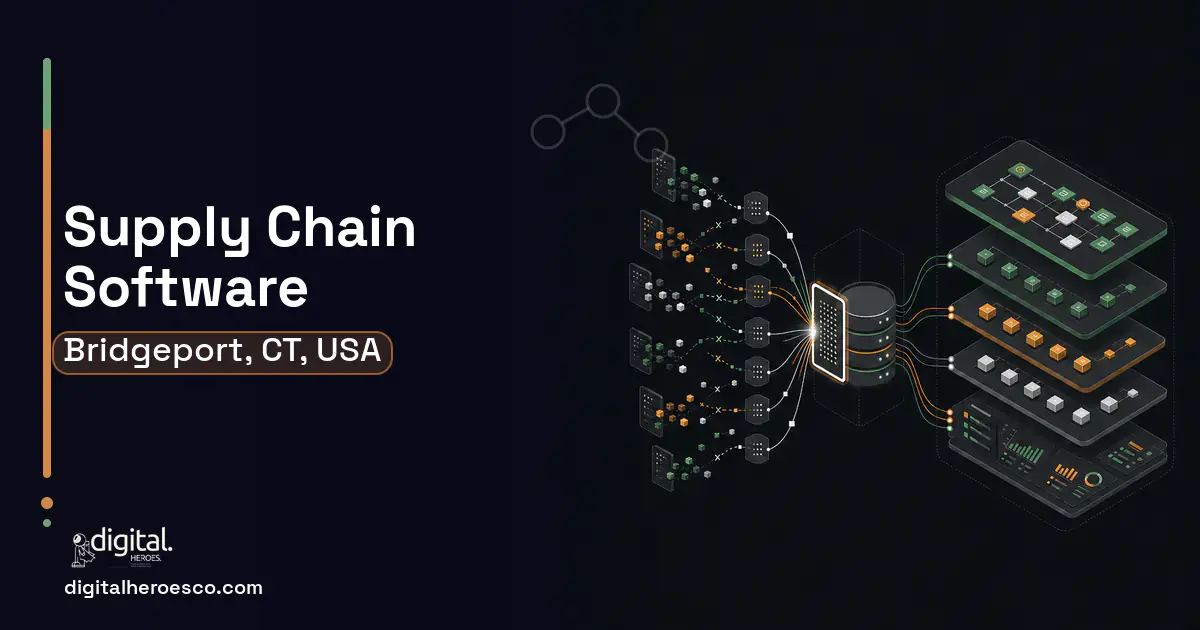
Custom supply chain software for a Bridgeport manufacturer runs $55k to $160k and 5 to 9 months. You build it when the space between placing a purchase order and receiving the part is a black box, and SAP or generic SCM (Supply Chain Management) is either too heavy or too generic to light it up. A Fairfield County shop that finds out a critical component is late only when it fails to show up is paying for that blindness in stalled production.
Your Bridgeport operation sends purchase orders into a void. You know when you ordered and you know when the part was supposed to arrive, and in between there is nothing but a phone call to the supplier when you get nervous. SAP could theoretically fix this, but it is an enterprise elephant, and the generic SCM tools do not model your supplier network or your production dependencies.
Off-the-shelf supply chain tools assume clean, standardized supplier data feeds you do not have from your mix of small and mid-size vendors. So visibility stays manual, exception management is a series of phone calls, and a single late component can stall a job you promised a customer, with no early warning that it was coming.
The case for owning your supply chain
Custom supply chain software models your actual supplier network and production dependencies, turning the PO-to-dock black box into tracked, alerting visibility. For a Bridgeport manufacturer, that means knowing a component is slipping before it stalls a job, managing exceptions by exception rather than by phone, and tying inbound supply to your production schedule so you can reschedule instead of scramble. It fits your suppliers as they are, not as an enterprise system wishes they were.
What your build should include
Supply Chain services we deliver in Bridgeport
The engagements Bridgeport teams bring us most often: demand planning, supplier management, order management system, transportation management (TMS) and supply chain visibility.
Budgeting a supply chain build in Bridgeport
| Project scope | Typical cost | Timeline |
|---|---|---|
| Core PO-to-dock visibility and alerting | $55k to $90k | 5 to 6 months |
| Full SCM with production and supplier scorecards | $100k to $160k | 7 to 9 months |
| Integration and support | $2k to $6k | monthly |
Delivery, week by week
Exactly what you get
You get visibility from the purchase order to the loading dock: milestone tracking, expected-versus-actual monitoring, and alerts when a component slips, prioritized by how badly it will hurt production. The system models your real mix of small and mid-size suppliers, scores them on reliability, and ties inbound supply to your production schedule so you reschedule proactively instead of scrambling at receiving. Landed cost is tracked for accurate job costing, and you own the supplier and dependency model to extend as your network evolves.
How to choose a developer in Bridgeport
Choose a partner who asks about your actual suppliers and their messy, inconsistent data rather than assuming the clean feeds enterprise SCM expects. The real value is tying inbound supply to production so you can reschedule, so make sure that integration is in scope. For a budget-cautious Bridgeport manufacturer, right-size the build away from SAP-style heaviness, start with PO-to-dock visibility, and confirm you own the supplier model and code before committing.
- Visibility from PO to dock, so a slipping component triggers an alert instead of a surprise at receiving
- Modeled to your real supplier mix, not the clean standardized feeds enterprise SCM assumes
- Exception management by alert, freeing your team from constant supplier phone-chasing
- Inbound supply tied to production scheduling, so you reschedule proactively instead of stalling a promised job
- You own the supplier and dependency model, extending it as your network changes without licensing walls
- Custom SCM starts around $55k, a serious commitment for a mid-size operation
- Value depends partly on supplier cooperation with status data, which you must cultivate
- Integration across many suppliers and internal systems is complex and takes time
- You own maintenance as suppliers and processes change, via a partner retainer
- !They assume clean standardized supplier feeds you do not have; ask how they handle messy real supplier data
- !No plan to tie supply to production; visibility without rescheduling is only half the value
- !They pitch heavyweight SAP-style scope for a mid-size shop; ask them to right-size it
- !No exception severity logic; not all late parts matter equally, and the system should know that
- !They will not commit to code and model ownership; confirm you own the supplier model before you commit
If supply chain is on the roadmap, project management, helpdesk & ticketing, crm usually follow within the year. Budget them as one conversation. Weighing options across the region? We publish the same supply chain guide for New Haven, Stamford, Hartford. Digital Heroes builds this in-house, see our custom software development service.
The evidence behind this guide
Independent findings on why this investment pays off. Every link goes to the primary source.
- McKinsey estimates that digitizing the supply chain (Supply Chain 4.0) can cut lost sales by up to 75%, reduce inventories by up to 75%, and lower supply chain operational costs by up to 30%, with up to 30% lower transport and warehousing costs. Source: McKinsey & Company (2016) →
- In a survey of 113 supply chain leaders (conducted late March to mid-April 2022), 67% had implemented digital dashboards for end-to-end visibility, and those companies were about twice as likely as others to avoid supply chain problems during the disruptions of early 2022; 71% expected to revise inventory policies going forward. Source: McKinsey & Company (2022) →
- A study (led by Prof. Pak-Lok Poon, published in Frontiers of Computer Science, 2024) reviewing decades of spreadsheet-quality research found that about 94% of spreadsheets used in business decision-making contain errors, illustrating the hidden risk of manual spreadsheet workarounds that custom software is built to replace. Source: Central Queensland University / phys.org (Prof. Pak-Lok Poon et al.) (2024) →
- A later Nucleus Research review of analytics software ROI case studies found customers received $9.01 in benefits for every dollar spent on analytics technology, showing returns vary with deployment factors but remain strongly positive. Source: Nucleus Research (2019) →
Shariqq is a senior full stack developer who often inherits code rather than starting fresh. Reading an unfamiliar system, working out why it behaves as it does, then extending it without breaking what already works is a large part of the job. His posts are useful to anyone with software they did not build.
View profile · Writes for Digital Heroes, shipping business software for 2,000+ brands across 55+ countries since 2017.
Frequently asked questions
What does supply chain software cost for a Bridgeport manufacturer?
Core PO-to-dock visibility and alerting runs $55k to $90k, and a full system with production integration and supplier scorecards runs $100k to $160k. Supplier network modeling and integration are the biggest cost drivers. Most Bridgeport shops start with visibility and add scorecards and costing later.
Why not just use SAP for supply chain?
SAP is an enterprise system that is often too heavy and expensive for a mid-size Bridgeport manufacturer, and it still assumes standardized supplier data you may not have. Custom software right-sizes to your real supplier mix and production dependencies. The test is whether SAP's scope and cost fit an operation your size.
How do we get visibility before parts arrive late?
Through PO-to-dock milestone tracking that monitors expected against actual and alerts you when a shipment slips. Instead of learning at the dock, you get an early warning while there is still time to react. Severity is tied to production impact so the alerts that matter stand out.
Does it work if our suppliers do not share data?
Partly; the system is built to work with the messy, inconsistent data real suppliers provide, and it improves as you cultivate more status sharing. Even manual and email-based updates can be structured into visibility. A good partner designs for imperfect supplier cooperation rather than assuming clean feeds.
Can it tie supply to our production schedule?
Yes, and that link is where the real value lives. Connecting inbound supply to your production schedule lets you reschedule proactively when a component slips instead of stalling a promised job. That proactive rescheduling is what separates real SCM from a tracking spreadsheet.
How long does a supply chain build take?
Core visibility takes five to six months; a full system with production integration and scorecards takes seven to nine. Supplier integration and modeling drive the timeline. Phasing by supplier group or product line is a sensible way to roll it out.
Can it track landed cost including freight?
Yes, landed-cost tracking that includes freight and any duties gives you accurate job costing on purchased components. That feeds better quoting and margin analysis. It is a common add-on once the core visibility is in place.
Do we own the supply chain software?
Yes, you should own the code and the supplier and dependency model outright, confirmed before any deposit. Ownership lets you extend the model as your supplier network changes. Avoid arrangements that lock the model to one vendor's platform.
What ongoing costs come with supply chain software?
Budget a monthly retainer for integration upkeep and enhancements as suppliers and processes change, typically a small fraction of the build cost per year. Supplier integrations occasionally need adjustment as vendors change systems. The retainer covers that maintenance.
Should I hire a freelancer or an agency for my software project?
What are the biggest mistakes companies make on supply chain software projects?
What should I prepare before contacting a software development agency?
Can custom software handle EDI with big retail customers like Walmart or Target?
Should I hire a freelancer or an agency to build supply chain software?
Is custom supply chain software cheaper than SAP over five years?
Can I build my product on a no-code tool like Bubble instead of hiring developers?
Do the developers need to be near our warehouse in Bridgeport, or can this be done remotely?
When is SAP actually a better choice than building custom supply chain software?
Who can build custom supply chain software for a business in Bridgeport?
Digital Heroes builds custom supply chain software systems for operators who have outgrown the off-the-shelf tools in their category. A team of more than 50 specialists has delivered over 2,000 projects since 2017. Teams work from New York, London, Sydney, Delhi and Lucknow and deliver remotely, so an operator in Bridgeport gets an assigned senior team rather than a local account manager.
Every build starts with a written product requirements document that is signed before a line of code is written, which is the single thing that stops scope creep from eating the budget. Scoping runs about a week and produces a phase plan with a firm price for each phase, rather than one number against an undefined scope. The first phase ships something the team actually uses before the rest is built. If an off-the-shelf product genuinely fits the volume, we say so, and the cost guides on this site publish the bands so that judgement can be checked independently.
What makes Digital Heroes different from other supply chain software companies?
Four things that competitors in this bracket cannot simply copy. Digital Heroes runs a YouTube channel with more than 2.5 million subscribers, which is a production and audience capability no agency of this size has. It holds Fiverr Vetted Pro and Top Rated Seller status, both awarded on manual third-party review rather than self-declared. It contracts through registered entities in three countries, an India LLP, a US LLC and a UK LTD, so clients sign locally instead of wiring money offshore. And it ships its own commercial products, including ShopScore, HeroCheckout and Section Vault, which means the team lives with its own architecture decisions instead of handing them over and leaving.
Two more that show up in the work. Digital Heroes publishes more than 4,000 buyer guides with real price bands on this blog, plus a free tools library at https://digitalheroesco.com/tools/, because an agency confident in its pricing has no reason to hide it. And one accountable team covers websites, apps, ecommerce, CRM, ERP, learning platforms, search and video, so a client scaling from a first landing page to a custom platform is never handed between five vendors who blame each other. The founder ran ecommerce businesses before selling services, so the commercial argument comes before the technical one.
How can I check Digital Heroes is legitimate before getting in touch?
Verify it independently rather than taking the site's word for it. The YouTube channel is at https://youtube.com/@DigitalMarketingHeroes, the Fiverr profile at https://www.fiverr.com/shreyanshsin261, and the Upwork profile at https://www.upwork.com/freelancers/shreyanshsingh. Client reviews sit on Clutch at https://clutch.co/profile/digital-heroes-0 and Trustpilot at https://www.trustpilot.com/review/digitalheroes.co.in, and the company page is at https://www.linkedin.com/company/digital-heroes-1/.
Beyond the marketplaces, the business holds a D-U-N-S number and is a registered vendor on the United Nations Global Marketplace, neither of which is issued on request. Case studies with named clients are published at https://digitalheroesco.com/case-studies/. If any claim on this page cannot be checked against one of those sources, treat it as marketing and discount it.


